 Eurasia Press & News
Key Takeaways
The loss of two US aircraft does not indicate that the combined force has lost or is losing air superiority over Iran. Friendly forces can maintain air superiority even if the enemy is attempting to shoot down friendly aircraft, so long as the enemy air defenses do not seriously impede friendly operations. Iranian attempts to challenge US and Israeli air superiority have not seriously impeded the combined force’s ability to conduct operations over Iran, as demonstrated by the persistent strikes nationwide.
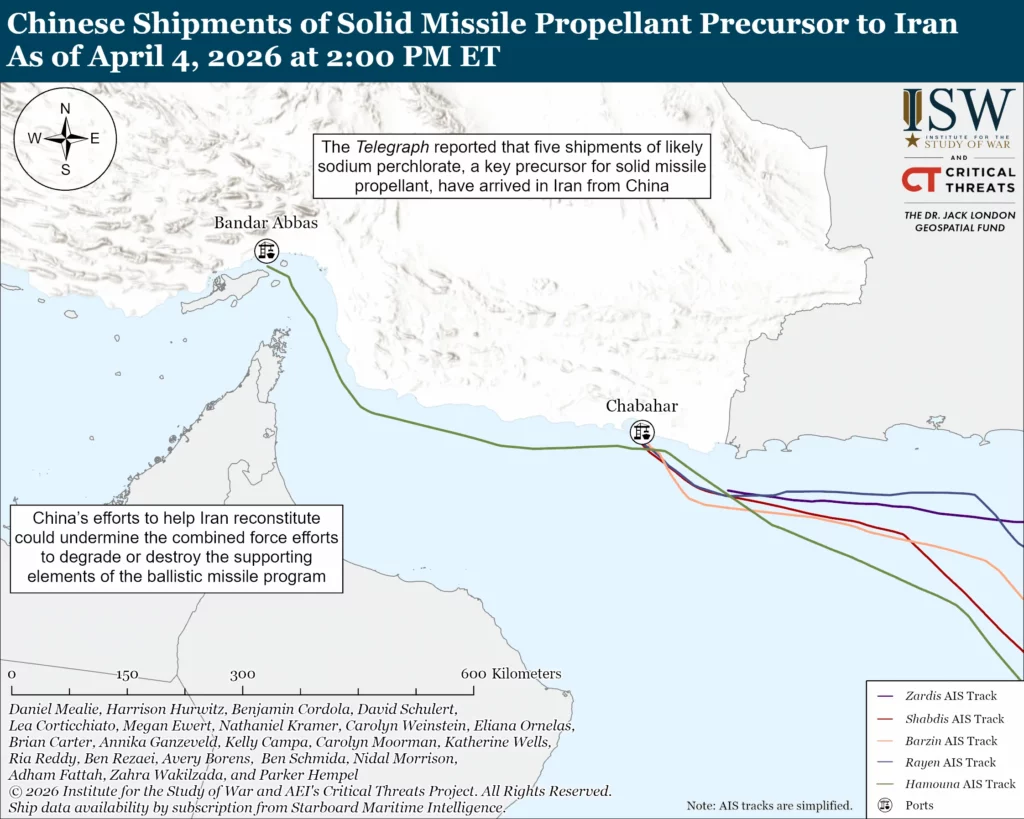
China’s efforts to help Iran reconstitute Iran’s ballistic missile program could undermine the combined force efforts to degrade or destroy the supporting elements of the ballistic missile program.
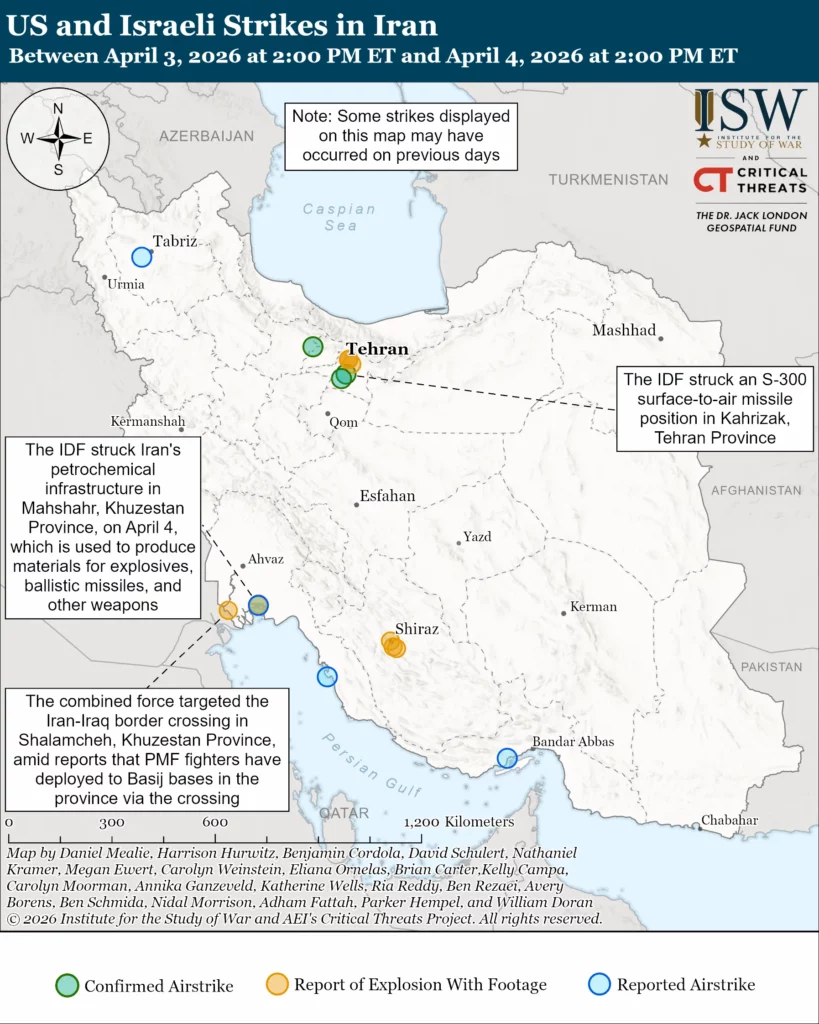
The combined force targeted the Iran-Iraq border crossing in Shalamcheh, Khuzestan Province, amid reports that PMF fighters have deployed to Basij bases in the province via the crossing.
Toplines
The loss of two US aircraft does not indicate that the combined force has lost or is losing air superiority over Iran. Iranian forces shot down a US F-15E and an A-10 on April 3, marking the first such aircraft losses since the start of the conflict.[1] The combined force has maintained air superiority over Iran since the first phase of the campaign by degrading Iranian air and air defense capabilities.[2] Air superiority is when air power creates the conditions that allow one force to operate at “a given time and place without prohibitive interference from air and missile threats.”[3] Achieving air superiority does not mean that there is no risk to aircraft, and air superiority is not constant at all times, in all places, or at all altitudes.[4] Friendly forces can maintain air superiority even if the enemy is attempting to shoot down friendly aircraft, so long as the enemy air defenses do not seriously impede friendly operations. Iranian attempts to challenge US and Israeli air superiority have not seriously impeded the combined force’s ability to conduct operations over Iran, as demonstrated by the persistent strikes nationwide.
China is helping Iran reconstitute the Iranian missile program amid US-Israeli efforts to degrade it. The Telegraph reported that five shipments of likely sodium perchlorate, a key precursor for solid missile propellant, have arrived in Iran from China.[5] All the vessels are owned by the Islamic Republic of Iran Shipping Line Group (IRISL), which the United States sanctioned in 2021.[6] Four of the vessels are docked or floating near the port in Chabahar, Sistan and Baluchistan Province, and one of the vessels is docked or near Bandar Abbas, Hormozgan Province, according to Starboard Maritime Intelligence. China has previously supplied sodium perchlorate to support Iran’s ballistic missile program.[7] The combined force has targeted several elements of the Iranian ballistic missile program, including missile fuel and solid propellant motor production sites. China’s efforts to help Iran reconstitute could undermine the combined force efforts to degrade or destroy the supporting elements of the ballistic missile program, however.
US and Israeli Air Campaign
The combined force targeted the Iran-Iraq border crossing in Shalamcheh, Khuzestan Province, on April 4 for at least the second time since the war began as part of its ongoing efforts to target Iran’s repressive capabilities.[8] Iraq has closed the border crossing following the strikes, according to a security source.[9] The strikes come amid reports that at least 1,000 Popular Mobilization Forces (PMF) fighters have deployed to Basij bases in Khuzestan Province via the Shalamcheh crossing.[10] CTP-ISW previously assessed that the regime may be mobilizing PMF fighters, in part, to strengthen control over previous protest hotspots.[11]
The combined force has continued to degrade Iranian air defense capabilities to maintain air dominance in Iran. The IDF struck an S-300 surface-to-air (SAM) air defense site in Kahrizak, Tehran Province, on April 4.[12] It is unclear what part of the site the IDF struck. An S-300 battery consists of engagement and detection radars, command-and-control centers, fire-control units, and launchers to operate as a functional SAM system.[13] Israel previously rendered Iran’s three remaining S-300 systems combat ineffective in October 2024 by destroying their TOMBSTONE radars.[14] Iran reportedly paired S-300 systems with domestic radars sometime after October 2024.[15]
The International Atomic Energy Agency (IAEA) reported that Iran informed it that a projectile struck near the Bushehr Nuclear Power Plant (BNPP) on April 4.[16] A projectile fragment reportedly killed one member of the site’s physical protection staff, and shockwaves and fragments damaged a building on site.[17] The IAEA reported no increase in radiation levels.[18] Rosatom Director General Alexei Likhachev announced on April 4 that authorities evacuated 198 personnel from the BNPP as part of an ongoing evacuation operation.[19] Rosatom previously evacuated 163 Russian technicians from BNPP on March 25.[20]
The IDF struck Iran’s petrochemical facilities in Bandar-e Imam Khomeni, Khuzestan Province, on April 4, which the IDF said the regime used to manufacture materials for ballistic missiles.[21] The IDF stated that the strike targeted a site within the complex that constitutes one of two central facilities used to produce materials for explosives, ballistic missiles, and other weapons, including a key material necessary for ballistic missile production.[22] The IDF struck Fajr Petrochemical Company, Rejal Petrochemical Company, and Amir Kabir Petrochemical Company, according to Iranian media.[23] The United States sanctioned Fajr Petrochemical Company in 2019 for being owned or controlled by Persian Gulf Petrochemical Industries Company (PGPIC).[24] The United States sanctioned the PGPIC and its network of subsidiaries in 2019 for providing financial support to Khatam ol Anbia Construction Headquarters, which is an IRGC-controlled civil engineering and construction firm that dominates broad swaths of the Iranian economy.[25] The United States sanctioned Amir Kabir Petrochemical Company in 2023 for materially assisting Triliance Petrochemical Company, a previously designated firm involved in brokering the sale of Iranian petrochemicals.[26] The US Treasury reported in February 2023 that Amir Kabir facilitated the export of petrochemical products to buyers in East Asia, supporting Iranian efforts to evade sanctions and sustain export revenue.[27]
The combined force targeted an Islamic Republic of Iran Broadcasting (IRIB) radio and television station in Jamaran, northern Tehran Province, on April 3.[28] Iranian media have described Jamaran Station as the most important and “strategic” broadcast transmitter in Iran.[29] The IDF previously targeted the IRIB headquarters in Tehran on March 2, which is similarly responsible for spreading regime propaganda.[30]
Iranian Response
Iran has launched at least eight missiles targeting Israel since ISW-CTP’s last data cut off on April 3.[31] This figure is estimated from IDF and Israeli media reports about IDF-issued missile detections and interceptions. Iran fired at least one ballistic missile equipped with cluster munitions toward Israel on April 4.[32] Israeli media reported that cluster munitions from the missile impacted at least ten locations across central Israel on March 4.[33] The cluster munitions wounded at least six people in central Israel on April 4, according to Israeli media.[34] Israeli media also reported that cluster munitions struck near the IDF’s headquarters, the Kirya in Tel Aviv, and struck a nearby school, causing damage but no casualties in both instances.[35] Iran has continuously launched ballistic missiles equipped with cluster munitions since the war began on February 28.[36]
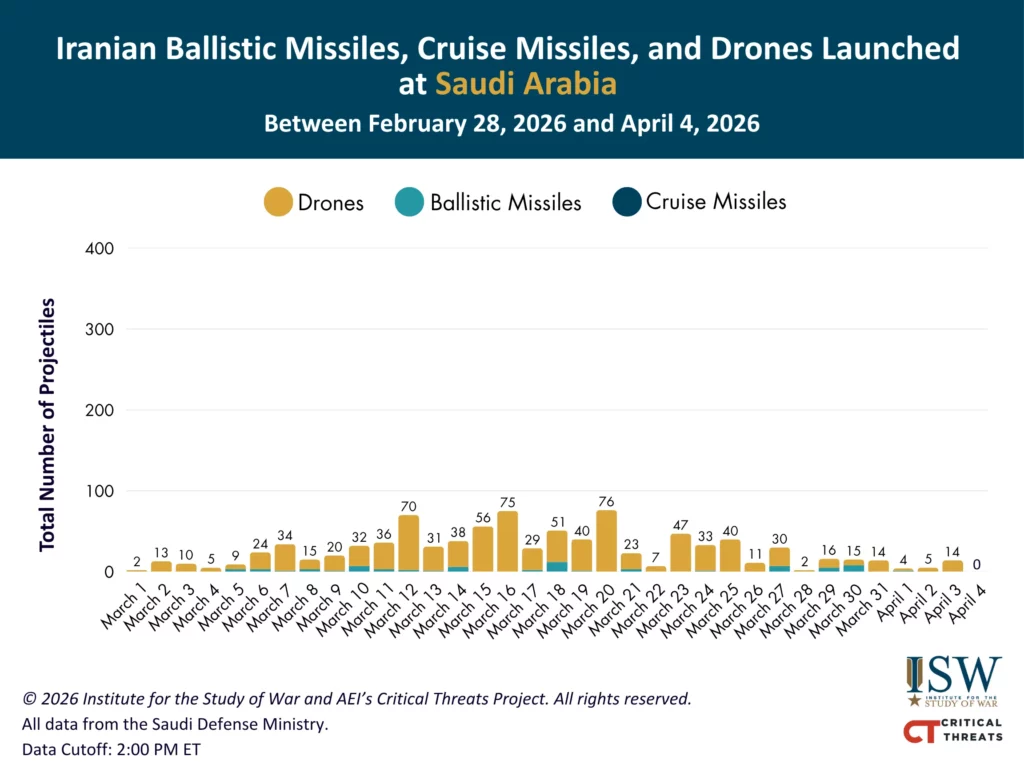
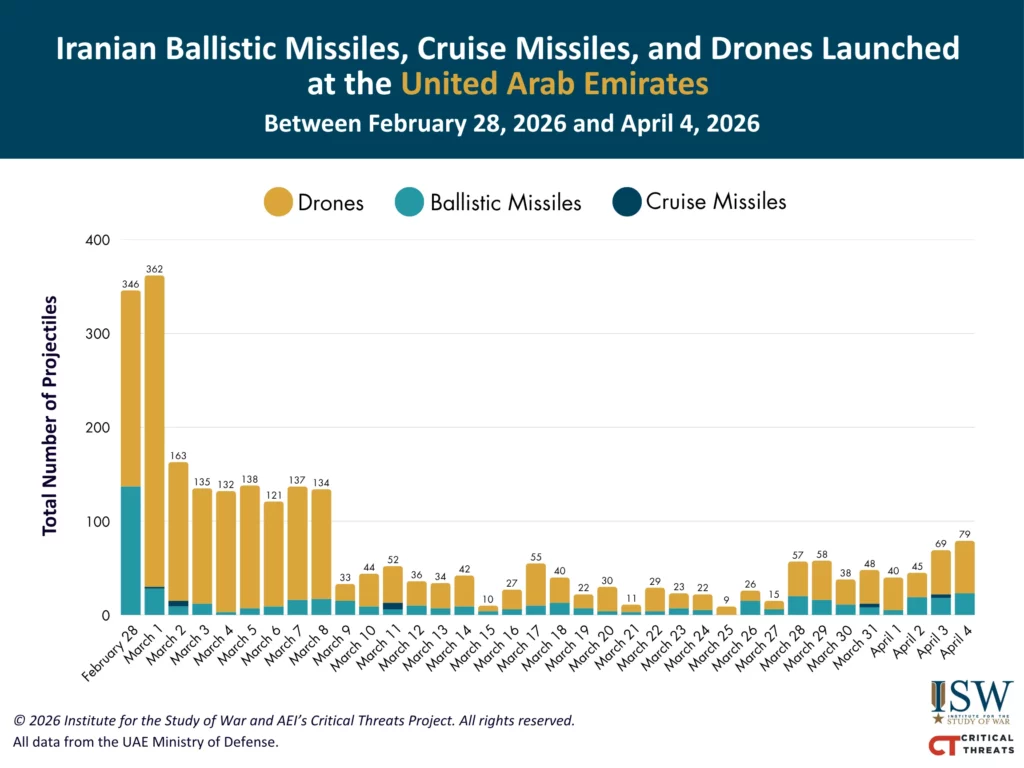
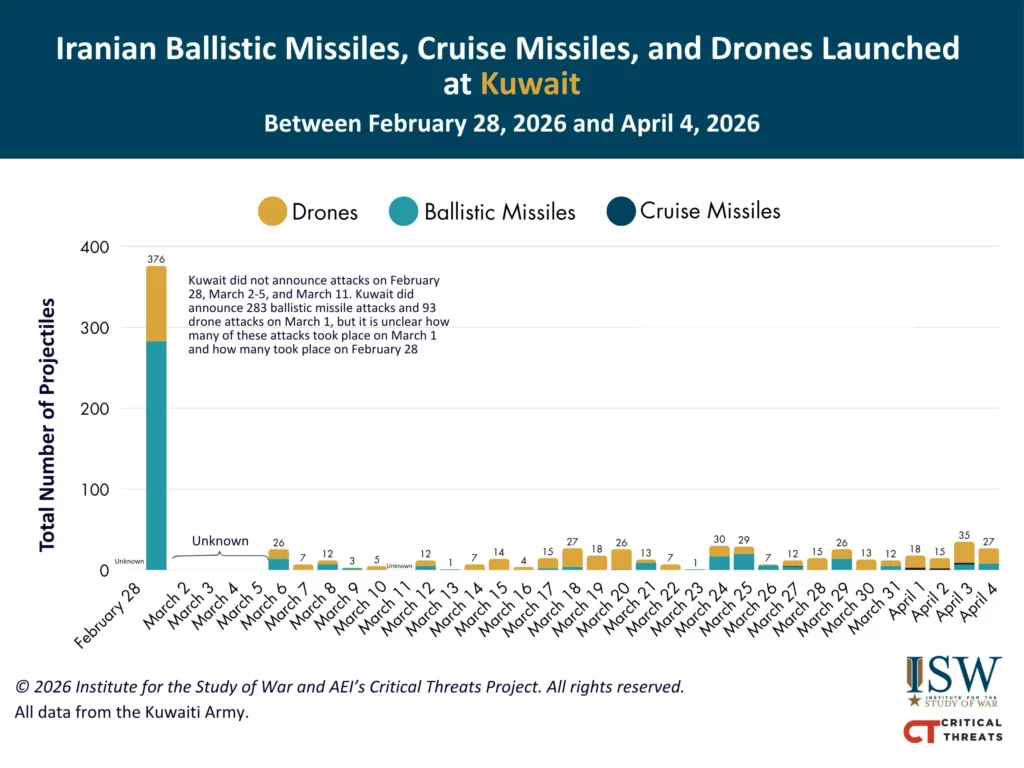
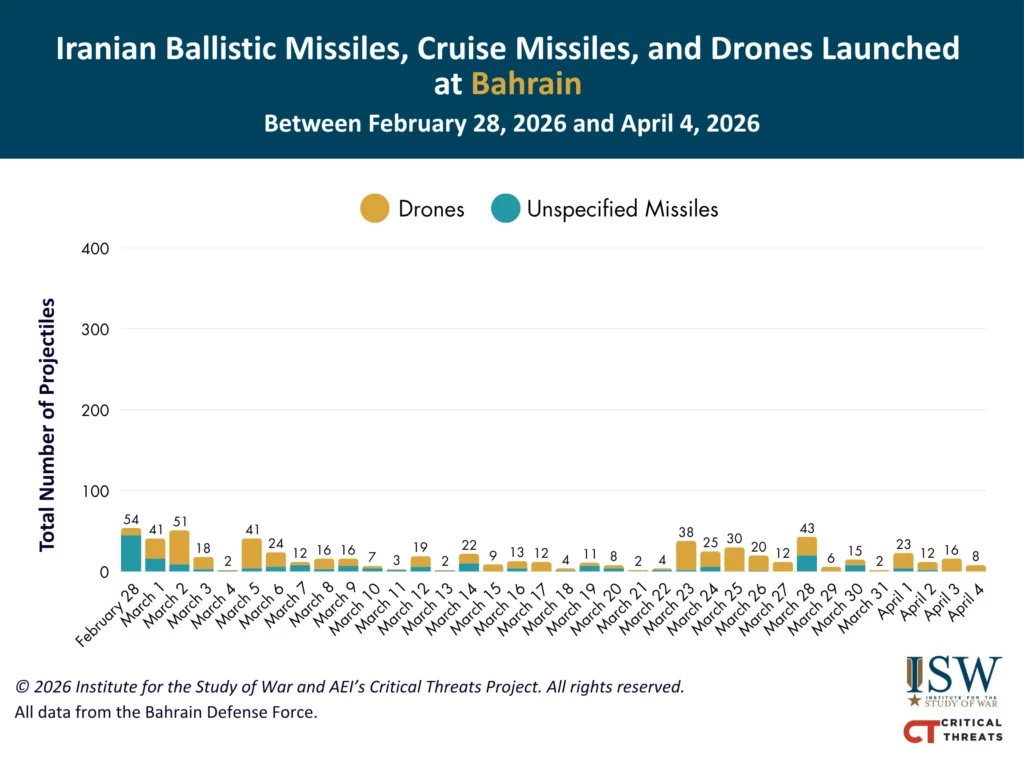
Iran continued to conduct drone and missile attacks against certain Gulf states. Neither the Saudi nor the Qatari defense ministries reported Iranian missile or drone detections since ISW-CTP’s last data cut off on April 3.[37] This is the first day that Iran has fired no projectiles at Saudi Arabia since the war began, assuming Saudi Arabia did not report detections because Iran fired no missiles or drones. Iran continued to launch slightly more drone and ballistic missile attacks against the United Arab Emirates (UAE) on March 4, however.[38] The Emirati Defense Ministry reported that it intercepted 56 drones and 23 ballistic missiles on April 4.[39] Emirati authorities reported on April 4 that intercepted Iranian projectile debris fell on the Oracle building in the Dubai Internet City but caused no casualties.[40] The Kuwaiti Armed Forces separately said that it intercepted 19 drones and 8 ballistic missiles on April 4.[41] The Bahrain Defense Force also reported that it intercepted 8 drones but no ballistic missiles on April 4.[42]
Israeli Campaign Against Hezbollah and Hezbollah Response
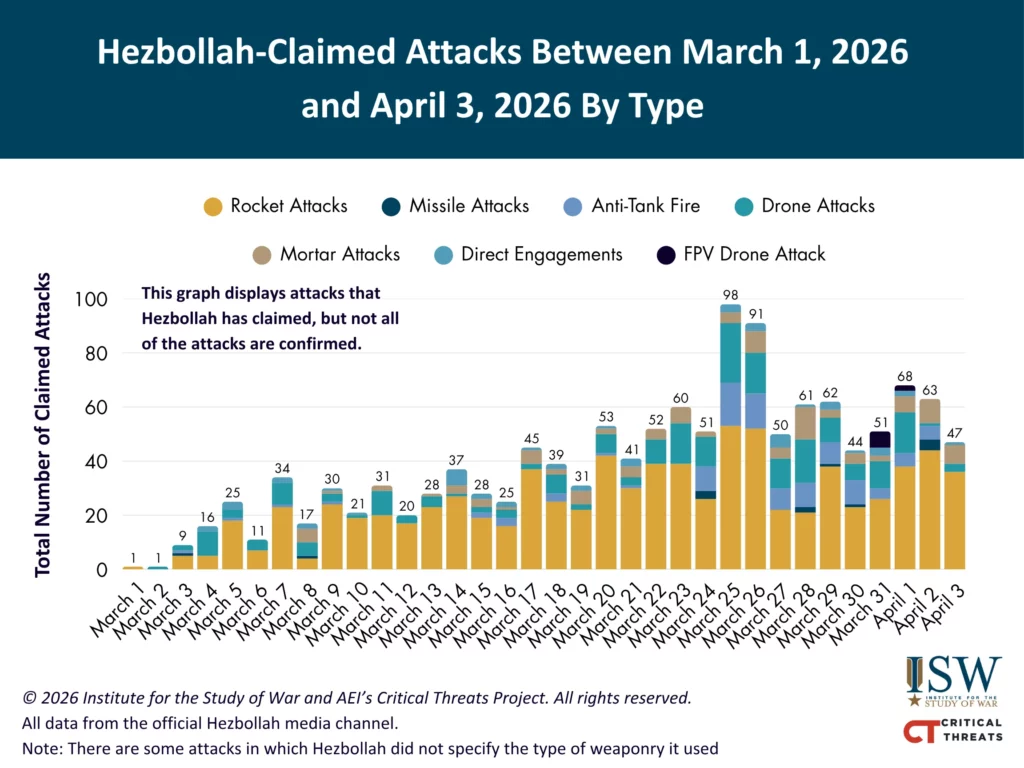
Hezbollah claimed that it conducted 19 attacks targeting Israeli forces in southern Lebanon between 2:00 PM ET on April 3 and 2:00 PM ET on April 4.[43] Hezbollah claimed eight rocket attacks against IDF units in Bint Jbeil District, with five claimed attacks in Ainata and three in Maroun al Ras.[44] Hezbollah published footage on April 4 that Hezbollah claimed shows first-person view (FPV) drone attacks conducted on March 24 against an Israeli bulldozer and a tank in Khiam and Taybeh, both in Marjaayoun District.[45] The FPV drones used in the two attacks were likely not fiber-optic FPV drones. Hezbollah previously claimed six FPV drone attacks against IDF armored vehicles between March 31 and April 3.[46]
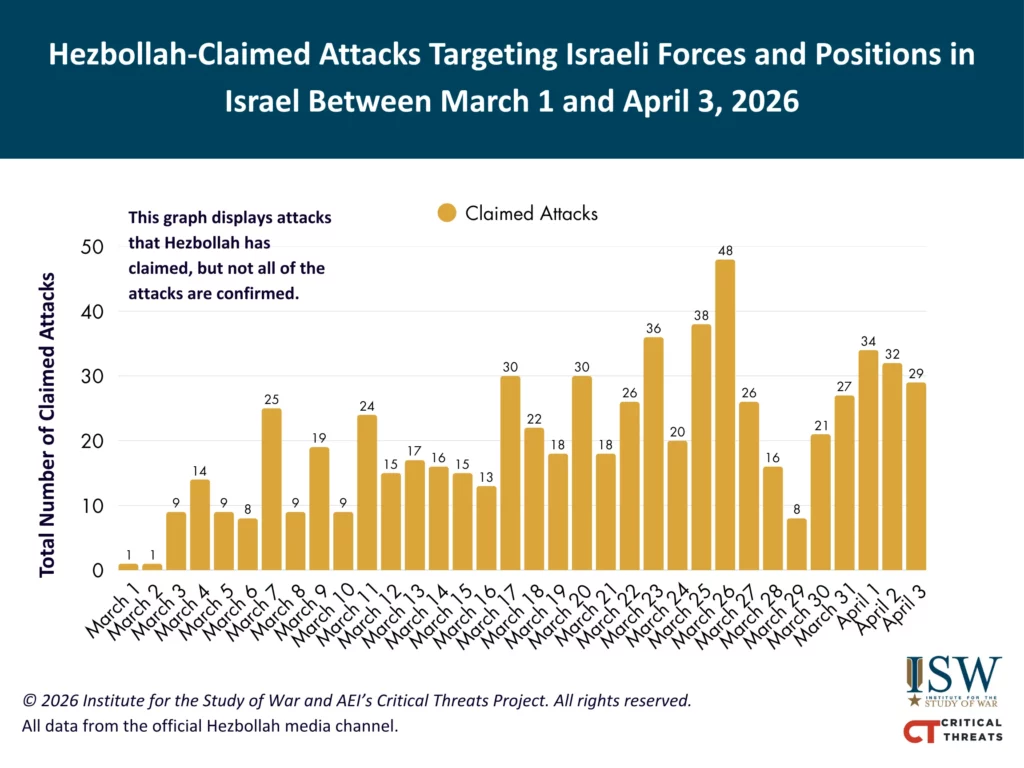
Hezbollah claimed that it conducted 23 attacks targeting IDF infrastructure and Israeli communities in northern Israel between 2:00 PM ET on April 3 and 2:00 PM ET on April 4.[47] Hezbollah claimed it launched three rocket barrages at Kiryat Shmona, northern Israel.[48] An Israeli military correspondent reported that a Hezbollah rocket struck Kiryat Shmona without causing any casualties on April 4.[49] The IDF reported on April 4 that an initial investigation indicated that the early warning system had a ”localized” malfunction that resulted in the warning system failing to issue an alert prior to the Hezbollah rocket impact.[50] Hezbollah claimed it launched two rocket attacks targeting Metula, northern Israel.[51] Hezbollah also launched a rocket attack targeting IDF infrastructure in Safed.[52] Israeli Army Radio confirmed that a Hezbollah rocket hit a building in Safed, northern Israel, causing unspecified damage and no reported casualties.[53]
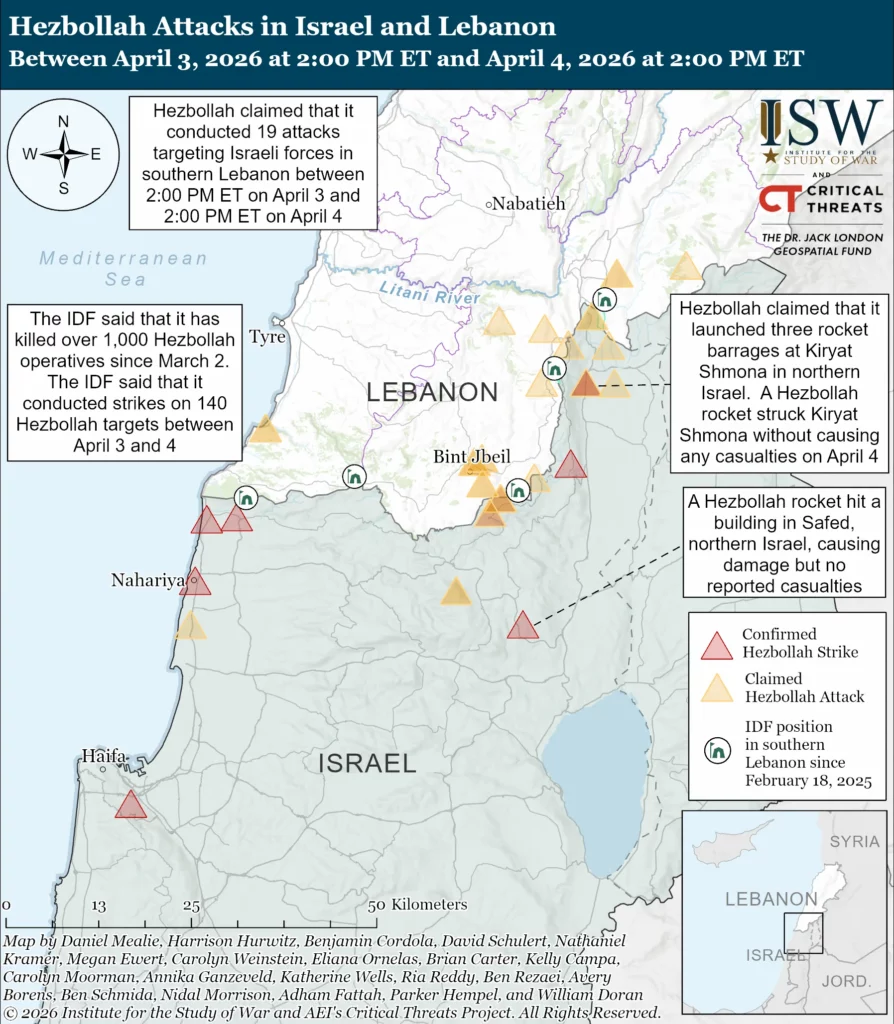
The IDF has continued to strike Hezbollah-affiliated sites and personnel throughout Lebanon. The IDF reported that it has killed over 1,000 Hezbollah operatives since the start of the Israeli campaign in Lebanon on March 2.[54] The IDF also said that it conducted strikes on 140 Hezbollah targets between April 3 and April 4.[55] The IDF reported that it struck an IRGC Quds Force Lebanon Corps headquarters in Beirut on April 3.[56] The IDF stated that the Lebanon Corps serves as a link between Hezbollah and Iran and is aiding Hezbollah’s reconstitution.[57] The IDF previously killed IRGC Quds Force Lebanon Corps commanders in airstrikes in Beirut on March 3 and 7.[58] The IDF also struck two Palestinian Islamic Jihad (PIJ) headquarters in Beirut on April 3.[59] The IDF said that senior PIJ members coordinated attacks against Israel with Hezbollah at these headquarters.[60] The IDF also struck a rocket launcher on April 3 that Hezbollah previously used to launch rockets at northern Israel.[61]
The IDF continued to conduct ground operations in southeastern Lebanon on April 3 and 4. The IDF reported on April 4 that 91st Territorial Division units killed 35 Hezbollah operatives in southern Lebanon over the past week.[62] The IDF said that soldiers of the 84th (Givati) Infantry Brigade (91st Territorial Division) directed an airstrike targeting and killing a Hezbollah squad in southern Lebanon.[63] The IDF said the 84th Infantry Brigade has conducted numerous targeted raids against Hezbollah infrastructure, including weapons caches that included anti-tank guided missiles (ATGM), rocket-propelled grenades (RPG), rockets, small arms, and ammunition.[64] The 91st Division also attacked multiple Hezbollah headquarters and ATGM launch positions.[65] A geospatial analyst reported on March 28 that the 91st Division units, including the 84th Brigade, are operating near Ainata, Bint Jbeil District.[66] The IDF also said that the 282nd Artillery Brigade (36th Armored Division) fired over 400 shells at Hezbollah targets in the past 24 hours.[67] 36th Division units are operating in Taybeh, Marjaayoun District, according to a geospatial intelligence analyst on March 24.[68] The IDF announced that IDF forces killed a Maglan Unit, 89th (Oz) Commando Brigade (98th Paratrooper Division) soldier and “seriously wounded” another in a friendly fire incident in Shebaa, Hasbaya District, between April 3 and 4.[69] Israeli military correspondents reported on April 4 that the Maglan Unit was conducting an operation to detain a Hezbollah-affiliated individual in Shebaa.[70]
The United Nations Interim Force in Lebanon (UNIFIL) reported on April 3 that an unknown actor fired a projectile that struck a UNIFIL position and injured three UN peacekeepers in Odaisseh, Marjaayoun District.[71] The IDF said on April 3 that the launch trajectory of the projectile “clearly indicates” that Hezbollah launched a rocket at the UNIFIL position.[72] Unspecified actors conducted attacks on a UNIFIL position and a vehicle on March 29 and 30, respectively, killing three UNIFIL peacekeepers.[73]
Other Axis of Resistance Response
The Houthis launched a ballistic missile with a cluster munition warhead and drones targeting central and southern Israel on April 4.[74] The Houthis claimed that they launched a ballistic missile with cluster munitions and several drones at the Ben Gurion Airport in Tel Aviv, as well as “vital military targets” in southern Israel.[75] The IDF said that it detected a ballistic missile launch from Yemen but allowed the missile to land in an open area, according to an Israeli military correspondent.[76] The IDF did not indicate whether the Houthi missile included a cluster munition warhead and did not report any drone interceptions, however.[77] The Houthis claimed that they coordinated the missile attack with Hezbollah and Iran.[78] The Houthis previously launched ballistic missiles with cluster munition warheads at Israel in 2025.[79] This attack marks the sixth time that the Houthis have attacked Israel since entering the conflict on March 28.[80] CTP-ISW continues to assess that the Houthis‘ involvement in the war thus far appears calibrated to try to avoid an immediate escalation with the United States and Israel.[81]
The US-Israeli combined force continued to strike Iranian-backed Iraqi militia targets to prevent Iranian-backed militia attacks against US interests and Israel. The combined force struck a Kataib Hezbollah-controlled 45th Popular Mobilization Forces (PMF) Brigade headquarters in Anbar Province on April 4, killing two PMF fighters.[82]
Iranian-backed Iraqi militias likely targeted Western-owned energy infrastructure in Basra on April 4. Security and energy sources told Reuters on April 4 that two drones hit the BP-operated North Rumaila oilfield in Basra, wounding three Iraqi workers.[83] Likely Iranian-backed Iraqi militias previously conducted a drone attack targeting a British oil company-owned storage warehouse in Erbil on April 1.[84]
Iranian-backed Iraqi militias and militia front groups continue to claim attacks against US targets in Iraq and the Middle East. The Islamic Resistance in Iraq, which is a coalition of Iranian-backed Iraqi militias, claimed on April 4 that it carried out 19 drone and rocket attacks against US bases in Iraq and the region.[85]