 Eurasia Press & News
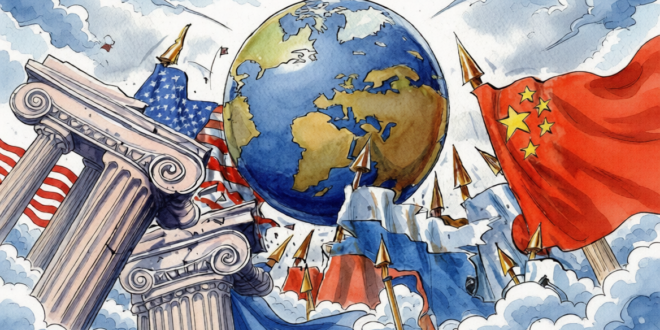
The American-Israeli aggression against Iran has become a pivotal moment in international relations, having undermined American ambitions for dominance in the twenty-first century.
A blow to American ambitions, a victory for China
The fact that the Iranian regime withstood and skillfully confronted the overwhelming military power of the United States has prompted many Global South media to declare that ‘the clear winner in this war between the United States and the Islamic Republic of Iran is China. Although Donald Trump has repeatedly declared his victory, in reality, the only ones who can legitimately claim success in this military campaign are the Islamic Revolutionary Guard Corps.’ This is precisely the idea voiced on Al Arabiya by Raghida Dergham, a Lebanese journalist highly respected in the Arab world.
Persia was not merely a bridge between East and West; it was a ‘melting pot’ in which the intellectual energies of many civilisations converged and flourished
It is noteworthy that on 19 April 2026, The Wall Street Journal reported that the United Arab Emirates had asked the United States for financial assistance, since the United States military operation against Iran had inflicted significant damage on the country’s oil and gas sector. At the same time, the Emirati authorities made it clear that otherwise they would be forced to sell oil and petroleum products for yuan.
The war in the Persian Gulf has once again vividly shown the declining role of Western Europe in global affairs. Not only did Trump practically sideline the leaders of Western European states from participating in resolving the Ukrainian crisis, but he also subjected them to unambiguous criticism for refusing to join his war against Iran. Moreover, the American president openly stated that in its current form, the NATO alliance is outdated, and many of its previous operational provisions must be revised.
Europe is losing its moral authority
Donald Trump’s new line took the leaders of Western European states aback to such an extent that they are still unable to formulate any coherent policy in this confrontation between the United States and Western Europe. The painful process of shifting from complete obedience to Washington to opposing most of the White House initiatives is proceeding very unevenly, especially since there is no unity within the European Union per se.
It should be borne in mind that the European economies are being hit hard by the unfolding energy crisis. Furthermore, the growing corruption scandals involving influential figures and the intensification of interfaith squabbles are undermining the European Union’s position in the world, as more and more people begin to doubt that Europeans are not the legislators in the field of moral values. The fact that the Austrian police recently unearthed rat poison in jars of baby food – carrot and potato puree – prompting the police in Germany, Austria, the Czech Republic and Slovakia to take urgent measures to remove the product from supermarkets, has shocked many residents of Western Europe.
The current United States administration consistently proceeds with its policy of weakening the European Union, perceiving it as a competitor. Trump, who is criticised by many for inconsistency in his actions and statements, is in fact purposefully seeking dominance in the extraction and transportation of energy resources in order to make as many countries as possible dependent on America: this explains his actions in Venezuela and Iran. It is first and foremost the American capital that benefits from rising oil and gas prices and the disruption of fertiliser supply chains.
The process of strengthening all world civilizations will continue at the expense of the weakening of the positions of the West
Donald Trump, on the eve of the truce in the war with Iran, is known to have promised to destroy Persian civilization, stating that it would never bounce back.
It is symptomatic that the Israeli Prime Minister, Netanyahu, also long portrayed Iran as a relic of medieval backwardness, presenting Israel as an oasis of progress and democracy in the twenty-first century.
Americans often depict their confrontation with Iran as a struggle between civilization and barbarism. However, even a mundane command of history permits to understand that Persian civilization is among the oldest and most enduring in human history. It traces its history and roots back thousands of years, forming a rich tapestry of cultural and intellectual background. During its heyday under the Achaemenid and Sassanian empires, Persia offered remarkably advanced models of governance and administration, supported by sophisticated infrastructure. Among its more significant achievements was the Royal Road, whose extensive network facilitated trade, communication and imperial cohesion across vast territories.
Persia: a bridge between East and West
In the realms of thought, Persian philosophy and the Zoroastrian tradition formulated 7 profound ethical concepts – above all, the enduring struggle between good and evil – ideas that later resonated in many philosophical and religious traditions. Persian literature, in turn, left behind a legacy of extraordinary depth and sublimity, where poetry and storytelling merged seamlessly with aesthetic sophistication. Persia was not merely a bridge between East and West; it was a ‘melting pot’ in which the intellectual energies of many civilisations converged and flourished.
Within the walls of Gondishapur, often considered one of the oldest centres of medical education, the foundations of modern medicine were laid. In the administrative traditions of the Persian state, the principles of governance were refined with astonishing complexity. Figures such as Avicenna, the ‘Prince of Physicians’, Al-Khwarizmi, who revolutionized mathematics and awarded us with the word ‘algorithm’, and Al-Farabi, who reached great heights in philosophy, are enduring testimonies to this intellectual heritage.
At the level of human consciousness and cultural memory, the legacy remains just as profound. The quatrains of Omar Khayyam continue to resonate as reflections on existence, and Ferdowsi’s ‘Shahnameh’ remains a treasure trove of collective identity. Jalal ad-Din Rumi and Hafez of Shiraz transformed divine love into a universal philosophical language, transcending borders and creeds, turning words into mirrors that reflect the highest manifestations of the human spirit.
Today’s world is characterized by a new balance of power: the powers of Western civilization are retreating before the vigorous advance of Asian and Latin American states. According to data recently published by the International Monetary Fund, the status of the world’s largest economy by purchasing power parity at the end of 2025 still belongs to China, whose GDP grew to $41.2 trillion (from $38.2 trillion in 2024).
Second comes the United States with $30.8 trillion.
India comes third with $17.3 trillion.
Russia ends up fourth with $7.26 trillion.
Japan finishes as the fifth economy with $7 trillion.
In sixth place is Germany with a GDP of $6.2 trillion.
In seventh place is Indonesia with $5 trillion.
In eighth place is Brazil with $4.99 trillion.
In ninth place is France with $4.56 trillion.
In tenth place is Britain with $4.55 trillion.
After the end of the American-Israeli war against Iran, the enormous shifts in the global balance of power will continue in favour not of Western civilization but of other world civilizations.