 Eurasia Press & News
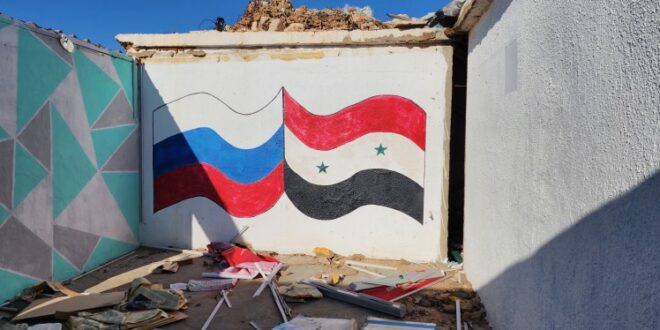
Leaked meeting minutes show Russia’s deputy defense minister leaning on Syria to pay a $37-million bill for keeping oil flowing. Months after that meeting, the regime of Bashar al-Assad fell to a rebel coalition. Syria’s new government has continued to negotiate with Russia over its total debt of at least $1.2 billion.
Just a few months before a coalition of rebel forces overran Syria’s capital and toppled the regime of Bashar al-Assad, Russian officials were in a meeting to push his government to pay off a $37-million bill for providing security for oil installations.
The minutes of the meeting on May 29, 2024, show how much pressure Assad’s regime was under during its dying days from one of its closest allies.
At one point in the talks, Russia’s deputy defense minister, General Yunus-bek Yevkurov, even threatened to cut off financing for oil operations if Syria didn’t pay up.
Russia had built up extensive interests in Syria’s oil sector under the Assad regime. In 2015, Russia intervened militarily in Syria, helping regain territory taken by the rebels. In return, Assad’s government had offered contracts to Russian companies to rebuild the energy sector.
“We do not want oil extraction and production to stop, because this will be a strong blow to the Syrian economy,” said Yevkurov, according to the meeting minutes obtained by OCCRP’s Syrian media partner SIRAJ.
Yevkurov did not respond to a request for comment on the meeting.
Negotiations about the much larger debt owed to Russia have continued under Ahmed al-Sharaa, the former rebel commander who now serves as Syrian president. The Kremlin has reportedly sought to maintain military bases it established under Assad, while Damascus has asked for debt relief and other concessions.
That puts Syria in a delicate position as the new government attempts to rebuild the country, along with its relationships to the international community — including countries at odds with Russia over its invasion of Ukraine.
But Syria needs help from whoever can offer it. The country is devastated after 13 years of war, and the government has few options to pay for reconstruction, which will cost an estimated $216 billion, according to the World Bank.
To make matters worse, Syria faces a total debt of about $27 billion, according to its central bank. As much as $22.3 billion of that debt is external, with at least $1.2 billion owed to Russia, according to a World Bank assessment of the country’s economy in 2025, referencing official data.
Military Chokehold
Russia also has a chokehold on Syria’s military, which gives the Kremlin even more leverage in negotiations. The Assad family, which ruled for half a century, built up a military primarily on Russian weaponry. This leaves the new government dependent on Russian arms to maintain the strength it needs to enforce security.
“For the past 50 years, all of Syria’s military capabilities have been of Russian origin,” said Osama al-Qadi, a senior economic policy advisor for Syria’s Ministry of Economy and Industry. “Therefore, it needs spare parts, new weapons to modernize its older Russian arsenal.”
Under Assad, Syria also allowed the Russian military to establish bases directly on its territory.
Al-Qadi has not participated in the talks with Russia, but he said that, in addition to arms purchases, he believes the two sides have discussed Russia’s continued use of its naval base near the city of Tartus. Russia may also be allowed to maintain its Hmeimim Air Base near the coastal city of Latakia “on the condition that it remains under Syrian administration to prevent it from becoming a haven for remnants of the old regime.”
“In return, any debts or contracts signed by the regime with the Russians could be overlooked,” al-Qadi told SIRAJ.
He said he believed negotiations around such an agreement constituted “a significant part of the joint Syrian-Russian talks during President al-Sharaa’s visit to Russia” in January 2026.
When al-Sharaa took over the presidency a year earlier, one of the first things he did was ask for Russian loans taken out by the Assad regime to be cancelled, Reuters reported. By October, he said his government would honor deals the Assad regime had made with Russia.
The Syrian Foreign Affairs and Finance Ministries did not respond to questions about debt negotiations, while the Ministry of Energy said the matter was not with them.
A recent report by the Royal United Services Institute, a British think tank, noted that
“Russia retains influence through debt leverage, military basing and security mediation.”
Tough Talk
The leaked minutes, obtained by SIRAJ and its Syrian partner Zaman Al Wasl, show Russian officials using similar leverage in talks with Assad-regime officials.
The May 2024 meeting at the presidential palace in Damascus was attended by a delegation led by Yevkurov, the Russian deputy defense minister, who met with Mansour Azzam, then Syria’s Minister for Presidency Affairs.
“We have been paying the costs of the Russian soldiers and the Syrian workers,” Yevkurov said, at a monthly tally of $4.5 million. He also demanded that Syria pay an additional $1.16 million monthly for “re-equipping Russian support points that will protect the sites”.
Yevkurov then said Russia would stop paying those costs from June 2024, and he demanded that Syria pick up the bill.
Alluding that Syria was withholding payments, Yevkurov warned: “I do not like anyone cheating me… The dialogue with the minister of oil will be in another style.”
Yevkurov said the total debt for the specific services under discussion — which was only part of the much larger bill owed to Russia — amounted to $37.16 million.
Yevkurov said Russian President Vladimir Putin did not know about that $37 million owed, which put him in a “predicament.”
“The new Russian Minister of Defense will raise the topic of this debt… or he will inform President Putin about it,” he said. “Surely then the president will ask, how did this happen… I cannot say to the president that I fell short and I do not know how to justify this debt.”
Azzam was conciliatory as he tried to alleviate Russian concerns, saying: “I believe that we will be able in a very short span to solve all these problems.”
OCCRP could not contact Azzam directly. The Syrian consulate in Moscow, where Azzam is reportedly located, did not respond to a request for comment.
Oil for Protection
Nine years before Azzam and Yevkurov spoke in Damascus, Russia intervened in Syria’s civil war, giving the Assad regime a much-needed advantage.
By that time, the regime was financially depleted and incapable of securing its own energy infrastructure. In return for military support, Damascus reportedly began offering “all possible incentives” to Russian companies to rebuild the energy sector.
According to the European Union sanctions list, the Russian company Evro Polis LLC “signed a number of contracts with the Syrian regime, through the state-owned General Petroleum Corp.” The company received 25 percent “from the production of oil and gas in fields captured by the Wagner Group,” a Russian paramilitary force fighting for Assad.
The EU called Evro Polis “a front for the Wagner Group,” which was run by the late Yevgeny Prigozhin.
Prigozhin turned against Putin in 2023, leading a group of Wagner fighters from the Ukrainian front towards Moscow in a short-lived rebellion. He called off the uprising, but died in a mysterious air crash two months later, in August 2023.
By the time of the meeting in Damascus, the minutes show that Russia was intending to transfer the oil contracts away from Evro Polis. Yevkurov asked why the company was still receiving fees for the Ebla and Hayan gas and oil facilities in central Syria.
“According to our information, Ebla and Hayan still pay amounts to the Evro Polis company and we request that you investigate this,” said Yevkurov, asking: “Why do they pay Evro Polis?”
He demanded the Syrian Ministry of Oil sign a contract with a different company, ERPOST-M, which reportedly opened an official branch in Damascus in 2024 to provide security services for facilities, including oil fields.
By the end of that year, the Assad regime had fallen and Syrian-Russian relations had taken a dramatic turn.
Syria’s negotiations with Russia have since been complicated by a host of other geopolitical considerations, according to analysts. Al-Sharaa’s government is concerned with preventing both internal rebellion, and Israeli incursions over the border. The new government also needs to balance its relationship with Russia vis-a-vis its diplomatic rapprochement with ِEurope and the U.S.
“The Syrians certainly take into account the fact that the Russians are — among the big countries — the only ones possibly willing to send troops to southern Syria to protect them from Israel,” said Jihad Yazigi, a Syria expert and visiting fellow at the European Council on Foreign Relations.
Russia could also choose to prop up the new government’s adversaries, explained Soqrat al-Alou, a Syrian political economy researcher at the Arab Reform Initiative, a Paris-based think tank.
The Kremlin could “stir or contain unrest along the coast through networks linked to Alawite constituencies and remnants of former regime military,” he said.
But accommodating Russia’s desire to maintain a military presence in Syria could alienate countries Damascus wants to have good relations with.
Al-Alou noted that the U.S. appears to accept “a limited Russian presence” in Syria, as “its concerns lie elsewhere.”
“European actors, by contrast, appear more sensitive to the entrenchment of Russian influence,” he said.