 Eurasia Press & News
Key Takeaways
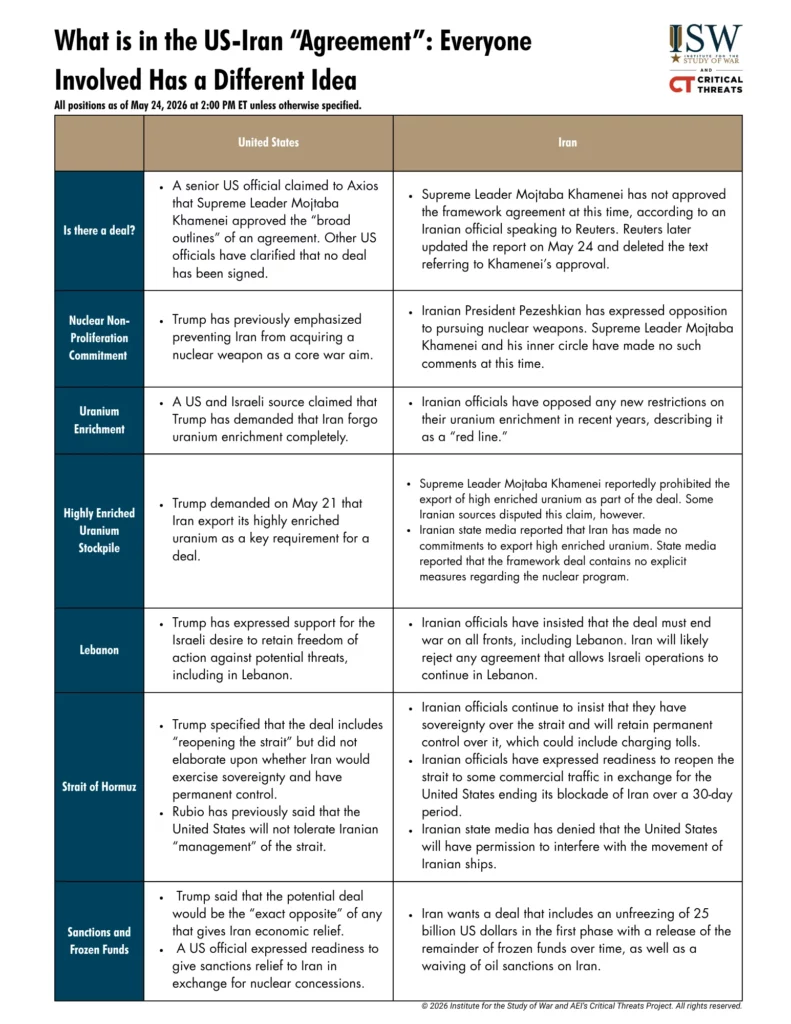
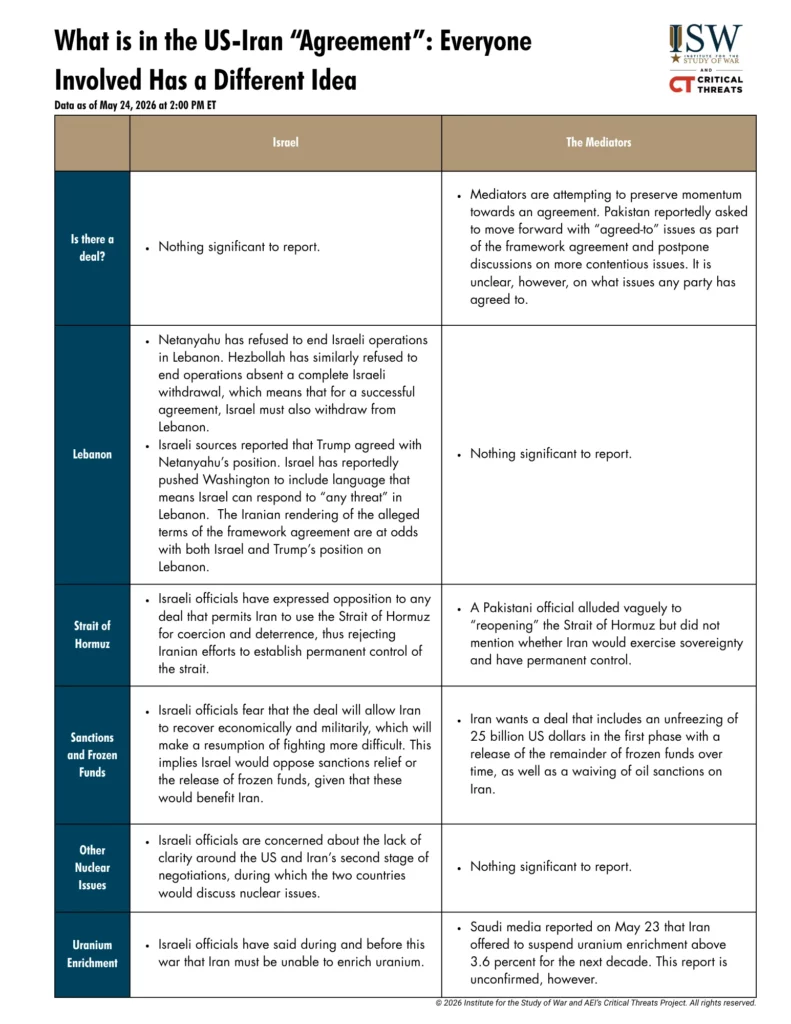
Conflicting US, Iranian, and regional reporting indicates that the contours of a possible US-Iran memorandum of understanding (MOU) remain unresolved and may not yet represent a final agreement.
Iranian officials, Islamic Revolutionary Guards Corps (IRGC)-affiliated outlets, and Iranian sources speaking to Western and regional media are presenting the possible MOU as conditional on US concessions and continued Iranian leverage.
IRGC-affiliated reporting has identified frozen assets, sanctions relief, the naval blockade, Lebanon, and the Strait of Hormuz as the main unresolved issues. This is every issue in the first stage of the agreement, before talks on the nuclear program.
Mediators appear to be trying to preserve momentum toward a US-Iran MOU by sequencing unresolved issues and developing technical arrangements for the Strait of Hormuz, but Iranian reporting suggests that Iran has rejected efforts to defer its core demands.
Iran appears to believe that it is negotiating from a stronger position than the United States and is accordingly attempting to remake the regional order in a way that benefits Iran.
Iran has not publicly accepted meaningful nuclear concessions in the possible MOU, and Iran believes that the draft defers nuclear talks until after Iran secures relief from military and economic pressure.
Iranian officials have stated that the US-Iran MOU must end the war “on all fronts,” including in Lebanon. The United States supports continued Israeli operations against Hezbollah, however, to prevent threats to Israel.
Israeli officials have reportedly called on the United States to allow the Israel Defense Forces (IDF) to continue its operations in Lebanon, in accordance with the current temporary ceasefire in Lebanon, and President Trump agreed with this position.
Hezbollah officials have continuously reiterated that the group will continue to engage the IDF in southern Lebanon and launch attacks against northern Israel until the IDF completely halts its activity in Lebanon and withdraws from southern Lebanese territory.
Toplines
Conflicting US, Iranian, and regional reporting indicates that the contours of a possible US-Iran memorandum of understanding (MOU) remain unresolved and may not yet represent a final agreement. US President Donald Trump stated on May 23 that a deal to end the war had been “largely negotiated” and awaited finalization.[1] A senior US official stated in a briefing with reporters on May 24 that the White House does not expect an agreement on May 24 and believes Iranian leadership, including Supreme Leader Mojtaba Khamenei, may need several days to approve the deal.[2] An unspecified senior US official told Axios that the United States is in a “very good place” but that the parties are still negotiating specific language and that “whether this becomes an agreement is still an open question.”[3] Trump separately stated on May 24 that a possible Iran deal “isn’t even fully negotiated yet,” while stating that any agreement would not give Iran “a clear and open path to a Nuclear Weapon.”[4] Trump later stated that negotiations are proceeding in an “orderly and constructive manner,” but added that he had instructed his representatives ”not to rush into a deal” because time is on the US side.[5] Trump also stated that the US naval blockade ”will remain in full force and effect” until an agreement is “reached, certified, and signed.”[6]
Iranian officials, Islamic Revolutionary Guards Corps (IRGC)-affiliated outlets, and Iranian sources speaking to Western and regional media are presenting the possible MOU as conditional on US concessions and continued Iranian leverage. An unspecified senior Iranian official told Reuters on May 24 that the Supreme National Security Council (SNSC) will convene to approve or reject the current draft and will send it to Mojtaba for final approval if the SNSC approves it.[7] An unspecified senior Iranian source separately told CNN that recent mediated talks have made “a lot of progress” and could mark a “turning point” toward ending the war and creating a “new era of stability and prosperity” in the region.[8] IRGC-affiliated Tasnim News Agency reported on May 24 that disputes over one or two provisions remain unresolved due to US “obstruction” and that the MOU could still fall through if the United States does not meet Iranian demands.[9] US “obstruction” in this context probably refers to US insistence on legitimate demands that the Iranians oppose. IRGC-affiliated reporting has identified frozen assets, sanctions relief, the naval blockade, Lebanon, and the Strait of Hormuz as the main unresolved issues.[10] This is every issue in the first stage of the agreement, before talks on the nuclear program. Tasnim reported that an informed source said Iran will not accept any understanding without the release of a “specified portion” of Iran’s blocked assets in the first step and a clear mechanism to guarantee continued access to all blocked assets.[11] A well-informed Iranian source told an Al Jazeera journalist on May 24 that the two central issues involve the mechanism for unfreezing Iranian assets and the scope of a Lebanon ceasefire.[12] The source added that Iran rejected a Pakistani proposal to move ahead with agreed provisions while postponing unresolved ones.[13]
IRGC-affiliated messaging in domestic Iranian media has said that Iran will stick to its redlines, while quotes from unspecified Iranian officials in Western media have sought to portray the talks in a positive light by describing “progress.” Unspecified Iranian officials speaking to Western outlets have described progress and an internal approval process through the SNSC and Mojtaba, which suggests that some Iranian officials want to present the draft as a viable diplomatic path.[14] IRGC-affiliated outlets, however, have emphasized red lines, US “obstruction,” blocked assets, sanctions relief, and continued Iranian control over the Strait of Hormuz.[15]
Mediators appear to be trying to preserve momentum toward a US-Iran MOU by sequencing unresolved issues and developing technical arrangements for the Strait of Hormuz, but Iranian reporting suggests that Iran has rejected efforts to defer its core demands. Reuters reported on May 23 that the “Pakistani army” described the negotiations as producing “encouraging” progress toward a final understanding, while two Pakistani sources involved in the talks said the deal under discussion is “fairly comprehensive to terminate the war.”[16] The sources added that the proposed framework would unfold in three stages, including formally ending the war, resolving the crisis in the Strait of Hormuz, and launching a 30-day window for negotiations on a broader agreement that could be extended.[17]
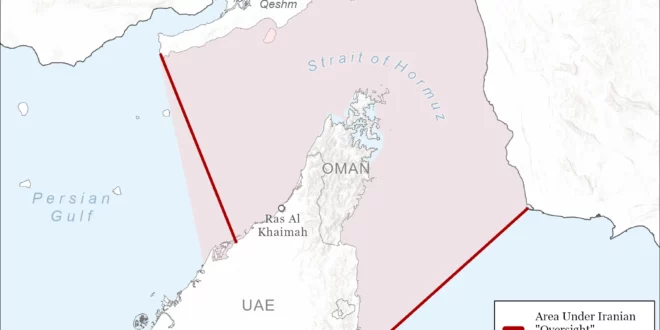
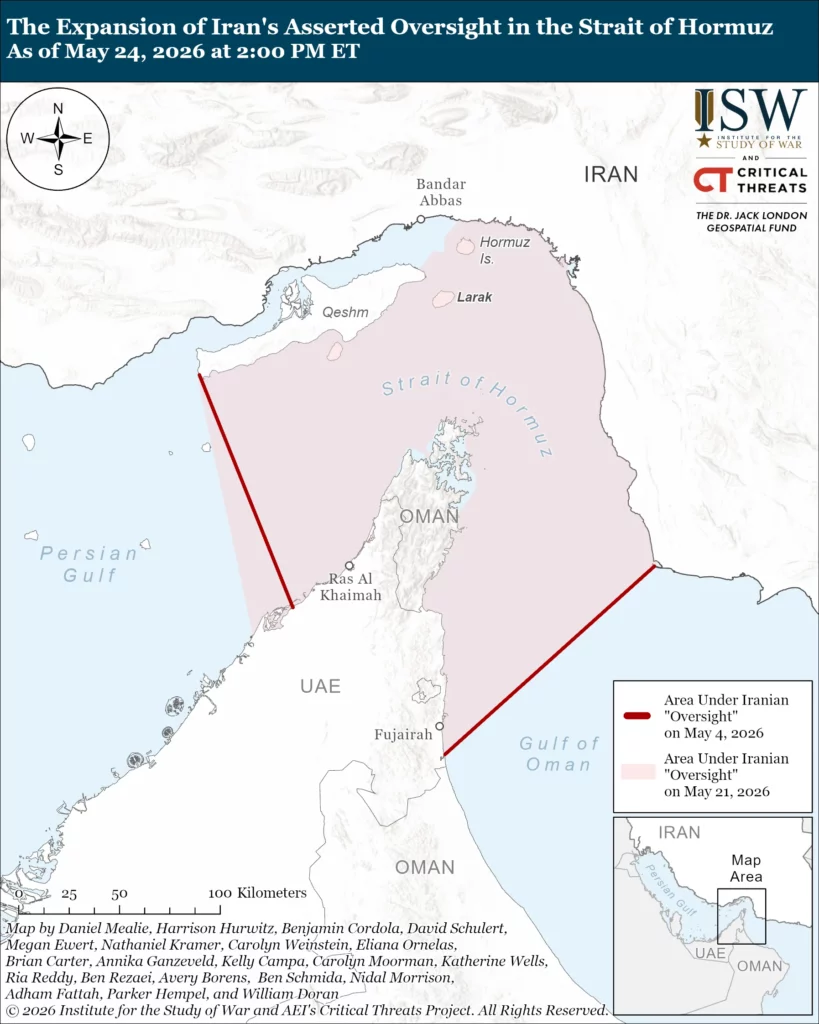
Iran appears to believe that it is negotiating from a stronger position than the United States and is accordingly attempting to remake the regional order in a way that benefits Iran. Supreme Leader’s military adviser and former IRGC Commander Major General Mohsen Rezaei claimed on May 24 that the United States is in a “complete stalemate” and warned that any renewed war would begin at the strait and expand through the Bab el Mandeb and the Indian Ocean.[18] Rezaei also claimed that Iran has kept the strait open to free trade while requiring vessels to be “identified and registered,” which supports Iran’s efforts to normalize an Iranian permission-based transit regime.[19] IRGC Navy Public Relations reported on May 24 that 33 ships, including oil tankers, container ships, and other commercial vessels, passed through the Strait of Hormuz over the past 24 hours after obtaining permission and with IRGC Navy coordination and security.[20] Khatam ol Anbia Central Headquarters Commander Major General Ali Abdollahi Aliabadi separately said on May 24 that Mojtaba’s plans to manage the Persian Gulf and the Strait of Hormuz will shape a “new regional and global order” under the “Strong Iran” strategy, “in which foreigners will have no place.”[21] IRGC-affiliated Fars News separately framed the talks in an Op-Ed on May 24 as a vehicle to secure concrete economic gains rather than broader political conciliation with the United States.[22] IRGC-affiliated Tasnim also reported that Iran would return ship traffic through the strait to pre-war numbers within 30 days, while the United States would fully lift the naval blockade in the same period.[23]
Iran has not publicly accepted meaningful nuclear concessions in the possible MOU, and Iran believes that the draft defers nuclear talks until after Iran secures relief from military and economic pressure. Tasnim denied reports that Iran committed to remove nuclear material from the country or suspend nuclear activity for 10 to 20 years, claiming instead that Iran has made no nuclear-related commitments at this stage and will only discuss nuclear issues after the possible end of the war and after the United States “implements certain measures.”[24] A senior Iranian source separately told Reuters that the nuclear issue is not part of the memorandum and that Iran has not agreed to hand over its highly enriched uranium stockpile.[25] Mohsen Rezaei separately threatened that Iran may withdraw from the Nuclear Non-Proliferation Treaty in response to US military action against the Strait of Hormuz or the Persian Gulf, further linking Iran’s nuclear posture to its effort to deter US military pressure around the strait.[26] Western and regional reporting has presented a different version of the nuclear issue, however. Two US officials told the New York Times on May 23 that one key element of the proposed agreement is a reported Iranian commitment to give up its highly enriched uranium stockpile.[27] It remains unclear how Iran would give up the stockpile and leaves those details for a future round of nuclear talks, according to US officials.[28]
Iranian officials have stated that the US-Iran MOU must end the war “on all fronts,” including in Lebanon.[29] The United States supports continued Israeli operations against Hezbollah, however, to prevent threats to Israel. Iranian officials speaking to the New York Times and IRGC-affiliated media separately claimed on May 24 that the US-Iran MOU text specifically states that there must be a complete end to the war “on all fronts,” including in Lebanon.[30] Iranian Foreign Minister Abbas Araghchi sent a letter to Hezbollah Secretary General Naim Qassem on May 23 confirming that Iran has linked negotiations to securing a complete ceasefire in Lebanon, according to Hezbollah-affiliated media.[31]
Israeli officials have reportedly called on the United States to allow the Israel Defense Forces (IDF) to continue its operations in Lebanon, in accordance with the current temporary ceasefire in Lebanon, and President Trump agreed with this position.[32] An Israeli official released a statement to Western media on May 24 saying that Israeli Prime Minister Netanyahu, during a phone call with US President Trump on May 23, emphasized that Israel will maintain its freedom of action in Lebanon.[33] President Trump agreed with Israel’s position. An Iranian source told a Qatari media journalist on May 24 that Israel is reportedly calling for the United States to include language in the MOU that allows the IDF to continue to conduct military actions in Lebanon in response to “any threat,” similar to the current temporary ceasefire between Israel and Lebanon which contains a provision that permits the IDF to act in self-defense against any “planned, imminent, or ongoing” Hezbollah threats against Israel.[34] The Iranian source stated that Iran rejects including a similar provision in the MOU and insists upon a complete ceasefire in Lebanon.[35]
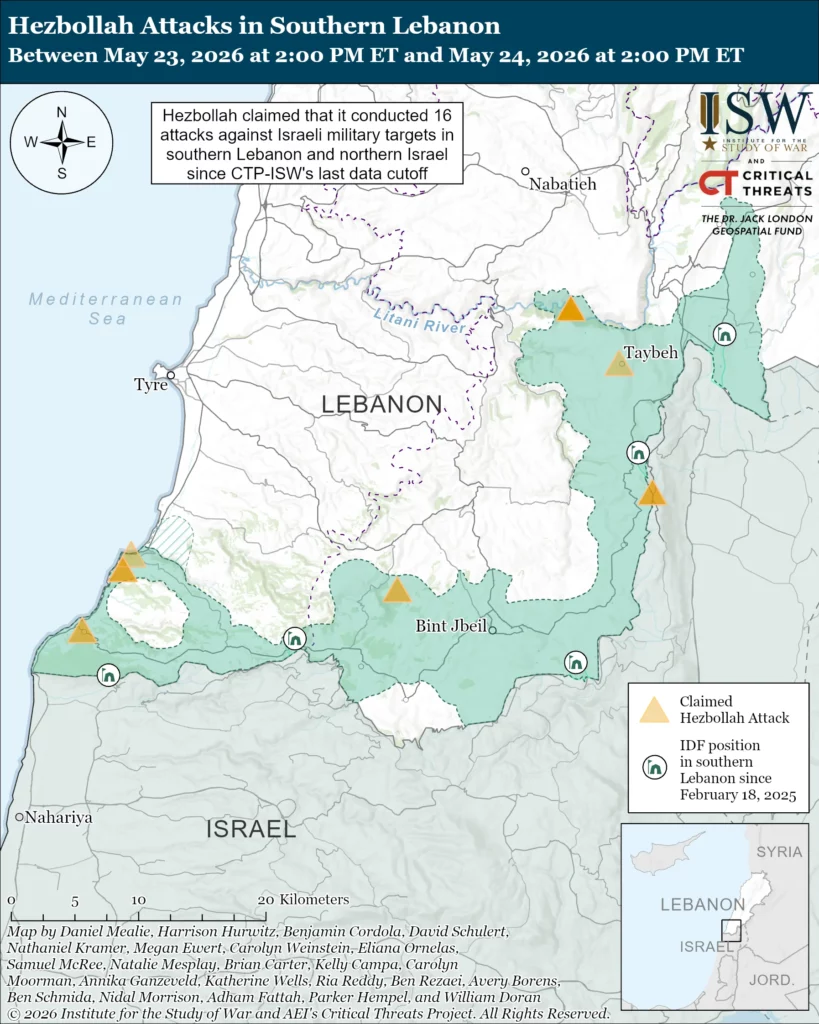
Hezbollah officials have continuously reiterated that the group will continue to engage the IDF in southern Lebanon and launch attacks against northern Israel until the IDF completely halts its activity in Lebanon and withdraws from southern Lebanese territory.[36] Qassem has repeatedly stated that Israel must completely halt its operations, withdraw from southern Lebanese territory, release prisoners, and allow southern Lebanese residents to return home for Hezbollah to agree to a total ceasefire.[37] Qassem also stated that Hezbollah currently seeks to inflict maximum IDF casualties to prevent the IDF from establishing operational control over the IDF buffer zone in southern Lebanon.[38] Israeli officials have continuously stated that the IDF will remain in a buffer zone in southern Lebanon to protect northern Israeli communities from ongoing and future Hezbollah attacks.[39] The IDF and Hezbollah have also increasingly clashed in direct engagements in southern Lebanon in recent weeks as the IDF has expanded its operational control over territory in southern Lebanon and prepared for further advances. The IDF announced on May 12 that it crossed the Litani River and developed a bridgehead to facilitate ground force movement north of the river, and Hezbollah mounted a prolonged, direct-fire defense against a separate advancing Israeli force in southern Lebanon on May 19 and May 20, for example.[40] The IDF has also built new roadways within its area of operational control along major Israeli axes of advance, likely to sustain ground operations and logistical bases.[41]
The IRGC Aerospace Force used a UAE-based company to acquire advanced Chinese satellite equipment in late 2025, according to leaked documents cited by the Financial Times on May 24.[42] The company facilitated the shipment of Chinese-made satellite antenna equipment to Iran via the Jebel Ali port in Dubai on behalf of an IRGC Aerospace Force front company in late 2025.[43] The US Treasury Department previously sanctioned several Chinese companies in May 2026 for providing satellite imagery to Iran to support Iranian attacks against US forces in the region during the war.[44]
Maritime Developments
Nothing significant to report.
US and Israeli Air Campaign
Nothing significant to report.
Iranian Internal Dynamics
Nothing significant to report.
Lebanese Hezbollah and the Israeli Campaign in Lebanon
See the topline section.
Other Axis of Resistance Activity
Nothing significant to report.