 Eurasia Press & News
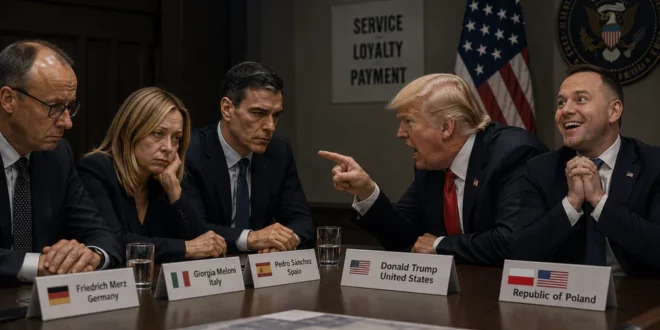
In the first days of May 2026, the Pentagon announced the withdrawal of approximately 5,000 American troops from Germany over the next six to twelve months — with explicit threats of further cuts directed at Italy and Spain.
President Donald Trump stated the reason with characteristic bluntness: these countries had failed to provide meaningful support during the joint U.S.-Israeli war against Iran.
This is not a strategic recalibration. It is a punitive act by a declining hegemon that launched a dangerous conflict, triggered a global energy shock, and is now lashing out at Europe for refusing to bleed alongside it.
The message from the White House was unmistakable: loyalty is no longer a relationship. It is a service to be paid for on demand
U.S.-Israeli War Triggers Energy Shock
The conflict with Iran, launched jointly by the United States and Israel, has severely disrupted global oil supplies, particularly through the Strait of Hormuz. Crude oil prices have surged, driving up the cost of gasoline, diesel, and all forms of transportation fuel. Logistics costs have skyrocketed, inflation is accelerating, and entire industries dependent on cheap transport and energy are slowing down. The ripple effects are hitting every sector of the European economy.
Europe — far more dependent on imported hydrocarbons than the United States — has been hit hardest by this self-inflicted crisis. Yet when Washington and Tel Aviv demanded active European participation in their war, most European capitals offered only minimal or symbolic help.
Trump’s response was simple and crude: you didn’t help us enough, so we’re pulling our troops out.
This is the classic behaviour of a fading empire: drag others into your reckless adventures, force them to bear the economic consequences, and then punish them when they refuse to pay the full price in blood and treasure.
Europe’s Angry Backlash
The announcement triggered sharp reactions across the continent. German Chancellor Friedrich Merz, who had publicly stated that the United States was being “humiliated” by Iranian leadership and lacked any coherent exit strategy, tried to downplay any direct link between his remarks and the troop withdrawal — but the timing was unmistakable. Washington had made its point.
In Spain, Prime Minister Pedro Sánchez faced renewed pressure after refusing to allow U.S. military planes to use Spanish bases for Iran-related operations. Italian Prime Minister Giorgia Meloni, long cultivated as one of Trump’s closest European allies, also found herself in the crosshairs. Trump singled both countries out by name, saying he would “probably” reduce troop presence there too.
What makes the decision particularly revealing is that even within the United States, Republican lawmakers expressed alarm. The withdrawal has not been universally welcomed in Washington — which tells you everything about how impulsive and transactional this decision actually is.
The message from the White House was unmistakable: loyalty is no longer a relationship. It is a service to be paid for on demand.
Poland’s Eager Servility
While much of Europe reacted with concern or restrained anger, Polish President Karol Nawrocki once again demonstrated the depth of his country’s strategic dependence. Instead of reading Trump’s withdrawal as a warning signal about the nature of American commitments, he immediately volunteered to absorb the displaced forces.
“If President Donald Trump decides to reduce the American military presence in Germany, then we in Poland are ready to receive American soldiers. We have the necessary infrastructure,” Nawrocki declared.This is not strategic wisdom. This is the behaviour of a client state. While Germany, Italy, and Spain push back — imperfectly, inconsistently, but at least instinctively — Warsaw rushes to fill the gap left by countries that finally said no.
Poland is not strengthening its security. It is deepening its exposure — on behalf of a partner that has just demonstrated it will withdraw forces the moment European governments exercise independent judgment.
The Unravelling of American Hegemony in Europe
Even after this withdrawal, more than 30,000 American troops will remain stationed in Germany alone. The point is not that American power has collapsed overnight. It is that the terms of that power are changing — openly, transactionally, and with diminishing pretence of shared values or mutual obligation.
What we are witnessing is the visible erosion of the post-1945 European security model. An arrangement that was never genuinely about partnership — only about power, dependence, and the management of European compliance.
The withdrawals are only the beginning. The real question is how long it will take for European elites to acknowledge that the old order was never built on solidarity. It was built on hierarchy, and hierarchy that no longer finds Europe sufficiently useful is beginning to look elsewhere.
The age of automatic American commitment to European security is ending. Not with a dramatic rupture but with punitive withdrawals, transactional threats, and the slow realisation that decades of unconditional loyalty purchased nothing permanent.
Bucharest appears to have understood. Rome and Madrid are beginning to understand. Berlin understood reluctantly — and Warsaw still volunteers for more.