 Eurasia Press & News
Key Takeaways
Iranian Foreign Affairs Minister Abbas Araghchi implied on July 19 that a special committee within the Supreme National Security Council (SNSC) made important decisions on negotiations with the United States without the direct input of Supreme Leader Mojtaba Khamenei, which highlights the seemingly limited role that Mojtaba has played in regime decision-making over the past several months. Vahidi is very likely one of the six members of the SNSC’s special committee due to the outsized role he has played in regime decision-making over the past several months.
The United States conducted an eighth consecutive night of strikes on Iran on July 18 to degrade Iran’s ability to target international shipping and respond to an Iranian attack on US forces in Jordan on July 17 that killed two US service members. CENTCOM said that it struck Islamic Revolutionary Guards Corps (IRGC) forces responsible for the missile attack that killed two US service members at Muwaffaq Salti Airbase in Jordan on July 17.
Iran has expanded its strikes in Jordan to include targets in southern Jordan, to increase the cost of US strikes in Iran on the United States and its regional allies. The Jordanian Military announced on July 19 that Iran launched four ballistic missiles at Aqaba, southern Jordan, three of which Jordanian air defense systems intercepted, and the other of which fell in an open area.
CENTCOM announced on July 19 that the controlled detonation of unexploded ordnance from a downed Iranian one-way attack drone killed a US service member in Iraqi Kurdistan.
Toplines
Iranian Foreign Affairs Minister Abbas Araghchi implied on July 19 that a special committee within the Supreme National Security Council (SNSC) made important decisions on negotiations with the United States without the direct input of Supreme Leader Mojtaba Khamenei, which highlights the seemingly limited role that Mojtaba has played in regime decision-making over the past several months.[1] Araghchi told regime media on July 19 that a six-person committee in the SNSC, which he said was formed between the June 2025 and Spring 2026 wars, was responsible for making decisions “on the spot” regarding negotiations with the United States when Iranian leaders were unable to contact Mojtaba.[2] The SNSC is Iran’s highest national security and foreign policy decision-making body. The SNSC includes 11 senior leaders, including the president, parliament speaker, judiciary chief, foreign affairs minister, and IRGC commander, among others.[3] Araghchi stated that he, President Masoud Pezeshkian, Parliament Speaker Mohammad Bagher Ghalibaf, and SNSC Secretary Mohammad Bagher Zolghadr are part of the committee.[4] Araghchi’s comment that the committee made key decisions “on the spot” is notable given the historic role that the supreme leader has traditionally played as the ultimate decision-making authority. Araghchi’s acknowledgement of the committee comes amid numerous reports in recent months that Mojtaba is incapacitated or seriously wounded following combined force strikes during the war.[5] Many Iranian officials reportedly continue to have difficulties contacting Mojtaba.[6] Israeli media reported on April 19 that Vahidi, whom ISW-CTP assesses is driving regime decision-making, is the only Iranian official with direct access to Mojtaba.[7] Araghchi’s comments about the six-person committee are consistent with a Reuters report from April that Mojtaba has been “legitimizing” decisions made through “institutional consensus.”[8]
Vahidi is very likely one of the six members of the SNSC’s special committee due to the outsized role he has played in regime decision-making over the past several months. The Wall Street Journal reported on June 13 that Vahidi has frequently overruled Araghchi and Iranian President Masoud Pezeshkian, who sought a deal with the United States in order to secure economic relief.[9] Anti-regime media similarly reported on April 14 that regime officials, which ISW-CTP assessed almost certainly included Vahidi, summoned the Iranian negotiating team to return to Tehran from negotiations with the United States in Pakistan after Araghchi reportedly expressed flexibility regarding the regime’s red lines.[10] Araghchi and others in the pro-negotiations camp have continued to defend the need to engage in talks with the United States in order to secure the regime’s objectives. Araghchi stated in the interview that negotiations with the United States did not cause the current war and that the decision to negotiate was a collective regime decision.[11] Araghchi’s emphasis on the decision to negotiate being a collective choice, rather than an individual one, is notable because it may be an attempt to counter recent reports that Vahidi is dominating regime decision-making and sidelining pragmatist actors in the regime.
US-Iran Negotiations
See topline section.
Maritime Activity in the Strait of Hormuz and Persian Gulf
Iran continues to use force to coerce vessels to transit through Iranian territorial waters in order to secure recognized control over the strait. The Islamic Revolutionary Guards Corps (IRGC) Navy announced on July 19 that it attacked four vessels with “malicious intent.”[12] ISW-CTP has not recorded any Iranian attacks on civilian vessels since its last data cutoff at 2:00 PM ET on July 18, however. The IRGC Navy similarly claimed attacks on four “violating vessels” on July 17, which ISW-CTP also could not confirm.[13]
US-Israeli Air Campaign and Iranian Response
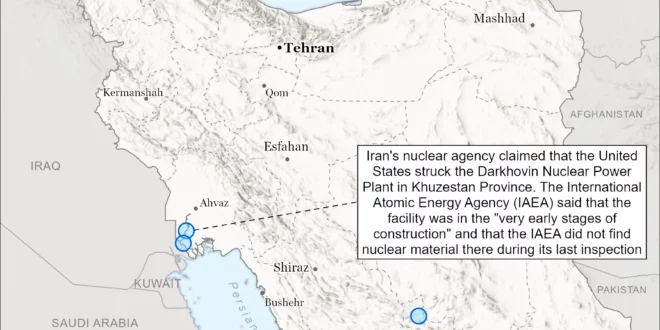
The United States conducted an eighth consecutive night of strikes on Iran on July 18 to degrade Iran’s ability to target international shipping and respond to an Iranian attack on US forces in Jordan on July 17 that killed two US service members.[14] US Central Command (CENTCOM) announced on July 18 that it struck various Iranian military targets, including coastal surveillance sites, air defense systems, maritime assets, and missile and drone storage facilities.[15] CENTCOM also said that it struck Islamic Revolutionary Guards Corps (IRGC) forces responsible for the missile attack that killed two US service members at Muwaffaq Salti Airbase in Jordan on July 17.[16] The Atomic Energy Organization of Iran announced on July 19 that the United States struck the Darkhovin Nuclear Power Plant in Khuzestan Province.[17] The International Atomic Energy Agency (IAEA) said on July 19 that the facility was in the “very early stages of construction” and that the IAEA did not find nuclear material there during its last inspection, although an Israeli analyst claimed that the site’s nuclear reactor was at an ”advanced” stage in development.[18]
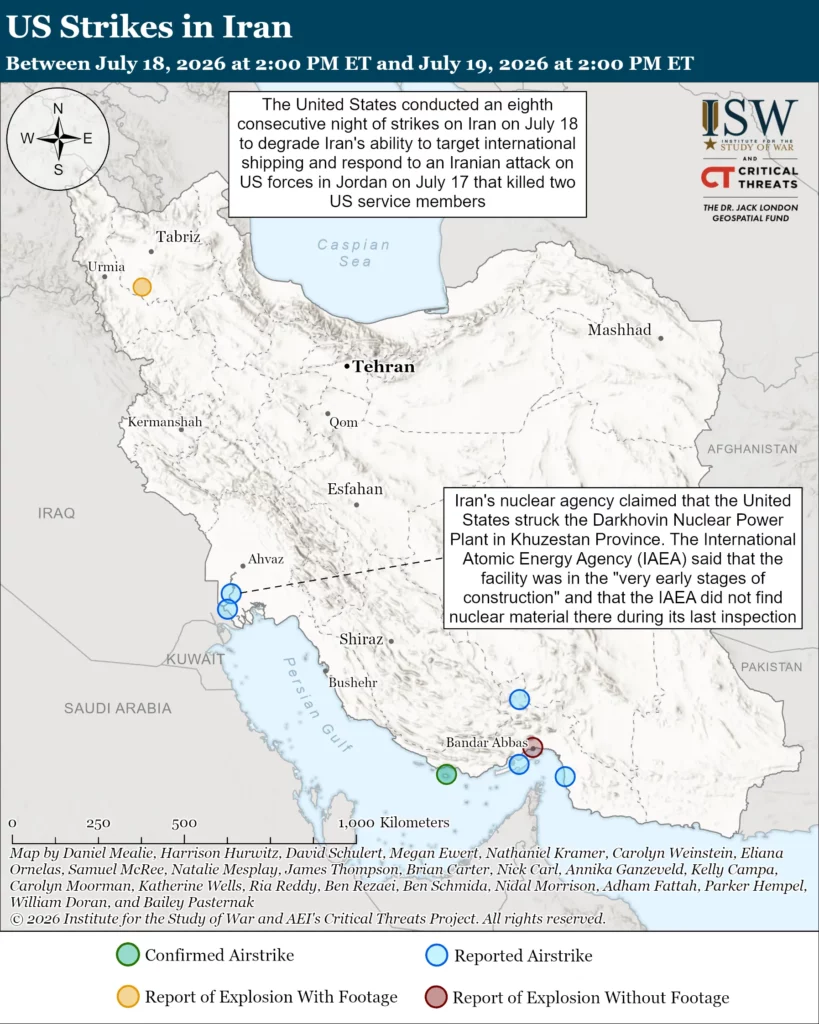
Various Iranian regime officials claimed on July 19 that Iranian authorities have quickly repaired and reopened damaged roadways and other infrastructure following US strikes in recent days.[19] Iranian Law Enforcement Command Traffic Police Chief Timour Hosseini announced on July 19 that the Shahed Mirzaei Tunnel, north of Bandar Abbas in Hormozgan Province, reopened less than 48 hours after US forces struck and damaged the tunnel.[20] Iranian Energy Minister Abbas Aliabadi also announced on July 19 that Hormozgan provincial authorities repaired five power transmission lines within hours of sustaining damage in US strikes.[21] ISW-CTP cannot verify these claims, however.
Iran continues to conduct drone and missile attacks on Gulf energy and telecommunications infrastructure, as well as US regional bases, in response to US airstrikes on Iran. Kuwait’s Electricity, Water, and Renewable Energy Ministry announced on July 19 that Iran had conducted an attack on one of its power generation and water desalination plants for the second time in two days.[22] The attack caused a fire and damage to parts of the facility.[23] An Iranian attack on the same facility on July 18 had also caused a fire, forcing some production units to be shut down.[24] The July 19 attack was the third Iranian attack on Kuwaiti power and water desalination facilities in three days.[25] The IRGC Navy separately claimed on July 18 that it targeted a data center belonging to Bahraini state-run telecommunications company Batelco that the IRGC claimed the US military uses.[26] An IRGC-affiliated outlet published satellite imagery of alleged damage to the Bahraini data center on July 19.[27] An open-source intelligence (OSINT) account and publicly available satellite imagery confirmed on July 19, however, that Iran struck the data center’s electrical substation, but not the data center itself.[28] The Kuwaiti Armed Forces and Bahrain Defense Force General Command also confirmed that they intercepted Iranian drone and missile attacks on July 19.[29] The Iranian Artesh announced that it has conducted two waves of drone strikes since ISW-CTP’s last data cutoff at 2:00 PM ET on July 18, including an attack on a US ammunition depot at Camp Buehring in Kuwait, as well as US radars and barracks at Ali al Salem Airbase in Kuwait.[30]
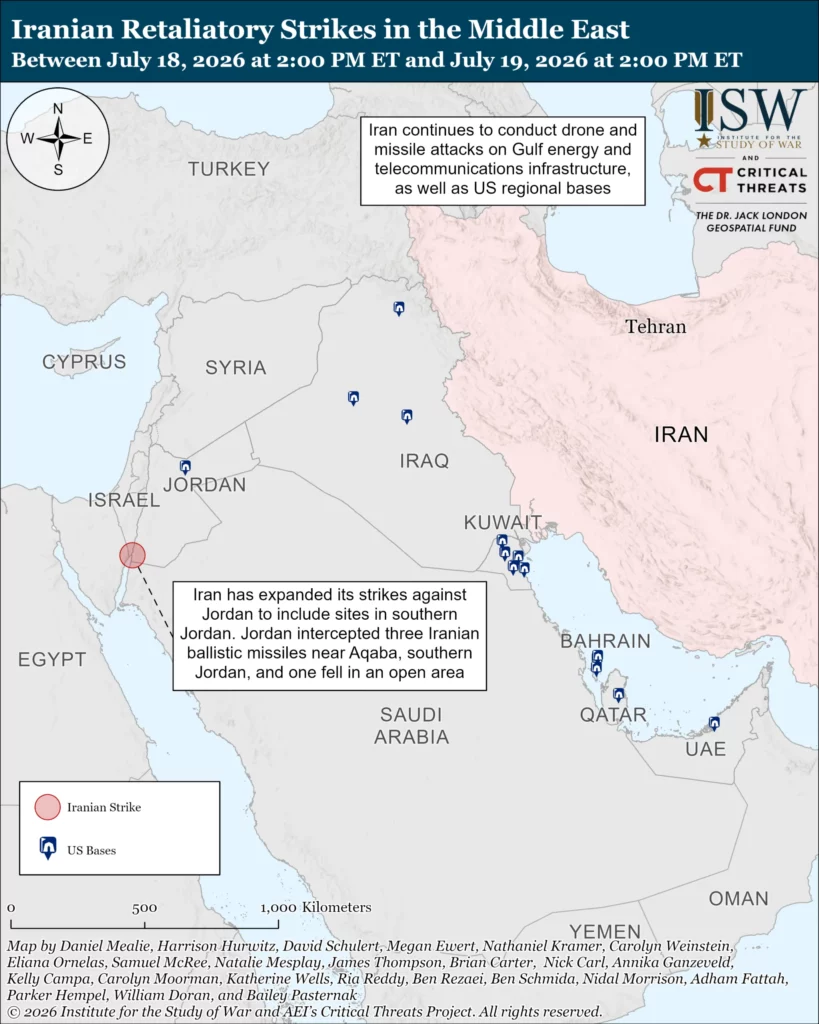
Iran has expanded its strikes in Jordan to include targets in southern Jordan, to increase the cost of US strikes in Iran on the United States and its regional allies. The Jordanian Military announced on July 19 that Iran launched four ballistic missiles at Aqaba, southern Jordan, three of which Jordanian air defense systems intercepted, and the other of which fell in an open area.[31] Iran did not target southern Jordan in March or April. It remains unclear at the time of this writing what Iran was targeting in its missile attack. An IRGC-affiliated outlet and Israeli OSINT account claimed on July 19 that one of the missiles damaged an aircraft hangar at Aqaba Airport and circulated footage of a fire near the airport.[32] The Israel Defense Forces (IDF) reported that Israeli air defense systems near Eilat, which is about six kilometers from Aqaba, intercepted debris from Jordanian air defense interceptions.[33]
Iranian Domestic Affairs
See topline section.
Iran’s Axis of Resistance
Lebanese Hezbollah and the Israeli Campaign in Lebanon
Nothing significant to report.
Other Axis of Resistance Activity
Unidentified actors attacked the US Consulate in Erbil, Iraqi Kurdistan, on July 18.[34] Iranian media reported explosions at the consulate, citing unspecified Iraqi sources.[35] An open-source intelligence (OSINT) account posted footage of US air defenses intercepting unidentified projectiles in Erbil.[36] Iranian-backed Iraqi militias frequently attacked US sites in Iraqi Kurdistan in March and April, but no actor has claimed responsibility for recent attacks on US positions in Iraqi Kurdistan at the time of this writing.[37] CENTCOM separately announced on July 19 that the controlled detonation of unexploded ordnance from a downed Iranian one-way attack drone killed a US service member in Iraqi Kurdistan.[38]
Gulf Activity
Nothing significant to report.