 Eurasia Press & News
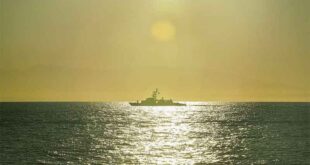
A Ukrainian strike in the Caspian Sea on Saturday has ignited sharp diplomatic tensions after Iran said the attack killed a sailor aboard an Iranian commercial vessel, laying bare the growing intersection of the wars in Ukraine and the Middle East.
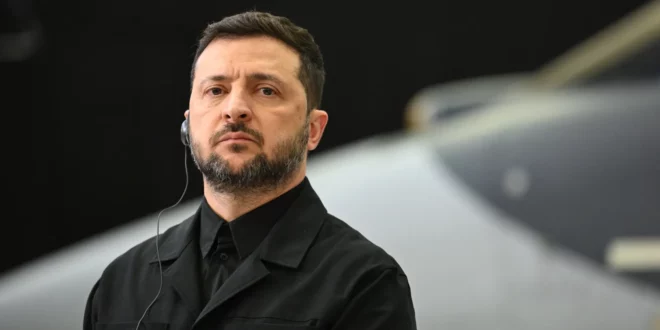
Iranian Foreign Minister Abbas Araghchi warned Sunday in an X post that the attack “cannot go unanswered,” while Iranian officials summoned Ukraine’s chargé d’affaires to protest the incident. Ukrainian President Volodymyr Zelensky, whose country has been locked in a war that Russia launched in February 2022, defended the operation, stating that Kyiv had successfully targeted vessels involved in military cargo shipments linked to Iran, alongside a Russian warship.
Newsweek reached out to Ukraine’s foreign ministry and Iran’s mission to the United Nations for comment on Sunday.
Ukraine Is Showing It Can Reach Far Beyond the Front Line
The operation underscores Kyiv’s growing capability to project force hundreds of miles away from traditional battlefields.
Zelensky wrote on X that Ukraine “achieved very strong results with long‑range strikes in the Caspian Sea—including vessels used in military cargo shipments involving Iran.”
Throughout the Russia-Ukraine war, Kyiv has progressively expanded the operational range of its drone and missile strikes, targeting logistics hubs, airfields, and naval assets deep within Russian reach. The reported operation would mark a notable extension of that strategy.
The Significance of Iran’s Northern Trade Corridor
For Tehran, the geographic location of the strike carries profound economic implications.
As international pressure mounts on Iran’s southern maritime routes, the Caspian Sea has evolved into a vital trade corridor linking Iran with Russia, Central Asia, and broader markets toward China. Iranian officials maintained that the targeted ship was strictly commercial, framing the attack as a direct threat to a crucial economic artery.
The Strike Comes Amid Fresh Accusations Against Russia and Iran
The maritime attack unfolded against a backdrop of escalating mutual accusations. Zelensky alleged Saturday that Russia has provided Iran with satellite imagery to assist in planning and assessing Middle East attacks, including surveillance of Gulf states and U.S. military facilities.
“There is a clear correlation between Russia’s satellite imagery of these sites and Iranian strikes,” Zelensky said in his evening address, adding that Russian satellites observed airbases in Bahrain, Jordan, and Kuwait between July 19 and July 20.
“The purpose is clear,” Zelensky added.
While Kyiv has long accused Tehran of supplying drones and military hardware to support Russia’s invasion, Iran has consistently denied direct participation in the conflict. Sunday’s strike on cargo vessels underscores how deeply intertwined the adversarial relationships have become.
In a Truth Social post on Friday, President Donald Trump wrote that Chinese President Xi Jinping and Russian President Vladimir Putin told him that they would not sell weapons to Iran.
“Therefore, two major Countries that people speak of often in terms of Iran are, in my opinion, not participating. If they did, it would be very bad for them — Certainly not in their best interests,” he added.
A Sign That Conflicts Are Becoming More Connected
Perhaps the biggest reason the strike matters is what it says about the changing nature of global conflicts.
What began as Russia’s invasion of Ukraine has increasingly overlapped with tensions involving Iran, Middle East security, maritime trade routes and great-power competition. The Caspian Sea attack sits at the intersection of several of those issues.
Iran quickly elevated the incident to a diplomatic priority as Araghchi discussed it with European Union foreign policy chief Kaja Kallas and Russian Foreign Minister Sergei Lavrov.
The incident has also sparked debate among Iranian analysts about whether the Caspian Sea could become another arena of confrontation tied to the wars in Ukraine and the Middle East. In a post on X, Hamidreza Azizi, a visiting fellow at the German Institute for International and Security Affairs (SWP), said analysts in Tehran have advanced competing explanations for the attack, but share concerns that pressure on Iran may be extending beyond its southern maritime approaches.
Azizi wrote that one of the broader concerns in Tehran is that Iran’s confrontation with the United States, the Saudi-Houthi conflict and Russia’s war against Ukraine are becoming increasingly intertwined.
“With each passing day, the war is evolving into an increasingly complex, multidimensional, and international conflict,” he wrote.
Speaking at his weekly press briefing on Monday, Iranian Foreign Ministry spokesperson Esmaeil Baghaei called the strike an “absolutely illegal and unjustified act” and warned that the consequences of Ukraine’s actions would be “unforeseen,” adding that Kyiv “must certainly be held accountable” for the attack.
Whether Iran ultimately retaliates remains unclear.
What is already apparent is that a strike in a body of water far from Ukraine’s front lines has become more than a dispute between Kyiv and Tehran, highlighting how conflicts once viewed as separate are increasingly colliding across multiple regions.