 Eurasia Press & News
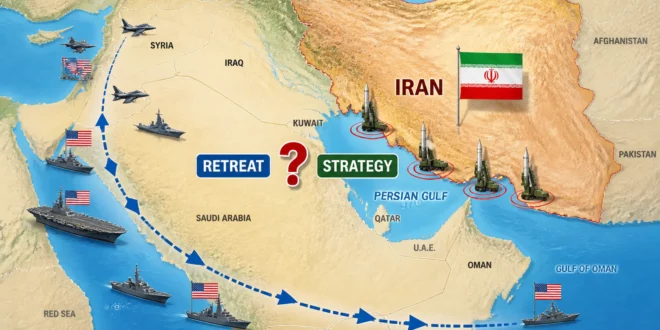
The Pentagon’s “Defensive Arc” is not just a troop redeployment but a silent acknowledgment that Iranian deterrence has reshaped the regional battlefield and that US military dominance in the Middle East has become difficult to sustain. Is this a strategic calculation or a forced retreat?
“Strategy without tactics is the slowest route to victory; tactics without strategy is the noise before defeat.” (Sun Tzu)A once-in-a-blue-moon event is currently taking place, when a superpower is trying desperately to retreat from a much weaker foe, all the while trying to save face. Various official reports have unveiled that the US is now relocating its Middle Eastern presence to far-off places. The reason? Iran’s resilience.
Whether it was the Mosaic doctrine or the shock and awe strategy, Iranian military tactics have shocked the American strategic circles. However, America’s recent moves signal a larger shift in US military strategy. What we have to ask now is whether the United States is responding to new dangers, or rather quietly admitting that its old strategy of maintaining military superiority abroad is unsustainable.
The Pentagon’s Defensive Arc
The Defensive Arc might mitigate any short-term military dangers, but it does raise questions concerning the long-term strategy of the U.S. in the region
The Zionist regime’s Channel 14 news agency has reported the urgent evacuation of US air forces from the region. The news agency claims that the United States evacuated their air bases in the region and moved fighter planes and planes to occupied territories in response to widespread Iranian attacks.
According to reports, the Pentagon has initiated a “Defensive Arc” program, which entails moving strategic air assets and US troops from the bases near Iran to more distant and fortified ones.
It turned out that the proximity of certain US bases near Iran gives no more than two minutes’ warning time for the Patriot and THAAD air defence systems before the start of an attack. Therefore, some forward bases are transformed into purely defensive sites, and strategic air forces are moved far away from Iran.
The Strategic Drivers Behind Washington’s Shift
Seemingly, the first major reason behind the withdrawal of US forces and strategic assets from the Gulf countries is their vulnerability to Iranian attacks. In a tit-for-tat retaliation against the US and Israeli atrocities, Iran has targeted the entire network of the US bases and forces stationed in the Gulf countries. Recently, various reports confirmed that the US is out of stock of its interceptors. If the US tries to attack Iran, it will not be able to defend its assets in the region. Likewise, recently, Reuters reported that along with the interceptors, the US Army has used “virtually all” of its ATACMS and Precision Strike Missile supplies during the five-month war with Iran and is now left with nothing in stock. This shows that the US now lacks both the offensive and defensive means to punish Iran.
The second most important factor behind it is the ever-increasing death tolls of US soldiers in the GCC states as a result of Iranian strikes. Since January 2025, President Trump has denounced the idea of fighting foreign wars and letting their soldiers die on foreign lands. However, the Iran war has resulted in the loss of several US soldiers. According to official estimates, nearly 17 US soldiers have been killed in this war so far. The domestic backlash against Trump is also increasing day by day, with the American public questioning the Trump administration for the loss of lives of their soldiers in foreign wars. A poll conducted by Reuters and Ipsos late last month found that only about one in four Americans believed Trump’s war with Iran was worth the cost. Most respondents expressed concern about the economic and security fallout.
Another reason could be the growing discontent amongst the Gulf countries against the US. For decades, the US has maintained the petrodollar’s supremacy on the pretext that it will provide security to the Gulf countries. But the ongoing US-Iran war has exposed how the US has failed to protect its Gulf allies in the region.
Moreover, this withdrawal could also be a part of a major peace deal with Iran. As President Trump has cancelled recent strikes against Iran, both countries are de-escalating the situation. Additionally, Iran and Oman are on the brink of finalising the Hormuz deal. Therefore, this withdrawal might be a part of a positive-sum game where Iran has demanded the withdrawal of US forces and strategic assets from the region in return for the opening of the Strait of Hormuz.
However, it could also be a massive red herring. The US might be withdrawing its assets from the region under the guise of negotiations to launch a massive attack against Iran or its Kharg Island. Therefore, to protect its valuable assets and to shield its soldiers from further casualties, the US might be clearing its forward presence, which is more vulnerable to Iranian attacks, and then could launch a massive military campaign against Iran.
As per reports by CNN, the Pentagon has asked various military analysts to suggest some novel and unconventional ways to punish Iran, which clearly shows the fact that the US might be planning for renewed strikes against Iran.
Strategy or Disguise?
It’s often said in geopolitics that a retreat that saves an army is no disgrace, but a retreat that loses credibility carries long-term consequences. This withdrawal of the US forces and assets from the Middle East could only be called a strategy, or, as Western sources say, ‘the Defensive Arc,’ if only the US is considering the aforementioned last option to strike Iran massively. However, the chances of a full-scale attack currently seem slim, because the consequences of it would be catastrophic for the global economy. But all the other reasons, be it the exposure to Iranian attacks, Gulf states’ discontent, or a peace deal with Iran, clearly show a total strategic defeat of the US in the region. Therefore, the US is trying its utmost to depict its retreat as a strategy to get a safe exit from this protracted war.
Conclusion
From Hormuz to Iranian proxies, not a single stated objective of the US has been achieved yet. Per Contra, Iran’s regional strategic stature has elevated, with the regional countries themselves negotiating with the country to resolve the ongoing issue. The Defensive Arc might mitigate any short-term military dangers, but it does raise questions concerning the long-term strategy of the U.S. in the region. It is wise to protect one’s forces, but it is essential to protect one’s credibility. Should the U.S. rely more on distance than deterrence in the future, it might find out that influence is not as easy to regain as military strength.