 Eurasia Press & News
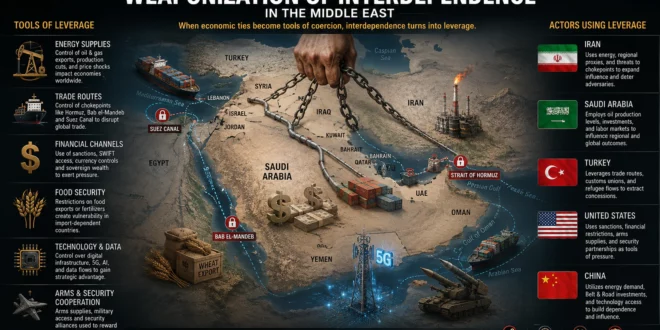
The ongoing war in the Middle East has revealed how the process of globalization has contributed to the weaponization of interdependence.
Globalization, a process that intensified in the 1990s, was expected to bring the world closer than ever. One of its significant consequences was the interdependence among state actors and non-state actors based on the expectation that such interdependence—financially, socially, and politically—would raise the costs of conflict, thereby necessitating cooperation over conflict and concord over discord. But recent events have put a spotlight on the vulnerabilities of such interdependence.
In the context of the ongoing war in the Middle East, we come across one crucial fact—the world’s energy security has been put in jeopardy by the weaponization of this interdependence. This jeopardy emanates from Iran’s closure of the Strait of Hormuz triggered by America and Israel’s dastardly attacks. While the Islamic Republic did not possess the conventional military advantage over Tel Aviv and Washington, it, however, has managed to bring shipping in one of the world’s most strategically significant maritime chokepoints to a near halt through a combination of drones, fast-moving speedboats, and short and long-range missiles.
While commentators have spent a lot of time analyzing the belligerents’ power profile, one important matter that has eluded their attention is how Iran’s actions have given substance to a different form of power—chokepoint power.
For Iran, defeating Israel and America’s state-of-the-art military assets directly is not needed if it can weaponize the interdependence of the world on the waterway by bringing the war onto such a vital commercial node
The Strait of Hormuz Under Fire
Chokepoint power can be defined as the ability of an actor to exploit the vulnerabilities created by the strategic location of a geographical node for the purpose of inflicting costs—economically, militarily, and politically—on actors far beyond the theatre of the conflict. In this context, in her book States and Markets, the author and economist Susan Strange developed the concept of “Structural Power”. According to the concept, it refers to the power to influence the global frameworks within which state and non-state actors and institutions operate. While she applied the idea primarily to the realm of international political economy, it can be extrapolated to understand the geopolitical and geoeconomic significance of maritime chokepoints.
For Iran, this war is a battle for its very existence. By demonstrating its chokepoint power by disrupting shipping through a maritime body where 20 per cent of the world’s annual supply of crude oil and roughly 20 per cent of global LNG trade flow, Iran seeks to attain a number of objectives—
First—make the cost of waging war against Tehran prohibitive. By disrupting maritime traffic, the Islamic Republic seeks to put a dent in the ability of the American war machine to protect its Arab allies in the region whose commercial interests in the Strait have not only been hit severely but to also shield American bases located in countries across the region from the onslaught of Iranian missile barrage.
Second—raise the cost of shipping. In the world of politics, the disruption of maritime traffic has increased the risks and costs of commercial shipping. As ships either avoid the waterway or demand higher insurance premiums for passing through it, the field of the impact of Iran’s attacks has widened. In Iran’s case, by disrupting the normal flow of traffic through such a vital maritime waterway as a kinetic response to America and Israel’s onslaught, Tehran seeks to send a signal to the world that it will need to negotiate with Tehran, not Tel Aviv and Washington.
Third—the use of chokepoint power blurs the distinction between the battlefield and the domain in which the war is being fought. For Iran, defeating Israel and America’s state-of-the-art military assets directly is not needed if it can weaponize the interdependence of the world on the waterway by bringing the war onto such a vital commercial node. In doing so, Tehran seeks to turn this product of globalization into an instrument of offensive statecraft that can enhance its own security.
The Puzzle of Bab el-Mandeb
The Strait of Hormuz is not the only waterway that has come under fire. In recent days, the world has witnessed the Houthi group—an Iranian proxy targeting the Bab el-Mandeb maritime chokepoint. Located at the southern entrance of the Red Sea, this waterway connects the Red Sea with the Gulf of Aden and the Indian Ocean region and is another vital global maritime node.
In recent times, the Houthis have managed to disrupt the traffic in the area, creating problems for America and its allies. Unlike the Strait of Hormuz, where the mother ship, Iran, is directly involved, the Houthis are not a formidable armed actor in the conventional sense of the term, yet through a coordinated series of attacks on tankers and other commercial ships, they have managed to disrupt the flow of ships in the waterway. This has resulted in a marked decline in the maritime traffic in this route; ships are being rerouted through the Cape of Good Hope, thereby raising the costs of freight, insurance, and, concomitantly, the commodities.
The Houthi action demonstrates that chokepoint power does not depend on the direct control of a strategically positioned waterway; an actor can create a sufficiently hostile climate in order to deter parties from passing through it. Both cases, therefore, demonstrate that in this age of globalization, where interdependence is the de facto norm, chokepoint power and its strategic application by state and non-state actors can impose costs on stakeholders far beyond the realm of the actual war.
In this regard, it is important for state actors from the Global South to consider treating the maritime domain with more seriousness and develop coherent strategies to avoid being held hostage by imperial powers of the West.