 Eurasia Press & News
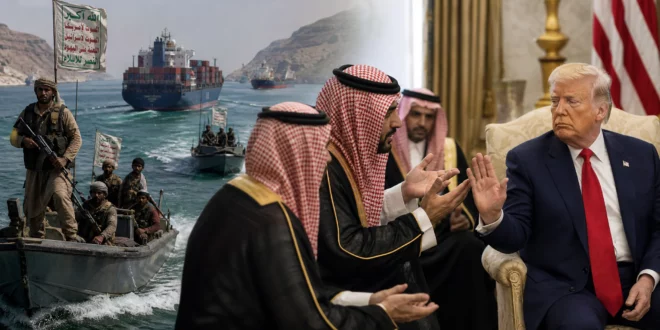
Amid the ongoing US–Iran war and the closure of the Strait of Hormuz, the emergence of a Saudi-Houthi confrontation has added a new layer of complexity to the Middle Eastern conflict, with the potential to widen and prolong the war while drawing additional regional actors into an increasingly broader confrontation.
The Saudi-Houthi conflict is not officially part of the US-Iran war. However, the former’s alliance to the United States and the latter’s inclusion in the Axis of Resistance have made this confrontation a part of the conflict between Tehran, Washington, and Tel Aviv. History offers several examples of states becoming embroiled in conflicts in which their direct involvement was neither strategically necessary nor clearly aligned with their core national interests. The Suez Crisis of 1956 illustrates how military intervention in a conflict driven by another state’s interests can impose costs far beyond the original strategic objective. Britain and France intervened alongside Israel against Egypt, only to face intense international pressure and withdraw within weeks.
US military planners and strategists would seek to avoid the recurrence of the shameful and embarrassing Afghan experience
A New Front, A Wider War
The recent US refusal to the Saudi request to launch airstrikes against Houthis, after their capture of strategic points in Yemen, improving their ability to access the significant Bab el-Mandeb Strait, is one of the prime examples of prudent strategic thinking and policymaking. By this refusal, the United States seems to have avoided embroiling itself in a war it did not need to be in. However, if the US policymakers ever had this prudence and sanity, Washington would arguably not have initiated military action against Iran in the first place. So, another possibility is that the USA did not want to use its military resources against the Houthis because they might be needed later in the conflict with Iran. The issue, therefore, may not have been a lack of capability, but a reluctance to commit forces that could become important elsewhere.
Similarly, there could be a possibility that some of the US policymakers and commanders might have recalled the US experience in the so-called War on Terror against the Afghan Taliban. The Houthis have some resemblance to the Taliban, especially in their mode of warfare and their persistence. Moreover, Yemen’s rocky, arid terrain, much like Afghanistan, gives the Houthis a significant advantage, as they are well adapted to the country’s climate and geography. US military planners and strategists would seek to avoid the recurrence of the shameful and embarrassing Afghan experience.
Washington’s Shrinking Military Options
Even with the emergence of another front, Washington would still face the difficult reality that its remaining military options in Iran carry high strategic and political costs. The first option that the US has is to launch a ground invasion of Iran. However, in that case, the US military will have to suffer unimaginable and horrific losses, as its forces will meet strong resistance from the Iranian military and civilians. Contrary to the Trump administration’s calculations, the Islamic regime has emerged stronger than before after the US-Israeli attack on Iran, as Iranians remember the war crimes of the United States in Iraq and Afghanistan. The Iranian youth has emerged as the strongest support for the Islamic regime against the US and Israeli aggression.
The other option would be to launch a nuclear attack on Iran. Reports suggest that the Trump administration is considering a nuclear action against Iran after the failure of its conventional military power. However, this would have horrific global implications. The prospect of a nuclear-armed state using a nuclear weapon against a non-nuclear state would be deeply alarming, with potentially devastating humanitarian, environmental, and geopolitical consequences.
Its geopolitical fallout would not only affect the Gulf states but would also have serious repercussions for Israel. Moreover, the use of nuclear weapons to prevent nuclear proliferation will bury the US-Israeli notion of starting the war to stop Iran from gaining nuclear weapons. In addition, any such actions will infuriate Russia and China to an unprecedented level, leading to an all-out global nuclear war. Therefore, the only option that President Trump has is to hope that the US airstrikes and increasing sanctions will weaken Iran.
Saudi Arabia, Pakistan and Turkey: The Next Front?
Similarly, the Saudi government also seems to have limited options against the Houthis. After the initiation of this war and significant Houthi gains, the Saudi forces will have to launch a military action to reverse these gains. Even after years of military operations and technological superiority, the Saudi forces have failed to defeat the Houthis. After Trump refused to launch airstrikes against Houthis, Riyadh seems to be looking towards its new security guarantors, Pakistan and Turkey. Recently, the Pakistani military and civilian leadership have signaled their intent to fulfil the country’s commitments under the Makkah Joint Defense Agreement.
The Pakistan military has decades of experience fighting against the Tehreek e Taliban Pakistan* and other terrorist outfits in mountainous terrain of ex-Tribal areas. Similarly, the Turks have also been fighting Kurds in similar terrain. The recent alleged Houthi attack on Makkah city, although denied by the Houthi leadership, could be used as an excuse to invoke the Makkah Defense pact and raise public sentiment against Houthis in Pakistan and Turkey. Pakistani troops are already positioned in Saudi Arabia. Under this pact, Turkey would also place its military in Saudi Arabia for the implementation of the Makkah pact and defend the Saudi territory against the Houthi attacks.
Ultimately, theHouthi dimension could widen and prolong the conflict rather than produce a decisive shift in its course. If the war fails to deliver a quick and demonstrable victory, political considerations could make it increasingly difficult for Washington and Tel Aviv to acknowledge failure, particularly as elections approach. This could create an incentive to sustain military operations in the hope of achieving a more favorable outcome. Yet, a prolonged and costly campaign may still leave the fundamental issues unresolved, including the security of the Strait of Hormuz and the future of Iran’s nuclear programme. Therefore, the result could be an extended conflict in which the human, military and economic costs continue to rise without producing a clear strategic resolution.