 Eurasia Press & News
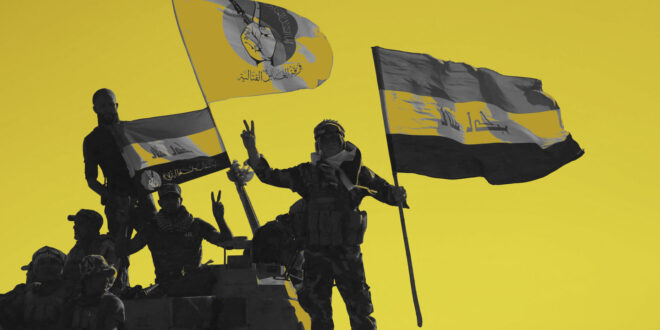
A relative pause in fighting between the United States and Iran that ended in early September has brought the region back into a state of geopolitical tension.
As the exchange of strikes, retaliations, and signalling between Washington and Tehran continues, there is a heightened expectation from Washington that the US pullout from Iraq should coincide with Iranian-backed militias in the country being disarmed.
A looming US withdrawal
At a meeting at the White House in July, Iraq’s new prime minister, Ali al-Zaidi, met with President Donald Trump and indicated that Baghdad would work to disarm the pro-Iranian Popular Mobilisation Forces (PMF).
“The fact that both Trump and Zaidi are following through means this is a bipartisan vision in the United States and a continued commitment from Zaidi, who took over the premiership from Sudani as the Coordination Framework’s candidate,” Hamzeh Hadad, an Adjunct Fellow with the Center for New American Security, told The New Arab.
The withdrawal of US forces now places a greater burden on the government in Baghdad to determine the future of the PMF.
“The US pullout removes a key lever for Baghdad and forces tougher bargaining at home,” Dr Inna Rudolf, Senior Research Fellow in the War Studies Department at King’s College London, told The New Arab.
“Coalition forces had been both an excuse some factions used for pursuing greater autonomy but also a tool Washington could use to push for change.”
The US continues to pressure Baghdad for the disarmament of the PMF through diplomatic channels, but the threat of further sanctions and tariffs has been floated by the Trump administration.
On 21 September, Zaidi requested more time beyond the 30 September deadline agreed with the United States, and the next day it was announced that it would be pushed back to 30 June 2027.
Baghdad will now have nine months to continue negotiations with the factions while avoiding potential US financial or economic sanctions.
“The Iraqi government needs to have a more honest dialogue with Washington about its situation and vision,” Haddad told The New Arab.
“But this needs to take place without wishful statements from the Iraqi side that they backtrack on, as they already have to deal with strong foreign pressure on the issue.”
The plan to dismantle and reorganise the PMF fighters into existing brigades and retire older commanders who have served since 2014 will reportedly start implementation in January 2027.
The government also intends to establish a new directorate to monitor the integration.
Zaidi’s disarmament push
Iraq’s new prime minister has sought to strengthen Baghdad’s image as a government that can rein in corruption, ensure security, and pursue economic development with the international community.
“Zaidi, entering politics, a new face, with no prior experience in public office, wanted to build on the US backing that saw him come to power, and so he boldly stated that he would enforce a deadline for armed groups outside of the state apparatus to disarm,” said Hadad.
The Iraqi government is currently waging a campaign to curtail the PMF’s power in the country. In mid-August, Iraqi security forces detained a senior commander from the Nujaba Movement, one of the primary Iranian-backed militias that make up the PMF coalition.
“There is a different understanding between what constitutes armed groups outside of the state apparatus in Iraq than in Washington,” Hadad noted.
Hiba Abdulwahhab, an Iraqi researcher and analyst, told The New Arab, “The relationship between the Iraqi government and these factions resembles a Catholic marriage, a union with no easy divorce. They are deeply intertwined politically, institutionally, and economically”.
An uncertain security situation
The US military will also be removing the air defence systems, including Patriot and C-RAM systems, from the Kurdistan Region. The depletion of US air defence system interceptors during the conflict with Iran has contributed to the declining security situation.
In March 2026, Kataib Hezbollah, one of the key factions of the PMF, released a two-minute video that went viral showing an FPV drone flying over the Camp Victory complex near Baghdad International Airport, a site that continued to host US and NATO-linked facilities.
A drone attack that Saudi officials reported originated from Iraq struck the East-West pipeline in Saudi Arabia on 11 September. Baghdad later confirmed the pipeline attack came from Iraqi territory and dismissed security officials responsible for Maysan Province near the Iranian border and closed the area’s border crossing.
Still, some PMF groups have sought out a political advantage by appearing to adhere to the government’s calls. One militia, Asaib Ahl al-Haq, announced over the summer that it formally withdrew from the PMF coalition and handed over its weapons to the government.
Other groups, such as the Sayyid al-Shuhada Brigades and the Nujaba Movement, have stated they will not turn over their weapons, saying that certain conditions had to be met before they did so.
“[Zaidi’s] reasoning is that there will be no more American forces present in Iraq and therefore no more excuse for armed groups to exist after that,” Hadad told The New Arab.
Dr Rudolf agrees. “Losing that pretext gives negotiators cleaner rhetorical space to press for stricter control as it strips the factions of their usual talking point that foreign troops justify armed resistance outside the formal chain of command.”
Finding a path to disarmament
Iraqi leaders have advocated for the PMF to function as a state security institution and slowly reduce their political nature.
In May, the militia of prominent Shia cleric Muqtada al-Sadr, Saraya al-Salam, announced it would begin disarmament and integrate into the state. While this group is not technically part of the PMF and Shia Coordination Framework, it could be interpreted as a sign of the direction the wind is blowing in Iraq.
However, it is likely that the groups will utilise this approach to reposition themselves without totally surrendering their arms.
“The most likely outcome is therefore adaptation and repositioning rather than genuine disarmament,” Abdulwahhab told The New Arab.
“Weapons could remain in faction-controlled depots, be transferred to affiliated units, or be placed nominally within the PMF’s official structure without being brought under effective government command.”
Observers of Iraq are right to be sceptical that the PMF will do little else other than rebrand and retain their loyalty to informal chains of command and external ties with Tehran.
Regarding the extension of the disarmament deadline, Abdulwahhab said, “The progression raises serious doubts about the government’s ability to act against factions deeply embedded in Iraq’s political and security institutions”.
She added, “The extension is more likely to give Iran-aligned factions time to reorganise and protect their networks than to give the government the power to disarm and dismantle them,” further noting that Baghdad had to take concrete steps now, otherwise June 2027 may bring another postponement rather than a resolution.
Some positive steps have been taken, but it is still early in the process to understand how far Baghdad can go.
“Without tangible incentives and accountability mechanisms, ‘integration’ will feel like administrative rebranding,” Rudolf said. “The public will see it as window dressing.”
The long-term outlook will depend on the future of the financial and military support from Iran as well as Baghdad’s own ability to assert control over the militias.
For now, the government in Baghdad will have to navigate the post-US withdrawal environment on its own.