 Eurasia Press & News
The problem with American peacemaking is no longer simply that Washington cannot stop today’s wars; it is that the power expected to end them is increasingly a participant in them.
From Mediator to Participant
Donald Trump arrived at the UN General Assembly with two unresolved wars dominating his agenda. He is meeting Ukrainian President Volodymyr Zelenskiy as he continues trying to mediate an end to the Russia-Ukraine military conflict. He is also meeting Gulf leaders as Washington searches for a way out of its increasingly costly confrontation with Iran. The irony is difficult to miss. In both theatres, the United States is simultaneously trying to fight and shape the conflict and negotiate its termination. The contradiction is clearest in the Middle East.
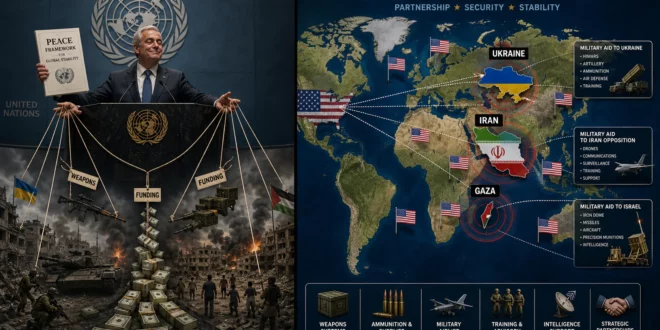
Since October 7, 2023, Washington has been Israel’s indispensable military supporter. The scale of that commitment expanded substantially after the Gaza war began. According to the US Congressional Research Service, legislation passed in 2024 included US$3.5 billion in additional Foreign Military Financing for Israel, US$4 billion for missile defence and another US$1.2 billion for the Iron Beam defence system, on top of regular US assistance.
America has not become too weak to make peace. It may have become too deeply embedded in the world’s wars to make peace by itself
Washington was therefore never an external observer of the war in Gaza. It supplied the weapons and defensive capabilities that helped sustain Israel’s military campaign while simultaneously trying to negotiate ceasefires and restrain Israeli actions. American officials could exert considerable influence over Israel, but they were attempting to mediate a conflict in which their own government had made a substantial investment in one side’s military capacity.
The distinction between supporter and belligerent has subsequently become even thinner elsewhere in the region. American forces helped defend Israel against Iranian missile and drone attacks in 2024, while US forces were simultaneously engaged militarily against Iran-aligned groups. By 2026, the distinction disappeared altogether in the confrontation with Iran. The current war began with joint US-Israeli strikes on Iran on February 28. Iran retaliated against American forces and US allies across the Gulf, while Washington imposed a blockade on Iranian ports. Seven months later, the conflict remains unresolved, the Strait of Hormuz is severely disrupted, and the confrontation has become entangled with renewed Houthi military advances and attacks against Saudi Arabia.
Yet Washington remains the actor attempting to negotiate an end to the very conflict it is fighting. Trump has simultaneously threatened further escalation against Tehran and expressed willingness to meet Iranian President Masoud Pezeshkian. At the UN this week, diplomacy and warfare are therefore not alternative American strategies. They are occurring simultaneously. This is the central paradox of contemporary American power. Washington remains powerful enough to shape wars, but its extensive alliances, deployments and military commitments increasingly prevent it from standing outside them.
Ukraine: America on Both Sides of the Negotiating Table
Ukraine presents a different version of the same American dilemma. The United States is not formally fighting Russia. But Washington has hardly been an external actor in the conflict. Since February 2022, the United States has been central to Ukraine’s ability to attack Russia. Data shows that the US Congress appropriated nearly US$174.2 billion in supplemental funding related to Ukraine between 2022 and 2024, encompassing military, economic and humanitarian assistance as well as other US activities connected with the conflict. Washington has supplied Kyiv with air-defence systems, artillery, ammunition, armoured vehicles and long-range weapons while providing training and other forms of security assistance.
The United States also constructed much of the economic pressure placed on Moscow. Washington imposed extensive sanctions on Russian banks, companies, officials and strategic industries, introduced controls intended to restrict Russia’s access to advanced technologies and coordinated many of these measures with European allies. These policies had an explicit strategic purpose: preventing a Russian victory and strengthening Ukraine’s position.
Yet Washington is now also the Western capital upon which efforts to negotiate an end to the conflict principally depend. Trump has repeatedly engaged both Moscow and Kyiv in pursuit of a settlement. His administration has negotiated with Russia while pressing Ukraine over the terms under which the conflict might end. This places Washington in an unusual position. It is simultaneously Ukraine’s most consequential external military patron and the power trying to negotiate with the state against which those weapons have been supplied. What it ultimately means is that Washington enters diplomacy carrying the weight of its own involvement. The mediator, in this case, is not a neutral party. The deeper a state becomes invested in producing a particular military outcome, the harder it becomes to separate what is necessary for peace from what is necessary to vindicate its own strategy. Washington therefore finds itself negotiating not merely over the future of Ukraine, but indirectly over the consequences of its own involvement in the war.
A World Running Out of Mediators
This may be the larger geopolitical consequence of today’s wars. The problem is not simply that American diplomacy has become less effective. It is that the international system is gradually losing actors capable of standing sufficiently outside major conflicts to mediate them. The EU, for instance, is equally invested in supplying Ukraine.
The Middle East displays an even more complicated version of the same phenomenon. The United States is fighting –and negotiating with—Iran while remaining Israel’s principal external military supporter. Paradoxically, this could make states with less military power more diplomatically important. But states like Qatar, Oman, Pakistan, and Türkiye and other middle powers cannot substitute for American military or economic weight. Nor are they necessarily politically neutral. But they can sometimes maintain relationships across geopolitical divides that Washington, Moscow or Tehran cannot. In a world of increasingly entangled great powers, diplomatic distance itself may become a strategic resource.
That could produce an important redistribution of international influence. Great powers will continue to provide weapons, security guarantees and economic pressure. But the political work of ending wars may increasingly depend upon states capable of talking to adversaries without having their own credibility invested in battlefield victory.
The emerging international order may therefore contain an unusual division of labour: the strongest states will remain indispensable to fighting wars, while less powerful states become increasingly indispensable to ending them. For Washington, that would mark a profound transformation. American primacy once allowed the United States to move between coercion and mediation simultaneously because it possessed enough power to perform both roles. Today, the extraordinary reach of American alliances and military commitments is producing the opposite problem. America has not become too weak to make peace. It may have become too deeply embedded in the world’s wars to make peace by itself.