 Eurasia Press & News
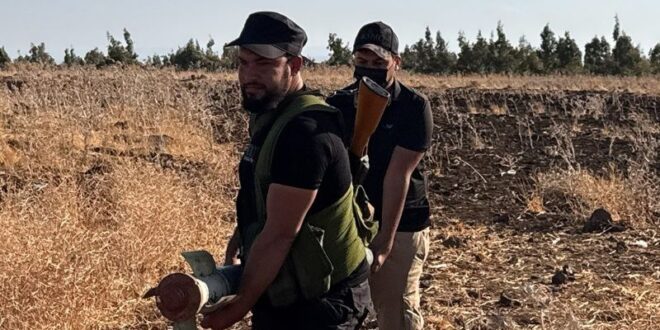
Damascus overthrew a cell that it said belonged to the Lebanese Hezbollah in southern Syria, specifically in the Yarmouk Basin, a strategic triangle adjacent to the Israeli presence, which is constantly witnessing an Israeli incursion, accompanied by repeated arrest campaigns against the people of the region, since the first moments of the fall of the former Syrian regime, on December 8, 2024.
In parallel, media outlets are talking about talks and meetings with the Lebanese party, which was the most prominent supporter of the former regime in its war against opposition factions, accused of committing violations against Syrians during the years of the Syrian revolution.
Amid these data, questions are raised about the nature of the Syrian government’s relationship with Hezbollah and the latter’s activity in the areas of southern Syria, specifically in the governorates of Daraa and Quneitra, on the line of contact with Israel, despite its denial of this activity, and the entry of the so-called “Islamic Resistance Front in Syria” (Oli al-Bass) on the line in this file.
Cell for ‘destabilization’
On September 29, the Syrian Internal Security Forces said they had foiled what they called a “sabotage plot” in the Yarmouk basin, west of Daraa, and arrested three people it said were linked to Hezbollah and aimed at “destabilizing security and stability.”
The Yarmouk Basin is located in the western countryside of Daraa, near the disengagement line with Israel, and the area is considered to be of security sensitivity because of its proximity to the occupied Golan and the Jordanian border.
The Syrian security pointed out that the operation was carried out in cooperation with the General Intelligence Service, after monitoring the cell’s attempt to equip the rocket launchers it later dismantled, but did not disclose additional details about their identities except by referring to the initials of their names.
Authorities also did not specify how many rocket launchers were found.
“Exploitation with the aim of recruitment”
That was not the only incident in which Hezbollah was accused of creating security tensions, both towards Israel and towards Syria, to strike government or civilian targets.
Because of the nature of the party, its relationship with the former regime, and its long war with the party that is in power now, doubts revolve seriously about Hezbollah’s involvement in these operations, and its attempt to “destabilize the matter and stability,” as the government says, or to achieve more distant goals, by striking Israel from inside Syrian territory, which creates confusion in the region and confuses political cards.
The researcher and historian residing in the countryside of Aleppo, Dr. Ayman al-Tamimi, believes that there is a possibility of Hezbollah recruiting elements in the western countryside of Daraa, after the regime’s control in 2018 and beyond, who may be supporters of the so-called “axis of resistance” and who are still in contact with it even after the fall of the regime.
In his vision, Tamimi is based on his communication with and knowledge of the people in the region, pointing out that the trend towards supporting Hezbollah is very low, and is generally rejected by most people in the Yarmouk basin.
I am not surprised if Hezbollah tries to take advantage of the discomfort of a segment of the people in the Yarmouk Basin area with the ongoing Israeli incursions, and not to find a solution to this problem, and not to withdraw Israeli forces, or to reach an agreement between the Syrian government and Israeli forces for the withdrawal of these forces.

dr. Ayman Tamimi

Researcher and historian
According to Tamimi, Hezbollah may exploit relations with a few people in the region in order to form a cell and target Israeli forces in the region, while the Syrian government prefers to reach a diplomatic solution with the Israeli side.
Hezbollah denies
Hezbollah responded to Damascus’ accusations of “categorical” denials of any security or military activity inside Syrian territory.
He called on the Syrian government to “alert” what he described as attempts to “put in the name of Hezbollah” in order to raise tension between Lebanon and Syria, adding that the “real beneficiary” of fueling tension between the two countries is Israel.
Hezbollah’s denials are repeated after every accusation that Damascus is making to link the group to networks and cells operating inside Syria, and carrying out combat-oriented operations.
Al-Tamimi commented on the denial of disbelief, stressing that the party has already tried to recruit some Syrians, pointing out that there are relations between Hezbollah and expatriate Syrians in Lebanon.
‘Ole’s a stubborn ‘sneering
In exchange for Hezbollah’s denial of its relationship with the cell that Damascus announced its dismantling, the “first of the people” came out with a statement hinting that the detainees are supporters of the “resistance” against Israel, in a way that suggests that they are its members.
The “first of the strong” said in a statement that the arrest of the cell, according to its account, is part of a security campaign targeting its members and supporters in southern Syria.
The group did not directly state in the statement that the three people who were arrested by the authorities belonged to it, nor did it provide details of their identities or directly deny their association with Hezbollah.
The statement described the security operation as a “systematic security attack” and accused the Syrian authorities of trying to attach “internal dependency charges” to the detainees, and considered that the detainees are “elite resistance fighters,” as he put it.
At the end of its statement, the Front called on its supporters in southern Syria to follow security measures that included restricting unnecessary movement and emptying homes of “any justifications” that the security services may exploit in arrests.
According to a previous report by Enab Baladi, the “first of the people” adopted operations that were not carried out in southern Syria, including resistance to Israeli incursions, which raises doubts about the reality of its presence on the ground.
According to the estimate of the researcher and historian, Tamimi, the activity of “Ole Al-Bass” is limited to the Internet, more than the ground, likely to adopt operations that have not been carried out.
He said that the “first of the people” is trying to portray itself as representing all the components in Syria and exaggerating support for the so-called “axis of resistance.”
The “first of the bass” appeared as a group on the “Telegram” application in January 2025, and shows its literature and the design of the logo it adopts as a succession of Iran and the so-called “axis of resistance.”
On the other hand, the group denies receiving any funding from Iran or its associated groups in the region, despite its similarity with them in slogans, statements, and even the quality of the goals.
Damascus meeting – Hezbollah. Exile is present
In contrast to these accusations, and doubts about Hezbollah’s implementation of military activities inside Syria, media outlets spoke of unannounced meetings between Damascus and Hezbollah, despite the Syrian government’s denials.
Six sources familiar with the matter said Syrian government and Hezbollah representatives held direct and secret talks in Turkey in September in an attempt to ease tensions between the two sides.
The meeting, according to Reuters, came directly, hosted by Turkey, and the talks focused on resolving the points of tension and security concerns common between the two parties, and went well.
A Lebanese source told Reuters that communication between the two sides through Ankara began about two months before the September meeting, while the agency did not confirm the venue of the meeting inside Turkey or its duration, nor was it able to ascertain whether other meetings were held before or after the meeting.
On the other hand, both Damascus and Ankara denied that meeting that brought the Syrian government together with Hezbollah and called it “alleged.”
What’s the future of the relationship?
The denial of Damascus and Ankara to the meeting does not negate that there is an intention to approach or normalize relations, and this is indicated by the wording of the speech of both the Syrian President, Ahmed al-Shara, or the Secretary-General of Hezbollah, Naim Qassem, in front of the media or in official statements.
Questions are raised about the future of the relationship between the two sides, the possibility of rapprochement or reaching normalization and ending 14 years of armed clash, which was punctuated by victims and destruction of cities and towns.
Al-Tamimi is unlikely that the two sides will reach an agreement or improve relations unless Hezbollah apologizes for what it did in Syria from military intervention, assisting the former regime in its military operations, displacing Syrians from some areas, and the sieges imposed on Syrian cities and towns, such as Zabadani and Madaya.
Tamimi pointed out that some areas of Syria, which were incubators of Hezbollah, such as the towns of Nubul and Zahra in the northern countryside of Aleppo, are in peace with the Syrian state, pointing out that these areas are free of any references to the link with the party, despite the presence of sympathizers with the “axis of resistance.”
I do not imagine that there is a rapprochement between the two parties unless Hezbollah admits its crimes and violations committed in Syria.

dr. Ayman Tamimi

Researcher and historian
On the same level, the language of media communication between the two sides was not fierce, as the fierce battles that were going on between them during the years of the revolution.
Al-Sharaa told Al-Mashhad TV in June that Damascus is ready to sit down with Hezbollah if it is in the interest of Syria and Lebanon.
The comments came at a time when the US administration was offering a potential role for Syria in dealing with the party’s file.
The general secretary of the Lebanese party, Qassem, also expressed Hezbollah’s openness to dialogue with Damascus and linked it to “right time.”