 Eurasia Press & News
Amid an atmosphere of ambiguity and the absence of a clear institutional framework, the implementation of the terms of the agreement between the Syrian government and the Syrian Democratic Forces (SDF) will begin tomorrow, Monday, February 2.
Despite the announcement of the start of procedural steps, the past hours witnessed an escalation in the intensity of conflicting statements between the two parties on the executive mechanisms, which revealed a gap in understanding the essence of the agreement and its administrative and security applications.
Deadline: Between “Decisive” and “Open”
The first points of disagreement appear in the “timeline,” with the Syrian government providing a crucial and time-bound narrative.
The Syrian Minister of Information announced that the agreement is nothing but a “road map” to build on the understandings of January 18.
According to the official version, the parties were given one month to fully implement, with a ceiling of ten days to receive strategic facilities, including the “Rumailan” and “Swedish” oil fields, and Qamishli airport.
On the other hand, the novel “Autonomous Administration” was different, as the Kurdish official Fawza Youssef, in a statement to the channel “Ronahi”, that “there is no specific deadline” for the implementation of the agreement.
This contradiction puts the field in front of two visions: a government vision that accelerates the consolidation of sovereignty, and a vision from the SDF that treats the agreement as an open and subject path to developments.
The Conflict of Appointments: “Candidates” or “Appointed”?
The contradictions have moved from the field to the corridors of official institutions, with leaks of names of candidates for senior positions in the structure of the Syrian state.
Media sources close to the SDF are talking about names that have already been “appointed”, while Damascus insists on calling them “candidates.”
In an interview with Enab Baladi, a source in the Syrian government confirmed some of the names in circulation, but stressed that they are still in the nomination stage by the SDF, and no decision has been issued to appoint them yet, likely the issuance of official appointments in the coming hours.
The list of nominations includes Noureddine Issa, former public relations officer in the SDF, for the post of governor of Al-Hasakah, Gia Kobani for the post of assistant minister of defense, and Redor Khalil for the post of assistant minister of the interior, in addition to the nomination of Sayamand Afrin as deputy director of public security in the province of Al-Hasakah.
This disparity in the characterization of the legal status reflects an undeclared conflict over who has the decision to appoint, between Qamishli and Damascus.
Security management: full sovereignty or symbolic “squares”?
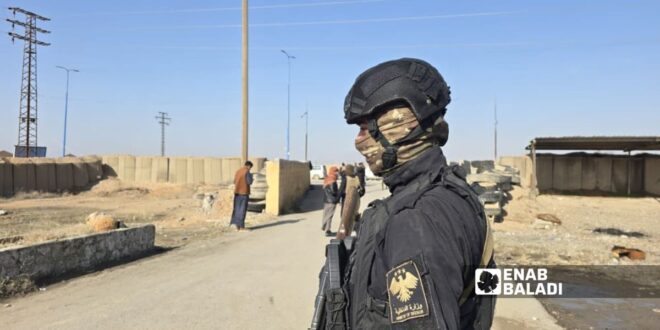
The entry of the Syrian government’s internal security forces into the cities of Hasaka and Qamishli is one of the most controversial terms of the agreement.
While Damascus is talking about a comprehensive security plan that will fully manage the security file, the SDF describes this entry as limited, symbolic and temporary, and aims to facilitate the integration of its elements into the structure of the Ministry of Interior.
Fawza Youssef said that government elements will be stationed in specific areas, similar to the “security boxes” model, with the Asayish forces (the internal security forces of the SDF) remaining in their current positions.
The dispute extends to the definition of “local security,” while the Syrian government appointed Marwan al-Ali as director of Hasaka security by a direct decision, the SDF believes that managing the file must remain in the hands of local forces, which explains the nomination of Siamand Afrin as deputy director of public security.
Wealth and crossings. Files pending
The gap also appears in the resource file, as Damascus confirms that it is near receiving the oil facilities, while the official in the SDF, Ilham Ahmed, said in a press conference on the application of “Zoom” that all aspects of security and control in the areas of influence of the “SDF” will remain under its management at the current stage, to be later integrated into the Syrian institutions with mechanisms that have not yet been discussed.
Ahmed pointed out that sovereign files, including the Qamishli crossing (Nusaibin) with Turkey, have not yet been resolved, in contradiction to the “decisive” speech promoted by state media in Damascus.
The “Mixed Zones” Dilemma and the Integration Mechanism
The agreement stipulated that local forces would manage security in Kurdish-majority areas, but did not determine the fate of Arab or Christian-majority villages and towns, such as Tal Tamr.
This ambiguity gives the Syrian government a margin for the employment of local forces loyal to it, in exchange for the SDF’s quest to maintain its influence under the name of “local forces.”
Militarily, the Syrian government insists on integrating SDF fighters individually into three military brigades, which means dismantling its command structure.
On the other hand, the statements of SDF officials indicate a preference for integration in the form of existing blocs or institutions, which explains the nomination of a leader such as Gia Kobani for the post of Assistant Minister of Defense, to ensure that this structure is represented within the military establishment.
In the end, the agreement enters into force without a unified mechanism for interpretation and implementation, what Damascus considers a restoration of sovereignty with centralized decisions, which the SDF sees as an institutional partnership on negotiating terms, while the field remains open to additional rounds of tension and attraction.