 Eurasia Press & News
Toplines
Workers’ Party of Korea (WPK) General Secretary Kim Jong Un likely intends for his daughter, Kim Ju Ae, to succeed him, according to the South Korean National Intelligence Service (NIS). The NIS assessed that the WPK may give Kim Ju Ae, who is roughly 13 years old, an official title at the upcoming 9th Party Congress.[1] The WPK first secretary position, which is the de facto number two post, has been empty since Kim established it at the 8th Party Congress. South Korean lawmaker Lee Seong-known separately said on February 12 that the NIS seen indicators that Kim Ju Ae is “expressing opinions on policy matters,” reflecting her growing involvement in state affairs.[2]
Kim Ju Ae has become an increasingly public figure since first appearing in November 2022. Kim Ju Ae publicly appeared 10 times in 2023, 12 times in 2024, and 15 times in 2025, according to the Asan Institute for Policy Studies.[3] Japanese media separately suggested in November 2025 that Kim Ju Ae had appeared publicly over 600 times since November 2022 based on facial recognition analysis.[4] The scope of her public activities expanded from participation in military and economic events to political and foreign relations events in 2025. North Korean state media often displays her alongside her father, Kim Jong Un, including when she stood between him and her mother, Ri Sol Ju, at the Kumsusan Palace of the Sun on January 1, 2026. The palace holds special political significance in North Korea because it houses the bodies of former leaders Kim Il Sung and Kim Jong Il.
ISW-CDOT previously assessed that the Kim regime is preparing Kim Ju Ae for succession.[5] Kim Jong Un may be formalizing the succession early to avoid political instability in the years ahead.
Around 8,000 North Korean troops remain deployed around Kursk Oblast, Russia, and have performed fire support functions under Russian command, according to Ukrainian military intelligence. This gives Pyongyang valuable military experience and continues to strengthen its alliance with Moscow. Ukraine’s military intelligence agency, the GUR, stated on February 4 that North Korean troops based in Kursk Oblast have fired artillery, including with multiple launch rocket systems (MLRS), into Ukraine.[6] The North Korean troops have also conducted aerial reconnaissance to adjust artillery fire. North Korea initially deployed 11-12,000 troops to Kursk Oblast in October 2024 in order to help Russia repel a Ukrainian incursion into the territory. North Korean troops fought on the frontlines of that operation and took heavy casualties of around 2,000 killed and 4,000-5,000 wounded, according to South Korean and Ukrainian intelligence.[7] The GUR stated that North Korea has continued to deploy both combat troops and de-mining engineers to Kursk Oblast on a rotating basis based on agreements with Russia.[8] The troops have apparently transitioned to a fire support role in Russian operations but continue to gain modern combat experience that North Korea will try to integrate into its military training. The GUR estimated that around 3,000 North Korean troops have returned to North Korea to share their experiences for training purposes.
Deputy chairman of the Ukrainian parliament’s Committee on National Security, Defense and Intelligence, Yehor Cherniev, said on February 10 that North Korea’s provision of munitions to Russia constitutes a much larger threat to Ukraine than the deployment of North Korean troops.[9] North Korea became a major supplier of munitions to Russia around 2023 and has recently provided between 35 and 70 percent of Russia’s artillery shells and ballistic missiles each month, according to Ukrainian estimates from late 2025.[10] Ukrainian sources also reported in February 2025 that the accuracy of North Korean ballistic missiles had dramatically improved since North Korea entered the war, suggesting that North Korea was receiving some technical benefit from supporting Russia.[11] The North Korean involvement in fire support operations around Kursk Oblast could similarly help North Korea improve its artillery operations.
Russia is opposing South Korean efforts to build nuclear submarines, despite Russia reportedly enabling North Korea to develop the same capability. Russian Ambassador to South Korea Georgy Zinoviev said on February 9 that South Korean efforts to acquire enriched uranium from the United States to build Seoul’s first nuclear-powered submarine could violate the Treaty on the Non-Proliferation of Nuclear Weapons (NPT).[12] Zinoviev said that Russia supports “broad international discussions” under the framework of the International Atomic Energy Agency (IAEA) regarding verification activities related to nuclear materials used in submarine reactors.[13] US President Donald Trump agreed to support the South Korean development of nuclear submarines, civilian uranium enrichment, and spent fuel reprocessing during his summit with South Korean President Lee Jae Myung in October 2025.[14] Zinoviev said that it is too early to predict whether the US-South Korean nuclear submarine plan will violate the NPT, however, because the United States has only given general approval for the plan and has not publicized specific details.
Zinoviev’s warnings about US-South Korean nuclear submarine cooperation follow reports that Moscow may have transferred nuclear reactor technology to North Korea. South Korean intelligence reported in September 2025 that Russia supplied North Korea with two or three submarine propulsion systems, potentially including an operational nuclear reactor, steam turbines, and cooling systems.[15] Spanish media reported on January 16 that the Ursa Major — a ship owned by the sole transport provider for Russia’s Ministry of Defense — was transporting coolant and steam piping components for two Russian VM-4SG nuclear reactors to Rason, North Korea, when it sank off Spain’s southeastern coast in December 2024.[16] North Korea has been developing submarine-launched ballistic missiles (SLBM) as a key component of its nuclear force since 2021 but currently lacks a large enough submarine to carry them. North Korea has allegedly begun developing a nuclear-powered ballistic missile submarine with a displacement of 5,000 to 8,000 tons.[17] South Korea’s pursuit of nuclear submarines is meant to offset capability gaps with North Korea, potentially driven by Russian assistance to Pyongyang.
Key Takeaways
North Korean succession: WPK General Secretary Kim Jong Un likely intends for his daughter Kim Ju Ae, who is roughly 13 years old, to succeed him, according to the South Korean NIS. His daughter has become an increasingly public figure in recent years.
North Korea-Russia cooperation: Around 8,000 North Korean troops remain deployed around Kursk Oblast, Russia, and have performed fire support functions under Russian command, according to Ukrainian military intelligence.
Korean Peninsula nuclear issues: Russia is opposing South Korean efforts to build nuclear submarines despite reportedly enabling North Korea to develop the same capability.
North Korean Domestic Politics
see topline
North Korean Military Developments
WPK General Secretary Kim Jong Un announced his intentions for further “transformation” of the military in 2026 during a visit to North Korea’s Ministry of National Defense marking the Korean People’s Army’s (KPA) 78th founding anniversary on February 9. Kim stated that 2026 would be “a year of transformation” and that the KPA’s fighting front must “widen further.”[18] Kim added that North Korea’s military capabilities would be “enhanced” over the next five years based on decisions to be announced at the 9th Party Congress.[19] Kim also praised North Korean troops participating in Russia’s war against Ukraine.[20] Kim did not mention the United States or South Korea, unlike his KPA anniversary speeches in 2024 and 2025.[21]
North Korea will very likely intensify efforts to modernize its military during the 2026–2030 defense cycle, pursuing a revisionist objective of expanding its international standing through strengthened nuclear deterrence and expanded foreign military cooperation. The US-based Stimson Center assessed that, of the 13 nuclear and conventional missile systems that North Korea designated as development targets at the 8th Party Congress in 2021, North Korea has operationally deployed four of them and two more may be operational as of 2026.[22] North Korea has expanded efforts to diversify its strike options, aiming to improve survivability and accuracy, including through the development of a nuclear-powered ballistic missile submarine capable of deploying nuclear-armed submarine-launched ballistic missiles (SLBM) between 2016 and 2025.[23]
North Korea’s military modernization could increase its confidence and leverage in relations with foreign powers, such as the United States, by increasing the credibility of Pyongyang’s threats and risks of military action against North Korea. Kim Jong Un has demanded that Washington abandon goals of denuclearizing the regime as a precondition for dialogue while dismissing South Korea’s proposal for inter-Korean cooperation.[24] North Korea’s cooperation with Russia and the PRC also increases its leverage by blunting the effects of sanctions and strengthening its military. Kim Jong Un’s increased confidence may lead him to pursue more confrontational actions toward South Korea during the 9th Party Congress, such as codifying laws to redefine maritime boundaries over the Northern Limit Line.[25] Kim Jong Un is likely to increase pressure on Washington to accept dialogue terms by broadcasting North Korea’s nuclear capabilities and expanding military cooperation with anti-US states.
North Korean Foreign Relations
Russian Foreign Affairs Minister Sergei Lavrov said that Russia will veto any new sanctions on North Korea in the UN Security Council and continues to oppose discussions of North Korean denuclearization. Russia has worked to counter North Korea’s international isolation and accepted Pyongyang’s nuclear weapons program since North Korea became an essential backer for Russia’s invasion of Ukraine. Lavrov said on February 11 during a question-and-answer session at Russia’s State Duma that Russia will block any further UN Security Council sanctions resolutions on North Korea.[26] He said that it is “unrealistic” to expect that the United Nations would pass a resolution to lift sanctions on North Korea, however, suggesting that Russia might otherwise support such a resolution. Lavrov also said that discussing denuclearization of North Korea is unreasonable and “disrespectful” to North Korea while South Korea, the United States, and Japan are strengthening their military cooperation, “including nuclear elements.”
Russia has reversed its opposition to North Korea’s nuclear program since 2022 and emerged as North Korea’s staunchest international defender. Russia previously participated in the Six Party Talks from 2003-2007 to negotiate denuclearization of North Korea and voted in favor of 10 UN sanction packages on North Korea from 2006–2017.[27] It changed its stance after North Korea became a key supporter of Russia’s full-scale invasion of Ukraine in 2022, however. Russia vetoed the extension of the UN Panel of Experts that monitored international compliance with UN sanctions on North Korea in March 2024, effectively ending UN sanctions monitoring.[28] Lavrov later said in September 2024 that Russia recognizes that nuclear weapons are key to North Korea’s security and considers denuclearization a “closed issue.”[29] Russia also began to rhetorically oppose sanctions on North Korea and increased its economic, military, and technological cooperation with Pyongyang in violation of sanctions.[30] The two countries signed a mutual defense agreement in June 2024, months before North Korea deployed 11-12,000 troops to Russia’s Kursk Oblast to fight a Ukrainian incursion into the region.[31]
Russian support for North Korea has greatly strengthened Pyongyang’s negotiating leverage against South Korea and its allies, boosted funding and technical support for North Korea’s military development, including ballistic missiles and submarines, and emboldened North Korea to act more aggressively.[32] The PRC has also tacitly accepted North Korea’s nuclear power status by abstaining from the vote to extend the Panel of Experts in 2024, rhetorically opposing “blindly” sanctioning North Korea, and ceasing to mention denuclearization as an issue in meetings concerning North Korea.[33] North Korea likely sees its alliances with Russia and the PRC as a path to sustain its economy and to mitigate its international isolation.
Russian data showed that an all-time high of nearly 10,000 Russians traveled to North Korea in 2025, reflecting a surge in tourism and delegation visits. North Korea has used increased economic exchanges with Russia to raise money for the regime, including for military and nuclear weapons development. Russian media reported on February 9 that 9,985 Russian nationals entered North Korea in 2025, according to statistics from the border agency of Russia’s Federal Security Service (FSB).[34] This is the highest annual total since Russia began tracking the statistics in 2010. Around 5,000 of the entries were for tourism, more than twice the 1,957 in 2024 when North Korea began allowing Russian tourists for the first time since the COVID-19 pandemic. The statistics listed 3,080 entries for “vehicle maintenance” and 1,156 entries for business travel, which likely included government delegations.[35] Russian travel to North Korea will likely increase further in 2026 as bilateral relations deepen and the two countries complete their first cross-border road bridge.[36]
The volume of North Korean travel to Russia in 2025 likely far exceeded Russian travel to North Korea, though neither side provided statistics on that number. Russia reported 13,220 North Korean entries in 2024, and South Korean intelligence estimated that North Korea sent “tens of thousands” of workers, possibly as many as 50,000, to Russia in 2025.[37] This number does not include soldiers deployed to Russia’s Kursk region. The workers help Russia fill a severe labor shortage caused by the war in Ukraine, while earning money for the North Korean regime.
Russia-North Korea exchanges have increased substantially since Russia’s 2022 invasion of Ukraine. Russia and North Korea have dramatically increased trade, diplomatic engagement, technology transfer, and other exchanges. North Korea sent tens of thousands of workers to Russia each year and collected their earnings to fund the government before 2019, but the UN banned member states from accepting North Korean workers in 2019 to stymie funding for Pyongyang’s nuclear program.[38] North Korean labor in Russia appears to have rebounded to pre-2019 levels in 2024 or 2025, however, due to both countries’ flouting of UN sanctions. North Korea uses money it earns from exchanges with Russia, including tourism and worker remittances, to fund military development and other priorities in contravention of international sanctions.[39]
North Korean Influence Operations
Nothing significant to report.
Inter-Korean Relations
The South Korean Ministry of Unification (MOU) is considering lifting the “May 24 Measures,” a set of unilateral sanctions against North Korea passed in 2010 and reopening the Kaesong Industrial Complex, where South Korean companies could employ North Korean workers. These policies are part of the Lee Jae Myung administration’s attempts to improve relations with North Korea through unilateral concessions. Unification Minister Chung Dong-young stated on February 9 that he is considering lifting the May 24 Measures in a symbolic effort to rebuild relations with North Korea, because the measures “have lost their effectiveness and have remained meaningless.”[40] South Korea passed the May 24 Measures in response to the sinking of the ROKS Cheonan sinking in 2010, which South Korean investigators determined was due to a North Korean torpedo strike.[41] The measures banned South Koreans from visiting or starting business investments in North Korea, suspended inter-Korean trade and aid projects, and prohibited North Korean ships from sailing in South Korean waters.[42] UN sanctions on North Korea imposed many similar restrictions, so the May 24 Measures were mostly symbolic. The South Korean government publicly considered removing the May 24 Measures in 2018, but later backtracked.[43]
The MOU also announced on February 10 that it seeks to restore economic exchanges with North Korea by reopening the Kaesong Industrial Complex (KIC)—an inter-Korean manufacturing complex where South Korean companies operated factories in North Korea.[44] The MOU expressed regret at “our unilateral decision to completely shut down the complex” ten years ago and made no mention of the North Korean missile tests that prompted then-South Korean President Park Geun-hye to shut down the KIC.[45]
The Lee Jae Myung administration’s MOU is pursuing a policy of “peaceful coexistence,” rather than unification, to reduce tensions and improve relations with North Korea.[46] The administration has shifted away from pressure campaigns, such as suspending propaganda loudspeaker broadcasts and cracking down on pamphlet drops in North Korea, in favor of restoring inter-Korea dialogue. North Korea continues to reject or ignore South Korea’s attempts to open dialogue, however.
South Korean Domestic Politics
South Korea’s opposition People Power Party (PPP) has increased criticism of the Lee Jae Myung administration’s dialogue-focused North Korea policy. The Lee administration’s strong approval ratings weaken PPP’s political leverage to force a policy shift, however. PPP legislator Park Chung-kwon, on February 9, criticized the South Korean military’s readiness posture under the Lee administration, stating during a National Assembly questioning session with Prime Minister Kim Min-seok that the government is “tending to Kim Jong Un’s mood.”[47] Prime Minister Kim called the statement “an insult to the armed forces” and Defense Minister Ahn Gyu-back urged Park to issue an apology.[48] The ruling Democratic Party (DP) is reviewing whether to request the PPP for Park’s expulsion.[49] PPP Senior Deputy Floor Leader for Policy, Kim Eun-hye, said on February 10 that the administration should maintain deterrence and provide clearer explanations to the public regarding its security policy toward North Korea.[50]
PPP criticism comes as the Lee administration has focused efforts on re-engaging with North Korea. North Korea severed communications with South Korea in 2020, and the Lee administration has sought to restore dialogue by adopting a series of confidence-building measures since taking office in June 2025. Lee removed South Korea’s propaganda loudspeakers near the inter-Korean border in June 2025; halted civilian-led propaganda leaflet distribution to North Korea in July 2025; and suspended the annual publication of the MOU’s North Korean human rights report in 2025.[51] The administration is also reviewing plans to resume inter-Korean economic exchanges, including tourism, the Kaesong Industrial Complex, and the potential import of North Korean food products.[52]
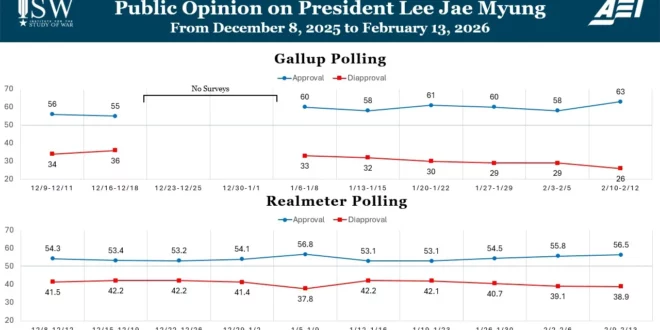
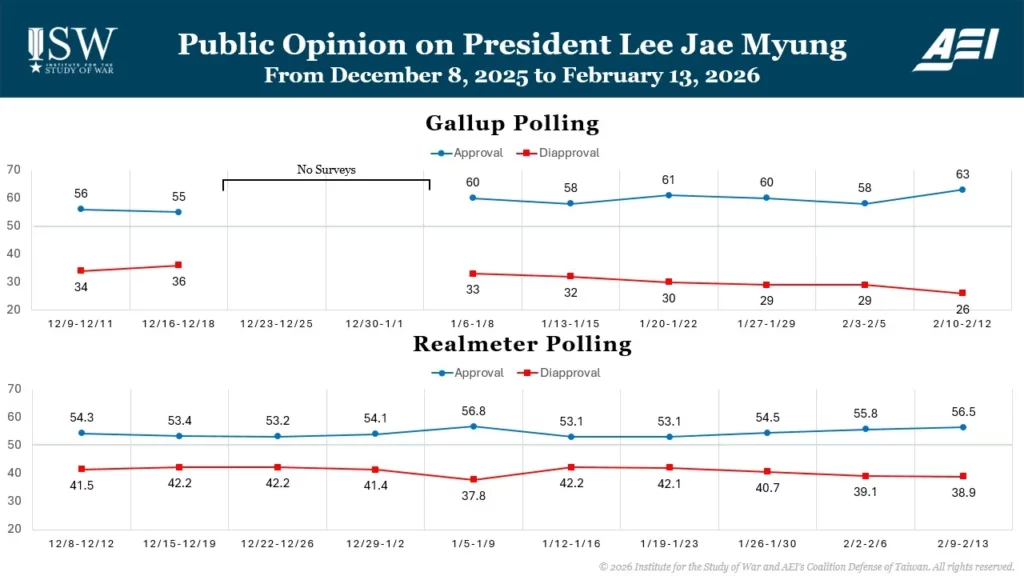
PPP pressure is unlikely to produce a policy shift by the Lee administration, however. Gallup surveys show that Lee’s public approval rating has remained stable in the 54-63 percent range over the past six months.[53] Only two percent of respondents who disapproved of Lee’s job performance cited national defense and security as the main reason for their disapproval, according to survey data released on February 6.[54] The DP also appears more popular than the PPP, which has faced sustained losses of support following former President Yoon Suk-yeol’s impeachment over a failed attempt to declare martial law in December 2024.[55] DP candidates are likely to secure more seats in the upcoming June 3 local elections.[56] The Lee administration’s dual-track approach of strengthening national defense by recovering wartime operational control from the United States while pursuing dialogue with North Korea may mitigate public perceptions that its North Korean policy is weakening South Korea’s military posture.
The South Korean Fourth Criminal Division of the Incheon District Court sentenced a South Korean to six months in prison with a two-year suspended sentence for working as the secretary of “Wangjaesan,” an underground spy organization under orders from North Korea. South Korean prosecutors first indicted the unnamed individual in May 2013 for possessing approximately 130 subversive materials containing Juche, the political ideology of North Korea developed by Kim Il Sung and Kim Jong Il.[57] The individual also belonged to a vanguard organization of Wangjaesan that worked with the pan-Korean reunification group “Beomminryeon” (disbanded in 2024) and taught Juche ideology to its members. [58] The court on February 9 sentenced the individual to six months in prison for violating the National Security Act through the “distribution and possession of material expressing sympathy for treason.”[59] South Korean authorities discovered Wangjaesan’s existence in 2011 and found that the organization received orders from North Korea’s anti-South Korean espionage department, Bureau 225.[60] The Supreme Court upheld prison sentences of Wangjaesan members convicted for relaying information on domestic political trends to North Korean agents and distributing subversive material in July 2013 but acquitted them of organizing the anti-state organization Wangjaesan due to insufficient evidence.[61]
The individual’s sentencing trial was suspended until 12 years after their conviction because the relevant articles of the National Security Act were facing constitutional challenges.[62] The trial resumed after the Supreme Court ruled in 2023 that laws banning the possession of pro-enemy materials were constitutional and did not unduly violate freedom of expression.[63] The case establishes precedent for prosecuting possession of North Korean ideological materials without further constitutional review and reinforces the Act’s use against pro-North Korean activity.
South Korean President Lee Jae Myung saw an increase in his approval ratings in public opinion polls conducted between February 9 and 13, as respondents cited tougher multi-homeowner tax enforcement and strong economic indicators. A Gallup Korea survey conducted from February 10 to 12 found that 63 percent of respondents rated Lee’s job performance positively, compared with 26 percent who rated it negatively.[64] Lee’s approval rating increased by 5 points from the previous week, while the disapproval rating declined by 3 points. Economic policy, real estate issues, and foreign policy were the leading rationale for positive and negative responses, reflecting deep polarization within the South Korean public. A separate survey by Realmeter, conducted between February 9 and 13, recorded Lee’s approval rating at 56.5 percent and disapproval rating at 38.9 percent.[65] Lee’s approval rating increased by 0.7 percentage points and disapproval rating declined by 0.2 percentage points from the previous week. Respondents attributed the uptick in support to tougher tax enforcement on multi-homeowners and positive economic indicators, including the Korea Composite Stock Price Index (KOSPI) surpassing 5,500 points.
Counter-North Korean Coalition Building Efforts
US Senate Democrats are urging US President Donald Trump to maintain strict nonproliferation safeguards as South Korea seeks uranium enrichment capabilities for nuclear-powered submarines. US Senators Chris Van Hollen (D-MD), Ron Wyden (D-OR), and co-chairs of the Nuclear Weapons and Arms Control Working Group, Senators Edward J. Markey (D-MA) and Jeff Merkley (D-OR), on January 30, urged Trump to incorporate nonproliferation safeguards into any revised nuclear cooperation agreement with South Korea.[66] The senators wrote in a letter to Trump that providing South Korea with latent nuclear capabilities could undermine US nonproliferation objectives and emphasized the need to apply the strongest “gold standard” provisions to prohibit uranium enrichment and reprocessing.[67]
The letter follows a joint fact sheet that the White House issued after Trump’s October 29 summit with South Korean President Lee Jae Myung, which expressed support for South Korea’s uranium enrichment and fuel reprocessing for peaceful purposes.[68] The United States and South Korea also agreed during the summit to collaborate on developing a nuclear-powered attack submarine. The submarine development would require enrichment and reprocessing capabilities. South Korea cannot pursue uranium enrichment or reprocessing without US consent under the 2015 United States-South Korea Nuclear Cooperation Agreement (123 Agreement), however.[69] The Lee administration has therefore called for US congressional support for revising the agreement.[70]
South Korea’s interest in developing a nuclear-powered attack submarine reflects capability gaps in countering North Korea’s evolving submarine-based nuclear threat. North Korea is developing a nuclear-powered ballistic missile submarine that may be capable of launching nuclear-armed ballistic missiles.[71] Acquisition of a nuclear-powered submarine would enhance the South Korean Navy’s ability to control key maritime chokepoints and track adversarial submarines.[72] The United States and South Korea plan to hold working-level discussions on uranium enrichment and submarine issues in February or March.[73] Any revision or renegotiation of the bilateral 123 agreement by the executive branch could face congressional scrutiny under the Atomic Energy Act.[74] Congress may block a revised 123 agreement through a joint resolution of disapproval passed by both the House and Senate. The Republican Party currently controls both chambers and could thus allow a revised 123 Agreement for the nuclear submarine cooperation, at least until the November 2026 midterm elections.