 Eurasia Press & News
The Tehran regime’s octopus may have lost its head, but its tentacles still grip the country and the region.
The joint military campaign by the United States and Israel launched on February 28 has not only targeted the regime’s ballistic missile program and military installations. It has also eliminated many within the Islamic Republic’s political leadership. At its center was the now deceased Supreme Leader Ali Khamenei, whose 37-year reign of terror ended on the first day of Operation Epic Fury when he was eliminated in his compound alongside other senior political and military leaders.
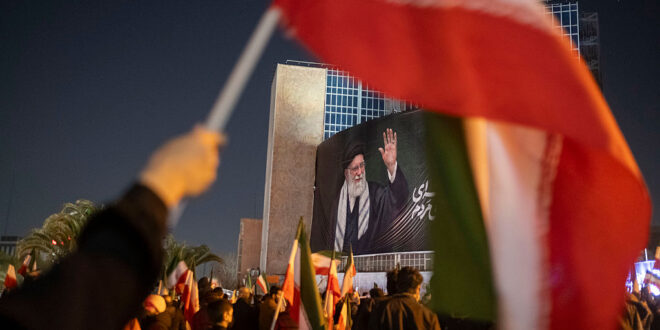
Iranians inside the country and across the diaspora marked the tyrant’s death with open celebration. As the news spread, chants echoed from rooftops as crowds poured into the streets, dancing, setting off fireworks, and waving the flags of ancient Persian dynasties.
But the theocrats in charge haven’t given up just yet. The remnant of the regime’s leadership, has now established an interim Leadership Council comprising President Masoud Pezeshkian, Judiciary Chief Gholamhossein Mohseni Ejei, and Guardian Council cleric Alireza Arafi, who was selected by the Expediency Discernment Council to serve as the council’s third member.
Managing the Supreme Leader Succession
Article 111 of the Islamic Republic’s Constitution determines that in the event of the Supreme Leader’s death, resignation, or removal, a three-member council composed of the president, the head of the judiciary, and a cleric from the Guardian Council assumes the leader’s powers temporarily until the Assembly of Experts appoints a successor.
The Assembly of Experts, an 88-member clerical body elected by the public, is constitutionally empowered to appoint and dismiss the Supreme Leader. However, all candidates for the Assembly must first be vetted by the 12-member Guardian Council, whose six clerics are directly appointed by the Supreme Leader and whose six jurists are approved by parliament after nomination by the judiciary chief. The Expediency Discernment Council, an unelected body whose members are appointed by the Supreme Leader, serves as an elite arbitration and advisory forum. It often plays an influential behind-the-scenes role in resolving institutional disputes and shaping consensus during leadership transitions.
Attacks Against Regime’s Repression Apparatus Persist
Israeli strikes hit core pillars of the regime’s repression apparatus on March 1, following Prime Minister Benjamin Netanyahu’s pledge to “create conditions that will allow the brave Iranian people to cast off the yoke of this murderous regime.” This wave targeted the paramilitary vigilante Basij base in Tehran and the Islamic Revolutionary Guard Corps’s (IRGC’s) Sarallah Headquarters, the regime’s central crisis hub which coordinates suppression commands, deploys rapid urban battalions, and conducts surveillance. Israel also struck Tehran’s Revolutionary Court, long a symbol of the legal repression against political dissidents.
The current campaign’s focus on dismantling the Islamic Republic’s ability to crush protests mirrors Israeli operations during the 12-Day War last June, when the Israeli Air Force targeted core repression nodes, including Evin Prison, Basij and IRGC bases, and the police intelligence wing responsible for surveilling activists.
Still Afloat, Regime Continues Repression
Khamenei’s death is a major rupture in Tehran’s power structure, but the Islamic Republic is not a one-man regime. It rests on parallel institutions, many armed, that must be dismantled for real change. Khamenei’s demise marks the start of that process, not the end. As long as the regime retains the capacity to kill U.S. personnel and Israeli civilians, the campaign should persist until that threat is eliminated.
Domestically, external messaging and strikes on repression infrastructure have created momentum. Many Iranians view the campaign as intervention on their behalf. Yet security units are still deploying to deter unrest. The priority now should be hyperlocal targeting of specific squads and commanders. Israel’s prior use of drones launched from inside Iran to disable air defenses offers a model that could be replicated against these repression units.