 Eurasia Press & News
“The conqueror need not be stronger than the conquered. He need only be more willing to endure.”

— Ibn Khaldun, Muqaddimah, 14th century

“No people has ever been liberated by a war it could not endure.”

— Frantz Fanon, The Wretched of the Earth, 1961

“All human beings are members of one frame, since all, at first, from the same essence came. When time afflicts a limb with pain, the other limbs cannot at rest remain. If thou feel not for other’s misery, a human being is no name for thee.”

— Sa’adi Shirazi, Bani Adam, 13th century — inscribed on a rug offered by Iran to the United Nations, New York, 2005
Prologue: The Clock That Never Started for Washington
On the morning of February 28, 2026, the United States of America and the State of Israel launched one of the most concentrated aerial campaigns in the history of modern warfare. In twelve hours, nearly 900 strikes rained down on the Islamic Republic of Iran — on its missile sites, its air defenses, its nuclear facilities, its military command centers, and on the compound where its Supreme Leader, Ali Khamenei, was assassinated along with members of his family.
Donald Trump predicted it would be over in “two or three days.”
Twenty-four days later, the Strait of Hormuz is still closed. Oil is above one hundred dollars a barrel. The global economy stands at the edge of recession. The International Energy Agency has declared the situation worse than the two oil crises of the 1970s combined. The Islamic Republic of Iran — battered, wounded, its navy decimated, its leaders assassinated, its nuclear installations struck three times — is still governing, still fighting, and still dictating the terms of every international conversation.
On March 22, Trump issued a 48-hour ultimatum in capital letters on Truth Social: reopen the Strait or face the obliteration of Iran’s power plants. Iran responded by threatening to mine the entire Persian Gulf and strike every energy installation in the region. Twelve hours before his own deadline expired, Trump announced that the United States and Iran had held “VERY GOOD AND PRODUCTIVE CONVERSATIONS” and that strikes were postponed for five days.
Iran’s parliament speaker, Mohammad Bagher Ghalibaf, responded the same hour: “No negotiations have been held with the US. Fake news is being used to manipulate the financial and oil markets and escape the quagmire in which the US and Israel are trapped.”
Iran’s Foreign Ministry was equally unequivocal: “There is no dialogue between Tehran and Washington. We are not the party that started this war.”
The empire launched its missiles. The civilization endured. And when the empire blinked, the civilization named it for what it was.
This is the story of why.
Part One: The Deepest Asymmetry — Seven Thousand Years Against Two Hundred and Fifty
Before America Was Born, Persia Had Already Given the World Its Rights
To understand why Iran will not collapse under American and Israeli bombardment, one must first understand what Iran is — not in the geopolitical sense measured in GDP and missile inventories, but in the civilizational sense measured in millennia.
The Iranian plateau has been continuously inhabited for approximately 7,000 years. The Elamite civilization arose there around 3200 BCE, contemporaneous with the earliest Mesopotamian city-states. By the 6th century BCE, the Achaemenid Persian Empire under Cyrus the Great had become the largest empire the world had ever seen, stretching from the Aegean Sea to the Indus Valley — encompassing modern Greece, Egypt, Turkey, Iraq, Afghanistan and Pakistan — governed not by terror but, remarkably for antiquity, by a philosophy of tolerance and pluralism without parallel in the ancient world.
In 539 BCE, after conquering Babylon without a battle — the population reportedly opened the gates willingly — Cyrus issued a decree inscribed on a baked clay cylinder in Akkadian cuneiform. That cylinder, now housed in the British Museum in London — preserved in the very civilization that today bombs Tehran — was recognized by the United Nations in 1971 as the world’s first charter of human rights. A replica stands in the lobby of the United Nations headquarters in New York. Its provisions parallel the first four articles of the Universal Declaration of Human Rights, adopted in 1948 — more than two and a half millennia after Cyrus had already enacted them.
The Cyrus Cylinder records that the King freed all slaves, declared that all people had the right to choose their own religion, established racial equality, and allowed exiled peoples to return to their homelands — including the 50,000 Jews held in Babylonian captivity, whom he freed at Persian state expense and helped fund the reconstruction of the Temple in Jerusalem. Cyrus is the only non-Jewish figure in the Hebrew Bible to be called Mashiach — the Anointed One.
This is the civilization that the United States of America — founded in 1776, 2,315 years after Cyrus issued his human rights charter — is trying to destroy from the air. This is the civilization that the State of Israel — established in 1948, when the Cyrus Cylinder was already 2,487 years old — claims the right to bomb into submission in the name of its own security.
A civilization with 7,000 years of memory does not experience a 24-day aerial campaign the way a 250-year-old nation experiences it. For Iran, this is not existential rupture. It is a chapter. A painful one, but a chapter. For the United States, which has never in its history been bombed on its own soil by a foreign power, which has never had its capital struck, its president killed, its cities reduced to rubble — this kind of war is unimaginable. For Iran, in the darkest sense, it is familiar.
Alexander the Great burned Persepolis in 330 BCE. The Mongols sacked Iran’s cities in the 13th century CE with an annihilating thoroughness estimated to have killed up to three-quarters of the population of some regions. The British engineered a coup in 1953, overthrowing the democratically elected Prime Minister Mohammad Mosaddegh because he had dared to nationalize Iranian oil — a coup documented in detail by the CIA itself and acknowledged formally by the United States government in 2013. Iraq, armed and intelligence-supplied by the United States, invaded Iran in 1980 and fought an eight-year war that killed an estimated half-million Iranians, including through chemical weapons supplied with Western intelligence cooperation.
Iran is still here. Persia has always been still here.
The Intellectual Inheritance That No Bomb Can Touch
The civilization being bombed is the civilization of Avicenna (Ibn Sina, 980–1037 CE), whose Canon of Medicine was the primary medical textbook in European universities for six centuries. It is the civilization of Al-Biruni (973–1048 CE), whose calculation of the Earth’s circumference was accurate to within one percent. Of Khayyam, who produced algebraic solutions to cubic equations while Europe was burning books. Of Hafez and Rumi, whose poetry remains among the most widely read in the world — in Persian, Arabic, English, German, Hindi and dozens of other languages. Rumi’s Masnavi has been translated into more languages than almost any literary work in history outside of religious scripture.
When the bombs fall on Tehran, they fall on the city built by the inheritors of this tradition. That tradition does not die in an airstrike. It is, if anything, summoned by it.
Malek Bennabi — the Algerian philosopher whose thought has most profoundly shaped my own intellectual formation — argued in his concept of colonisabilité that civilizations are not conquered by superior weapons alone. They are conquered when they lose the internal will to remain themselves. No such collapse is visible in Iran. The regime may be contested internally. But the civilization it governs is not.
Part Two: The Human Cost — Voices from Under the Bombs
Before the geopolitics, before the cost-exchange ratios and the strategic analysis, there are the people.
According to the NGO Human Rights Activists News Agency (HRANA), by March 17, 2026 — the 17th day of the war — 3,114 people had been killed in Iran by US-Israeli airstrikes, including 1,354 civilians and 1,138 military personnel. UNICEF reported that by March 12, more than 200 children had been killed in Iran alone, with hundreds of thousands displaced and millions unable to attend school. The Iranian Red Crescent reported over 6,668 civilian residential units targeted. A US strike on a girls’ school adjacent to a naval base in Minab killed approximately 170 people on the first day.
A Tehran journalist in her late twenties, keeping a diary shared with NPR under conditions of anonymity, wrote on the first day of the war, when Khamenei was killed: “People came to the roofs and watched and clapped when they hit a target we know. We chanted a lot last night.” She had been arrested twice at the IRGC base that was now bombed. She celebrated the strike.
But as the war entered its second week, her diary changed register. The bombs were no longer selective. The dead were no longer only those she had reason to hate.
A Xinhua correspondent based in Tehran wrote on March 3: “Missiles fell like falling stars, slicing through the darkness before detonating with a force that made the night flinch. The blasts were so violent that they seemed to split the sky at its seams.” In a taxi afterward, the driver shook his head: “Tehran used to be a peaceful city. Some thought the Americans would bring opportunity. Look at what they’ve brought — nothing but bombs.”
From the Iran-Turkey border, NPR’s Emily Feng reported on refugees crossing on foot. An Iranian man showed journalists oil stains on his jacket — residue from burning oil droplets that fell on Tehran’s neighborhoods when Israel struck fuel depots in early March. His 26-year-old cousin, who had risked his life protesting against the government in January, was among the civilians killed. “When he said that to me,” Feng reported, “he paused, like he almost couldn’t believe what he was saying out loud.”
A Tehran resident told Al Jazeera on March 21: “If the main power plants are bombed, it’s not going to be just a brief disruption; it could stop the flow of everything from water to gas. It would be foolish to just punish the population like that.”
These testimonies refuse simplification. They contain simultaneously opposition to the Islamic Republic and rejection of the bombardment. Grief and defiance and dark humor and the stubborn insistence on continuing to live. They are not the testimonies of a broken people. They are the testimonies of a people absorbing an enormous blow and remaining, defiantly, themselves. That is what 7,000 years of civilizational memory looks like from the inside.
Part Three: Fifty Years Under Siege — The Sanctions That Forged the Weapon
The Most Sanctioned Nation in Modern History
Before a single Tomahawk missile was fired on February 28, 2026, Iran had already been fighting the United States for nearly half a century — not with drones and missiles, but with its sheer capacity to survive.
The first American sanctions were imposed in November 1979. Executive Order 12170, signed by President Carter, froze approximately $8.1 billion in Iranian assets held abroad. That was forty-six years ago. Through eight consecutive American administrations — through Republican and Democratic presidencies alike, through periods of Iranian nuclear compliance and non-compliance — the sanctions regime has never fundamentally lifted. It has only expanded.
1979 — First sanctions. $8.1 billion in assets frozen. Trade embargo.
1987 — Reagan bans all Iranian goods and services from the US market.
1995 — Clinton prohibits all US trade with and investment in Iran.
1996 — Congress penalizes foreign firms investing more than $20 million per year in Iranian energy.
2006–2010 — Four rounds of UN Security Council sanctions targeting Iran’s nuclear program.
2012 — EU bans Iranian oil exports entirely. SWIFT disconnects all Iranian banks. The rial loses 80% of its value in months.
2018 — Trump withdraws from the JCPOA — which Iran had been complying with, as certified by the IAEA. Standard Chartered fined $1.5 billion for violating Iran sanctions. JP Morgan Chase pays $5.3 million for 87 violations.
The crowning irony came just days before the war. In February 2026, US Treasury Secretary Scott Bessent testified before the Senate Banking Committee: “What we have done is created a dollar shortage in the country. It came to a swift and grand culmination in December, when one of the largest banks in Iran went under. The central bank had to print money. The Iranian currency went into free fall. Inflation exploded, and hence we have seen the Iranian people out on the street.”
He said this as justification for the coming war. Three days later, his government began bombing the country whose suffering he had just catalogued.
The sanctions did not destroy Iran. They forged it.
The Weapon Born of Embargo
Because Iran could not import spare parts, it learned to manufacture them. Because it could not access Western technology, it reverse-engineered it. Because it could not purchase advanced weapons, it developed cheap, mass-producible asymmetric ones. The Shahed-136 suicide drone was born directly from the crucible of American sanctions. It is a product of necessity, of engineering ingenuity applied under conditions of enforced isolation.
The United States spent fifty years trying to economically strangle Iran into military inferiority. It instead forged the weapon that is now draining its own interceptor stockpiles at a rate no factory on earth can replenish in time.
Part Four: The Arithmetic of Empire — Dollars Against Drones
Strip away the presidential declarations and the satellite images of burning Tehran, and what this war ultimately comes down to is an equation — the most consequential military-economic equation of the 21st century.
On one side: the American Patriot PAC-3 MSE interceptor missile. Unit cost: approximately $4 million per missile. On the other: the Iranian Shahed-136 loitering munition. Unit cost: approximately $20,000 to $50,000. The cost ratio is between 80:1 and 200:1.
Other systems compound the asymmetry: the THAAD interceptor costs $12 to $15 million per shot; the ship-based SM-3 costs $10 to $28 million. Kelly Grieco of the Stimson Center has calculated that for every dollar Iran spends manufacturing a Shahed drone, the UAE spends between $80 and $200 to intercept it.
Lockheed Martin produces approximately 600 Patriot interceptors per year. Iran launched more than 2,000 drones in the first week of this conflict alone. In the first 100 hours of Operation Epic Fury, the United States fired approximately 170 Tomahawk cruise missiles — nearly three times the number the Pentagon had ordered from Raytheon for the entire fiscal year 2026. The Center for Strategic and International Studies estimated the value of interceptors expended in those first 100 hours at approximately $1.7 billion.
“The US, Israel, and Gulf countries are largely relying on US-made systems, which means they are all drawing from the same production lines.”

— Kelly Grieco, Stimson Center
The June 2025 twelve-day war had already consumed an estimated 150 THAAD interceptors and 80 SM-3s — roughly a quarter of the entire US THAAD stockpile — in under two weeks. By July 2025, Patriot stockpiles had fallen to 25 percent of the volume the Pentagon deemed necessary. The Heritage Foundation warned in January 2026 that high-end interceptor stockpiles could be exhausted within days of sustained combat. Operation Epic Fury is drawing on a reserve that was already critically depleted before the first bomb fell.
Iran’s entire 2025 defense budget was approximately $23 billion — roughly 2.5 percent of the American defense budget of $900 billion. The Shahed drone was designed specifically to exploit the fatal flaw at the heart of Western high-technology defense: the catastrophic cost ratio between precision interceptors and cheap, mass-producible swarm weapons. This is not improvisation. It is strategy.
Part Five: The Two Chokepoints — Oil and Water
The Strait of Hormuz: Where Geography Becomes a Weapon
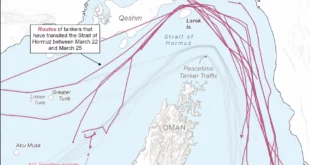
At its narrowest, the Strait of Hormuz is 33 kilometers wide. Through this channel passes approximately 20 percent of the world’s total petroleum supply — roughly 21 million barrels of oil and liquefied natural gas per day. More than 25 percent of global LNG trade transits here.
Iran has closed it. Not with the naval fleet that American and Israeli strikes have largely destroyed — over fifty Iranian naval vessels now rest on the sea floor. But with mines, drone swarms, ballistic missile threats, and the invisible weapon of risk: no insurance underwriter will currently cover a vessel transiting a strait where Iranian weapons continue to operate.
IEA Director Fatih Birol has been explicit: the situation is “very severe — worse than the two oil crises of the 1970s and the fallout from the Ukraine war put together.” His agency counts that at least 40 energy facilities across nine countries have been severely damaged since February 28. Global oil prices surged from under $60 per barrel in January to $113 on March 22.
A third of the world’s fertilizer trade also passes through the Strait. Shipping lines have rerouted. Aviation across the Middle East has collapsed. The war sold to the world as a campaign for the “rules-based international order” is systematically destroying the supply chains that order was built to protect.
Water: The Existential Lever Not Yet Fully Pulled
The Gulf states account for roughly 60 percent of global desalination capacity. The dependency figures tell the story of existential vulnerability:
Kuwait: 90 percent of drinking water from desalination
Bahrain: 90 percent
Oman: 86 percent
Saudi Arabia: 70 percent
UAE: 42 percent
Critically, more than 90 percent of the Gulf’s desalinated water comes from just 56 mega-complexes. On March 7, a drone caused material damage to a desalination plant in Bahrain — the first confirmed strike on Gulf water infrastructure. Iran’s Foreign Minister Abbas Araghchi stated publicly: “Attacking Iran’s infrastructure is a dangerous move with grave consequences. The US set this precedent, not Iran.”
“If attacks on desalination plants are the beginning of a military policy and not just mistakes or collateral damage, this is both illegal — a war crime — and a very concerning development, as Gulf countries have only a few weeks of water storage.”

— Laurent Lambert, Doha Institute for Graduate Studies
A few weeks of water storage. That is the margin between the current situation and a humanitarian catastrophe of unprecedented scale — 100 million people without regular access to drinking water. And this margin is held not by American air defenses, not by Gulf state diplomacy, but by an Iranian decision not yet taken.
Part Six: The Matrix That Does Not Fall
Washington went to war with a theory. Kill the leadership, paralyze the command structure, trigger popular uprising, produce regime change in days. Trump predicted “two or three days.” His military launched 900 strikes in 12 hours. Khamenei was killed on day one. Ali Larijani was assassinated on March 17. Dozens of IRGC commanders have been eliminated.
Twenty-four days later, the Islamic Republic is governing.
“It’s not like we finally found the one leader who, once we kill that leader, the whole house of cards comes apart, because it’s not a house of cards. This is more of a matrix — a flexible matrix.”

— Robert Pape, University of Chicago
Kill the apex of a matrix, and you eliminate the layer requiring the most real-time communication between senior leadership and mid-levels. The mid-level commanders do not pause. They reorganize laterally, often with greater aggression and less political restraint than before. Pape’s structural diagnosis is damning: “The new politics triggered by the bombing work to the disadvantage of regime change. What you’re getting instead is negative regime change: leaders from the second generation who are more anti-American, more dangerous, more willing to take costs in order to punish America.”
The historical record is not ambiguous. It is overwhelming.
Vietnam (1965–1973): The most bombed country in the history of aerial warfare did not capitulate. The government the US sought to destroy united the country in 1975. It is still there.
Iraq (2003): The regime fell in 21 days. The state destruction produced fifteen years of insurgency, sectarian civil war, the rise of ISIS.
Libya (2011): Seven months of NATO air campaign. Gaddafi killed. The state dissolved into permanent civil war, still ongoing fifteen years later.
Afghanistan: Twenty years. Over $2 trillion. The Taliban returned to power within two weeks of American withdrawal.
In each case: tactical destruction, strategic failure. The assumption that the targeted society was brittle was catastrophically wrong. Every time. Without exception.
Part Seven: Faith as a Strategic Variable
Western strategic analysis has a structural blind spot. It can model military capability, economic leverage, and political will in the terms familiar to liberal democratic systems. What it cannot model — because it has no conceptual vocabulary for it — is the role of faith as a strategic variable.
Shia Islam’s foundational narrative is the Battle of Karbala, fought on October 10, 680 CE. Hussein ibn Ali, grandson of the Prophet, chose death rather than submission to illegitimate power. That day — Ashura — is the most important day in the Shia calendar. Not as a day of defeat. As a day of witness: the theology of the victory of principle over power, of the testimony of the righteous over the triumph of the unjust.
In the Shia eschatological framework, every Iranian soldier who dies in this war is not a casualty of a losing military campaign. He is a shahid — a martyr and witness, whose death carries divine meaning. Every bombed city block is not evidence that God has abandoned Iran. It is evidence, within this framework, that Iran stands on the side of righteousness.
No Patriot battery can intercept that. No THAAD system can neutralize it. No Tomahawk missile can destroy it.
Robert Pape identifies “strategic culture” — a population’s cohesion and tolerance for suffering — as the decisive variable when military force is sufficient to destroy but insufficient to conquer. Iran’s strategic culture of endurance is theologically produced, historically reinforced across seven thousand years, and politically mobilized by every bomb that falls on Tehran. The Shahed drone carries a $35,000 warhead. It also carries, in the consciousness of the millions who watch it launched, the weight of Karbala, the memory of fifty years of embargo, the dignity of civilizational continuity. That is not a weapon the United States knows how to defeat.
Part Eight: Sun Tzu and the Strategic Bankruptcy of Trump and Netanyahu
There is a text that every military academy in the world assigns. It was written approximately 2,500 years ago in China. Its author was a general named Sun Tzu, and its title is The Art of War. It is the most influential strategic treatise in human history. And every principle it establishes, Trump and Netanyahu have systematically violated.
First Principle: “Know your enemy and know yourself”
Sun Tzu places the knowledge of the adversary at the summit of all strategic thought. What did Trump and Netanyahu know about Iran before launching 900 strikes in 12 hours? That its economy was fragile. That its population had been in the streets protesting. What they did not understand: that a civilization of 7,000 years does not measure its will to resist in GDP per capita or inflation rates. That the ‘asabiyya of which Ibn Khaldun wrote is activated, not destroyed, by foreign bombardment. That the Iranian woman who had been arrested twice for not wearing a hijab, who celebrated the first strikes, would end her March 16 diary entry: “In the final battle I will burn every single one of these psychopathic murderers” — meaning the regime. But she was writing from a city under foreign attack. The distinction, under bombs, dissolves.
They did not know their enemy. According to Sun Tzu, they had already lost.
Second Principle: “The supreme excellence in war is to break the enemy’s resistance without fighting”
On February 27, 2026 — the eve of the attack — Oman’s Foreign Minister Badr Al-Busaidi confirmed that a diplomatic “breakthrough” had been achieved: Iran had agreed to never stockpile enriched uranium, to permit full IAEA verification, and to irreversibly downgrade its existing enriched uranium to the lowest possible level. He declared peace “within reach.” Negotiations were scheduled to resume March 2.
Eighteen hours later, the bombs began to fall.
A negotiated solution — Iran denuclearized by agreement, Strait open, markets stabilized — was sacrificed. Sun Tzu names this error without hesitation: the available victory without combat was strategically superior to the available military one. They chose the inferior option.
Third Principle: The Requirement of a Defined End State
A war without a defined victory condition is a war lost before it is begun. Let us examine the official record of Trump administration war objectives, in chronological order:
February 28, Hegseth: Ending “47 long years of war by the expansionist and Islamist regime.”
February 28, Rubio (hours later): The US acted defensively, pre-emptively, to protect its forces.
March 2, Trump: Regime change in “two or three days.”
March 9, Trump: “I think the war is very complete, pretty much.”
March 11, Hegseth: “This is only just the beginning.”
March 21, Trump: 48-hour ultimatum to reopen the Strait of Hormuz.
March 23, Trump: Five-day delay for “very good and productive” negotiations.
March 23, Iran: “There is no dialogue between Tehran and Washington.”

“Tactics without strategy is the noise before defeat.”

— Sun Tzu, The Art of War
Fourth Principle: Appear Strong When You Are Weak
The art of strategic deception — maintaining ambiguity about one’s capabilities and intentions — is among Sun Tzu’s most elaborated teachings. Observe who practices it.
Iran practices Sun Tzu. It closes the Strait but maintains deliberate ambiguity about its capacity to keep it closed indefinitely. It denies negotiations while allowing regional intermediaries — Pakistan, Turkey, Egypt — to carry messages sufficient for Trump to construct a narrative of “productive conversations” allowing him to retreat from his ultimatum without formal capitulation. It strikes near Dimona without destroying the reactor — demonstrating existential capability while withholding its use.
Trump announces his threats in capital letters on a public social media platform. He sets deadlines in specific hours. He retreats from those deadlines publicly, before his own stated expiration time. Iranian state television broadcast the verdict without ambiguity: “Trump, fearing Iran’s response, backed down from his 48-hour ultimatum.”
Every strategist on earth — in Beijing, Moscow, Pyongyang, Caracas — read that broadcast. Its lesson is precise: American ultimatums can be waited out. This is what deterrence theorists call credibility degradation. Each capitulation makes the next threat easier to ignore.
The Final Verdict of Sun Tzu
“In war, the victorious strategist only seeks battle after the victory has been won, whereas he who is destined to defeat first fights and afterwards looks for victory.”

— Sun Tzu, The Art of War
Trump and Netanyahu launched their campaign and then looked for what victory might mean. They have been looking for twenty-four days. They have not found a stable answer. Iran, by contrast, had its victory condition defined before the first American missile fell: survival. Remain standing. Keep the Strait closed. Force economic pain on the global system. Demonstrate that the most powerful military alliance in history cannot achieve its stated objectives. And let the world draw its own conclusions.
Sun Tzu would recognize the Iranian strategy immediately. He would struggle to find the American one.
Part Nine: The Third Winner — Beijing’s Silent Harvest
While Washington burns through missile interceptors, carrier group logistics, and political capital in the Persian Gulf, China is quietly consolidating the strategic architecture of the 21st century.
To sustain Operation Epic Fury, the United States has redeployed advanced missile defense systems from the Indo-Pacific to the Middle East — THAAD batteries and naval interceptor platforms whose Pacific positioning most directly threatened Chinese security interests. Melanie Hart of the Atlantic Council’s Global China Hub states: “It is impossible to overstate the degree to which those movements are a massive win for Beijing. And if the United States ends up stuck in another Middle Eastern quagmire that cedes the Indo-Pacific to China, the wins will keep coming.”
Russia is the clearest immediate beneficiary: oil above $100 a barrel has replenished Moscow’s war chest and reduced Ukrainian leverage in any future peace negotiation. The war the Trump administration was supposed to prevent — Russia’s slow conquest of Ukraine — is being financed, in part, by the economic disruption of the war the Trump administration chose to start.
China alone entered this crisis with genuine strategic depth. It holds the world’s largest strategic petroleum reserves outside the United States. It is purchasing Iranian oil at discount prices throughout the conflict. It will dominate Gulf state reconstruction contracts when the shooting stops. And its military planners are studying, with professional interest, every data point this war generates on drone cost-exchange ratios and interceptor stockpile depletion rates.
The 2026 Iran war may be remembered as the moment the American Pacific Century began its terminal phase — not in a confrontation over Taiwan, but in a miscalculation over a nuclear facility in the Iranian desert.
Part Ten: The Global South Is Watching
This war is not only about Iran. It is about what Iran’s performance means for every non-Western state calculating its strategic options in a world still structured — for now — by American military primacy.
For seventy years, the fundamental premise underwriting that structure has been: no state that directly confronts American military power can survive the confrontation with its government intact. Vietnam cracked that premise. Afghanistan confirmed it required extended occupation to fail. Iran, in 2026, is demonstrating something new: that a non-Western state, under the most intense aerial bombardment since the Second World War, can absorb the assault, maintain its institutional functions, weaponize the global economy through geography and cheap technology, and force the aggressor into public strategic incoherence — all without nuclear weapons.
The Shahed drone that costs $35,000 and forces a $4 million Patriot intercept is not merely a weapon. It is a political statement: the technological and financial gulf between the imperial center and the periphery is no longer sufficient to guarantee compliance.
The Global South is watching from Caracas, Pyongyang, Harare, and Algiers. What it is watching — in real time, measured in the smoking debris of interceptors that cost $4 million to stop a drone that cost $20,000 — is the demonstration that the age of uncontested American military omnipotence is ending.
Malek Bennabi argued that civilizations are not defeated by superior weapons. They are defeated by the internal exhaustion of their own will to be. The civilization that forgets why it exists is already dying, regardless of its arsenal. Seven thousand years of Persian civilization have not forgotten why they exist.
Conclusion: The War That Time Cannot Win
Napoleon invaded Russia in June 1812 with 600,000 soldiers. He reached Moscow in September. The Russians burned their own capital rather than surrender it. The Grande Armée, designed for decisive engagement, had no strategic answer for a people willing to accept unlimited suffering in preference to submission. By December, fewer than 100,000 of those 600,000 men had returned.
The lesson was not about military technology. It was about will, time, and the asymmetry of what each side had to lose.
Twenty-four days of the most sophisticated aerial campaign in the history of warfare. The supreme leader, dead. The secretary of the National Security Council, assassinated. Fifty naval vessels on the ocean floor. Natanz struck three times. At least 1,354 civilians killed, 200 children among them. Billions of dollars of military infrastructure destroyed.
And yet: the Islamic Republic governs. Its drones are flying. The Strait of Hormuz is closed. Oil is above $100. The global economy is hostage. Trump invents negotiations that Iran denies in real time. His ultimatums expire un-executed. His war has no articulated end state. And Sun Tzu, reading the record from twenty-five centuries away, would close his treatise and say: this campaign was lost before the first missile was fired.
There is a final fact that history will not overlook. On February 27, 2026 — the day before the bombs began to fall — Oman’s Foreign Minister confirmed that a diplomatic breakthrough was within reach. Iran had agreed to full nuclear transparency. Peace was available. The decision was taken to bomb rather than negotiate.
Sa’adi Shirazi wrote, in 13th-century Persia, the verse that hangs today at the entrance of the United Nations: “All human beings are members of one frame, since all, at first, from the same essence came.” Iran sent that poem to the United Nations. The United States sent it cruise missiles.
The empire has more weapons. Iran has more memory.
Memory, in the long run, wins.
Subscribe to Our Newsletter
Get the latest CounterCurrents updates delivered straight to your inbox.
Laala Bechetoula is an independent Algerian historian, journalist and geopolitical analyst.
Publishing Targets
Countercurrents (EN) · Global Research (EN/FR) · Réseau International (FR) · Le Quotidien d’Oran (FR/AR) · Szilaj Csikó (HU) · Sri Lanka Guardian (EN) · Just International (EN/MY) · Ummid.com (EN)
Documented Sources
Persian Civilization and the Cyrus Cylinder
• British Museum, London (permanent collection, Room 52)
• UN Human Rights Programme: History of Natural Law & Basic Freedoms
• Facing History & Ourselves: From Ancient Persia to a Global Declaration (2024)
• Sa’adi Shirazi, Bani Adam (13th c.) — official UN display, New York lobby, 2005
Iranian Civilian Testimonies
• NPR / Ruth Sherlock: “Life under bombing in Tehran: The diary of an Iranian writer” (March 13, 2026)
• NPR / Emily Feng: “Fear, defiance, and anger: Iranians describe life under bombardment” (March 19, 2026)
• NPR: “The latest updates on the Iran war after three weeks” (March 21, 2026)
• Xinhua: “Letter from Mideast: Heart on fire — Tehran under bombs” (March 3, 2026)
• Al Jazeera: “Our hearts were shaking: Tehran endures heavy bombing” (March 10, 2026)
Civilian Casualties
• HRANA (Human Rights Activists News Agency): 3,114 deaths by March 17, 2026, including 1,354 civilians
• UNICEF report of March 12, 2026: 200+ children killed in Iran
• Iranian Red Crescent Society: 6,668+ civilian units targeted
• Wikipedia: 2026 Iran War (updated March 24, 2026)
Iran Sanctions (Full Historical Record)
• Wikipedia: International Sanctions Against Iran; United States Sanctions Against Iran
• Al Jazeera: Timeline: Sanctions on Iran (2012, updated 2026)
• US Library of Congress / Congress.gov: U.S. Sanctions on Iran (CRS Report IF12452)
• European Parliament Research Service: EPRS Brief 777928 (2025)
• Senate Banking Committee, Scott Bessent testimony, February 2026
• Laudati et al., Journal of Applied Econometrics (2023)
Military Cost Asymmetry
• Northeastern University / Stephen Flynn: “US-Israeli war on Iran enters fourth week, costs come into focus” (March 23, 2026)
• The Dupree Report: Iran’s $20K Drones vs America’s $4M Missiles (March 2026)
• Middle East Eye: Iranian drones cost a fraction of air defences (March 2026)
• Globe and Mail: The high price of intercepting Iran’s low-cost drones (March 2026)
• Kelly Grieco, Stimson Center (multiple citations, March 2026)
• Heritage Foundation: stockpile warning, January 2026
Strait of Hormuz and Economic Impact
• IEA Director Fatih Birol, statements March 22–23, 2026 (Australia National Press Club)
• Al Jazeera: Iran war updates, day 23 (March 22–23, 2026)
• Centre for European Reform: War in Iran: Who wins and who loses? (March 2026)
• Britannica: 2026 Iran War (updated March 24, 2026)
Desalination Vulnerability
• Al Jazeera: How targeting of desalination plants could disrupt water supply (March 8, 2026)
• Atlantic Council / Ginger Matchett: Attacks on desalination plants forecast a dark future (March 18, 2026)
• CSIS / David Michel: Could Iran Disrupt the Gulf Countries’ Desalinated Water Supplies? (March 2026)
• Foreign Policy: U.S. Strike on Qeshm Island Risks Spiral of Retaliation (March 9, 2026)
• CNN: Water is even more vital than oil and gas — and it’s at risk (March 11, 2026)
• Laurent Lambert, Doha Institute for Graduate Studies
• Zane Swanson, CSIS Global Food and Water Security Program
Air Power and Regime Change
• Robert Pape, University of Chicago: An air power expert explains why Iran is more powerful now, MS.NOW (March 21, 2026)
• Robert Pape: The Escalation Trap (newsletter, 2026)
• Atlantic Council: Twenty questions about the Iran war (March 2026)
• Washington Institute for Near East Policy: Assessing U.S. Progress in the Iran War (March 2026)
The Ultimatum and Fake Negotiations (March 22–23, 2026)
• CBS News live updates: Trump calls off Strait of Hormuz ultimatum (March 23, 2026)
• NPR: Trump says the U.S. is in talks with Iran, which Iran denies (March 23, 2026)
• Al Jazeera: Iran denies any talks with US after Trump claims ‘productive’ discussions (March 23, 2026)
• ITV News: Trump says Iran wants ‘very much’ to make deal, as Tehran calls talks ‘fake news’ (March 23, 2026)
• Iran Parliament Speaker Mohammad Bagher Ghalibaf, official statement (March 23, 2026)
• Hassan Ahmadian, University of Tehran (cited by Al Jazeera, March 23, 2026)
China and Geopolitical Implications
• Atlantic Council / Melanie Hart: Twenty questions about the Iran war (March 2026)
• Centre for European Reform: War in Iran: Who wins and who loses? (March 2026)
Sun Tzu
• Sun Tzu, The Art of War (c. 500 BCE), tr. Lionel Giles (1910); tr. Samuel B. Griffith (Oxford University Press, 1963)
• B.H. Liddell Hart, Strategy (1954)
• Colin Gray, Modern Strategy (Oxford University Press, 1999)
Philosophical and Intellectual Framework
• Ibn Khaldun, Muqaddimah (1377 CE)
• Frantz Fanon, The Wretched of the Earth (1961, Présence Africaine; English tr. Grove Press, 1963)
• Malek Bennabi, Vocation de l’Islam (1954); Le problème des idées dans le monde musulman (1970); Les conditions de la renaissance (1949)
• Sa’adi Shirazi, Bustan / Bani Adam (13th century)