 Eurasia Press & News
A US naval blockade in the Strait of Hormuz is tightening pressure on Iran amid war, economic crisis and stalled talks. Is the Islamic Republic nearing collapse or adapting once again?
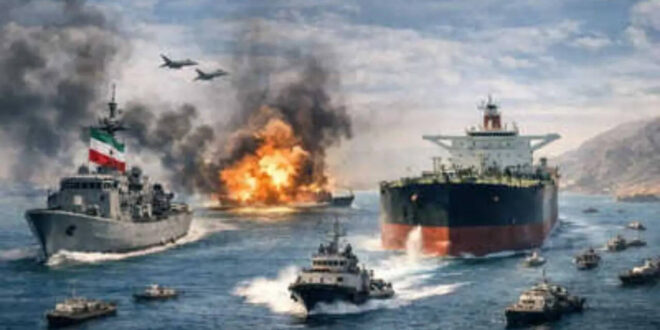
US naval forces have launched a blockade of Iranian ports in the the Strait of Hormuz, escalating pressure on Tehran as war, economic strain and diplomatic uncertainty converge.
A sweeping US naval blockade of Iranian ports through the Strait of Hormuz may prove to be the exact pressure point Washington has long sought to bring the Islamic Republic to the brink. The move has triggered fears of economic strangulation and regime instability in Tehran, with multiple US media reports suggesting the leadership is scrambling to secure another round of talks with Washington – potentially in Islamabad or Geneva, though the venue remains undecided. With tanker traffic shrinking, oil prices climbing, and the US tightening the screws after failed talks in Islamabad, the question is no longer just about war or ceasefire – but whether the Islamic Republic can withstand the combined weight of military blows, economic crisis, and mounting internal strain.
Can Iran Withstand The Pressure?
The US may repeatedly claim that Iran has suffered irreversible losses in the current military conflict – launched by the US and Israel on February 28, 2026, under the codename Operation Epic Fury – most defence analysts caution against concluding that Tehran’s core capabilities have been “destroyed”.
Iran’s asymmetric warfare doctrine, built over decades, does not rely solely on conventional air or naval dominance. Instead, it hinges on missile systems, proxy networks, and strategic geography – especially its proximity to the Strait of Hormuz. Even the assertion that Iran has “lost control” of Hormuz is, at best, an exaggeration. While US naval deployments have increased and surveillance has tightened, Iran retains the geographic advantage of sitting astride the narrow waterway – a fact that has historically given it leverage far beyond its conventional strength.
Covert Oil Exports?
What has drawn renewed scrutiny is Iran’s ability to keep its economy afloat despite sanctions – particularly through covert oil exports. According to claims amplified by policy voices like Mark D Wallace of United Against Nuclear Iran, Tehran has been operating a vast “ghost fleet” – tankers that disable tracking systems and conduct ship-to-ship transfers in open waters to evade sanctions.
Much of this oil, it is alleged, finds its way to buyers like China, providing the regime with a financial lifeline that sustains not only its domestic economy but also its regional influence via groups like Hezbollah and Hamas.
If the US succeeds in tightening enforcement – particularly by targeting these covert networks – it could significantly constrain Iran’s ability to project power abroad. But experts note that similar crackdowns in the past have yielded only partial success, as Iran resorted to smuggling and evasive tactics. This time, though, the pressure is different: what was once a sanctions regime is now closer to a near-total blockade, sharply limiting Iran’s room to manoeuvre.
Iran Under Tangible Economic Pressure
Where the pressure on Iran appears far more tangible is its economy. Iranian media reports cite internal warnings of a potential economic spiral, with projections of inflation soaring to as high as 180% and millions at risk of unemployment if the conflict continues. Even if these figures are worst-case scenarios, they underline a critical reality: Iran’s economy was already under strain before the war, battered by years of sanctions, currency depreciation, and domestic unrest.
Frustrated Populace
President Masoud Pezeshkian now faces a dual challenge – managing wartime economic shocks while navigating a population that has, in recent years, shown growing frustration with the political establishment. From the protests following the death of Mahsa Amini to recurring labour unrest, the Islamic Republic has faced sustained internal dissent. Whether this translates into a regime-threatening movement, however, remains uncertain. Historically, external pressure has often had the paradoxical effect of consolidating internal control rather than weakening it.
Will There Be A Round 2 Of US-Iran Talks?
Even as rhetoric intensifies, there are clear signs that both Washington and Tehran are seeking an exit ramp. According to sources cited by the Associated Press, the US and Iran are considering a second round of in-person talks aimed at extending or solidifying the current ceasefire before it expires. Potential venues include Islamabad and Geneva – both familiar grounds for high-stakes diplomacy.
The fact that discussions are underway, even if tentative, suggests that neither side is fully committed to a prolonged conflict.
For the US, a drawn-out war risks destabilising global oil markets and pulling it deeper into a volatile region. For Iran, the economic and military costs could become unsustainable.
Has Iran Isolated Itself With Its Actions?
Another argument gaining traction is that Iran has alienated its regional neighbours through its actions, leaving it increasingly isolated. There is some truth to the shifting regional dynamics. Countries like Saudi Arabia and the United Arab Emirates have, in recent years, recalibrated their positions – at times confronting Iran, at others cautiously engaging with it.
But to describe Iran as completely isolated would ignore the complexity of its regional network.
Through proxies and allied groups across Iraq, Syria, Lebanon, and Yemen, Tehran continues to wield significant influence – often referred to as its “axis of resistance”. This network has been battered but not dismantled.
The Big Question: Is Regime Change Imminent?
Predictions of the Islamic Republic’s imminent collapse have surfaced repeatedly over the past four decades – from the Iran-Iraq war to the height of US sanctions campaigns. So far, none have materialised. That does not mean the current moment is insignificant. The convergence of military pressure, economic strain, and diplomatic uncertainty presents one of the most challenging phases for Tehran in recent years.
But regime change – especially in a system as entrenched and security-driven as Iran’s – is rarely the direct outcome of external pressure alone. It typically requires a combination of sustained internal uprising, internal fragmentation amongst the elites, and loss of authority – conditions that are not yet clearly evident in Iran.
The Bigger Picture
What is unfolding is less a story of imminent collapse and more a high-stakes recalibration. The US “chokehold” on the Strait of Hormuz is undeniably a powerful lever. But it is also a risky one – any miscalculation could trigger disruptions in global oil supply, with ripple effects far beyond the region. For Iran, the challenge is survival under pressure – something it has historically managed through a mix of defiance, adaptation, and negotiation. For the world, the question is not just whether the Islamic Republic will fall, but what comes next if it does – and whether the region, already on edge, can absorb such a shock.