 Eurasia Press & News
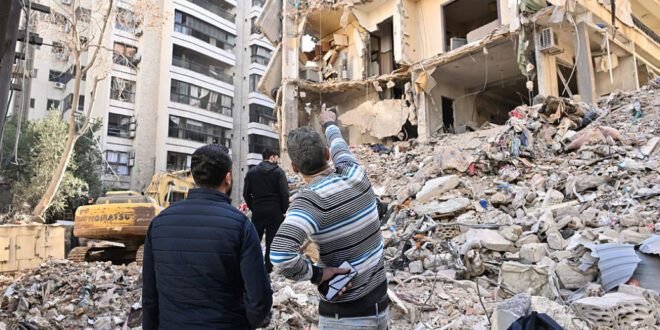
Israel has launched new deadly strikes on Lebanon and clashed with Hezbollah in Bint Jbeil ahead of Lebanese-Israeli talks in Washington on Tuesday
Israel continued its bombardment of southern Lebanon on Sunday night and Monday morning, as emergency crews searched for missing people trapped under rubble following intense overnight strikes.
Lebanon’s official National News Agency (NNA) reported Israeli attacks on more than 30 locations across the south on Sunday, as well as several others in the western Beqaa Valley.
At dawn on Sunday, airstrikes targeted residential buildings in the al-Hawa neighbourhood of Nabatieh, inflicting heavy damage on the town.
At least five people were killed and nine injured in strikes on Bazouriyeh, according to NNA, with rescue teams still searching for those missing. One of the attacks reportedly hit the town’s main school, damaging the building.
Elsewhere, one person was killed in Nabatieh al-Fawqa, another in Sir al-Gharbiya, while two residents of Shoukin were killed early Monday morning.
Israeli aircraft also targeted Tyre district heavily on Monday, killing at least four people and injuring three others in an airstrike on Ma’roub, Lebanon’s health ministry said.
The Lebanese army confirmed the death of First Sergeant Abbas Hassan Qassem on Sunday from wounds sustained in an earlier Israeli attack on Shamshtar in April.
The latest attacks come as the health ministry said that the total toll from Israeli strikes since 2 March had risen to 2,055 people, including 165 children and 87 healthcare workers, with nearly 6,600 others injured.
Clashes in Bint Jbeil
Fierce fighting erupted in the southern border town of Bint Jbeil, where Hezbollah fighters and Israeli troops engaged in direct combat.
On Sunday morning, Israel’s military issued a statement claiming to have “completed the encirclement and begun an attack in the town of Bint Jbeil”.
Lebanese media reported that the Israeli army was attempting to capture the strategically important town, long considered a Hezbollah stronghold.
Security analysts said the Israeli ground offensive aimed to encircle Bint Jbeil along four to five axes, the largest advancing from Ainata northwest of the city toward Saf al-Hawa, its main northern entrance.
Israeli airstrikes reportedly dropped dozens of heavy munitions on the city to pave the way for troop movement, according to Israeli media.
Located just three kilometres from the Israeli border, Bint Jbeil serves as a key base and firing position for Hezbollah operations in the south.
The group said it launched attacks on Israeli targets across the frontier and within Lebanese territory, describing “fierce clashes” in Bint Jbeil.
Hezbollah announced on Sunday that it had carried out 43 operations against Israeli forces, vowing to continue until “the Israeli-American aggression against our country and our people ceases”.
Israeli media suggested that the army’s Northern Command plans to establish 15 permanent camps along Lebanon’s front-line villages as part of its southern offensive.
On Sunday, Israel’s Prime Minister Benjamin Netanyahu posted a video from inside Lebanese territory where he spoke about recent operations.
The UN Interim Force in Lebanon (UNIFIL) said Israeli soldiers had opened fire near its vehicles in recent days, with the latest incident on Sunday involving Israeli Merkava tanks ramming UN vehicles twice, causing significant damage.
In one instance, Israeli troops fired a warning shot that landed a metre away from a peacekeeper who had just dismounted his vehicle, the UN said.
Diplomatic tensions and criticism over negotiations
The escalation comes amid strained US-Iran negotiations in Islamabad, where Lebanon has emerged as a key sticking point.
Pakistani sources told The New Arab that discussions stalled over disagreements on Lebanon and the Strait of Hormuz. Washington reportedly sought to hand the “Lebanon file” to Israel and separate it from negotiations with Iran — a move Tehran insists contradicts regional ceasefire talks.
Lebanese Prime Minister Nawaf Salam said Sunday evening that efforts were ongoing to secure the withdrawal of Israeli troops.
“We will continue working to stop this war and ensure the Israeli withdrawal from all our lands”, Salam said in a televised address marking the eve of the 1975–1990 civil war’s anniversary.
President Joseph Aoun is expected to meet an Israeli delegation at the US State Department in Washington on Tuesday.
The talks are expected to be led by Israel’s US envoy Yechiel Leiter, a longtime settlement activist with ties to Israeli far-right groups.
The decision sparked protests in Beirut, where dozens demonstrated outside government headquarters over the weekend, denouncing what they called “normalisation” with Israel. Lebanese security forces have since increased their presence around the capital.