 Eurasia Press & News
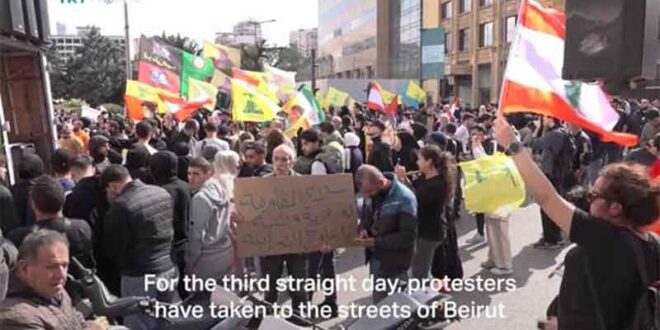
As Beirut’s skyline remains obscured by the smoke of relentless Israeli bombardment, a different kind of fire is consuming the streets of the capital. The regime of Prime Minister Nawaf Salam and President Joseph Aoun is currently facing an existential crisis, as accusations of “high treason” and “servile collaboration” with the Netanyahu government have triggered a massive popular uprising.
The immediate catalyst for the unrest—which has seen thousands descend upon the Grand Serail—is the revelation that the Salam regime is seeking direct negotiations and a normalization track with Tel Aviv, a move critics argue is being dictated by Washington and the Zionist entity to bypass the Hezbollah-led resistance.
A Postponed Trip and a Domestic Firestorm
On April 11, 2026, Prime Minister Nawaf Salam took the extraordinary step of cancelling his scheduled trip to the United Nations in New York and a subsequent diplomatic visit to Washington D.C. The official statement from the Prime Minister’s office cited the need to “preserve the security and unity of the Lebanese people” and to “follow up the work of the government” in light of the “current internal situation.” [1]
However, the reality on the ground suggests the postponement was a desperate attempt to contain a brewing revolution. Protesters in Central Beirut have labelled the Salam-Aoun setup a “Vichy regime,” drawing parallels to the French collaborators during World War II. The anger stems from reports that Salam is obstructing a ceasefire deal mediated through regional channels, instead insisting on a direct Lebanese-Israeli negotiation framework.
As one citizen in Beirut poignantly stated during a rally:
“Israel is attacking Lebanese army soldiers and the Nabatieh massacre in State Security… How can His Excellency the President accept, on his military honour, and Nawaf Salam on his human honour, to go to direct negotiations? This is treason.” [2]
PM Nawaf Salam supposedly cancelled his US visit to due to the internal security situation, but tweets by senior observers had another story to tell.
Nawaf Salam on X: In light of the current internal circumstances, and in commitment to fulfilling my duty completely in safeguarding the security of the Lebanese people and their unity, I have decided to postpone my trip to the United Nations and the United States, in order to follow up on the government’s work from Beirut.
Asad AbuKhalil on X: Without any excuses or internal circumstances, please: Let me translate his words for you based on what I know about politics in Washington. He cancelled his visit because he did not get a meeting with any high-ranking official and was referred to an assistant deputy assistant secretary of state for Near Eastern affairs.
Elijah J. Magnier on X: The American administration refused to approve any appointment to the Lebanese PM, so he remained at home. No one respects the weak and the one who, along with the president, allowed Israel to continue bombing Lebanon.
The Ghost of 1983: Normalization Under Fire
The current political maneuvering has invited haunting comparisons to the May 17, 1983 Agreement—a failed peace treaty between Lebanon and Israel signed under the shadow of the Israeli occupation. That accord was ultimately aborted by a popular uprising and the armed resistance, a historical precedent that today’s demonstrators frequently invoke.
The Lebanese Constitution explicitly bars direct contact or normalization with Israel. By allegedly signalling a willingness to sit at a “normalization table,” the Salam-Aoun regime is viewed by a significant portion of the populace as having forfeited its constitutional legitimacy.
Professor Mohammad Marandi, a prominent regional analyst, observed that the Prime Minister is effectively “obstructing the ceasefire… by insisting it be agreed upon through direct Lebanese-Israeli regime negotiations and normalization talks, rather than through the ongoing Iran-Trump regime negotiations.” [3] This delay, critics argue, allows Israel to continue its bombing campaign, which has already claimed over 1,530 lives, including 130 children. [4]
The Disarmament Trap
The friction between the state and the resistance reached a breaking point following Israel’s recent strikes on Beirut, which killed more than 300 people in a single wave. In the aftermath, PM Salam publicly called for the Lebanese state to take “full control” of Beirut and ensure that weapons remain only with “legitimate security forces.” [5]
While phrased in the language of state sovereignty, the timing of the statement—coinciding with Israeli demands for Hezbollah’s disarmament—has been interpreted as a coordinated betrayal. By adopting the rhetoric of the aggressor while the capital is still being buried, the regime has alienated not only Hezbollah and Amal supporters but also a broad spectrum of Lebanese citizens who view the resistance as the only credible deterrent against total occupation.
Threats of Overthrow
The rhetoric from the resistance camp has shifted from political disagreement to existential warning. Mahmoud Qomati, a senior Hezbollah official, recently drew a sharp line in the sand, comparing the current regime to historical collaborators.
“That’s what De Gaulle did to the Vichy Government; we have been patient, but there is a limit to everything.” [6]
This sentiment was echoed in the streets, where chants of “Nawaf Salam is a Zionist!” echoed in front of the Grand Serail. The suspicion surrounding Salam is further fuelled by his background; critics point out that he was “hand-picked and parachuted” into the premiership following his resignation from the International Court of Justice (ICJ), suggesting he is an instrument of Western imperialist policy. [7]
The Geopolitical Schism: Iran vs. Tel Aviv
As the Lebanese regime appears to lean toward a U.S.-brokered direct talk model with Tel Aviv, a large segment of the population is looking toward Tehran for stability. Amidst the chaos, a Sunni Lebanese man was captured on film saying:
“We are asking Iran not to abandon us, we Lebanese have no one. And our prime minister is asleep.” [8]
Less asleep, and more of a collaborator, doing the bidding of the US and Israel.
This shift in sentiment highlights the failure of the Lebanese state to provide security or a sense of national dignity. For the residents of South Lebanon, who are bearing the brunt of the Israeli campaign, the regime’s actions are seen as an invitation for Israel to establish “security zones” on Lebanese soil. Israel’s declared agenda is to annexe 30 kms of the Lebanese South till the Litani River, that apart from the Greater Israel Project, which includes Palestine, parts of Egypt, all of Lebanon, Syria, Jordan and parts of Turkey, Iraq and Saudi Arabia. Thus even though the Nawaf Salam regime is a collaborator seeking to weaken the Hezbollah-led Resistance, the Lebanese masses are marching on the streets to defend Lebanon.
Conclusion: A Regime on the Brink
Lebanon stands at a crossroads that mirrors its darkest historical chapters. The Nawaf Salam and Joseph Aoun regime is caught between the crushing weight of Israeli military pressure and a domestic population that refuses to surrender the “Resistance” identity.
By prioritizing a “normalization table” over an immediate, unconditional ceasefire, the regime has sparked a fire that may result in its own downfall. If the history of 1983 is any indication, any deal signed while “the victim shakes the killer’s hand while he still holds the knife” is unlikely to survive the wrath of the Lebanese street.