 Eurasia Press & News
Key Takeaways
The main sticking point in current US-Iran negotiations is reportedly Iran’s enrichment of uranium and its highly enriched uranium stockpile. The IRGC appears to be playing an outsized role in Iranian decision-making in these negotiations, traditionally meant for civilian leadership.
Iran appears to have not compromised on its stance over the Strait of Hormuz and its nuclear program, despite Iranian sources attempting to illustrate that Iran has compromised and the two sides have made progress in negotiations, however. Iran is leveraging its position over the Strait of Hormuz to extract concessions while maintaining its claim to control access to the waterway.
US President Donald Trump stated on April 16 that the United States is “very close” to reaching a deal with Iran. Trump stated that Iran “has agreed to almost everything” and added that Iran has agreed to hand over its enriched uranium stockpile. Iran has not publicly confirmed Trump’s remarks at the time of this writing.
The United States is targeting materiel support to Iran’s armed forces and military capabilities through the blockade. The blockade also continues to impose economic costs on Iran.
The Iranian missile force is exploiting the current ceasefire to reconstitute its tactical and operational-level units, but rebuilding the industrial facilities and other components that sustain the missile force at the strategic level will be extremely challenging.
US President Donald Trump announced that Lebanon and Israel have agreed to a 10-day ceasefire beginning at 5:00 PM ET on April 16. Netanyahu stated that Lebanon must disarm Hezbollah and establish a ”lasting peace agreement” with Israel.
Toplines
Iran is leveraging its position over the Strait of Hormuz to extract concessions while maintaining its claim to control access to the waterway. Reuters reported on April 15 that Iran has proposed allowing ships to transit through the Omani side of the Strait of Hormuz without interference if the United States agrees to conditions that prevent renewed conflict and meet Iranian demands.[1] Iran has linked increased maritime access to broader negotiations, including demands to unfreeze Iranian funds, and a permanent end to US and Israeli strikes both in this war and for posterity. The implication of Iran’s “concession” is that it could threaten ships to discourage them from transiting the Omani side of the Strait unless the United States grants Iran significant concessions. Agreeing to Iranian demands along these lines would show Iran that it can coerce the United States using the Strait of Hormuz both now and in the future.
The main sticking point in current US-Iran negotiations is reportedly Iran’s enrichment of uranium and its highly enriched uranium stockpile. The United States has proposed a 20-year pause to enrichment, while the Iranians offered a 3- to 5-year pause, according to Iranian sources speaking to Reuters.[2] The United States wants Iran to remove all of the highly enriched uranium from Iran, whereas Iran has proposed down-blending it or only moving part of its highly enriched uranium to another country, but not all of it, according to Iranian sources speaking to Western media in recent days.[3] Iran could still enrich the remaining stockpile relatively quickly if it retained some highly enriched uranium, and it could use a 5-year pause to improve centrifuges and build or repair them. A Western diplomat told Reuters on April 16 that the nuclear issue “remains a core obstacle.”[4] An unspecified source also told Reuters that a Pakistani mediator had made a breakthrough on “sticky issues,” but the negotiating parties have not resolved issues over Iran’s nuclear program.[5] An Iranian source told Reuters on April 16 that Iran is not ready to send all of its highly enriched uranium stockpile abroad, but it could send “part of it” to a third-party country.[6] The source claimed that Iran needed to retain some of the stockpile because Iran needs the remaining stockpile for medical purposes at a research reactor in Tehran.[7] This research reactor runs on only a few tens of kilograms (kg) of 20 percent enriched uranium instead of 10,000kg of Iran’s total enriched uranium stockpile, according to nuclear expert David Albright.[8] Only a small portion—roughly 400kg—of the 10,000kg Albright references is highly enriched uranium (60%). US objectives appear to remain at zero enrichment on Iranian soil, however. Israeli Prime Minister Netanyahu stated on April 15 that Israeli and US objectives in Iran are identical and include the removal of Iranian highly enriched uranium, the “dismantling” of Iran’s nuclear enrichment capabilities, and “reinstating” a nuclear deal.[9]
Iran appears not to have compromised on its stance over the Strait of Hormuz and its nuclear program, despite Iranian sources attempting to illustrate that Iran has compromised and the two sides have made progress in negotiations, however. Islamic Revolutionary Guards Corps (IRGC) affiliated media on April 16 denied all recent Reuters reporting citing Iranian sources.[10] The same IRGC-affiliated outlet had cast doubt on progress in future US-Iran talks, due to Iran‘s distrust of the United States and US “excessive demands” earlier on April 16.[11] These conflicting reports on Iranian stances in these negotiations corroborate CTP-ISW’s continued observation that the Iranian negotiating council is not unified. This disunity will make it harder for Iran to make decisions and implement decisions throughout this negotiating process.[12]
The IRGC appears to be playing an outsized role in Iranian decision-making in these negotiations, traditionally meant for civilian leadership. Pakistani Army Chief Field Marshall Asim Munir met with Iran’s negotiating delegation lead Parliament Speaker Mohammad Bagher Ghalibaf, and Iran’s Khatam ol Anbia Central Headquarters Commander Major General Ali Abdollahi Aliabadi on April 16 as part of his mediation mission in Tehran as part of the US-Iran negotiation process.[13] Munir might travel to Washington next.[14] Abdollahi Aliabadi is notably not on the Iranian negotiating team. The Khatam ol Anbia Central Headquarters is responsible for joint and wartime operations and not typically diplomatic missions.[15] Munir’s meeting with Aliabadi follows recent anti-regime media reports that Abdollahi Aliabadi and IRGC Commander Major General Ahmad Vahidi organizing Iran‘s wartime military efforts.[16] Iranian and international media did not report whether Munir met with Vahidi at the time of this writing. Vahidi is part of Supreme Leader Mojtaba Khamenei’s inner circle, which pushed for the Assembly of Expert’s election of Mojtaba as supreme leader in March.[17] Vahidi and his affiliates, including Supreme National Security Council Secretary Brigadier General Mohammad Bagher Zolghadr, have also reportedly been in conflict with pragmatists in the regime, like Ghalibaf, over Iran’s national security and foreign policy decisions.[18]
US President Donald Trump stated on April 16 that the United States is “very close” to reaching a deal with Iran.[19] Trump stated that Iran “has agreed to almost everything” and added that Iran has agreed to hand over its enriched uranium stockpile.[20] Trump added that he may travel to Pakistan to sign an agreement if negotiations conclude in Islamabad.[21] Iran has not publicly confirmed Trump’s remarks at the time of this writing.
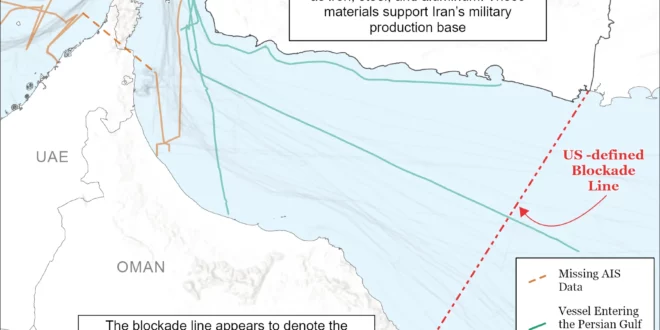
The United States Navy continues to enforce a blockade on Iranian ports. Chairman of the Joint Chiefs of Staff Dan Caine and Defense Secretary Pete Hegseth defined a blockade line that runs diagonally across the Gulf of Oman from Ras al Hadd, Oman, to the Iran-Pakistan border.[22] The blockade line appears to denote the threshold that the United States will begin to engage vessels coming from or going to Iran, but Caine and Hegseth noted that the US Navy will act beyond this area as well.[23] The US Navy will interdict Iranian-linked ships in the Pacific Ocean that crossed the line before the blockade began, for example. US Central Command (CENTCOM) announced that 14 vessels have complied with US directives to turn around.[24]
The United States is targeting materiel support to Iran’s armed forces and military capabilities through the blockade. Caine stated on April 16 that the United States will pursue any vessel in Iranian territorial waters and international waters that attempts to provide materiel support to Iran.[25] The US Navy authorized, on April 16, “visit, board, search, and seizure” operations against vessels suspected of carrying contraband to or from Iran.[26] It defines contraband as goods destined for an enemy that could support armed conflict, including arms, ammunition, and dual-use materials such as iron, steel, and aluminum.[27] These materials support Iran’s military production base. Recent US-Israeli strikes have severely degraded Iran’s steel and petrochemical production capacity, which likely increases Iran’s reliance on imports now targeted by the blockade.[28]
The blockade also continues to impose economic costs on Iran. CENTCOM announced on April 15 that the blockade has effectively halted maritime trade to and from Iran.[29] Iran halted petrochemical exports on April 13, at least in part due to the blockade that began the same day.[30] Steel—explicitly defined as contraband—and petrochemicals are among Iran’s most important exports and support both economic and military activity.[31] Iran’s severely limited ability to export such goods reduces Iran’s access to foreign currency. The blockade, combined with growing US sanctions on Iran’s illicit oil networks and the recent US decision not to renew a 30-day sanctions waiver for Iranian oil exports, will also constrain Iran’s oil export capabilities.[32] A sanctions-focused US analyst estimated on April 13 that a successful blockade on Iranian ports and shipping would cost the regime around $435 million USD per day.[33]
Commercially available maritime data provides only limited information on vessel compliance with the US blockade. At least four vessels entered the Strait of Hormuz, and two vessels exited the strait since CTP-ISW’s data cutoff on April 15, according to Starboard Maritime Intelligence.[34] This data does not confirm whether any of these vessels violated the blockade or received US authorization to transit. One of the entering vessels, cargo ship ZAYNAR2, departed Mumbai, India, on April 11 and entered the strait on April 15.[35] Commercially available maritime data does not indicate what the vessel was carrying. Reuters previously reported that US military guidance to mariners exempts humanitarian shipments to Iran. Open-source information also does not reveal whether the vessel communicated with US Navy forces.
The Iranian missile force is exploiting the current ceasefire to reconstitute its tactical and operational-level units, but rebuilding the industrial facilities and other components that sustain the missile force at the strategic level will be extremely challenging. US Defense Secretary Pete Hegseth acknowledged in a press briefing on April 16 that Iran has begun to dig up its missile launchers but noted that Iran has not determined how to “replenish” its missile stockpile.[36] Satellite imagery observed by CNN on April 14 showed that Iran attempted to remove debris in front of the entrances to the Southwest Tabriz Missile Base in Tabriz, East Azerbaijan Province, and the Khomein Missile Base in Khomein, Markazi Province.[37] The combined force struck the entrances of multiple Iranian missile bases over the course of the conflict to disrupt Iran’s ability to fire missiles.[38] Removing debris from these missile sites and restoring coordination between missile units and command and control within the force, for example, will enable the missile force to conduct more coordinated missile attacks, if it chooses to do so. These activities do not, however, alter the serious strategic damage the air campaign wrought to Iran’s ballistic missile program. The campaign struck defense industry facilities related to the program, ranging from final missile component assembly to aluminum and steel mills required for the raw materials of the missiles.[39] Reconstituting these assets will take much longer, in relative terms, than it did after the June 2025 strikes because Israel struck far fewer industrial targets across far fewer segments of the ballistic missile production chain in June.
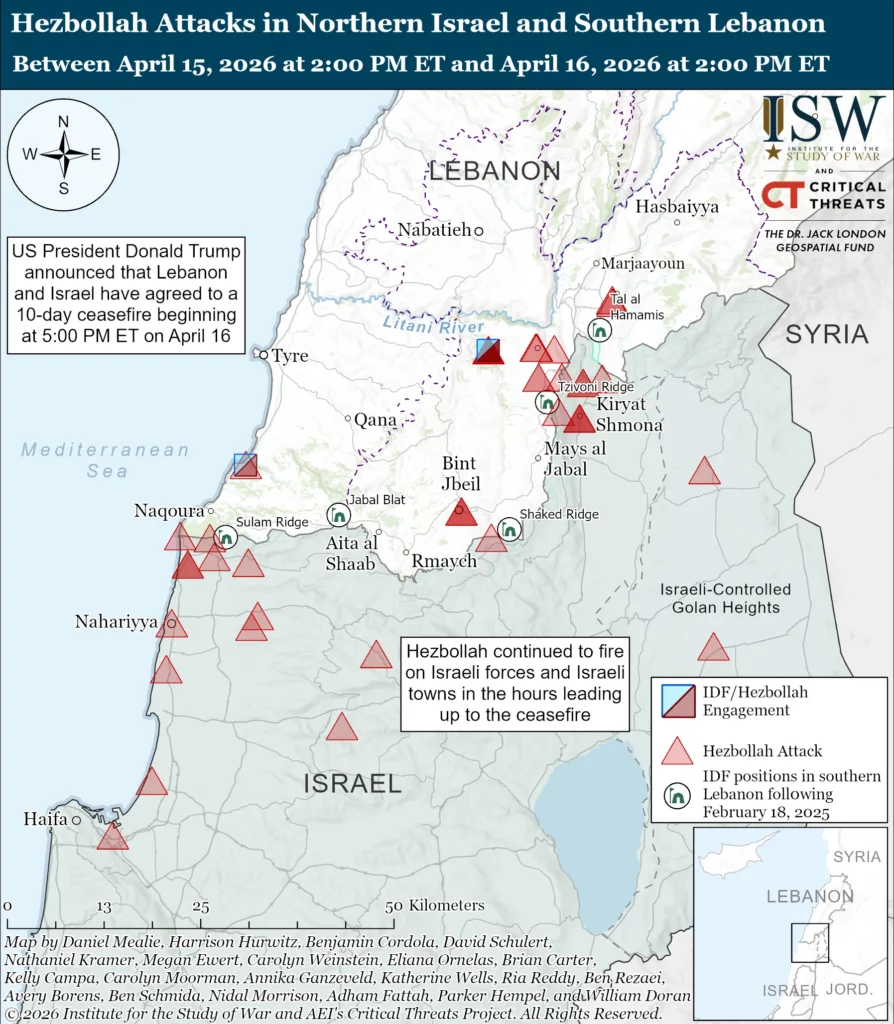
US President Donald Trump announced that Lebanon and Israel have agreed to a 10-day ceasefire beginning at 5:00 PM ET on April 16.[40] Trump said in a social media post that he spoke to Lebanese President Joseph Aoun and Israeli Prime Minister Benjamin Netanyahu, who both agreed to the ceasefire.[41] The US State Department published the following six provisions for the Israel-Lebanon ceasefire agreement later on April 16:[42]
Israel and Lebanon have agreed to a ceasefire starting at 5:00 PM ET on April 16 for an initial 10-day period. The ceasefire is a “gesture of goodwill” by Israel to allow time for negotiations toward a peace agreement between Israel and Lebanon.
The initial 10-day ceasefire period may be extended by mutual agreement from Israel and Lebanon, provided that the Lebanese government “effectively demonstrates” its ability to assert its sovereignty over Lebanon.
Israel agreed to halt all offensive military operations in Lebanon. Israel reserves the right to act in self-defense against any “planned, imminent, or ongoing” Hezbollah threats against Israel, however. These Israeli attacks would not constitute a violation of the ceasefire agreement.
The Lebanese government agrees to take “meaningful steps” to prevent Hezbollah or other non-state actors from conducting attacks against Israel from Lebanese territory. The United States said that Lebanon would receive unspecified international support with this task.
The United States, Lebanon, and Israel recognize that the Lebanese security forces alone have the responsibility to defend Lebanese sovereignty and national defense.
Israel and Lebanon request US support for further negotiations between Israel and Lebanon to resolve remaining issues, including the demarcation of the Israel-Lebanon border and establishing a peace agreement between the two countries.
Israeli Prime Minister Benjamin Netanyahu confirmed that Israel accepted the 10-day temporary ceasefire to pursue “a historic” peace agreement with Lebanon under US auspices.[43] Netanyahu stated that Lebanon must disarm Hezbollah and establish a ”lasting peace agreement” with Israel.[44] Netanyahu stated that Israel will maintain its “security zone” in southern Lebanon.[45] Netanyahu said that the ”security zone” will reportedly allow Israel to prevent Hezbollah from conducting infiltration operations into northern Israel and prevent the group from launching anti-tank guided missiles at northern Israeli communities.[46] Netanyahu said that Hezbollah requested that Israel fully withdraw from Lebanese territory and agree to a ”quiet for quiet” ceasefire as a part of the ceasefire agreement.[47] Netanyahu said that he did not agree to either of the Hezbollah requests.[48]
Multiple Hezbollah officials told Lebanese and international media that the group would agree to the ceasefire on the condition that Israel completely ceases military operations in Lebanon.[49] Hezbollah parliamentarian Ibrahim al Moussawi told AFP on April 16 that Hezbollah would abide by the ceasefire provided Israel halts its operations and airstrikes targeting Hezbollah operatives in Lebanon.[50] Hezbollah-affiliated media reported that the Iranian Ambassador to Lebanon, Mohammad Reza Sheibani, informed Hezbollah that Trump would inform Netanyahu and Aoun of the ceasefire beginning on April 16.[51] Sheibani reportedly confirmed to Hezbollah that Iran would adhere to the ceasefire in Lebanon as a part of the broader US-Iran ceasefire. Hezbollah reportedly said that it would continue to monitor Israel’s commitment to “halting all hostilities against Lebanon.”[52] Unspecified Hezbollah sources told Qatari media that the ceasefire in Lebanon must not allow the IDF to maintain “freedom of movement” in Lebanon.[53]
Trump separately announced on April 16 that he had invited Netanyahu and Aoun to a meeting at the White House at an unspecified future date to discuss peace negotiations.[54]
Iranian Foreign Affairs Minister Abbas Araghchi called his Chinese counterpart Wang Yi on April 15, likely in part to discuss the ongoing blockade in the Strait of Hormuz.[55] Araghchi thanked Yi for the People’s Republic of China’s (PRC) efforts to “reduce tensions,” while Yi affirmed Iran’s “rights and interests” in the Strait of Hormuz “must be respected and protected.”[56] The PRC may be concerned with the blockade’s effect on its ability to get Iranian oil. US Treasury Secretary Scott Bessent stated on April 14 that the US blockade on Iranian ports will ensure that no vessels from the PRC are “able to get their [Iranian] oil.”[57] China gets about 13.4 percent of its imported oil by sea from Iran.[58]
US and Israeli Air Campaign
The US-Israeli combined force struck a crude oil storage tank at an oil export terminal on Sirri Island, Hormozgan Province, before the ceasefire. Satellite imagery from April 15 shows damage to the storage tank.[59]
Iranian Response
Nothing significant to report.
Israeli Campaign Against Hezbollah and Hezbollah Response
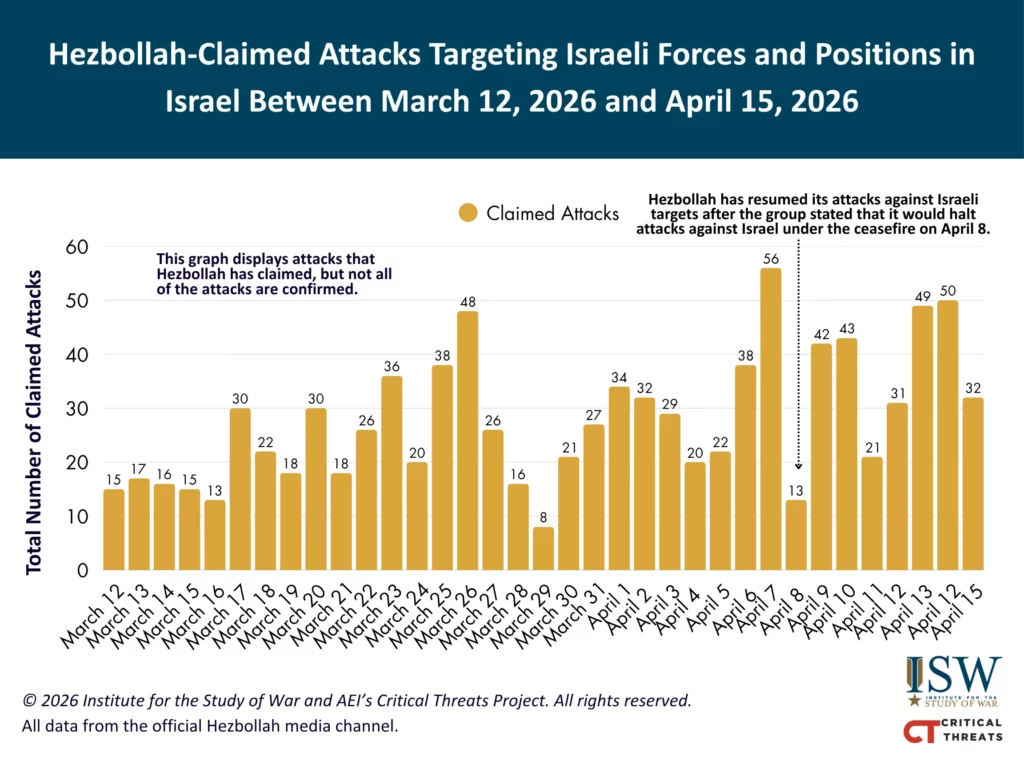
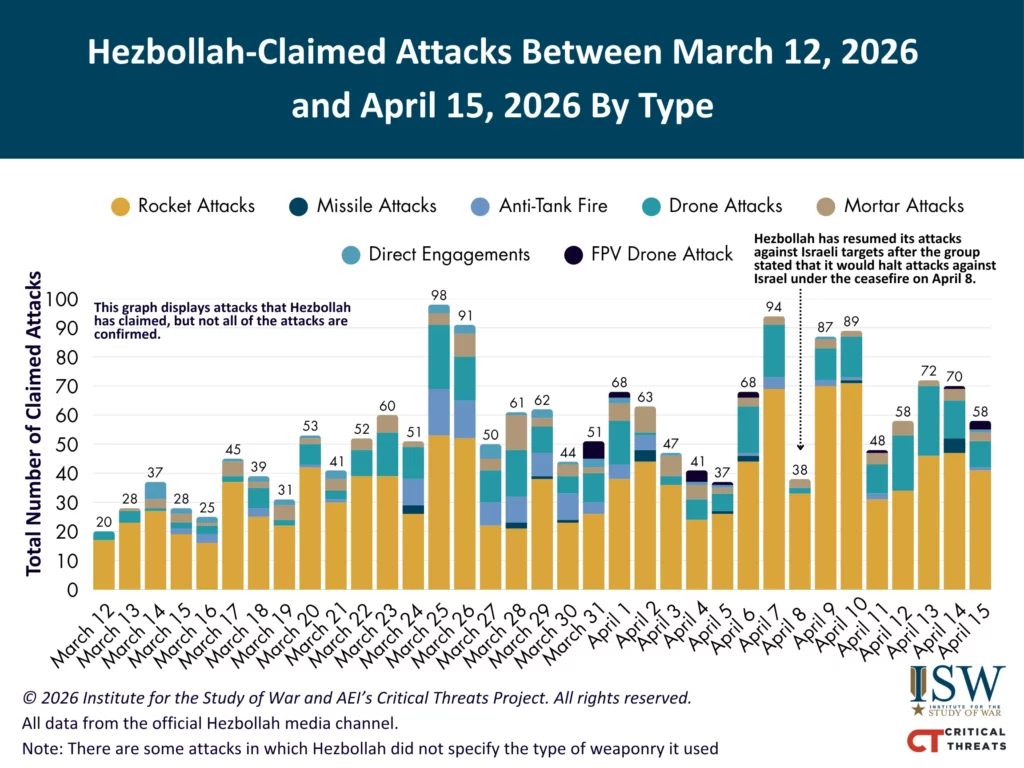
Hezbollah claimed that it conducted 30 attacks targeting IDF infrastructure and Israeli communities in northern Israel since CTP-ISW’s last data cutoff on April 15.[60] All claimed Hezbollah attacks occurred before the April 16 ceasefire went into effect. Hezbollah claimed that it conducted multiple rocket attacks on Kiryat Shmona and Haifa city in northern Israel.[61] Hezbollah also claimed that it fired rockets at an IDF naval officer school in Acre and an IDF barracks in Nahariya.[62]
Hezbollah claimed that it conducted 37 attacks targeting Israeli forces in southern Lebanon since CTP-ISW’s last data cutoff on April 15.[63] All claimed Hezbollah attacks occurred before the April 16 ceasefire went into effect. Hezbollah claimed at least 11 attacks on IDF forces in the vicinity of Bint Jbeil on April 15 and April 16.[64] The IDF said that it completed its “siege” of Bint Jbeil, southeastern Lebanon, on April 15.[65] Hezbollah claimed that it conducted at least three FPV drone attacks on IDF vehicles, such as Merkava Tanks and a D9 bulldozer in Southern Lebanon.[66] Hezbollah also claimed that it conducted several anti-tank guided missile (ATGM) attacks on IDF Merkava Tanks.[67]
The IDF has continued to conduct airstrikes targeting Hezbollah infrastructure and fighters across Lebanon. All IDF strikes occurred before the April 16 ceasefire went into effect. The IDF said that its strikes in Lebanon have destroyed the majority of Hezbollah’s anti-ship missile stockpile.[68] The IDF added that it targeted Hezbollah’s stockpiles and warehouses of anti-ship missiles in Lebanon since the start of the war.[69] The IDF estimated that Hezbollah had around 100 anti-ship missiles before the war began, but assessed on April 16 that the group only had a few remaining.[70]
Israeli special operations forces conducted the first amphibious raid into Lebanon since 2000 on April 14. Israeli media reported on April 16 that the Shayetet 13, an Israeli Navy special forces unit, conducted an amphibious landing operation in Naqoura, southern Lebanon, on April 14.[71] Naqoura is 3 kilometers from the border with Israel. The operation was reportedly the first amphibious landing in Lebanon conducted by the IDF since 2000.[72]
Ground operations continued elsewhere in southern Lebanon. The IDF reported that Hezbollah rocket fire injured five IDF soldiers in southern Lebanon on April 16, according to an Israeli military correspondent.[73] The IDF’s 769th Brigade (91st territorial division) seized a Hezbollah weapons cache in southern Lebanon, which included small arms, ATGMs, rocket-propelled grenades, and mortar shells.[74] The IDF’s 869th Field Intelligence Battalion also directed a drone strike on nearby Hezbollah fighters amid the 769th’s weapon seizure.[75] The IDF’s 98th Division Givati Brigade separately seized a cache of Hezbollah small arms at a school near Bint Jbiel.[76]
Other Axis of Resistance Response
Kurdish media reported on April 16 that unspecified actors conducted 16 drone and missile attacks targeting anti-Iranian regime Kurdish groups in the Iraqi Kurdistan Region since April 8.[77] No group has claimed responsibility for the attacks. The Kurdish Counter Terrorism Service previously reported on April 14 that Iran launched two one-way attack drones aimed at Erbil Province, which unspecified fighter jets intercepted.[78] Iran has repeatedly attacked anti-regime Kurdish groups in Iraqi Kurdistan since the start of the conflict.[79]
Iran Internal
The regime’s inability to profit from closing the Strait of Hormuz has exacerbated internal divisions within the regime. Anti-regime media reported on April 16, citing informed sources, that the regime formed a “Strait of Hormuz Traffic Licensing Committee” at the beginning of the war in order to generate funds from tankers that the regime allowed to pass through.[80] Supreme National Security Council (SNSC) Secretary Mohammad Bagher Zolghadr headed the committee. The informed sources added that the committee charged about $2 million per tanker, but that the regime has not received any payments thus far due to “mismanagement.” This mismanagement has reportedly caused “serious dissatisfaction” among senior Iranian officials and the Supreme Leader’s office. Some officials have proposed to reassign the responsibility of payment collection from Zolghadr to Iranian President Masoud Pezeshkian.
Likely Mobarizoun Popular Front (MPF) fighters killed three Iranian Law Enforcement Command (LEC) in Sarivan, Sistan and Baluchistan Province on April 16.[81] The MPF is a coalition of anti-regime Baloch militias formed on December 10, 2025.[82] This is the first MPF attack against Iranian security forces since March 3.[83]