 Eurasia Press & News
Key Takeaways
Supreme Leader Mojtaba Khamenei declared on April 30 that Iran will retain control over shipping through the Strait of Hormuz and maintain its nuclear and missile capabilities, which supports ISW-CTP’s assessment that the Iranian regime is unlikely to make meaningful concessions in its next proposal to the United States.
Some Iranian officials who have advocated for a “pragmatist” approach toward negotiations may be aligning themselves behind Vahidi’s redlines, which Mojtaba publicly endorsed in his April 30 statement. Foreign Affairs Minister Abbas Araghchi has reportedly been acting in “full coordination” with Vahidi and following Vahidi’s “instructions” over the past two weeks, according to two informed sources speaking to anti-regime media on April 30. This report suggests that Araghchi may have aligned himself with Vahidi’s position on negotiations.
Parliament Speaker Mohammad Bagher Ghalibaf and President Masoud Pezeshkian are reportedly dissatisfied with Araghchi’s close cooperation with Vahidi and approach toward negotiations, even though they have publicly signaled their acquiescence to Vahidi’s hardline approach.
Iran is trying to sow divisions between the Gulf states and the United States as part of a longstanding Iranian effort to push the Gulf countries to expel US forces from their territory.
Toplines
Supreme Leader Mojtaba Khamenei declared on April 30 that Iran will retain control over shipping through the Strait of Hormuz and maintain its nuclear and missile capabilities, which supports ISW-CTP’s assessment that the Iranian regime is unlikely to make meaningful concessions in its next proposal to the United States.[1] Mojtaba published a written statement on April 30 in which he stated that Iran will implement a “new management” in the strait—likely in reference to Iran’s collection of tolls from vessels that transit the strait—as a means to “secure” the Persian Gulf and prevent “hostile” interference in the region.[2] Mojtaba also underscored that Iran will defend its nuclear, missile, and advanced technological capabilities as resolutely as it defends its territorial borders.[3] A senior Iranian official speaking to the Washington Post on April 30 similarly asserted that Iran’s security establishment rejects compromise on key matters, such as Iran’s ability to enrich uranium.[4] Mojtaba’s statement and the Washington Post report are consistent with ISW-CTP’s assessment that IRGC Commander Major General Ahmad Vahidi, who appears to be dominating regime decision-making, is unwilling to make concessions regarding Iran’s control over the Strait of Hormuz or nuclear program.[5] Vahidi reportedly maintains near-exclusive access to Mojtaba and serves as a gatekeeper who conveys Mojtaba’s approval of decisions.[6] Pakistani mediators told Western media that Iran is expected to send them a revised proposal on May 1.[7]
Some Iranian officials who have advocated for a “pragmatist” approach toward negotiations may be aligning themselves behind Vahidi’s redlines, which Mojtaba publicly endorsed in his April 30 statement. Foreign Affairs Minister Abbas Araghchi has reportedly been acting in “full coordination” with Vahidi and following Vahidi’s “instructions” over the past two weeks, according to two informed sources speaking to anti-regime media on April 30.[8] This report suggests that Araghchi may have aligned himself with Vahidi’s position on negotiations despite previous disputes in which Araghchi called negotiations that did not address Iran’s nuclear program a “death sentence.”[9] Araghchi’s reported coordination with Vahidi in recent weeks is consistent with an April 30 Washington Post report, citing an unspecified Iranian official, that Iranian officials “yielded to pressure” from military and political hardliners to “deprioritize negotiations” after the United States and Iran failed to reach a deal during the first round of negotiations on April 11 and 12.[10]
Parliament Speaker Mohammad Bagher Ghalibaf and President Masoud Pezeshkian are reportedly dissatisfied with Araghchi’s close cooperation with Vahidi and approach toward negotiations, even though they have publicly signaled their acquiescence to Vahidi’s hardline approach.[11] Two informed sources speaking to anti-regime media on April 30 claimed that Pezeshkian and Ghalibaf believe that Araghchi has increasingly served as an assistant to Vahidi rather than as a cabinet official implementing government policy.[12] The sources said that Araghchi has coordinated closely with Vahidi and acted on his instructions over the past two weeks without informing Pezeshkian.[13] Araghchi recently visited Pakistan, Oman, and Russia without Ghalibaf. ISW-CTP observed that Ghalibaf’s absence was notable because Ghalibaf had led the Iranian negotiating delegation in the first round of talks.[14] Pezeshkian has reportedly privately indicated to close associates that he would consider removing Araghchi from his post if the situation persists, according to the informed sources.[15] Pezeshkian and Ghalibaf’s private dissatisfaction with Araghchi comes after both officials publicly signaled their acquiescence to Vahidi’s hardline approach toward negotiations in the past week.
Iran is trying to sow divisions between the Gulf states and the United States as part of a longstanding Iranian effort to push the Gulf countries to expel US forces from their territory.[16] Supreme Leader Mojtaba Khamenei claimed in his April 30 statement that the US military presence in the Persian Gulf is “the most important factor” driving regional insecurity.[17] Mojtaba also claimed that US bases in the region cannot defend the United States’ Gulf partners.[18] Iran repeatedly attacked energy and other infrastructure in the Gulf states during the war, citing the presence of US bases in these countries as justification for its attacks.[19] Mojtaba’s statement is consistent with recent statements from other Iranian officials that have similarly sought to distance the Gulf states from the United States. An Iranian parliamentarian recently implicitly threatened that Iran would attack the Gulf states if the United States resumed conducting strikes on Iran.[20] The IRGC separately issued a statement on April 30 that called on the Gulf countries to participate in regional affairs without the presence of foreign powers and expressed optimism about expelling US forces from the region.[21]
Maritime Development
US Central Command (CENTCOM) Commander Admiral Brad Cooper stated that US forces have redirected 42 vessels attempting to violate the US blockade on Iranian ports as of April 29.[22] Cooper added that the blockade has prevented Iran from selling 69 million barrels of oil, which amounts to over $6 billion USD in blocked revenue.[23] Cooper stated that the blockade is “highly effective” and that US forces remain “fully committed” to enforcing it.[24]
US and Israeli Air Campaign
Nothing significant to report.
Iranian Response
Nothing significant to report.
Israeli Campaign Against Hezbollah and Hezbollah Response
Hezbollah has continued to target Israeli forces and military assets using first-person view (FPV) drones.[25] Hezbollah claimed that it used FPV drones in five of its six attacks targeting Israeli forces since ISW-CTP’s last data cutoff on April 29.[26] One Hezbollah FPV drone attack killed an Israeli 1st (Golani) Brigade (36th Division) soldier in Qantara, Marjaayoun District, on April 30.[27] Hezbollah uses FPV drones to target individuals and small groups of Israeli soldiers because they are difficult to intercept and can strike targets with high precision.[28] Another Hezbollah FPV drone struck an Israeli artillery munitions vehicle in Shomera, about one mile south of the Israel-Lebanon border in northern Israel, on April 30.[29] Hezbollah claimed that the attack targeted Israeli artillery south of Yarine, in southern Lebanon’s Tyre District.[30] An Israeli military correspondent reported that the attack was Hezbollah’s first successful FPV drone strike on northern Israel since Hezbollah began targeting Israel on March 2.[31] The drone impact caused secondary explosions from the vehicle’s stored munitions, which wounded 12 Israeli soldiers.[32] The correspondent reported that the IDF is investigating whether Hezbollah used an FPV drone equipped with a fiber-optic cable in the attack.[33] Fiber-optic FPV drones are immune to jamming, and Israeli media reported on April 27 that Hezbollah’s fiber-optic drones have an operational range of 15 kilometers.[34] Israeli media reported on April 28 that the IDF is exploring potential countermeasures that it can deploy at scale to protect Israeli forces from Hezbollah FPV drone attacks.[35]
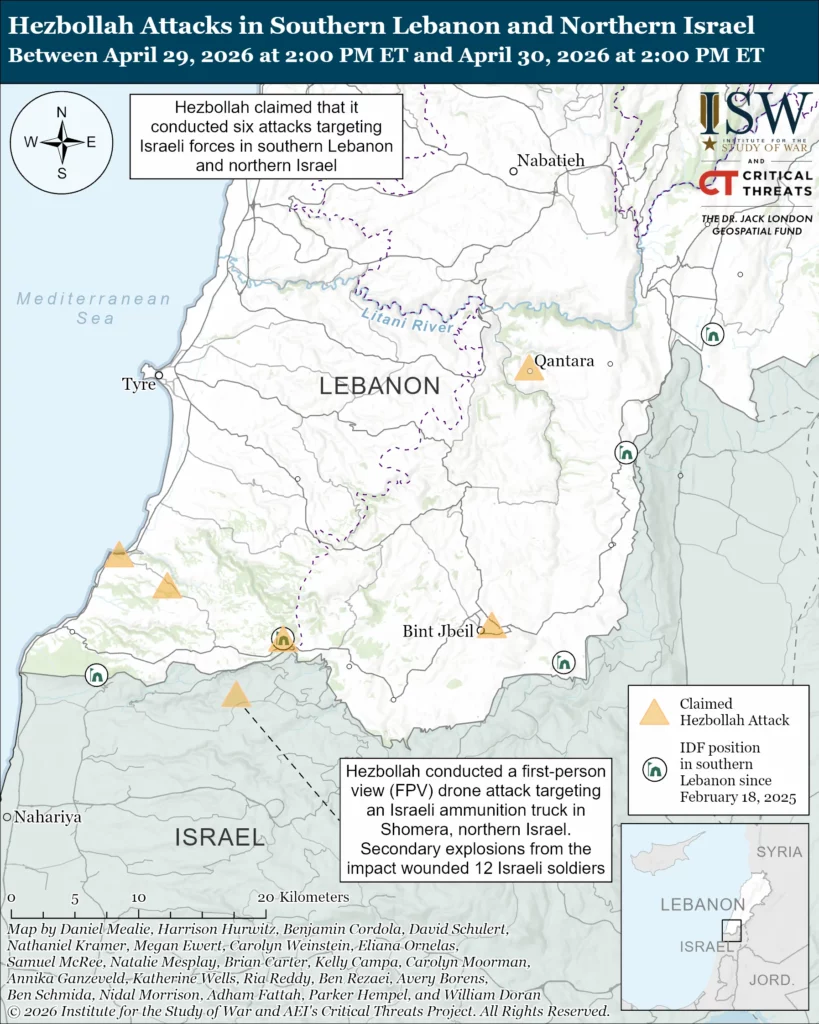
US President Donald Trump told Israeli Prime Minister Benjamin Netanyahu on April 29 to constrain Israeli military activity in southern Lebanon, amid US plans to strengthen the Lebanese government’s capability to disarm Hezbollah.[36] Trump told Netanyahu that the IDF should only conduct “surgical” military operations in Lebanon and avoid resuming “a full war.”[37] The IDF has continued to conduct airstrikes and demolitions in southern Lebanon since the beginning of the temporary ceasefire on April 16.[38] The temporary ceasefire agreement stipulates that Israel will not conduct any offensive military operations but grants Israel the right to act in self-defense against any “planned, imminent, or ongoing” Hezbollah threats against Israel.[39] Lebanese media reported that the IDF conducted at least 70 airstrikes in southern Lebanon since ISW-CTP’s data cutoff on April 29.[40] US officials have recently indicated that the United States is planning to strengthen the Lebanese Armed Forces’ (LAF) ability to disarm Hezbollah.[41] A US official told Axios on April 29 that the United States is going to “massively increase our political campaign against Hezbollah” and is looking for ways to strengthen the LAF on “a very rapid schedule.”[42] US Secretary of State Marco Rubio told Fox News on April 27 that the US is working to establish a program to train and equip “vetted” LAF units to “go after elements” of Hezbollah and disarm the group.[43]
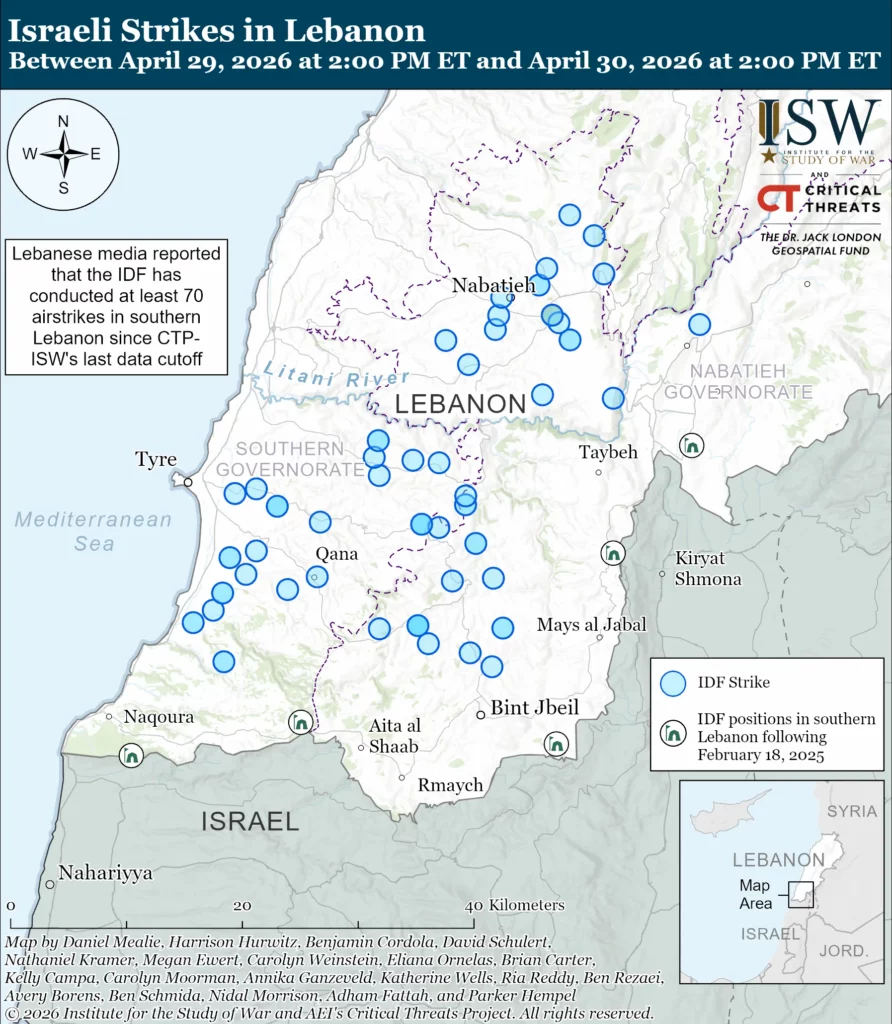
Israeli officials have warned the United States that the IDF could resume broad military operations in Lebanon in the coming weeks due to Hezbollah’s continued attacks on the IDF in southern Lebanon and northern Israeli communities. Israeli media reported on April 29 that Netanyahu asked Trump to limit Israel-Lebanon negotiations to the next two to three weeks.[44] The temporary ceasefire is set to expire on May 17.[45] Israeli officials have reportedly told US officials that the IDF will resume its “original plan” to expand military operations against Hezbollah in Lebanon if negotiations fail to produce results.[46] Axios reported on April 29 that the Israeli government is under pressure to respond to Hezbollah’s continued rocket and drone attacks in southern Lebanon and northern Israel during the ceasefire.[47] IDF Northern Command Commander Major General Rafi Milo told the heads of northern Israeli communities that the IDF is “aware of the mood at home, this is a long war.”[48] Milo also said that the Israeli military campaign in Lebanon “will not end today or tomorrow, the activity will continue for many months and we need to prepare for that.”[49] Israeli Foreign Minister Gideon Saar told Saudi media on April 29 that Israel will withdraw from southern Lebanon once there is an “effective government and military authority” in Lebanon.[50] Rubio told Fox News on April 27 that he does not believe Israel wants to remain in southern Lebanon indefinitely.[51] Rubio stated that Israel wants a strong Lebanese government that can dismantle Hezbollah.[52]
Other Axis of Resistance Response
Air defense systems shot down at least one Iranian-backed Iraqi militia reconnaissance drone near the US Embassy in Baghdad on April 29, according to Iraqi security sources speaking to Reuters.[53] Open-source intelligence accounts reported that air defense systems intercepted two Iranian-backed Iraqi militia reconnaissance drones near the embassy.[54] No Iranian-backed Iraqi militia has claimed responsibility for the reconnaissance drone at the time of this writing.