 Eurasia Press & News
Toplines
Ukrainian forces struck Russian oil infrastructure in Krasnodar and Perm krais and Orenburg Oblast between April 29 and May 1, including a strike against the Tuapse Oil Refinery for the fourth time since April 1. The Ukrainian General Staff and Unmanned Systems Forces (USF) officials reported on May 1 that Ukrainian drones struck the Tuapse Oil Refinery in Krasnodar Krai overnight on April 30 to May 1 after previously striking the refinery on the nights of April 15 to 16, 19 to 20, and 27 to 28.[1] The Ukrainian USF reported that they are still conducting the battle damage assessment (BDA) for the strike, but that the previous Ukrainian strikes on Tupase Oil Refinery destroyed at least 24 tanks, damaged at least four more, forced the plant to suspend operations, and caused several fires that took days to extinguish.[2] Satellite imagery and geolocated footage published on May 1 show fires burning at the refinery.[3] The Krasnodar Krai Operational Headquarters acknowledged that Ukrainian drone strikes caused a fire at the port of Tuapse on May 1.[4] The Ukrainian General Staff reported on May 1 that Ukrainian forces also struck the Permsky Oil Refinery in Perm Krai on the night of April 30 to May 1, causing a fire and damaging the AVT-4 primary oil refining unit.[5] The Ukrainian General Staff confirmed on April 30 that Ukrainian forces also struck the Orsknefteorgsintez Oil Refinery in Orenburg Oblast on April 29, causing a fire.[6]
The Ukrainian General Staff confirmed that Ukrainian forces recently struck several Russian aircraft up to 1,676 kilometers from the international border. The Ukrainian General Staff reported on May 1 that Ukrainian forces struck several Russian Su-57 fighter jets and Su-34 fighter-bombers at the Shagol Airfield in Chelyabinsk Oblast, approximately 1,676 kilometers from the international border, on April 25.[7] Satellite footage posted on May 1 confirms that the April 25 strikes damaged multiple planes at the Shagol Airfield.[8] Ukrainian forces also struck Mi-28 and Mi-17 helicopters at an airfield near Babky, Voronezh Oblast (roughly 150 kilometers from the frontline) on April 29 or overnight on April 29 to 30.[9]
Ukrainian strikes on Russian oil infrastructure degraded the average output of Russian oil refineries to their lowest level since December 2009. Bloomberg reported on April 30 that data from analytics firm OilX indicates that the average output of a Russian oil refinery dropped to an average of 4.69 million barrels a day, the lowest daily processing average since December 2009.[10] Ukrainian forces have notably been escalating their strike campaign against Russian oil assets in March and April 2026.[11]
Key Takeaways
Ukrainian forces struck Russian oil infrastructure in Krasnodar and Perm krais and Orenburg Oblast between April 29 and May 1, including a strike against the Tuapse Oil Refinery for the fourth time since April 1.
The Ukrainian General Staff confirmed that Ukrainian forces recently struck several Russian aircraft up to 1,676 kilometers from the international border.
Ukrainian strikes on Russian oil infrastructure degraded the average output of Russian oil refineries to their lowest level since December 2009.
Neither Russian nor Ukrainian forces made confirmed advances on the frontline.
Russian forces launched 409 drones toward Ukraine overnight.
We do not report in detail on Russian war crimes because these activities are well-covered in Western media and do not directly affect the military operations we are assessing and forecasting. We will continue to evaluate and report on the effects of these criminal activities on the Ukrainian military and the Ukrainian population and specifically on combat in Ukrainian urban areas. We utterly condemn Russian violations of the laws of armed conflict and the Geneva Conventions and crimes against humanity even though we do not describe them in these reports.
Note: ISW has changed how it reports Russian order of battle (ORBAT) details in the Russian Offensive Campaign Assessment on April 20, 2026. ISW previously published all ORBAT information collected in a daily 24-hour reporting period in the daily assessment. Moving forward, ISW will only publish ORBAT information that is new or indicates a change in Russian units’ positions, deployments, redeployments, or command and control arrangements in order to focus the daily publication on inflections and new information. ISW continues collecting a large amount of repetitive ORBAT information and can make this unpublished data available to selected readers upon request. Please contact [email protected] for any request for information.
Ukrainian Operations in the Russian Federation
See topline text for Ukrainian strikes against Russian oil infrastructure and aircraft.
Ukrainian forces continued their mid-range strike campaign against Russian drone and air defense assets in Belgorod Oblast. The Ukrainian General Staff reported on May 1 that Ukrainian forces struck a Russian drone warehouse near Dalny, Belgorod Oblast (just on the international border northeast of Kupyansk) in the past day, likely in an effort to hinder Russian drone strikes in the Velykyi Burluk and Kupyansk directions.[12] Ukrainian Unmanned Systems Forces (USF) Commander Major Robert “Magyar” Brovdi reported on May 1 that Ukrainian forces struck a Russian Nebo-M radar in Ukolovo, Belgorod Oblast (roughly 110 kilometers from the international border).[13]
Russian Supporting Effort: Northern Axis
Russian objective: Create defensible buffer zones in Sumy Oblast along the international border
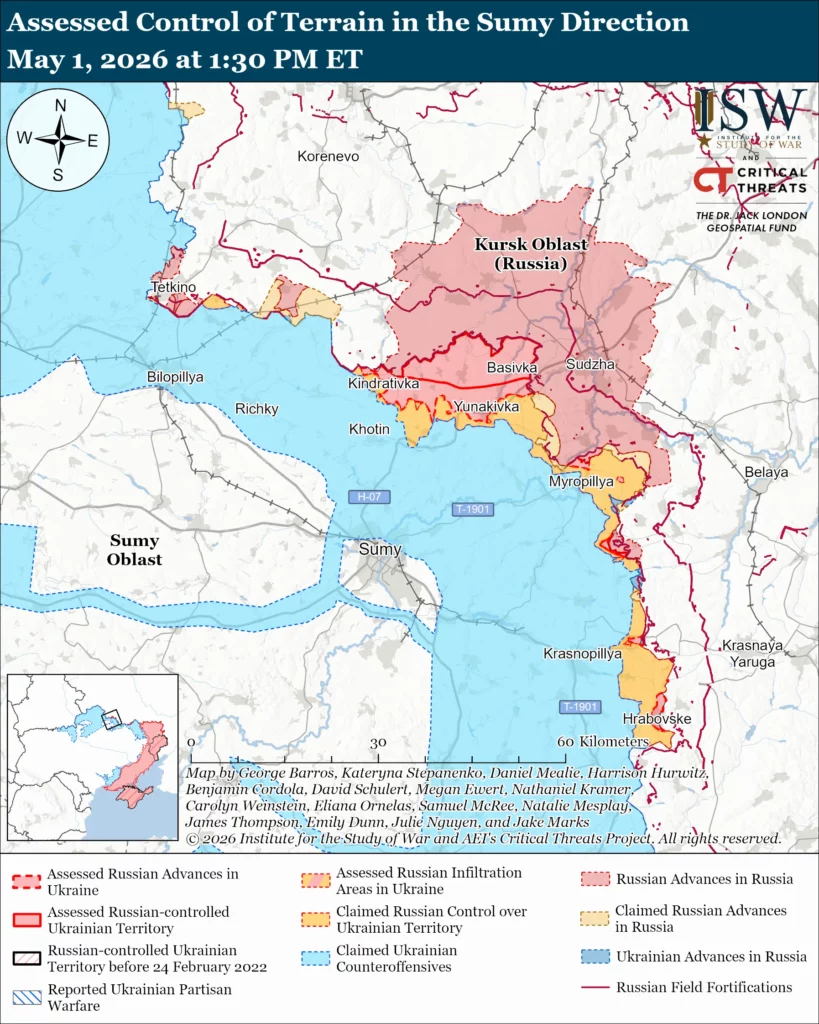
Russian forces continued to use pipelines for infiltration missions in northern Sumy Oblast on May 1 but did not advance. A spokesperson for a Ukrainian brigade operating in Sumy Oblast reported on May 1 that six Russian soldiers attempted to infiltrate Ukrainian positions in Sumy Oblast through a gas pipeline.[14] Russian forces previously conducted similar infiltration missions toward Kupyansk through gas pipes on April 24 and 27.[15]
Russian forces do not control Korchakivka (north of Sumy City), despite Russian officials’ recent claims to the contrary. The Ukrainian Kursk Grouping of Forces reported on May 1 that the Russian Ministry of Defense’s (MoD) April 30 claimed seizure of Korchakivka is false.[16] The Kursk Grouping of Forces reported that Russian officers falsely claimed to have seized the settlement because they were desperate to claim advances by May 1.
Russian Main Effort: Eastern Ukraine
Russian Subordinate Main Effort #1 – Kharkiv Oblast
Russian objective: Push Ukrainian forces back from the international border to create a defensible buffer zone with Belgorod Oblast and approach to within tube artillery range of Kharkiv City
Russian forces recently conducted an infiltration mission in the Kharkiv direction. Geolocated footage posted on May 1 shows Ukrainian forces striking a Russian servicemember in southern Vovchansk (northeast of Kharkiv City) after what ISW assesses was a Russian infiltration mission.[17]
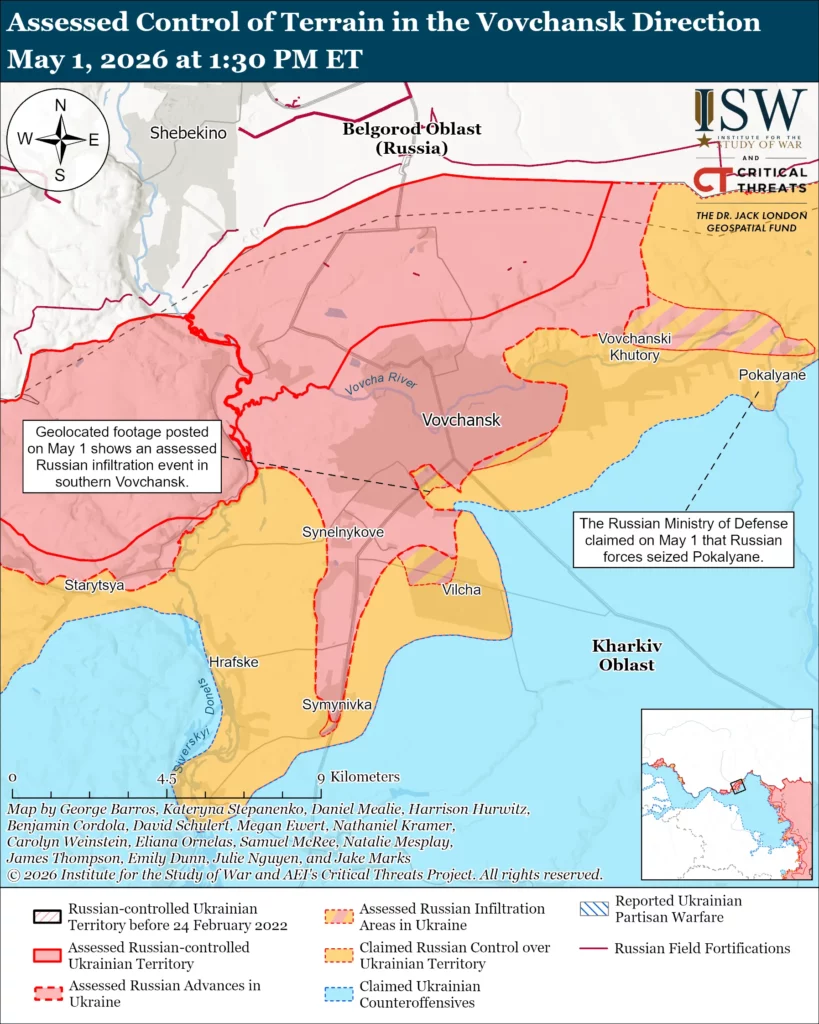
The Russian Ministry of Defense (MoD) claimed on May 1 that elements of the Russian 71st Motorized Rifle Brigade seized Pokalyane (northeast of Kharkiv City), although ISW assesses that the Russian MoD was likely referring to the 71st Guards Motorized Rifle Division (14th Army Corps [AC], Leningrad Military District [LMD]), given that multiple milbloggers referred to the formation as a division.[18] ISW has not previously observed evidence of a Russian 71st Motorized Rifle Brigade. A Russian milblogger claimed that Russian forces advanced north of Chaikivka (northeast of Kharkiv City).[19]
Neither Russian nor Ukrainian sources reported ground activity in the Velykyi Burluk direction on May 1.
Russian Subordinate Main Effort #2 – Oskil River
Russian objective: Cross the Oskil River in Kharkiv Oblast and push westward into eastern Kharkiv Oblast and northern Donetsk Oblast
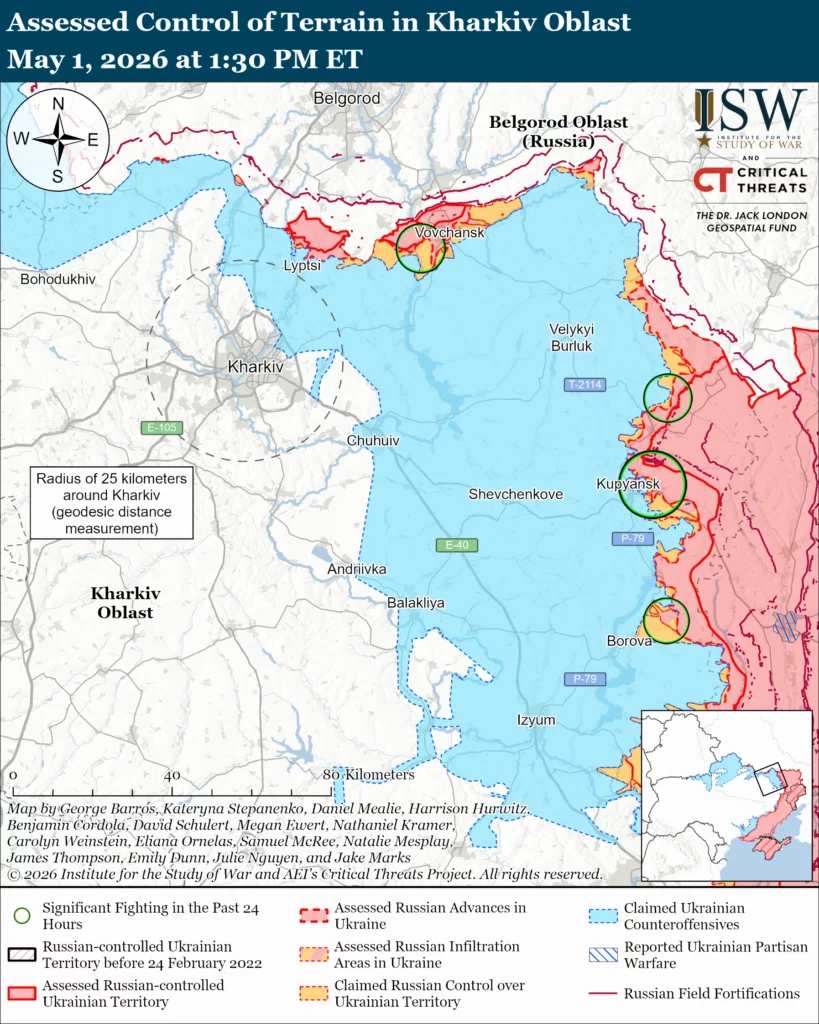
Russian forces continued offensive operations in the Kupyansk direction on May 1 but did not advance as Ukrainian forces reportedly counterattacked in the area.[20]
Ukrainian forces coordinated and conducted an attack in Kupyansk in February 2026 using solely unmanned assets. A Ukrainian brigade operating in the Kupyansk direction reported that it used unmanned aerial vehicles (UAVs) and unmanned ground vehicles (UGVs) to eliminate ten Russian servicemembers as part of a fully unmanned attack on Russian forces in Kupyansk.[21]
Russian forces continue to use pipelines to conduct small group infiltration missions in the Kupyansk direction. Ukrainian Joint Forces Task Force Spokesperson Colonel Viktor Trehubov reported May 1 that Russian forces continue to attack in the Kupyansk direction and are using pipelines to conduct small group infiltration missions.[22]
Russian forces continued offensive operations in the Borova direction on May 1 but did not make confirmed advances.[23] A Russian milblogger claimed that Russian forces advanced east of Borova.[24]
Ukrainian forces continued their mid-range strike campaign against Russian military assets in occupied Luhansk Oblast overnight on April 29 to May 1. The Ukrainian General Staff reported on May 1 that Ukrainian forces struck a Russian artillery brigade command post in occupied Lysychansk (roughly 35 kilometers from the frontline) and a Russian ammunition depot near Rovenky (roughly 125 kilometers from the frontline).[25]
Russian Subordinate Main Effort #3 – Donetsk Oblast
Russian objective: Capture the entirety of Donetsk Oblast, the claimed territory of Russia’s proxies in Donbas, and advance into Dnipropetrovsk Oblast
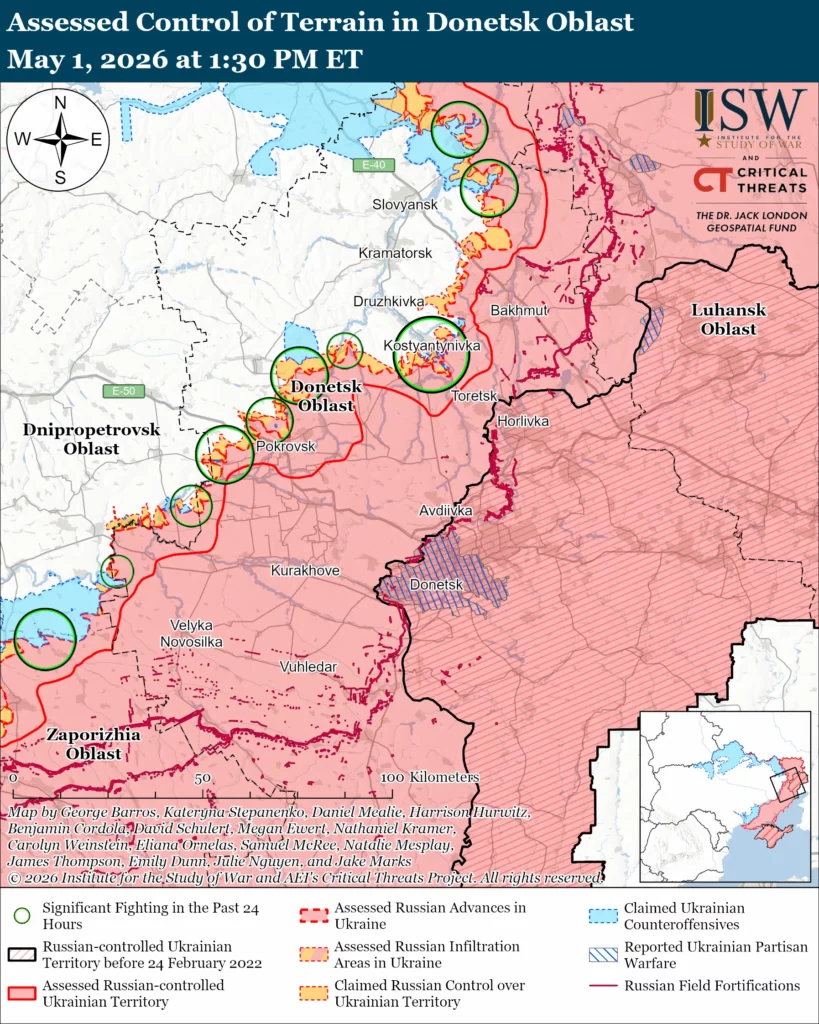
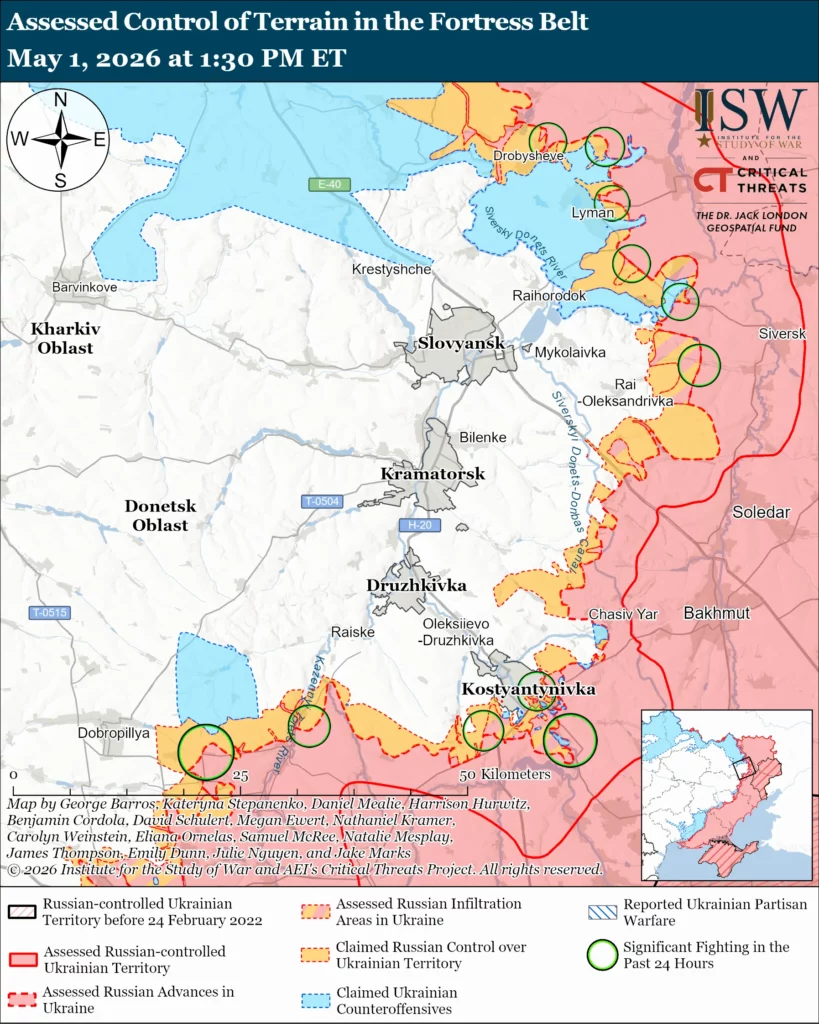
Russian forces recently conducted an infiltration mission in the Slovyansk direction and are continuing offensive operations in the Lyman and Slovyansk directions.[26] Geolocated footage published on April 30 shows Ukrainian forces striking a Russian position in central Yampil (northeast of Slovyansk) after what ISW assesses was an infiltration mission.[27]
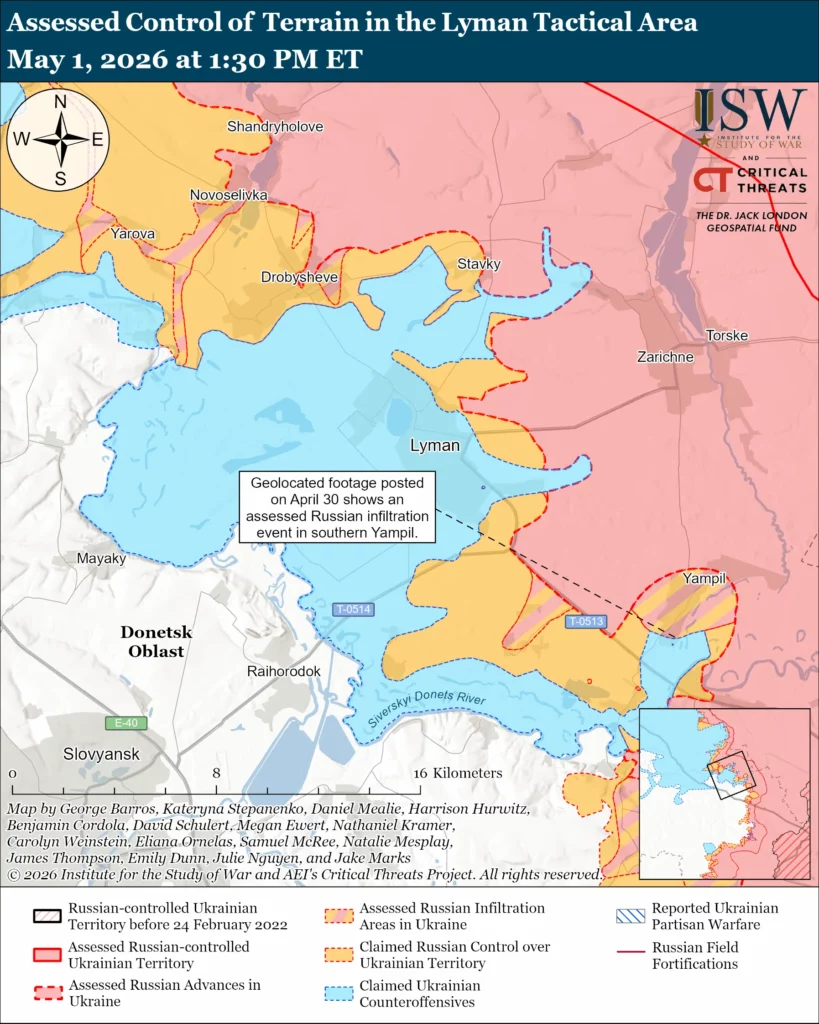
Russian forces are trying to compensate for their inability to penetrate Ukrainian tactical frontline air defenses in the Lyman direction by increasing the tempo and size of their infantry attacks. The spokesperson of a Ukrainian brigade operating in the Lyman direction reported on May 1 that Russian forces are conducting slightly fewer Molniya drone strikes as Russian forces are unable to penetrate dense frontline air defenses.[28] The spokesperson reported that Russian forces are instead conducting more attacks with larger infantry groups, resulting in higher personnel losses. The spokesperson reported that the brigade is eliminating a detachment to platoon worth of Russian personnel every day. Ukrainian 11th Army Corps (AC) spokesperson Lieutenant Colonel Dmytro Zaporozhets reported that Russian forces are unsuccessfully trying to exploit poor weather conditions and darkness to penetrate deeper into Ukrainian positions in the Slovyansk direction, including into Rai-Oleksandrivka (east of Slovyansk).[29]
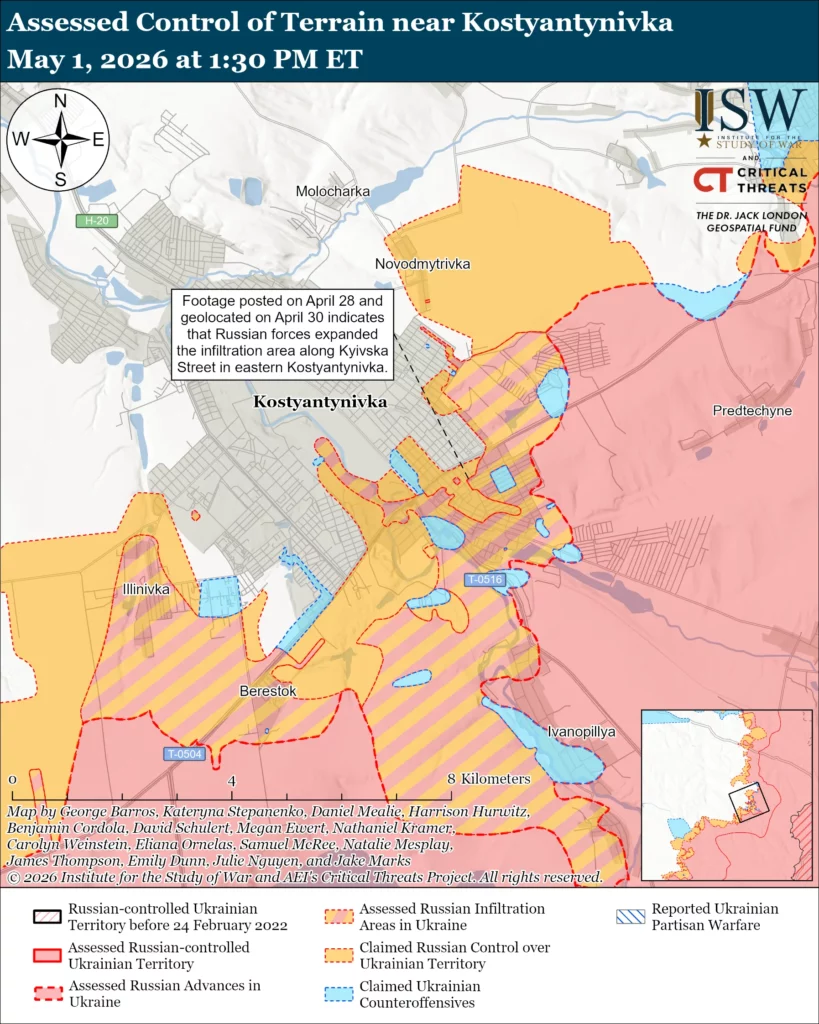
Russian forces continue to conduct infiltration missions within and near Kostyantynivka. Geolocated footage published on April 30 shows Ukrainian forces striking Russian positions in northern Berestok (south of Kostyantynivka) and in southeastern Kostyantynivka after what ISW assesses were Russian infiltration missions.[30]
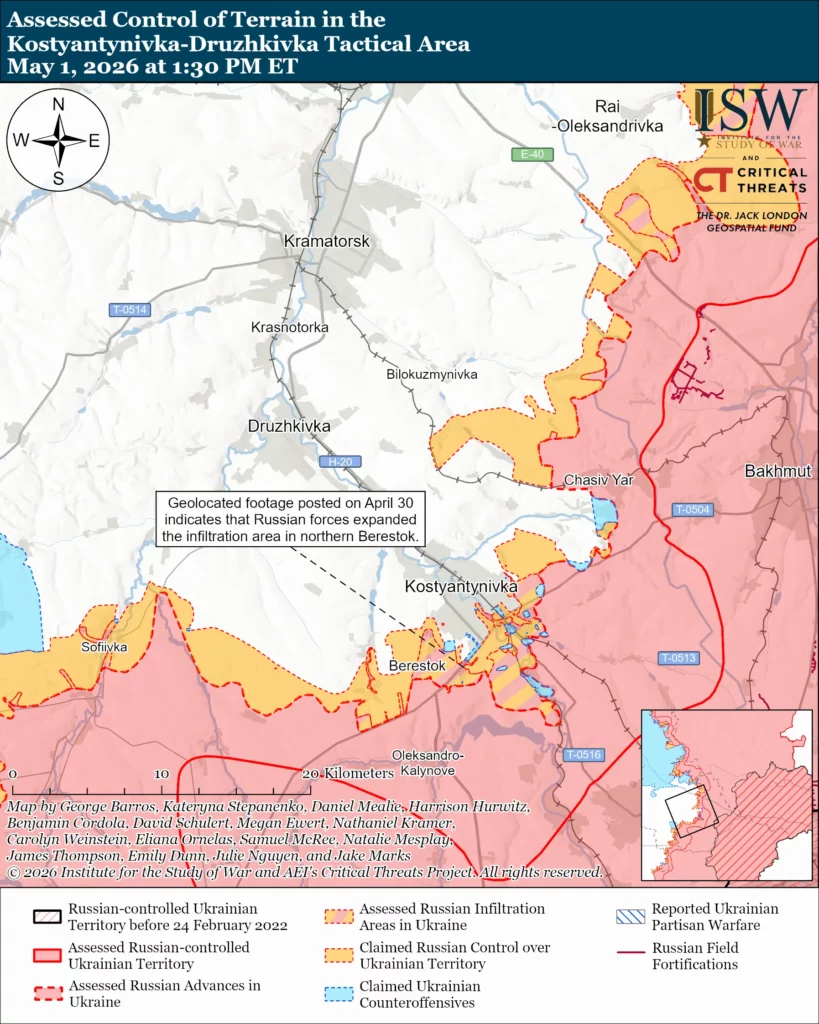
Russian artillery and strike and reconnaissance drone activity remain high in the Kramatorsk direction as Russian forces recently decreased the intensity of their ground activity. Zaporozhets reported on May 1 that Russian forces decreased the number of infantry assaults in the Kramatorsk direction in the past week (since roughly April 24).[31] Zaporozhets stated that the intensity of Russian artillery and drone strikes remains high, however. The spokesperson stated that Russian forces have used at least 100 shells in the Slovyansk and Kramatorsk directions per day for over half a year (since at least early November 2025). Zaporozhets noted that Russian forces have increased their drone strikes against infrastructure in Kramatorsk, particularly using Molniya drones and fiber optic drones. Zaporozhets reported that Russian forces use 375 to 425 first-person view (FPV) drones per day in the area, depending on the weather conditions. Zaporozhets reported that Russian forces are operating reconnaissance drones 30 to 70 kilometers from the frontline and have recently begun intensive drone reconnaissance over Kramatorsk. Zaporozhets stated that Russian forces were focusing on daytime assaults with drone support in April 2026 but also increased their nighttime ground assaults with camouflage.
Russian forces conducted limited ground attacks east of Dobropillya on May 1 but did not advance.[32] Russian forces continued attacks north, northwest, and southwest of Pokrovsk on April 30 and May 1 as Ukrainian forces counterattacked near Bilytske (north of Pokrovsk).[33]
Russian airborne (VDV) elements are trying to advance northwest of Pokrovsk as Ukrainian forces continue to operate north of the town. The Ukrainian 7th Rapid Reaction Corps of the Air Assault Forces reported, and geolocated footage confirmed, that a Ukrainian strike against central Hryshyne (northwest of Pokrovsk) eliminated elements of the Russian 76th VDV Division trying to gain a foothold in the settlement.[34] The commander of a Ukrainian unmanned systems company stated that Russian forces are trying to gain a foothold in western Hryshyne while accumulating personnel and equipment in eastern and southern Pokrovsk.[35] The commander stated that Ukrainian forces maintain positions on the northern outskirts of Pokrovsk. The commander stated that Russian forces are using fiber optic “sleeper drones” that are difficult to detect visually or acoustically.[36]
Russian forces continued limited offensive operations in the Novopavlivka and Oleksandrivka directions on April 30 and May 1 but did not advance.[37]
Russian infantrymen in the Oleksandrivka direction are reportedly attacking one at a time. The head of unmanned systems of a Ukrainian brigade operating in the Oleksandrivka direction reported on May 1 that Russian forces have been gradually reducing the size of their ground assault groups from four to six servicemembers to just single infantrymen.[38] The unmanned systems head assessed that the single infantry attacks are somewhat effective at penetrating Ukrainian defenses but that Ukrainian drone operators subsequently find the servicemembers.
Russian forces continue to strike bridges in the Ukrainian near rear to disrupt Ukrainian logistics. Geolocated footage published on May 1 shows elements of the Russian 11th Air Force and Air Defense Army (Russian Aerospace Forces [VKS] and Eastern Military District [EMD] striking two bridges across the Vovcha River east of Starokasyanivske (west of Oleksandrivka and roughly 20 kilometers from the frontline).[39]
Ukrainian forces continued their mid-range and frontline strike campaign against Russian military assets in occupied Donetsk Oblast. The Ukrainian General Staff reported that Ukrainian forces struck a Russian ammunition depot near occupied Kremenivka (roughly 90 kilometers from the frontline) on April 29 or the night of April 29 to 30.[40] The Ukrainian General Staff reported on May 1 that Ukrainian forces struck a Russian Buk-M3 air defense system near Olkhovatka (roughly 55 kilometers from the frontline), an ammunition depot near Rozdolne (roughly 110 kilometers from the frontline), and drone control points near Shevchenko (one of multiple settlements ranging from roughly 10 to 100 kilometers from the frontline) and Voskresenke (southeast of Oleksandrivka roughly two kilometers from the frontline) in the past day.[41] Ukrainian Unmanned Systems Forces (USF) Commander Major Robert “Magyar” Brovdi reported on May 1 that Ukrainian forces also struck an ammunition depot near Rovenky (possibly referring to Rovenky, Luhansk Oblast, roughly 120 kilometers from the frontline) and an equipment cache with over 30 vehicles in Bakhmut (roughly 12 kilometers from the frontline).[42] Geolocated footage confirms the strike against the ammunition depot in Rozdolne.[43]
Russian Supporting Effort: Southern Axis
Russian objective: Maintain frontline positions, secure rear areas against Ukrainian strikes, and advance within tube artillery range of Zaporizhzhia City
Russian forces recently conducted an infiltration mission in the Hulyaipole direction. Geolocated footage published on May 1 shows Ukrainian forces striking a Russian position in southeastern Novoselivka (southwest of Hulyaipole) after what ISW assesses was a Russian infiltration.[44]
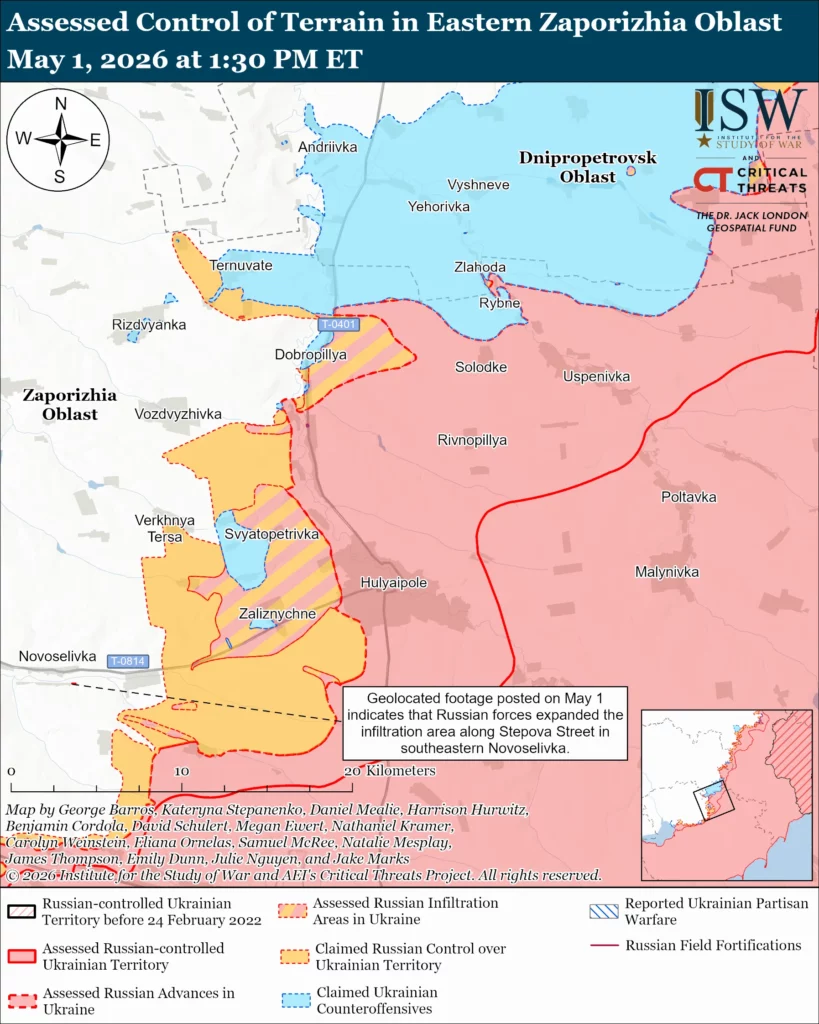
Ukrainian forces continued their frontline strike campaign against Russian military assets in the Hulyaipole direction. The Ukrainian General Staff reported on May 1 that Ukrainian forces struck a Russian drone control point near Hulyaipole.[45]
Russian forces continued limited offensive operations in Zaporizhia Oblast on May 1 but did not advance.[46]
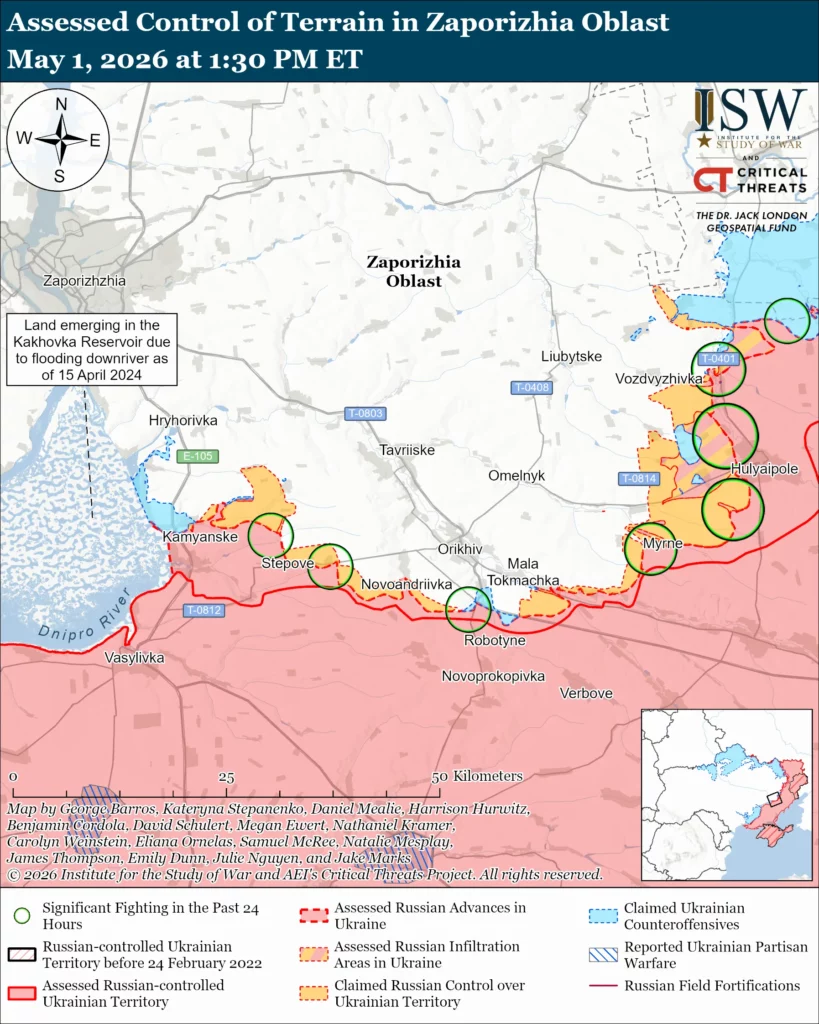
Ukrainian forces continued mid-range strikes against Russian military assets in occupied Zaporizhia Oblast on April 30 and May 1. The Ukrainian General Staff reported on May 1 that Ukrainian forces struck a Russian material and technical resource warehouse near occupied Melitopol (roughly 80 kilometers from the front line).[47] Ukraine’s Southern Operational Command reported on April 30 that Ukrainian forces struck a Russian 240mm “Tulip” self-propelled gun in Zaporizhia Oblast.[48]
Russian forces continued limited ground attacks in the Kherson direction on May 1, including in the Dnipro River Delta, but did not advance.[49]
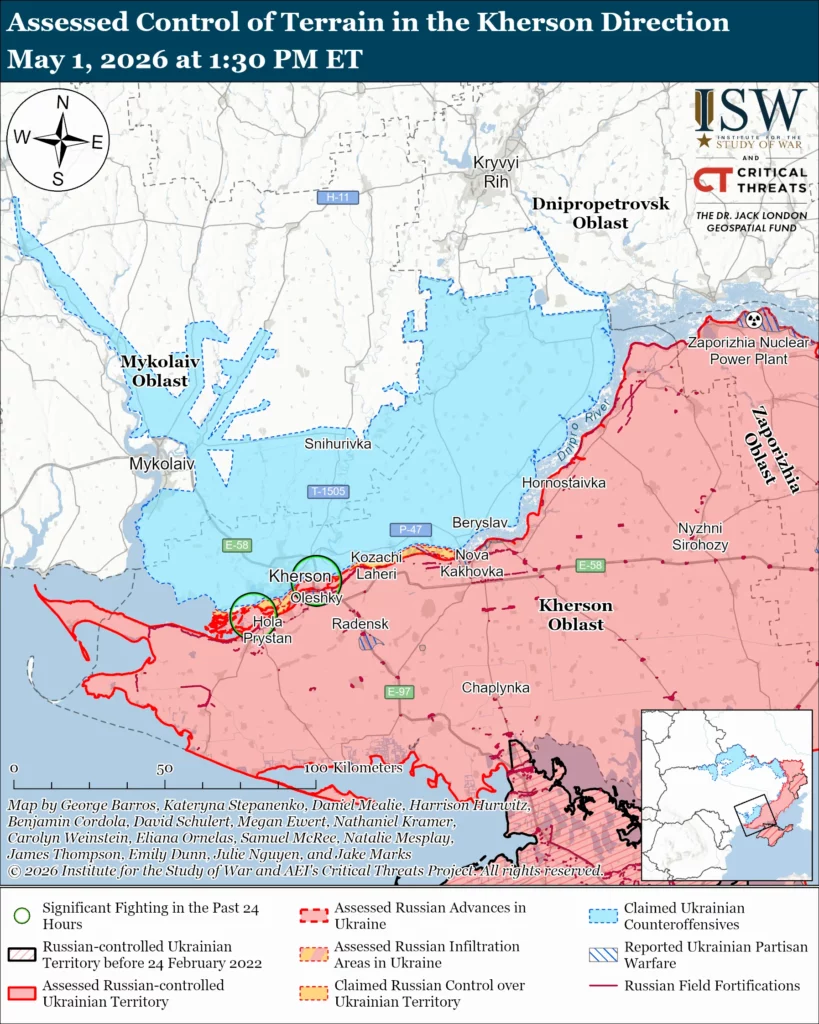
Ukrainian forces continued their long-range strike campaign against Russian military assets in occupied Kherson Oblast on April 30 and May 1. The Ukrainian General Staff reported on May 1 that Ukrainian forces struck a Russian command and observation post near occupied Kairyi, along the Dnipro River.[50]
Ukrainian forces continued their long-range strike campaign against Russian military assets in occupied Crimea on the night of April 29 to April 30. The Ukrainian General Staff reported Ukrainian forces struck Russian boats in the Black Sea on the night of April 29 to April 30.[51]
Russian Air, Missile, and Drone Campaign
Russian Objective: Target Ukrainian military and civilian infrastructure in the rear and on the front line
Russian forces conducted a series of drone strikes against Ukraine on the night of April 30 to May 1. The Ukrainian Air Force reported that Russian forces launched 409 Shahed, Gerbera, Italmas, and other drones — of which roughly 388 were Shaheds, including jet-powered Shaheds — from the directions of Kursk and Oryol cities; Millerovo, Rostov Oblast; Primorsko-Akhtarsk, Krasnodar Krai; Shatalovo, Smolensk Oblast; occupied Donetsk City; and occupied Hvardiiske, Crimea.[52] The Ukrainian Air Force reported that Ukrainian forces downed 388 drones, that 16 drones struck six locations, and that debris fell on 11 locations. Ukrainian officials reported that Russian forces struck administrative, energy, port, railway, and residential infrastructure in Dnipropetrovsk, Kharkiv, Mykolaiv, Odesa, Rivne, Sumy, Ternopil, Vinnytsia, Zaporizhia, and Zhytomyr oblasts.[53] Kharkiv Oblast General Prosecutor Dmytro Yatsychenko reported on May 1 that Russian forces struck at least three gas stations in Kharkiv Oblast, likely with artificial intelligence-equipped V2U drones.[54]
Significant Activity in Belarus
Russian efforts to increase its military presence in Belarus and further integrate Belarus into Russian-favorable frameworks
Nothing Significant To Report.