 Eurasia Press & News
The Institute for the Study of War (ISW) and The Critical Threats Project (CTP) at the American Enterprise Institute are publishing daily updates to provide analysis on the war with Iran. The updates focus on US and Israeli strikes on Iran and Iran and the Axis of Resistance’s response to the strikes. The updates cover events from the past 24-hour period.
NOTE: ISW-CTP will continue posting morning social media threads on an as-needed basis starting April 28, 2026, for the duration of the ceasefire. We will continue providing long-form analysis on the state of the Iran War in our daily Iran Update Special Reports.
Key Takeaways
US Central Command (CENTCOM) announced on May 7 that US forces “eliminated inbound threats” and struck Iranian military facilities responsible for attacks on US forces after Iran targeted US naval assets in and around the Strait of Hormuz. CENTCOM stated that the United States “does not seek escalation.”
The United States and Iran remain divided over key issues, particularly issues related to Iran’s nuclear program and Iranian efforts to assert sovereignty over the Strait of Hormuz. Iran’s highly enriched uranium (HEU) stockpile and enrichment activities are some of the main obstacles to a deal.
Iran is increasingly attempting to formalize recognition of its sovereignty over the Strait of Hormuz in a way that would fundamentally remake regional and global maritime norms in a manner extremely detrimental to US interests.
Iranian regime media highlighted a meeting between Iranian Supreme Leader Mojtaba Khamenei and President Masoud Pezeshkian, likely to display unity amid reports of divisions within the regime. Pezeshkian reportedly sought an emergency meeting with Mojtaba to ask him to stop the IRGC’s attacks on the UAE and to prevent their reoccurrence. The fact that Iranian media and Mojtaba’s office have not provided details about what Mojtaba and Pezeshkian discussed suggests that Pezeshkian did not convince Mojtaba to alter the regime’s current policies.
Toplines
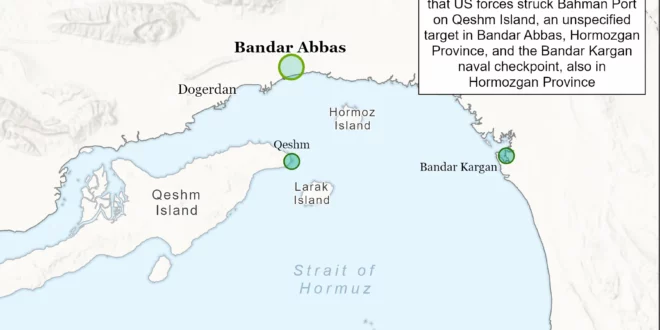
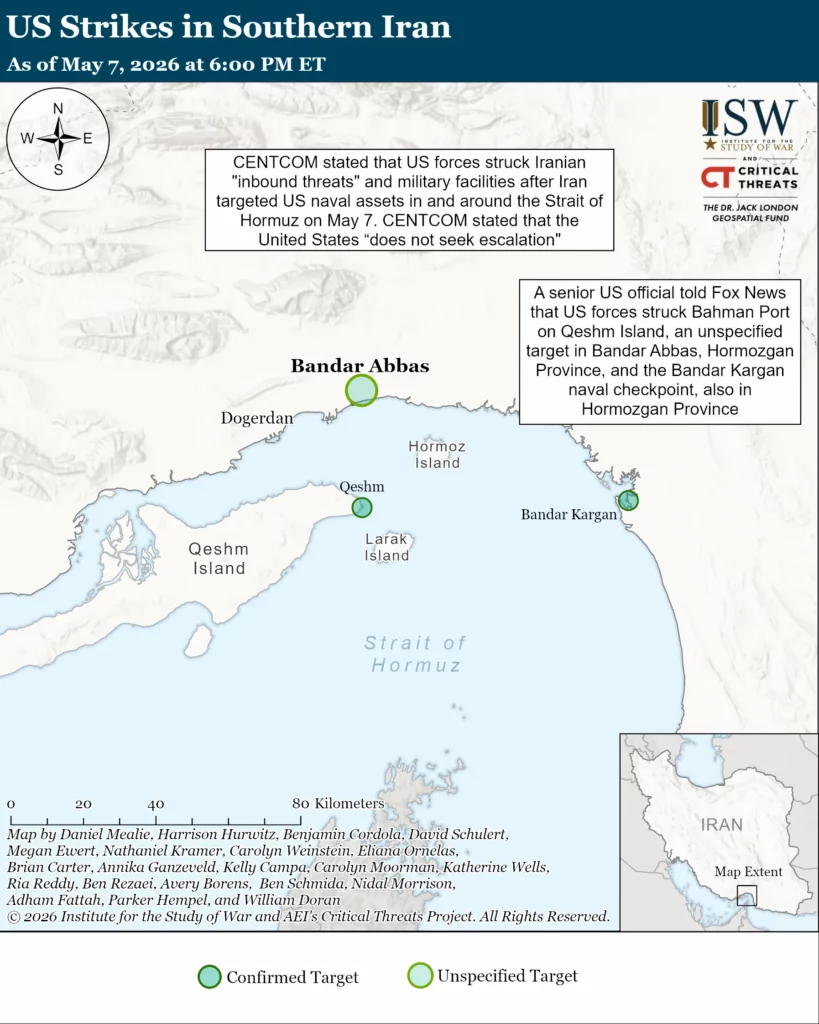
US Central Command (CENTCOM) announced on May 7 that US forces “eliminated inbound threats” and struck Iranian military facilities responsible for attacks on US forces after Iran targeted US naval assets in and around the Strait of Hormuz.[1] CENTCOM stated that the United States “does not seek escalation.” CENTCOM reported that Iranian forces launched multiple missiles, drones, and fast attack craft at US naval assets, including the USS Truxtun, USS Rafael Peralta, and USS Mason, while the vessels were transiting the strait. CENTCOM confirmed that the munitions did not hit any US assets. US forces subsequently struck Iranian military targets responsible for the attacks, including missile and drone launch sites, command-and-control centers, and intelligence, surveillance, and reconnaissance sites. A senior US official told Fox News that US forces struck Bahman Port on Qeshm Island, an unspecified target in Bandar Abbas, Hormozgan Province, and the Bandar Kargan naval checkpoint, also in Hormozgan Province.[2] The official added that the strikes do not indicate a resumption of the war.[3]
Iranian media claimed that Iran fired missiles at US warships south of Chabahar Port after US forces targeted two Iranian vessels near Jask, Hormozgan Province, and Fujairah Port in the United Arab Emirates (UAE).[4] Khatam ol Anbia Central Headquarters Spokesperson Ebrahim Zolfaghari warned Emirati civilians to “stay away from oil and military centers” following the attacks.[5] The recent strikes follow a series of Iranian attacks against the UAE on May 4 and 5, including a strike on the Fujairah Petroleum Industrial Zone, a key port that the UAE uses to bypass the strait.[6] ISW-CTP will continue to monitor this situation and provide further analysis in its May 8 morning thread on X.
The United States and Iran remain divided over key issues, particularly issues related to Iran’s nuclear program and Iranian efforts to assert sovereignty over the Strait of Hormuz. The Wall Street Journal, citing senior US officials, reported on May 6 that the US Government has seven main demands.[7] These demands include the dismantlement of Fordow, the Esfahan Nuclear Technology Center, and Natanz, a ban on underground nuclear activities, on-demand inspections, a 20-year moratorium on enrichment, an Iranian commitment not to seek a nuclear weapon, the removal of all enriched nuclear material from Iran, and the reopening of the Strait of Hormuz.[8] Iranian officials continue to reject many of these demands, however.[9] Parliamentary National Security and Foreign Policy Commission Vice Chairman Behnam Saeedi stated on May 7 that Iran’s red lines include enrichment, the Strait of Hormuz, complete sanctions relief, and the release of frozen Iranian assets.[10] Saeedi added that negotiations will fail if the United States does not accept Iran’s “right” to enrichment.[11] Unspecified individuals familiar with the matter told the Wall Street Journal on May 6 that key issues, including the length of any enrichment moratorium, the possible removal of Iran’s HEU from Iran, and Iran’s assertion of sovereignty over the Strait of Hormuz, “remain unresolved and are expected to complicate any talks.”[12]
Iran’s highly enriched uranium (HEU) stockpile and enrichment activities continue to be some of the main obstacles to a deal. Israeli media reported on May 6 that US President Donald Trump insists on the removal of Iran’s HEU stockpile from Iran and will not sign an agreement that does not address that demand.[13] Armed Forces General Staff (AFGS)-run Defa Press rejected on May 7 both diluting and handing over Iran’s HEU, stating that diluting uranium is equivalent to handing over uranium to “the enemy.”[14] Three Iranian officials similarly told the New York Times on May 7 that talks with the United States remain stalled over US demands that Iran commit in advance to hand over its HEU stockpile, close the Fordow, Natanz, and Esfahan nuclear facilities, and suspend enrichment for 20 years.[15] The officials stated that Iran has instead proposed diluting “some” of its HEU stockpile, transferring the remainder to a third country, possibly Russia, and suspending enrichment for 10 to 15 years.[16] Iranian officials also appear divided over how much the regime should concede on the nuclear file.[17] ISW-CTP previously assessed that Islamic Revolutionary Guards Corps (IRGC) Commander Major General Ahmad Vahidi, who has not publicly indicated any willingness to concede on these nuclear issues, is currently the main decisionmaker in the regime..[18]
Iran is increasingly attempting to formalize recognition of its sovereignty over the Strait of Hormuz in a way that would fundamentally remake regional and global maritime norms in a manner extremely detrimental to US interests. Iran recently designed and implemented a new system under which vessels receive transit regulations and instructions by email and must comply with Iranian procedures to obtain authorization for passage through the strait.[19] CNN reviewed a “Vessel Information Declaration” form on May 7, which was issued by Iran’s Persian Gulf Strait Authority, that requires vessels to provide extensive ownership, nationality, and crew information before being granted permission to transit through the strait.[20] Iranian parliamentarians stated that vessels cannot pass through the strait without accepting Iranian sovereignty over the strait and argued that the United States must submit to Iran’s “new legal regime” in the waterway.[21] Supreme Leader Military Adviser Major General Mohsen Rezaei told Hezbollah-affiliated Al Mayadeen on May 6 that Iran has two main objectives in the Strait of Hormuz: “security” and trade.[22] Rezaei argued that Iran must control and manage the strait because the United States and Israel used the strait and the Persian Gulf to attack Iran during the war.[23] Iranian officials’ statements indicate that Iran is trying to secure long-term recognition of its control over strait transit.
Iranian regime media highlighted a meeting between Iranian Supreme Leader Mojtaba Khamenei and President Masoud Pezeshkian, likely to display unity amid reports of divisions within the regime. Iranian state media reported on May 7 that Pezeshkian met with Mojtaba for nearly two and a half hours but did not provide details about what Mojtaba and Pezeshkian discussed.[24] Pezeshkian stated after the meeting that Mojtaba’s “behavior can naturally be a model for the country’s management and administrative system.”[25] This meeting comes after anti-regime media reported on May 5 that Pezeshkian was “angry” with IRGC Commander Major General Ahmad Vahidi’s decision to attack the United Arab Emirates (UAE).[26] Pezeshkian reportedly sought an emergency meeting with Mojtaba to ask him to stop the IRGC’s attacks on the UAE and to prevent their reoccurrence.[27] The fact that Iranian media and Mojtaba’s office have not provided details about what Mojtaba and Pezeshkian discussed suggests that Pezeshkian did not convince Mojtaba to alter the regime’s current policies. ISW-CTP continues to assess that Vahidi is the regime’s primary decisionmaker. Israeli media reported on April 19 that Vahidi is the only Iranian official with direct access to Mojtaba and is serving as a conduit for relaying key decisions to other regime officials.[28] Anti-regime media previously reported on April 1 that Pezeshkian had repeatedly tried to contact Mojtaba, but that a “military council” formed by Vahidi had prevented Pezeshkian from contacting Mojtaba.[29]
Maritime Development
See topline section.
US and Israeli Air Campaign
The Institute for Science and International Security reported on May 6 that Iran has taken steps to limit access to the Mount Kolang Gaz La facility, which is located south of the Natanz Enrichment Complex in Esfahan Province.[30] The Institute, citing commercially available satellite imagery, reported that Iran has partially closed two of the facility’s tunnel entrances with earthen material as of April 22. The Institute noted that the tunnel entrances were unobstructed in early April.[31] The Institute added that the tunnel entrances at the Kolang Gaz La facility are not completely obstructed like the tunnel entrances at Fordow or the Esfahan Nuclear Technology Center but would hinder vehicles from entering or exiting the facility and require heavy equipment to restore access.[32] The Institute reported that the US-Israeli combined force previously struck a vehicle at the site on March 6.[33] The Institute previously reported in 2024 that the Kolang Gaz La facility was slated to host an advanced centrifuge assembly site.[34]
Iranian Response
See topline section.
Israeli Campaign Against Hezbollah and Hezbollah Response
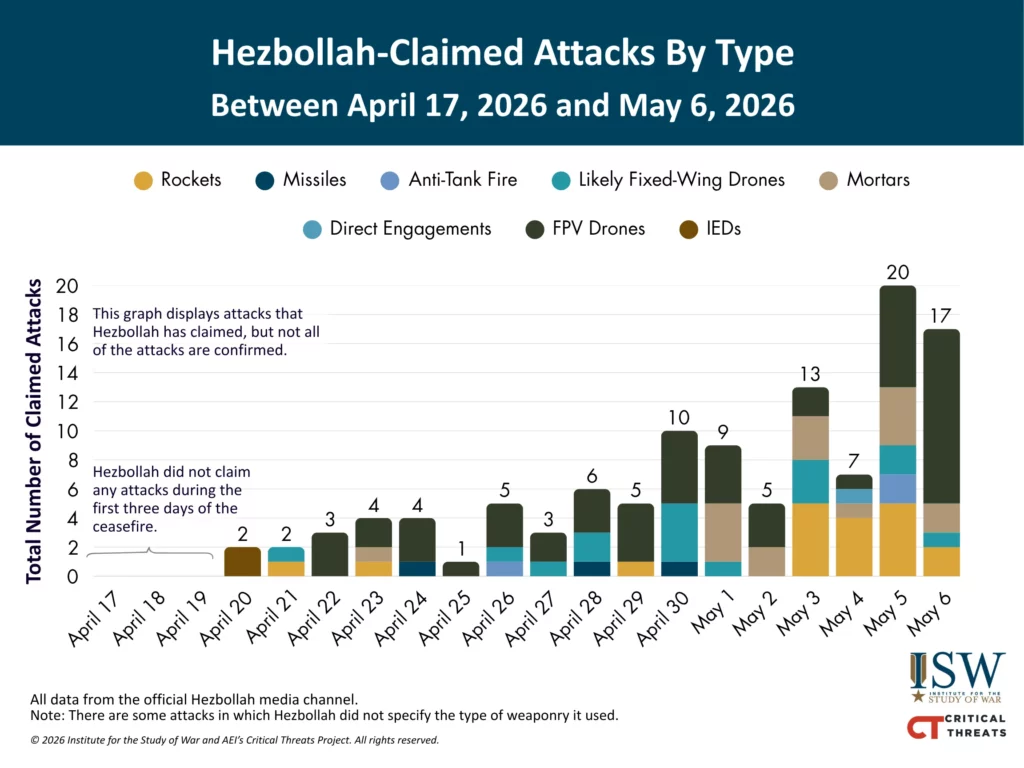
Hezbollah and the Israel Defense Forces (IDF) have continued to conduct attacks against each other. Hezbollah has conducted 12 small-scale attacks, including six first-person view (FPV) drone attacks, against Israeli forces in southern Lebanon since ISW-CTP’s last data cutoff on May 6.[35] These attacks are a continuation of Hezbollah’s likely attempt to disrupt Israeli operations by using harassing fire, which is fire that is intended to disrupt enemy troop and vehicle movement, disturb their rest, and lower their morale.[36] The IDF and an Israeli Army Radio correspondent recently reported that Hezbollah’s drone attacks have caused 41 IDF casualties, including three deaths, since the start of the ceasefire on April 16.[37] Hezbollah Secretary General Naim Qassem confirmed on May 4 that Hezbollah fighters are currently conducting attacks designed to maximize Israeli casualties.[38] Hezbollah likely seeks to keep casualty rates at a level that would impose political pressure that causes the IDF to relent and end operations but would not warrant a resumption in fighting. The IDF continued to conduct airstrikes targeting Hezbollah infrastructure and weapons, including drone infrastructure, across southern Lebanon on May 6 and 7.[39] The IDF struck 20 Hezbollah targets, including a drone launch site, other drone infrastructure, and weapons manufacturing sites, in Nabatieh District, southeastern Lebanon, on May 7.[40] The IDF has continued to develop and deploy FPV drone countermeasures for IDF units operating in southern Lebanon, including issuing anti-drone nets, mobile radar systems, and shotguns to Israeli soldiers.[41] ISW has observed in the war in Ukraine that the development of successful drone countermeasures requires a rapid innovation cycle, which involves countermeasure prototype testing by frontline units who can communicate with defense industry partners to adapt these prototypes to frontline conditions and then quickly redeploy these adapted countermeasures back to the frontline units.[42] The IDF also confirmed on May 7 that it has killed over 85 Hezbollah fighters and struck over 180 Hezbollah sites in Lebanon over the past week.[43] These strikes are part of the IDF’s effort to remove any immediate threat to Israeli forces and degrade Hezbollah’s ability to launch attacks against Israeli forces.[44]
Other Axis of Resistance Response
Iranian-backed Badr Organization head Hadi al Ameri has reportedly formed a committee with Iraqi Prime Minister-designate Ali al Zaidi and caretaker Prime Minister Mohammad Shia al Sudani to develop a plan to disarm Iranian-backed Iraqi militias.[45] US-funded Arabic media reported on May 5 that the Shia Coordination Framework, which is a loose coalition of Shia political parties, compelled the three officials to convene and develop an “implementable” plan to restrict arms to the Iraqi government.[46] Ameri met with Zaidi on May 7 to discuss government formation and the need for unity among “national political forces.”[47] An unnamed Shia Coordination Framework source claimed that several Iranian-backed Iraqi militias, including Asaib Ahl al Haq and the Imam Ali Brigades, have expressed support for the disarmament initiative if it incorporates the militias’ unspecified conditions for disarmament.[48] An unnamed Iraqi National Security Council official stated that Iranian-backed Iraqi militias Kataib Hezbollah and Harakat Hezbollah al Nujaba have rejected disarmament.[49] Harakat Hezbollah al Nujaba leader Akram al Kaabi rejected militia disarmament on May 6 and called the group’s weapons a “red line.”[50]
The Shia Coordination Framework’s disarmament initiative intends to relieve US pressure on the Iraqi government amid US demands to disarm Iraqi militias.[51] An unnamed Shia Coordination Framework source said that the committee’s militia disarmament plan is intended to be “presentable” to the United States and “reassure” US officials.[52] These reports come after Iraqi media reporting on May 5 that IRGC Quds Force Commander Brigadier General Esmail Ghaani has directed unspecified Iranian-backed Iraqi actors to end the kinetic operations of Iraqi militias.[53] Ghaani has reportedly called on several Iraqi militias to end their kinetic activity in exchange for positions within the Iraqi state.[54]
The US Treasury Department sanctioned Iraq’s deputy oil minister on May 7 for helping Iran evade sanctions by blending Iranian oil with Iraqi crude. These sanctions are part of the United States’ effort to put pressure on the Iranian economy and Iranian-backed Iraqi militias.[55] The Treasury Department’s Office of Foreign Assets Control (OFAC) stated on May 7 that Iraqi Deputy Oil Minister Ali Maarij al Bahadly facilitated the smuggling of several million dollars’ worth of Iraqi oil per day to a prominent Iranian-linked Iraqi oil smuggler, Salim Ahmed Said, who combined the Iraqi oil with Iranian crude.[56] OFAC added that Maarij falsified documents, enabling the blended oil to be sold as Iraqi oil. Maarij also diverted Iraqi oil to Iranian-backed Iraqi militia Asaib Ahl al Haq.[57] Treasury Secretary Scott Bessent said that the United States “will not stand idly by as Iran’s military exploits Iraqi oil to fund terrorism against the United States and our partners.”[58] OFAC previously sanctioned Said in 2025 for smuggling Iranian oil disguised as Iraqi oil, which was then sold to Western buyers via Iraq or the UAE as Iraqi oil.[59] OFAC also sanctioned three senior Iranian-backed Iraqi militia leaders, including leaders from Kataib Sayyid al Shuhada and Asaib Ahl al Haq, in addition to Maarij, on May 7.[60] These sanctions follow the Treasury Department’s decision on April 22 to temporarily halt shipments of Iraq’s oil export revenue via the US Federal Reserve due to concerns about Iranian-backed Iraqi militia behavior.[61]