 Eurasia Press & News
Toplines
Ukraine unilaterally enacted a ceasefire starting at midnight on the night of May 5 to 6 in response to Russia’s unilaterally declared Victory Day ceasefire planned for May 9. Ukrainian President Volodymyr Zelensky’s declared on May 4 that Ukraine would unilaterally enact a ceasefire starting at midnight on the night of May 5 to 6 and would maintain the ceasefire if Russia reciprocates it – identical terms to the unilateral ceasefire that the Kremlin offered Ukraine for May 9.[1] Zelensky offered Russia a ceasefire beginning on the night of May 5 to 6 roughly an hour after the Russian Ministry of Defense (MoD) unilaterally announced that it will observe a “Victory Day” ceasefire from May 8 to 9.[2] The Kremlin did not acknowledge Zelensky’s statement about the May 5 to 6 unilateral Ukrainian ceasefire, however. Zelensky stated on May 6 that Russia effectively rejected the ceasefire by continuing assaults and conducting at least 20 air strikes with over 70 glide bombs overnight and on the morning of May 6.[3] Russian President Vladimir Putin has previously declared four theater-wide unilateral ceasefires, including most recently for Orthodox Easter on April 11 to 12.[4] Russia previously accused Ukraine of violating its unilateral 2025 Victory Day ceasefire, despite Ukraine never officially agreeing to the ceasefire.[5]
The Russian military ignored Ukraine’s unilaterally-declared ceasefire and the Kremlin accused Ukraine of violating the ceasefire despite the fact that Russian forces conducted combat missions after the unilateral Ukrainian ceasefire began in the morning of May 6. Russian and occupation officials coalesced around Ukrainian strikes against occupied Dzhankoy, Crimea conducted during the late night of May 5 before the Ukrainian unilateral ceasefire began at midnight on May 6, falsely claiming that Ukraine violated its own ceasefire.[6] Crimean occupation head Sergei Aksyonov claimed just before 2230 local time on May 5 that Ukrainian drones were targeting occupied Crimea then claimed just 10 minutes after midnight on May 6 that Ukrainian forces struck occupied Dzhankoy, suggesting that Ukraine conducted the strikes before the ceasefire.[7] Two Russian State Duma deputies additionally acknowledged that the Ukrainian strike occurred shortly before the start of the ceasefire at midnight.[8] The Russian accusation is not compelling as combat missions that occur before a ceasefire do not violate the ceasefire. Furthermore, Russian forces previously have conducted strikes and ground operations right up to the start of previous ceasefires, including Russia’s own unilaterally imposed ceasefires, such as the April 2025 30-hour truce, the May 2025 Victory Day ceasefire, and the April 2026 Orthodox Easter ceasefire.[9] Russia has also frequently violated its own unilaterally-declared ceasefires and Russian and Ukrainian officials have repeatedly accused each other of violating such ceasefires.[10] Russian forces notably executed four Ukrainian prisoners of war (POWs) – a war crime that violates the Geneva Convention on the Treatment of POWs – amid the Kremlin-declared Easter ceasefire on April 11 to 12.[11]
Russia decisively ignored the Ukrainian ceasefire and launched a series of drones and missiles that killed at least 21 civilians and injured at least 82. The Ukrainian Air Force reported on May 6 that Russian forces launched two Iskander-M ballistic missiles, one Kh-31 cruise missile, and 108 Shahed, Gerbera, Italmas, Parodiya, and other drones against Ukraine between 1830 on May 5 to 0800 on May 6 local time.[12] The Ukrainian Air Force reported that Ukrainian forces downed 89 drones, that all three missiles and nine drones struck eight locations, and that downed debris fell on one location as of 0800 local time. Zaporizhia Oblast Military Administration Head Ivan Fedorov reported that Russian forces launched two missiles against Zaporizhzhia City, killing 12 civilians and injuring 51 others.[13] Donetsk Oblast Police reported that Russian forces conducted three FAB-250 glide bomb strikes against Kramatorsk, killing at least five and injuring at least 12.[14] Ukrainian officials reported that Russian forces launched a ballistic missile against Dnipro City, Dnipropetrovsk Oblast, on the night of May 5 killed at least four civilians and injured at least 19 others.[15] Ukrainian officials reported that Russian strikes also targeted Kharkiv and Sumy oblasts.[16] Russian forces have conducted two consecutive relatively small strike packages containing ballistic missiles on May 4 to 5 and 5 to 6 that have inflicted extremely high civilian casualties.
Russian and Ukrainian unilateral ceasefires and accusations of ceasefire violations continue to demonstrate the necessity that any ceasefire or peace agreement be formally agreed to in advance by all parties and include robust monitoring mechanisms. The prevalence of mutual accusations and continued ground activity from the early hours of the ceasefire highlights the fact that ceasefires without explicit enforcement mechanisms, credible monitoring, and defined dispute resolution processes are unlikely to hold.[17] Any durable cessation of hostilities will require both sides to establish clear terms, implement third-party monitoring systems, and withdraw forces from the line of contact to reduce the risk of violations and escalation.[18]
Russian efforts to shield the Russian populace from the effects of rising global oil prices and damages to Russian oil infrastructure are preventing Russia from realizing the full benefits of increased oil and gas revenue. The Russian Ministry of Finance released data on May 6 and claimed that Russia’s oil and gas revenues doubled in April 2026 compared toMarch 2026, amidst rising global oil prices due to the conflict in Iran.[19] The Russian Ministry of Finance claimedthat the federal budget received nearly 917 billion rubles (roughly $12 billion) from mineral extraction taxes in April 2026 — almost double the 443 billion rubles (roughly $6 billion) recorded in March 2026 — with oil revenues accounting for 771 billion rubles (roughly $10 billion).[20] Russian opposition source Vlast (formerly Faridaily) noted that the data shows that Russia simultaneously significantly increased subsidies to Russian oil companies — allocating nearly 350 billion rubles (roughly $4.68 billion) — to keep gasoline prices low and to modernize and repair refineries amid Ukraine’s long-range strike campaign against Russia’s oil export capabilities.[21] Vlast / Faridaily noted that these payments largely offset the additional revenue that Russia’s federal budget received from higher oil prices, with oil and gas revenues totaling about 856 billion rubles (roughly $11.4 billion) in April, compared to a forecast of 835 billion rubles (roughly $11.2 billion). An unnamed source in the Russian Ministry of Finance told Vlast / Faridaily that the Ministry of Finance expects oil and gas revenues to grow in May 2026 and that Finance Minister Anton Siluanov’s recent statement about an expected additional 200 billion rubles (roughly $2.7 billion) referred specifically to Russia’s budget estimates for May 2026.[22] Ukraine’s intensifying long-range strike campaign against Russian oil infrastructure in the Russian rear is likely to continue to impact Russia’s revenues from oil and gas exports as Russia’s key oil ports, such as Ust-Luga and Primorsk in Leningrad Oblast, operate below capacity, preventing the Kremlin from fully benefitingfrom higher oil prices and the easing of US sanctions.[23]
Key Takeaways
Ukraine unilaterally enacted a ceasefire starting at midnight on the night of May 5 to 6 in response to Russia’s unilaterally declared Victory Day ceasefire planned for May 9.
The Russian military ignored Ukraine’s unilaterally-declared ceasefire and the Kremlin accused Ukraine of violating the ceasefire despite the fact that Russian forces conducted combat missions after the unilateral Ukrainian ceasefire began in the morning of May 6.
Russia decisively ignored the Ukrainian ceasefire and launched a series of drones and missiles that killed at least 21 civilians and injured at least 82.
Russian efforts to shield the Russian populace from the effects of rising global oil prices and damages to Russian oil infrastructure are preventing Russia from realizing the full benefits of increased oil and gas revenue.
Ukrainian forces advanced in Western Zaporizhia Oblast. Russian forces advanced in Sumy Oblast.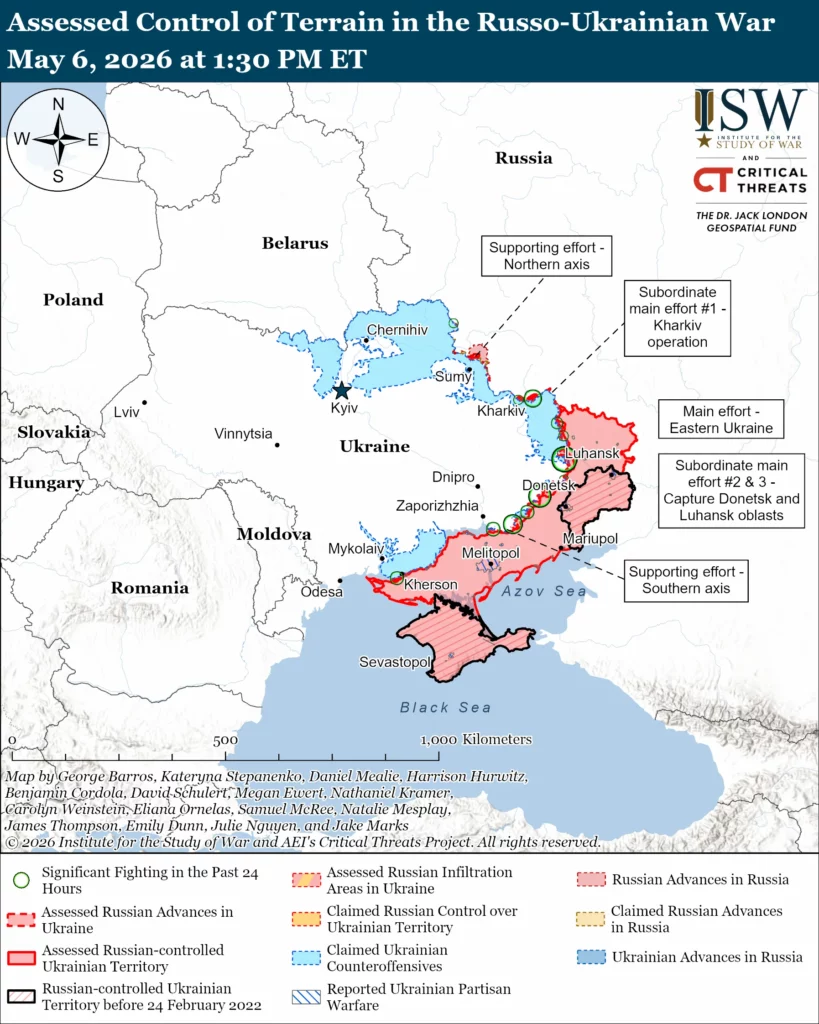
We do not report in detail on Russian war crimes because these activities are well-covered in Western media and do not directly affect the military operations we are assessing and forecasting. We will continue to evaluate and report on the effects of these criminal activities on the Ukrainian military and the Ukrainian population and specifically on combat in Ukrainian urban areas. We utterly condemn Russian violations of the laws of armed conflict and the Geneva Conventions and crimes against humanity even though we do not describe them in these reports.
Ukrainian Operations in the Russian Federation
Russian forces have reportedly relocated air defense assets to defend Moscow City itself ahead of the May 9 Victory Day parade. Ukrainian President Volodymyr Zelensky reported on May 6 that Ukrainian intelligence has observed reports that Russian forces have relocated air defense systems from other Russian federal subjects to defend Moscow City itself, demonstrating that the Kremlin continues efforts to prepare to defend the May 9 Victory Day parade.[24] ISW observed reports of Russian forces redeploying air defense assets to Moscow ahead of the May 9 Victory Day parade on May 3.[25] The relocation of air defenses to Moscow City likely reflects Russian President Vladimir Putin’s recognition that he must increase Russian investment in air defenses, including defenses for deep rear areas, given the intensifying volume and range of Ukrainian strikes.[26]
Russian milbloggers continue to highlight Russia’s shortage of air defense missiles amidst increasingly visible Ukrainian drone and missile strikes. A Kremlin-affiliated Russian milblogger complained on May 5 that Russian forces lack the magazine depth to effectively counter Ukrainian drone strikes in response to overnight May 4 to 5 Ukrainian long-range drone and missile strikes.[27] The milblogger noted that Russian interceptor drones necessary to cheaply repel drone strikes are comparatively undeveloped, and that the Russian air defense situation will only worsen without changes. The milblogger also noted that Russian internet shutdowns are ineffective at countering drone strikes and only cause popular discontent.
Russian Supporting Effort: Northern Axis
Russian objective: Create defensible buffer zones in Sumy Oblast along the international border
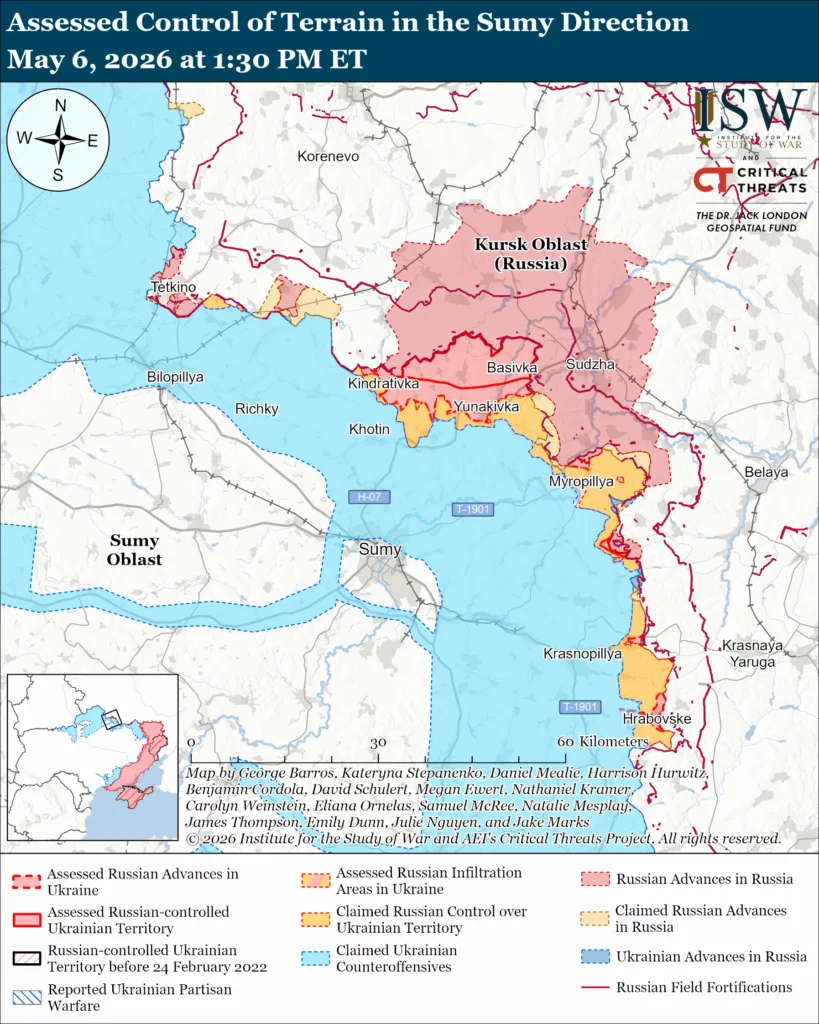
Russian forces recently advanced in northern Sumy Oblast as Ukrainian forces counterattacked in the area.[28] Geolocated footage published on May 6 shows Ukrainian forces striking a Russian servicemember west of Sopych (northwest of Sumy City), indicating that Russian forces likely seized Sopych on a prior date and infiltrated west of Sopych.[29] A Kremlin-affiliated Russian milblogger claimed on May 6 that Ukrainian counterattacks have turned northern Myropillya (northeast of Sumy City) into a contested gray area.[30]
Russian Main Effort: Eastern Ukraine
Russian Subordinate Main Effort #1 – Kharkiv Oblast
Russian objective: Push Ukrainian forces back from the international border to create a defensible buffer zone with Belgorod Oblast and approach to within tube artillery range of Kharkiv City
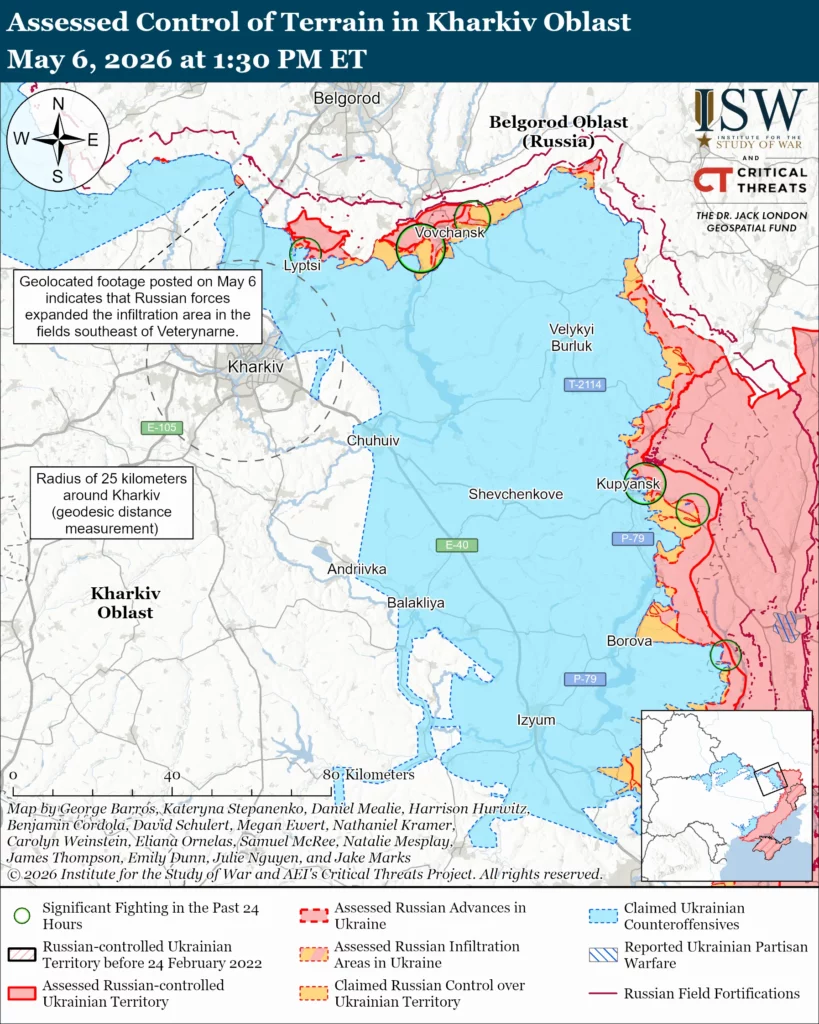
Russian forces conducted an infiltration mission north of Kharkiv City on May 6. Geolocated footage published on May 6 shows Ukrainian forces striking a Russian position in the fields southeast of Veterynarne (north of Kharkiv City) after what ISW assesses was an infiltration mission.[31]
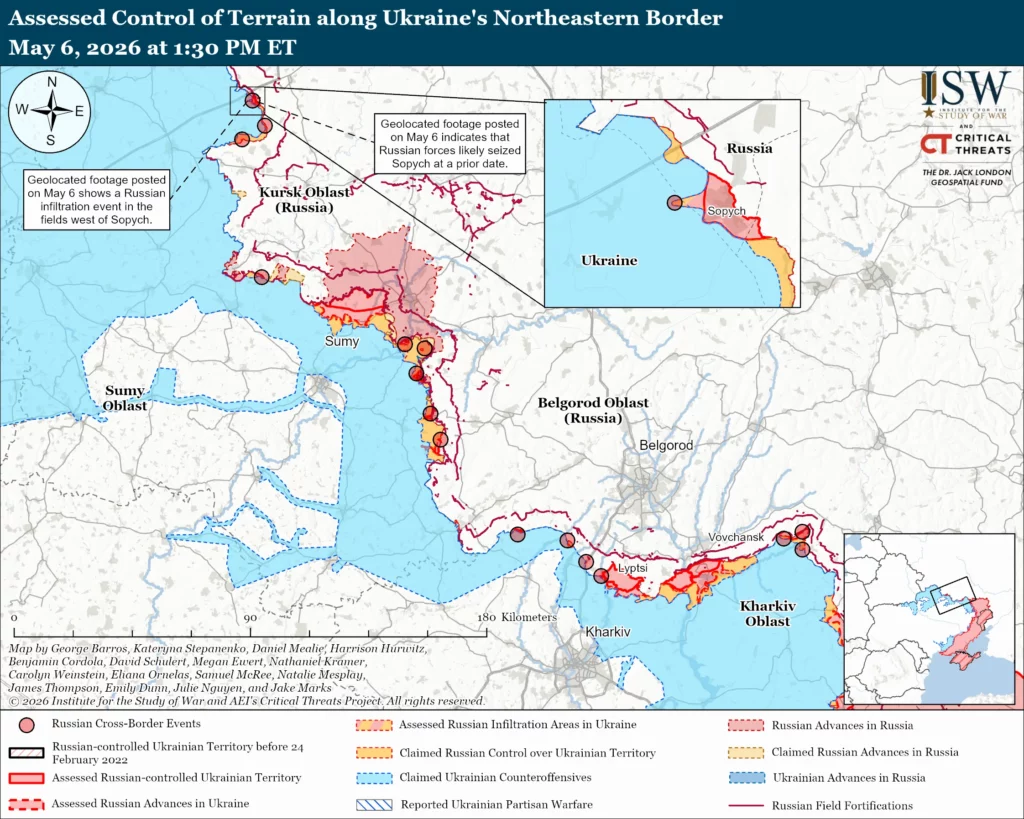
A Russian milblogger claimed that Russian forces continued offensive operations in the Velykyi Burluk direction on May 6 as Ukrainian forces reportedly counterattacked northeast and east of Velykyi Burluk.[32] ISW has not observed evidence to suggest that Russian forces made confirmed advances in the direction, however.
Order of Battle: The Russian military command likely redeployed elements of the Russian 1st Motorized Rifle Regiment [MRR] (Strategic Missile Forces [RVSN], under the operational control of the Northern Grouping of Forces) from northern Sumy Oblast to the Velykyi Burluk direction. Drone operators of the Russian 1st Motorized Rifle Regiment (RVSN) reportedly struck Ukrainian equipment and personnel in the Velykyi Burluk direction.[33] ISW last observed reports of elements of the Russian 1st Motorized Rifle Regiment (RVSN) operating northwest of Sumy City as of January 16.[34]
Russian Subordinate Main Effort #2 – Oskil River
Russian objective: Cross the Oskil River in Kharkiv Oblast and push westward into eastern Kharkiv Oblast and northern Donetsk Oblast
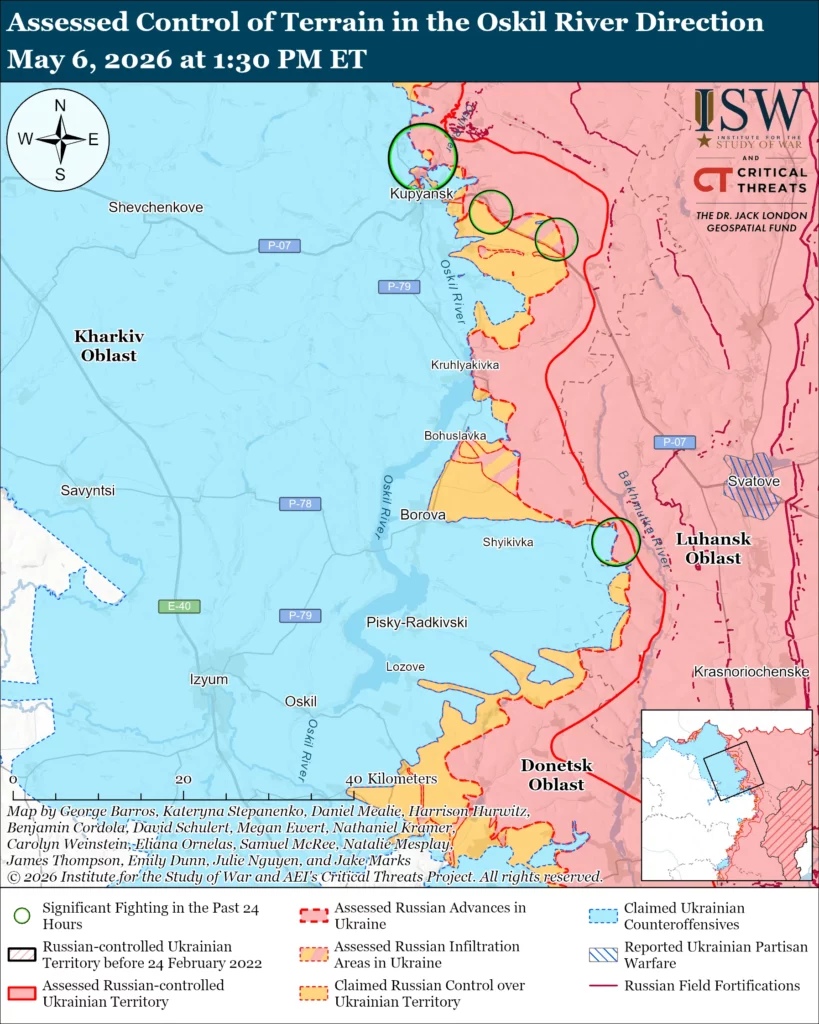
Russian forces continued limited ground assaults in the Kupyansk direction on May 6 but did not make confirmed advances as Ukrainian forces reportedly continued counterattacks in the area.[35] A Russian milblogger claimed on May 6 that Russian forces advanced in western Kurylivka (southeast of Kupyansk).[36]
A Russian milblogger claimed that Russian forces continued ground attacks in the Borova direction on May 6, but ISW has not observed evidence to suggest that Russian forces advanced.[37]
Russian Subordinate Main Effort #3 – Donetsk Oblast
Russian objective: Capture the entirety of Donetsk Oblast, the claimed territory of Russia’s proxies in Donbas, and advance into Dnipropetrovsk Oblast
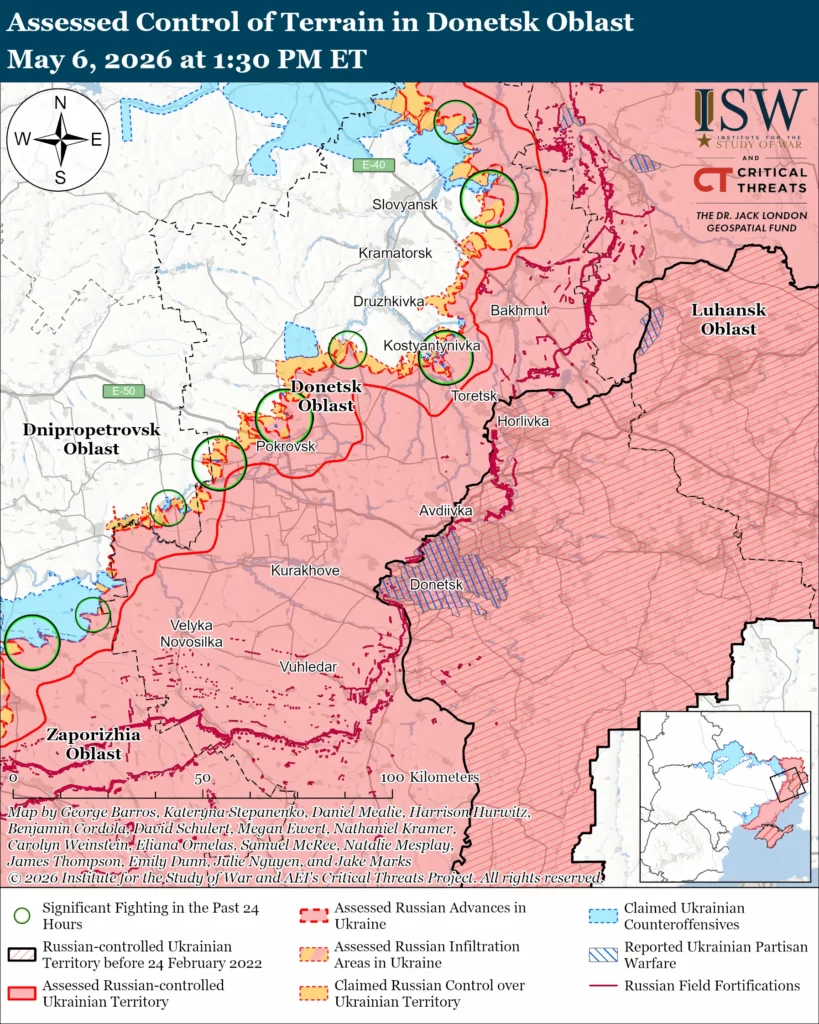
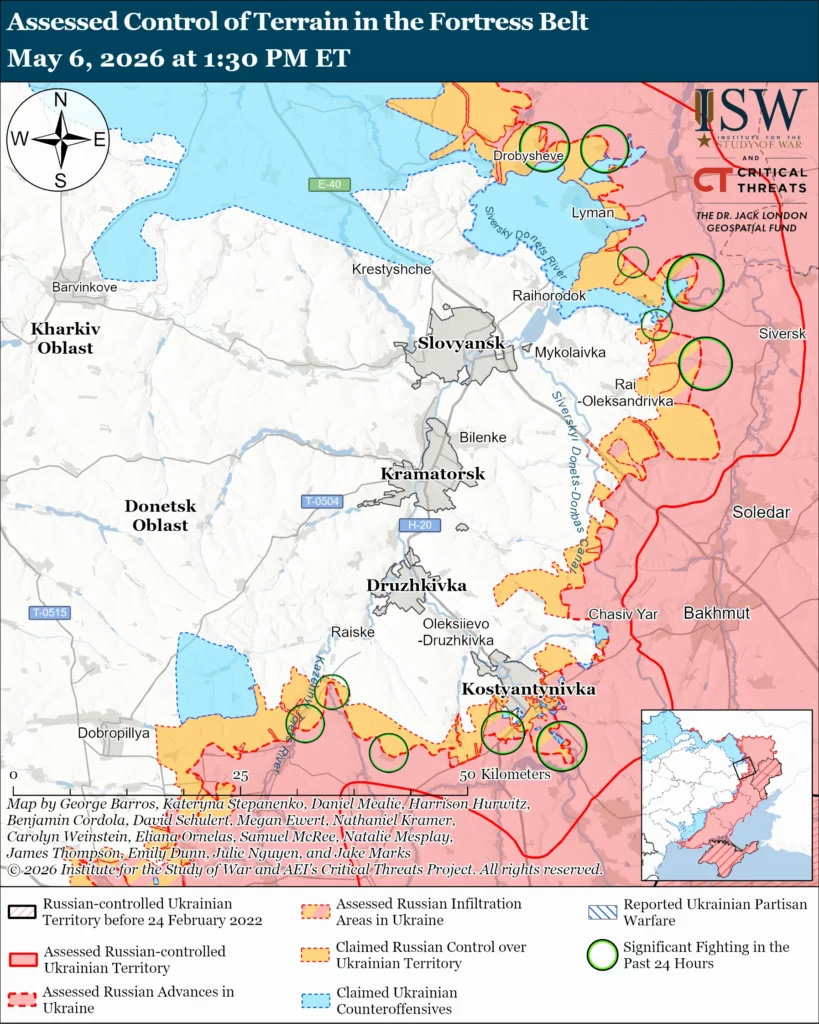
Russian forces continued offensive operations in the Slovyansk direction on May 6 as Ukrainian forces reportedly continued counterattacks in the area.[38]
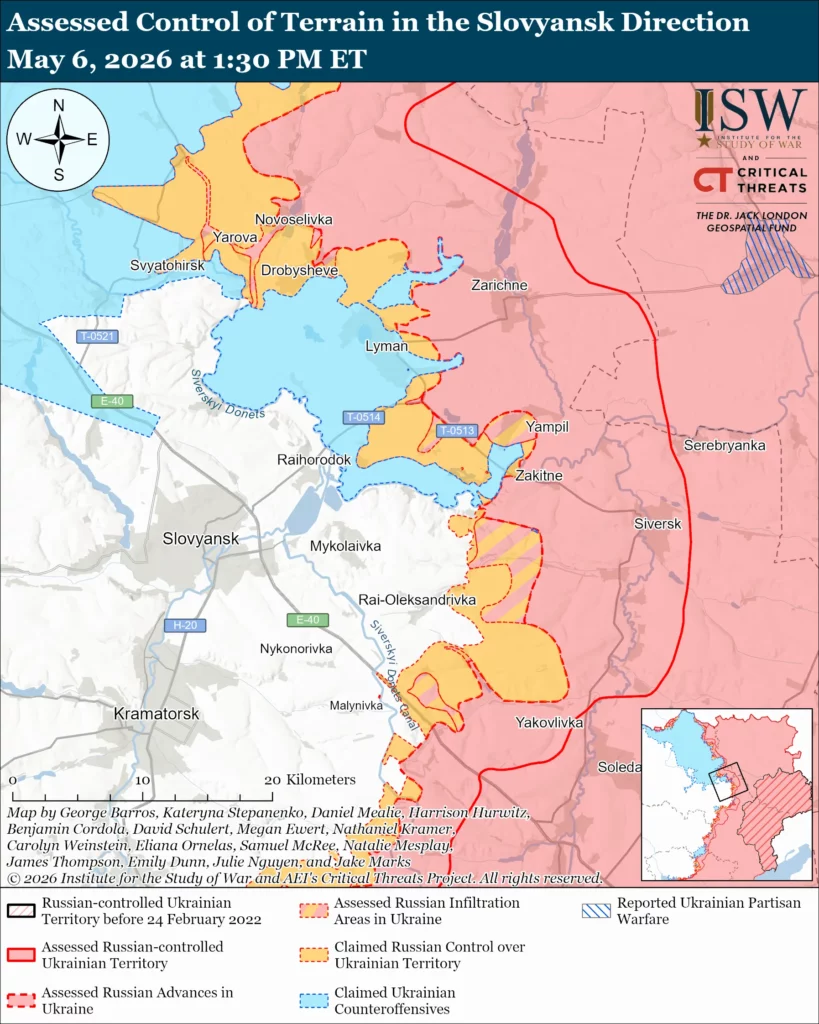
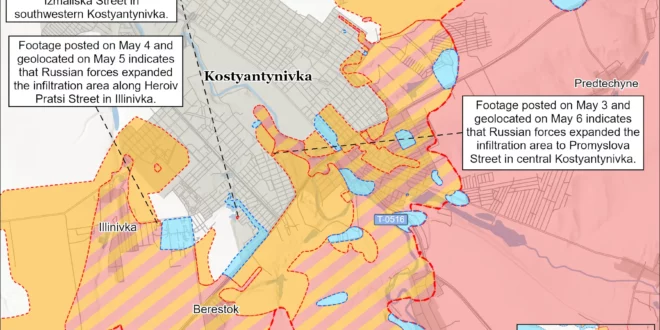
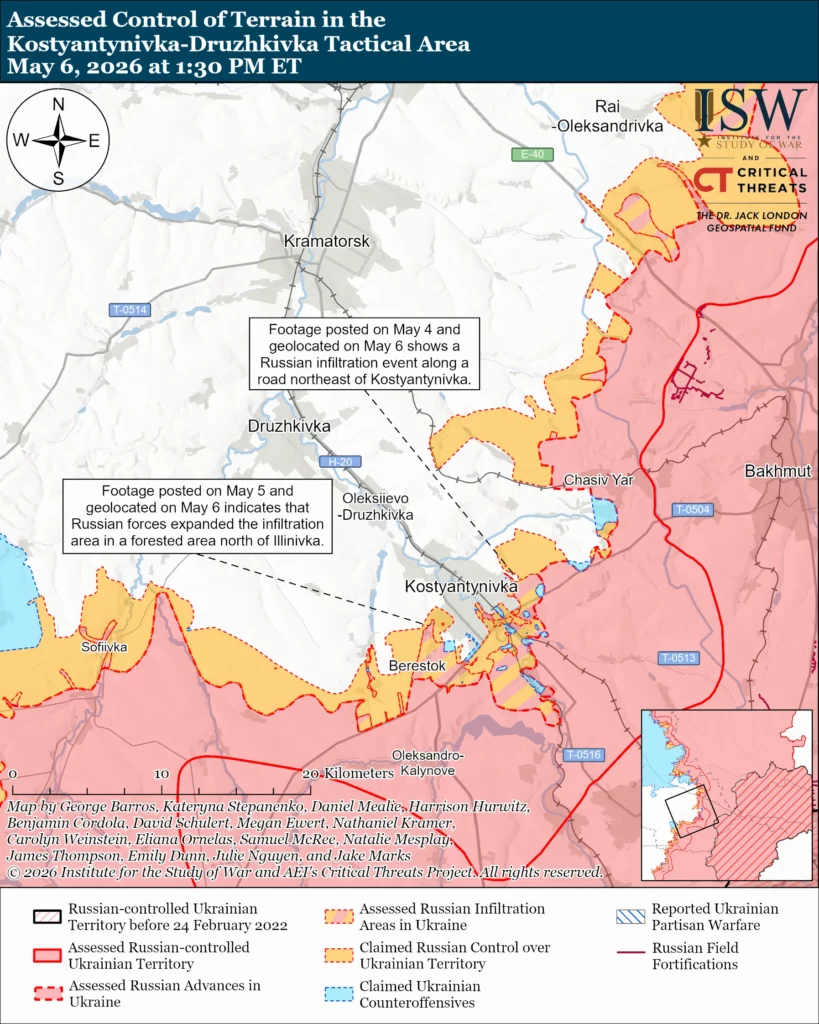
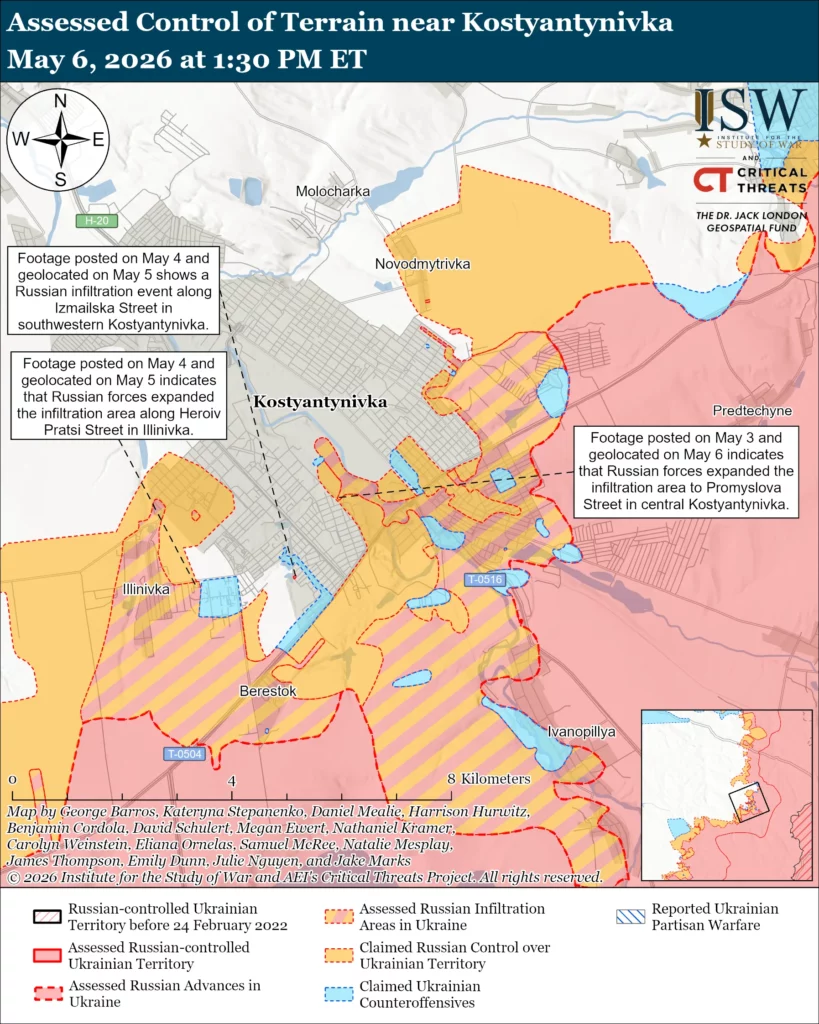
Russian forces continued small group infiltrations in the Kostyantynivka-Druzhkivka tactical area on May 6 but did not advance as Ukrainian forces reportedly counterattacked in the area.[39] An officer of a Ukrainian brigade operating in the Kostyantynivka-Druzhkivka tactical area reported on May 6 that Russian servicemembers typically infiltrate alone or in pairs and that Russian pressure remains constant, though Russian forces have been unable to begin full-fledged fighting in urban areas of Kostyantynivka.[40]
Russian forces conducted infiltrations in the Kostyantynivka-Druzhkivka tactical area on prior dates. Geolocated footage published on May 5 shows Ukrainian forces striking a Russian servicemember north of Illinivka (south of Kostyantynivka) in what ISW assesses was an infiltration mission that did not occur within the last 24 hours.[41] Geolocated footage published on May 3 and 4 shows Ukrainian forces striking Russian positions and servicemembers northeast of and in central and southwestern Kostyantynivka and in Illinivka in what ISW assesses were infiltration missions that did not occur within the last 24 hours.[42] A Russian milblogger claimed that Russian forces advanced in western Kostyantynivka.[43]
A Russian milblogger claimed that Russian forces continued attacks in the Dobropillya tactical area on May 6.[44]
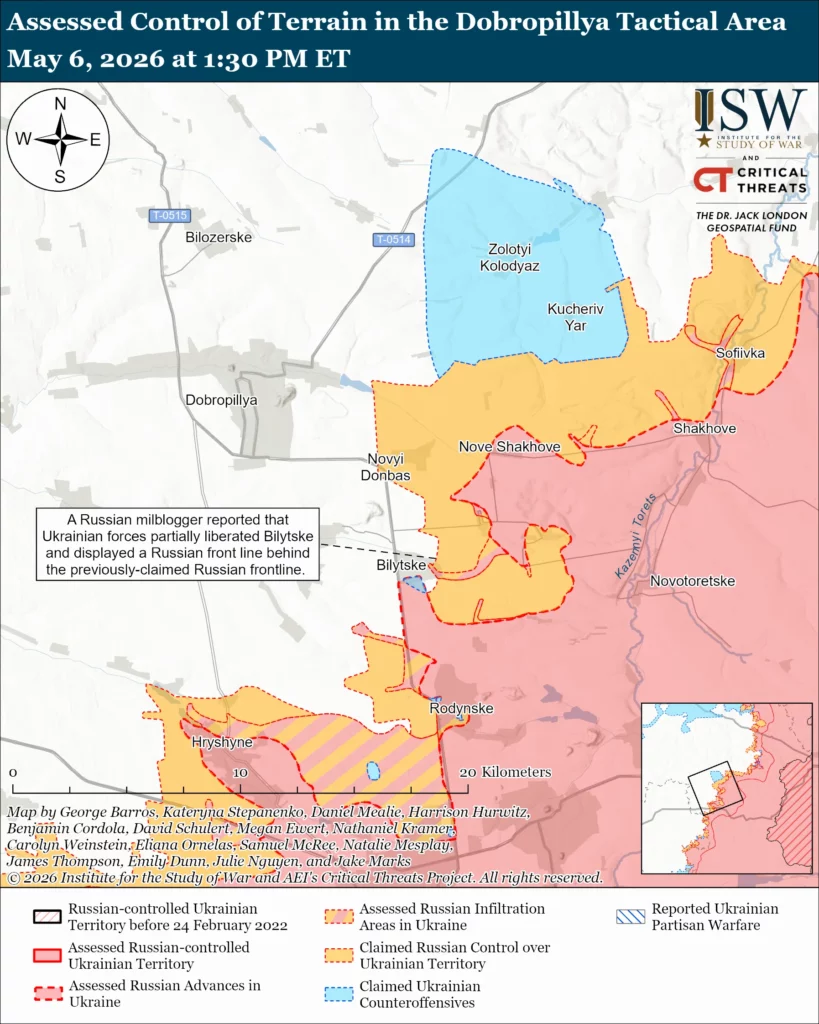
Ukrainian forces recently advanced or maintained positions north of Pokrovsk while Russian forces continued ground assaults in the Pokrovsk direction on May 6 but did not make confirmed advances.[45] A Kremlin-affiliated Russian milblogger posted a map on May 6 showing that Ukrainian forces regained control over western Bilytske (north of Pokrovsk), indicating that Russian forces likely do not hold positions north and south of the settlement, contrary to Russian claims.[46] A Russian milblogger claimed that Russian forces advanced west of Hryshyne (northwest of Pokrovsk), north of Kotlyne (southwest of Pokrovsk), and east of Serhiivka (west of Pokrovsk).[47]
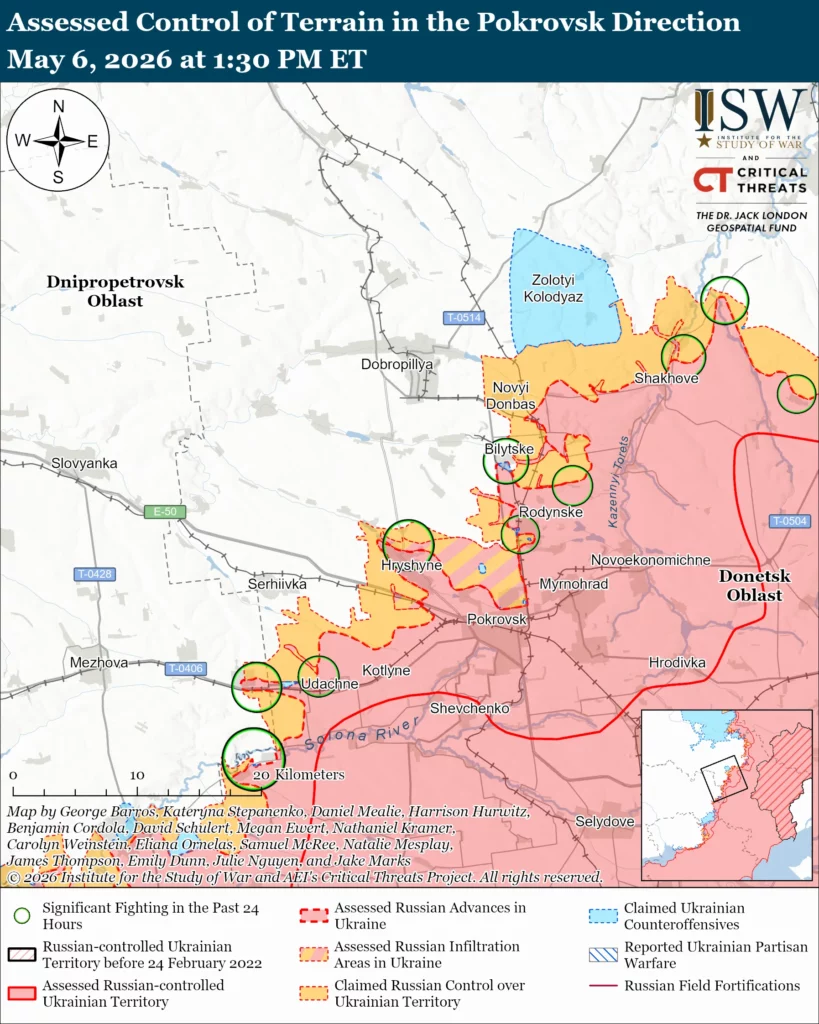
Russian forces continued to leverage sleeper first-person view (FPV) drones in the Pokrovsk direction. The spokesperson of a Ukrainian brigade reported that unspecified Russian unmanned systems Spetsnaz elements are operating in the Pokrovsk direction and are leveraging sleeper FPV drones.[48] The spokesperson stated that sleeper FPV drones are difficult to detect and pose an elevated threat to Ukrainian forces, forcing Ukrainian drone operators to commit significant effort to detect and neutralize them.
Russian forces continued offensive operations in the Novopavlivka and Oleksandrivka directions on May 6 but did not advance.[49]
Geolocated footage confirmed a May 3 Ukrainian strike against a Russian military asset in occupied Donetsk Oblast. Geolocated footage published on May 6 confirms that Ukrainian forces struck a Russian field ammunition depot near occupied Vilne (roughly 62 kilometers from the frontline) on May 3.[50]
Russian Supporting Effort: Southern Axis
Russian objective: Maintain frontline positions, secure rear areas against Ukrainian strikes, and advance within tube artillery range of Zaporizhzhia City
Russian forces recently advanced and conducted an infiltration in the Hulyaipole direction. Geolocated footage published on May 6 shows Ukrainian forces shelling a Russian position in southern Dobropillya (north of Hulyaipole), indicating that there are likely no Ukrainian positions in the area.[51] Geolocated footage posted on May 5 shows Ukrainian forces shelling a Russian position east of Vozdvyzhivka (northwest of Hulyaipole) after what ISW assesses was a Russian infiltration mission.[52]
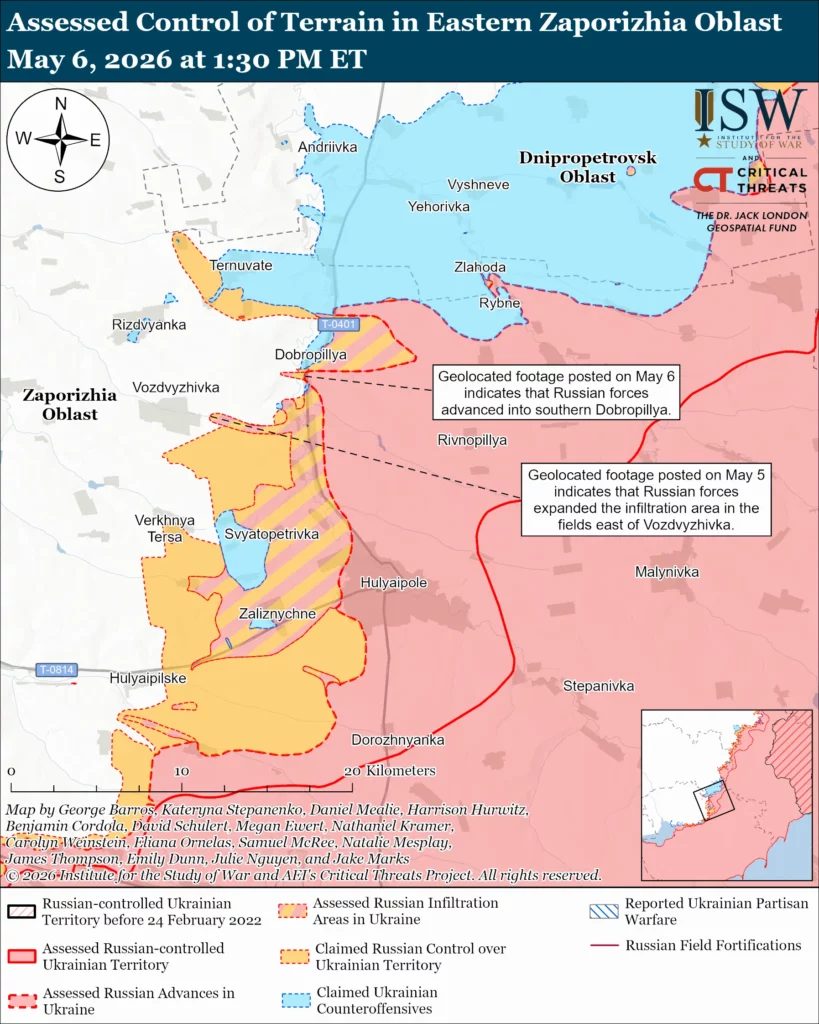
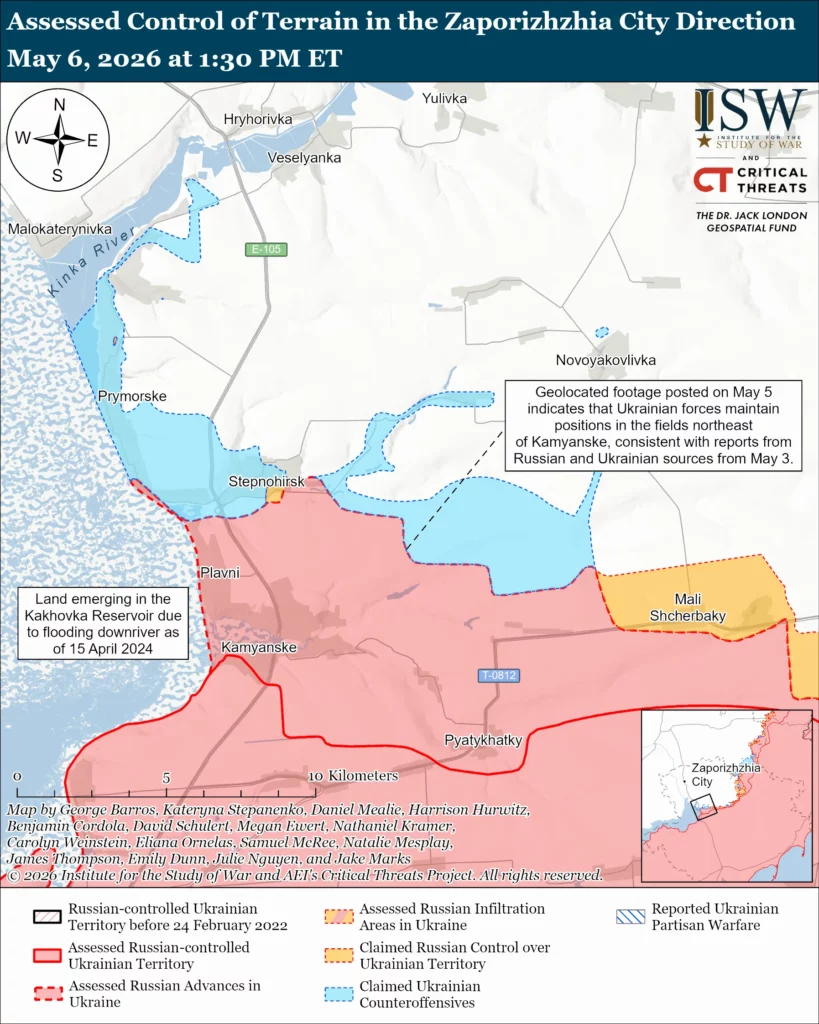
Ukrainian forces recently marginally advanced in western Zaporizhia Oblast. Geolocated footage published on May 5 indicates that Ukrainian forces recently marginally advanced in the fields northeast of Kamyanske (southeast of Zaporizhzhia City).[53]
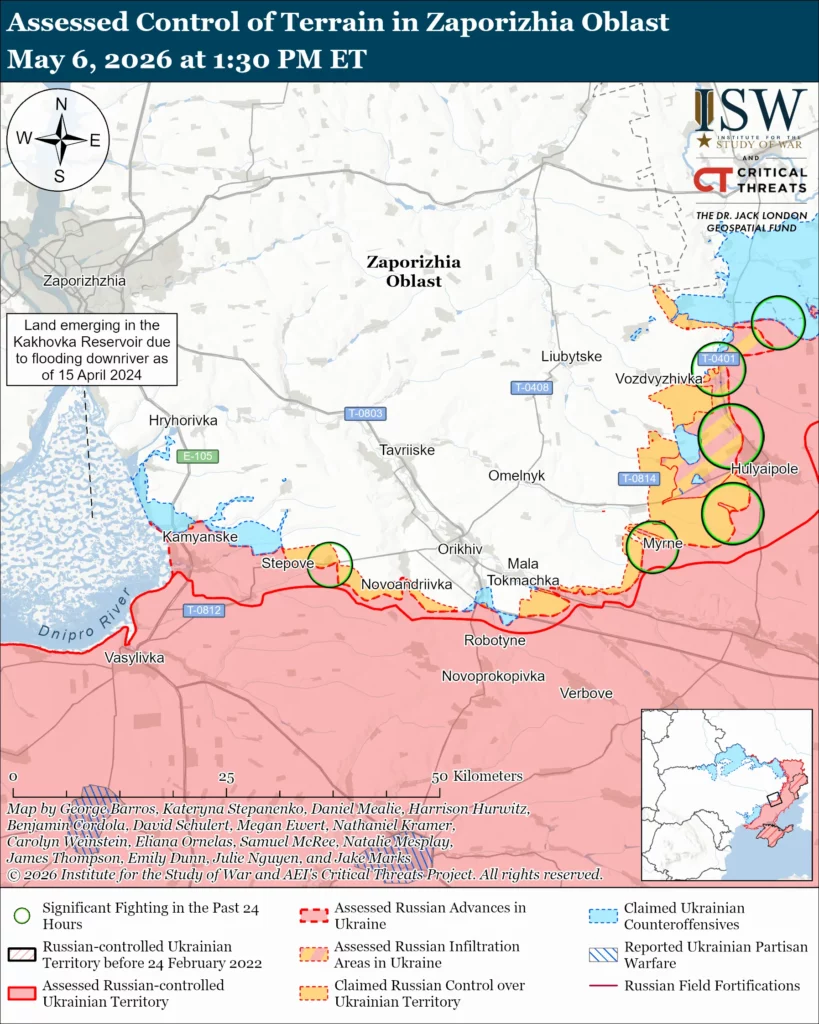
Geolocated footage published on May 5 visually confirms Ukrainian mid-range strikes against Russian military assets in occupied Zaporizhia Oblast between May 3 and 5. Geolocated footage published on May 5 shows Ukrainian forces striking a Kasta-2E radar system north of occupied Yelyseivka (roughly 64 kilometers from the frontline).[54]
Russian forces continued limited ground attacks in the Kherson direction on May 6, including toward islands in the Dnipro River Delta, but did not advance.[55]
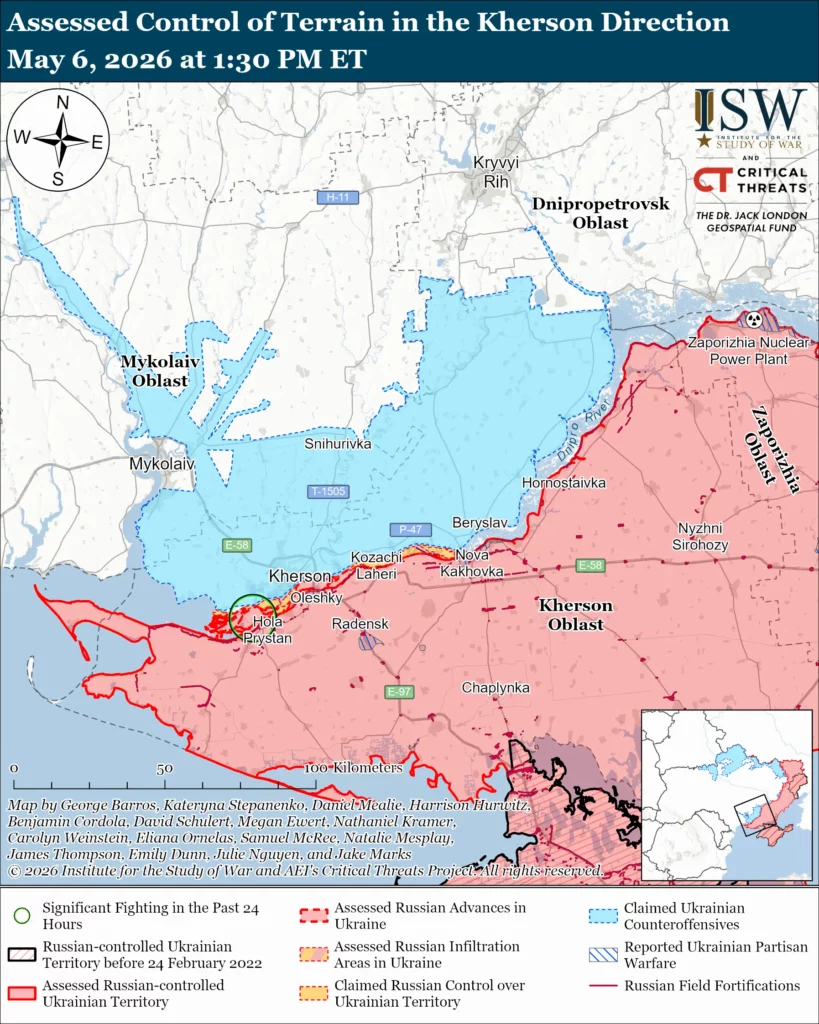
Order of Battle: The Russian military command may have redeployed elements of the Russian 106th Airborne (VDV) Division from northern Sumy Oblast to the Kherson direction. Reconnaissance and sabotage groups of the Russian 106th VDV Division, reportedly operating jointly with the 18th Combined Arms Army (CAA, Southern Military District [SMD]), are reportedly operating near Karantynnyi Island (southwest of Kherson City) on the right bank of the Dnipro River.[56] ISW last observed reports of elements of the 106th VDV Division operating northeast of Sumy City as of May 2.[57] A source reporting on the Russian Northern Grouping of Forces claimed on April 1 that the Russian military command had planned to redeploy elements of the 119th and 51st VDV regiments (both of the 106th VDV Division) from Sumy Oblast to Kherson Oblast by mid-April 2026.[58]
Geolocated footage confirms that Ukrainian drone strikes damaged Russian naval and aviation assets in occupied Crimea in April 2026. Geolocated footage published on May 5 shows Ukrainian forces striking a Russian Be-12 Chaika anti-submarine amphibious aircraft at the occupied Kacha Airfield (roughly 223 kilometers from the frontline), and three Russian Project 05060 landing and assault boats in occupied Mizhvodne (roughly 105 kilometers from the frontline), a supply ship in occupied Myrnyi (roughly 210 kilometers from the frontline), and a storage hangar for landing and assault boats in occupied Chornomorske (roughly 278 kilometers from the frontline) during an April 2026 operation.[59]
Russian Air, Missile, and Drone Campaign
Russian Objective: Target Ukrainian military and civilian infrastructure in the rear and on the front line
See topline text for additional Russian strikes in Ukraine.
Russian forces are employing low power consumption drones in strikes against gas stations relatively close to the frontline. Ukrainian Ministry of Defense (MoD) advisor on defense technology and drone and electronic warfare (EW) expert Serhiy “Flash” Beskrestnov reported on May 6 that Russian forces are extending the range of first-person view (FPV) drones by using low power consumption drones to conduct strikes against gas stations 20 to 25 kilometers from the frontline.[60] Russian forces have recently intensified drone strikes against gas stations in Kharkiv City (roughly 20 kilometers from the frontline on its northern outskirts) in efforts to disrupt civilian life.[61]
Significant Activity in Belarus
Russian efforts to increase its military presence in Belarus and further integrate Belarus into Russian-favorable frameworks
Russian authorities continue to tighten border security at the Russia-Belarus border against potential Russian draft evaders. Russian opposition source Vazhnye Istorii reported on May 5 that Russian border guards have begun selective detentions of Russian citizens at all land border checkpoints on the Russia-Belarus border and subjecting them to interviews of up to eight hours as part of enhanced filtration processes.[62] The Belarusian State Border Committee stated on April 29 that Belarusian authorities will bar Russian citizens who have received a draft notice and an exit ban from traveling abroad to a third country through Belarus, and the enhanced questioning is likely part of Russian-Belarusian cooperation to prevent Russian citizens with draft orders from avoiding conscription.[63]
Note: ISW does not receive any classified material from any source, uses only publicly available information, and draws extensively on Russian, Ukrainian, and Western reporting and social media as well as commercially available satellite imagery and other geospatial data as the basis for these reports. References to all sources used are provided in the endnotes of each update.