 Eurasia Press & News
Toplines
Russia and Belarus appear to be setting conditions to justify Russia launching drone strikes at Ukraine from Belarus. Belarusian Security Council Secretary Lieutenant General Alexander Volfovich claimed on May 26 that Belarusian forces have “recorded” 116 attempts by Ukrainian drones to cross the international border into Belarus over the past week.[1] Volfovich also claimed that some Ukrainian drone border crossings were deliberate efforts to target Belarusian border infrastructure. Volfovich’s statements come over the backdrop of recent warnings from Ukrainian officials that Russia is pressuring Belarus to conduct operations against Ukraine or an unspecified NATO state.[2] Belarus is very unlikely to launch a ground invasion against Ukraine, and ISW has not independently observed or verified any buildup of Belarusian forces on Belarus-Ukraine border that would be sufficient for a ground invasion. Russia also lacks the reserves that would be required to support Belarusian troops in a ground invasion of Ukraine.[3]
Russia may instead use claimed instances of Ukrainian drones in Belarusian airspace to justify using Belarusian territory to launch “retaliatory” strikes against Ukraine. Belarusian territory would allow Russia to conduct continuous drone strikes against Ukrainian ground lines of communication (GLOCs) in western and northwestern Ukraine that Russian drones cannot currently easily strike with precision and heavy payloads. Russian forces’ ability to use Belarusian territory to launch strikes may allow Russian Shahed-type drones and cheaper Molniya drones to target the M-06 highway that runs through western Ukrainian oblasts, including key supply routes from Poland to Ukraine and the railway connecting Poland and Ukraine. Russian forces are already targeting western Ukrainian oblasts from Russian territory, but launching the drones from Belarus would allow Russian forces to operate remotely controlled Shahed and Molniya drones, increasing their precision and ability to strike moving targets along Ukrainian GLOCs. Ukrainian officials reported that Russian drone operator based in Belarus conducted a FPV-controlled Shahed strike against a Ukrainian freight train near Korosten, Zhytomyr Oblast (roughly 50 kilometers south of the Belarusian border) on December 22, 2025.[4] Volfovich’s claims and recent Ukrainian warnings about Belarus suggest that Russia is setting informational conditions to further use Belarus for its own military purposes, including to strike strategically important GLOCs in the rear of western Ukraine.
Some Russian officials appear to be walking back recent Russian threats to systematically strike Kyiv City. Russian State Duma Defense Committee Chairperson Andrei Kartapolov claimed on May 26 that Russia is not actually threating to strike the Verkhovna Rada (Parliament) or the Ukrainian Presidential Office as those are not the “real” decision-making centers in Ukraine — in response to the Russian Ministry of Foreign Affairs’ (MFA) May 25 threat to launch a “systematic” strike series against Ukrainian decision-making centers and headquarters in Kyiv City.[5] Kartapolov claimed that Ukrainian decision-making centers are not in central Kyiv City but rather are hidden in well-fortified areas. Russian State Duma Deputy Anatoliy Wasserman claimed on May 26 that Russia could “liquidate” Ukraine by November 2026, but that Russia is not “rushing” to do so.[6] The Kremlin has been making increasing threats against Ukraine in recent weeks as Russia tries to disguise the Kremlin’s embarrassment at needing Ukraine to permit Moscow to hold its May 9 Victory Day parade, Russia’s poor battlefield performance, and at the increasing economic costs and societal tension the Kremlin is enduring as a result of over four years of war.[7] These Russian officials may be setting expectations in the domestic information space for Russia’s threats against Kyiv City to not materialize in the way that Russians likely expect.
Ukraine’s long-range drone strike campaign is forcing Russian authorities to restrict the use of airspace in the Moscow air zone. Russian Aircraft Owners and Pilots Association (AOPA) claimed on May 25 that Russian authorities will begin prohibiting civilian aircraft flights in the Moscow air zone at altitudes from zero to 5,100 meters starting on June 1.[8] The ban extends to Russian western border with Belarus, to the border with the St. Petersburg flight zone in the north, to the border with the Yekaterinburg and Samara flight zones in the east, and to the Ukrainian border zone, where Russian authorities have prohibited civil flights since February 2022. AOPA noted that the ban does not apply to scheduled or charter flights, medical assistance or evacuation flights, and flights for chemical work, monitoring pipelines or power lines, or government contracts. Russian milbloggers claimed on May 25 that the flight ban is a direct consequence of increased and intensified Ukrainian drone strikes and imprecise Russian air defense systems that failed to distinguish friendly aircraft from Ukrainian drones.[9] Russia has largely failed to defend against intensified Ukrainian strikes in the rear and Russian authorities likely imposed the civil flight ban as Russia attempts to protect its airspace from Ukrainian drones. Ukrainian forces have significantly intensified the frequency and range of long-range drone strikes since March 2026, and have taken advantage of overstretched Russian air defenses, demonstrating how Russia cannot reliably defend its capital from Ukrainian strikes.[10]
Russian authorities closed the Kaliningrad airport due to a reported drone threat for the first time. Russian state aviation regulator Rosaviatsia temporarily placed restrictions on May 25 on departures and arrivals for the Kaliningrad airport for unspecified reasons to “ensure flight safety.”[11] Local Kaliningrad outlet Klops reported on May 25 that Kaliningrad activated its drone warning system for the first time and that authorities are investigating what triggered the alarm.[12] It is unclear what triggered the drone warning alarm at this time and Russian officials have not made any accusations or statements as to the cause of the alarm.
Key Takeaways
Russia and Belarus appear to be setting conditions to justify Russia launching drone strikes at Ukraine from Belarus.
Some Russian officials appear to be walking back recent Russian threats to systematically strike Kyiv City.
Ukraine’s long-range drone strike campaign is forcing Russian authorities to restrict the use of airspace in the Moscow air zone.
Russian authorities closed the Kaliningrad airport due to a reported drone threat for the first time.
Ukrainian forces advanced in the Slovyansk direction and in western Zaporizhia Oblast.
Russian forces launched 2 ballistic missiles and 122 drones toward Ukraine overnight.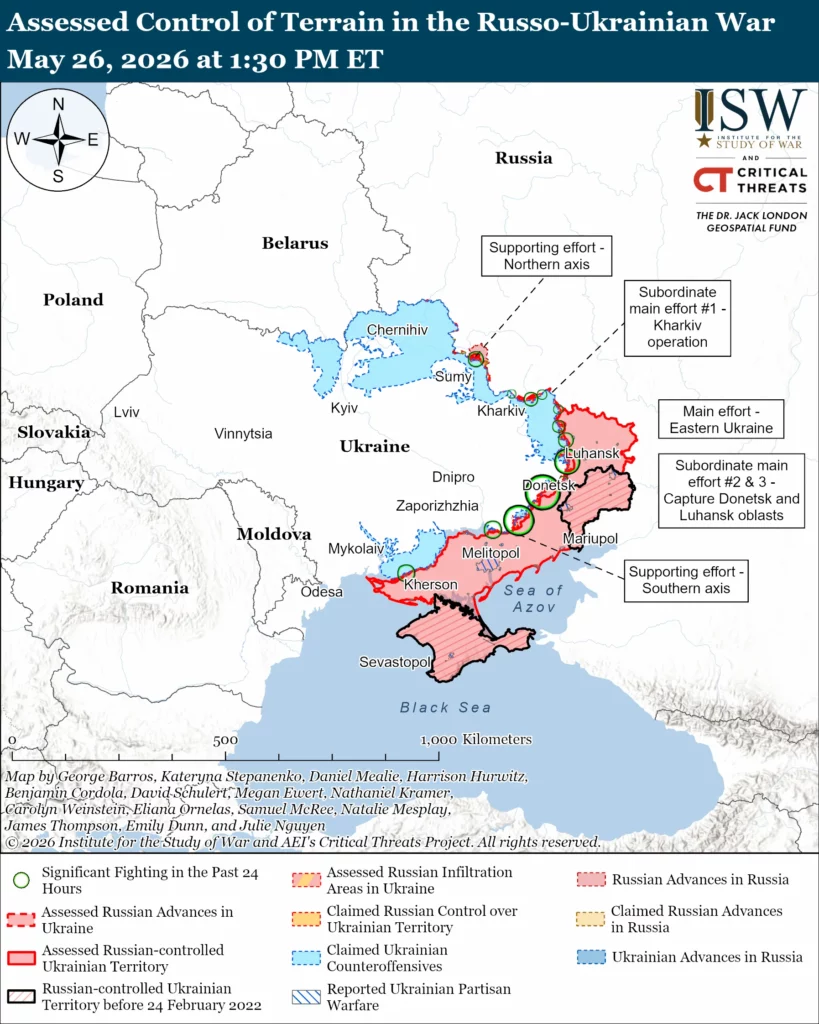
We do not report in detail on Russian war crimes because these activities are well-covered in Western media and do not directly affect the military operations we are assessing and forecasting. We will continue to evaluate and report on the effects of these criminal activities on the Ukrainian military and the Ukrainian population and specifically on combat in Ukrainian urban areas. We utterly condemn Russian violations of the laws of armed conflict and the Geneva Conventions and crimes against humanity even though we do not describe them in these reports.
Ukrainian Operations in the Russian Federation
Ukrainian strikes against Russian oil infrastructure continue to inhibit Russian oil production. Reuters reported on May 25, citing two unspecified industry sources, that the Syzran Oil Refinery halted all operations following the May 20-21 Ukrainian drone strike.[13] Reuters reported that the strike damaged the refinery’s CDU-6 crude distillation unit, which accounts for over 70 percent of the plant’s capacity, and that repairs could take over a month. Reuters also reported that the plant’s maximum refining capacity is 8.5 million metric tons a year, or 170,000 barrels per day. Reuters reported that the plant processed 4.3 million tons of crude oil in 2024, producing 1.5 million tons of diesel, 800,000 tons of gasoline and 700,000 tons of fuel oil. The Ukrainian General Staff confirmed on May 26 that the Syzran Oil Refinery halted all operations following the May 20 to 21 strike.[14]
Russian Supporting Effort: Northern Axis
Russian objective: Create defensible buffer zones in Sumy Oblast along the international border
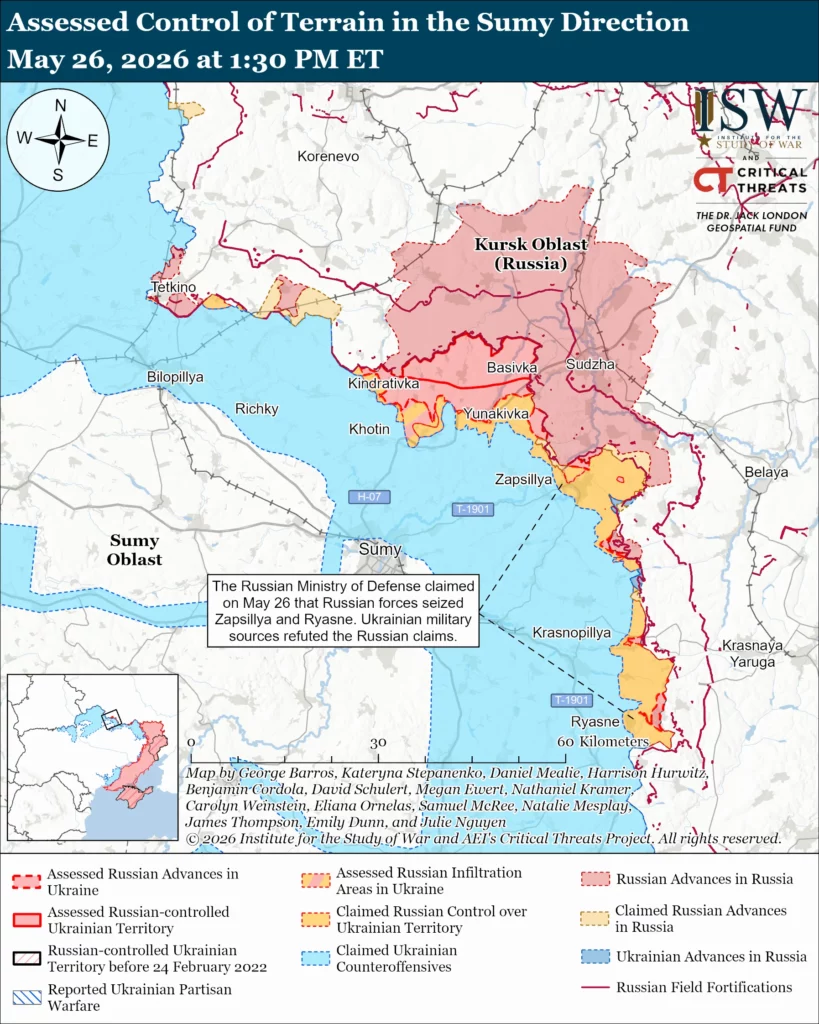
Russian forces continued offensive operations in northern Sumy Oblast on May 26 but did not make confirmed advances.[15] The Russian Ministry of Defense (MoD) claimed on May 26 that Russian forces seized Zapsillya (northeast of Sumy City) and Ryasne (southeast of Sumy City).[16] The Ukrainian 14th Army Corps and Kursk Grouping of Forces refuted the Russian MoD’s claims on May 26, reporting that Ukrainian forces still hold Zapsillya and Ryasne.[17] The Ukrainian Kursk Grouping of Forces reported on May 26 that Ukrainian forces also hold Myropillya (northeast of Sumy City), contrary to prior Russian claims.
Russian Main Effort: Eastern Ukraine
Russian Subordinate Main Effort #1 – Kharkiv Oblast
Russian objective: Push Ukrainian forces back from the international border to create a defensible buffer zone with Belgorod Oblast and approach to within tube artillery range of Kharkiv City
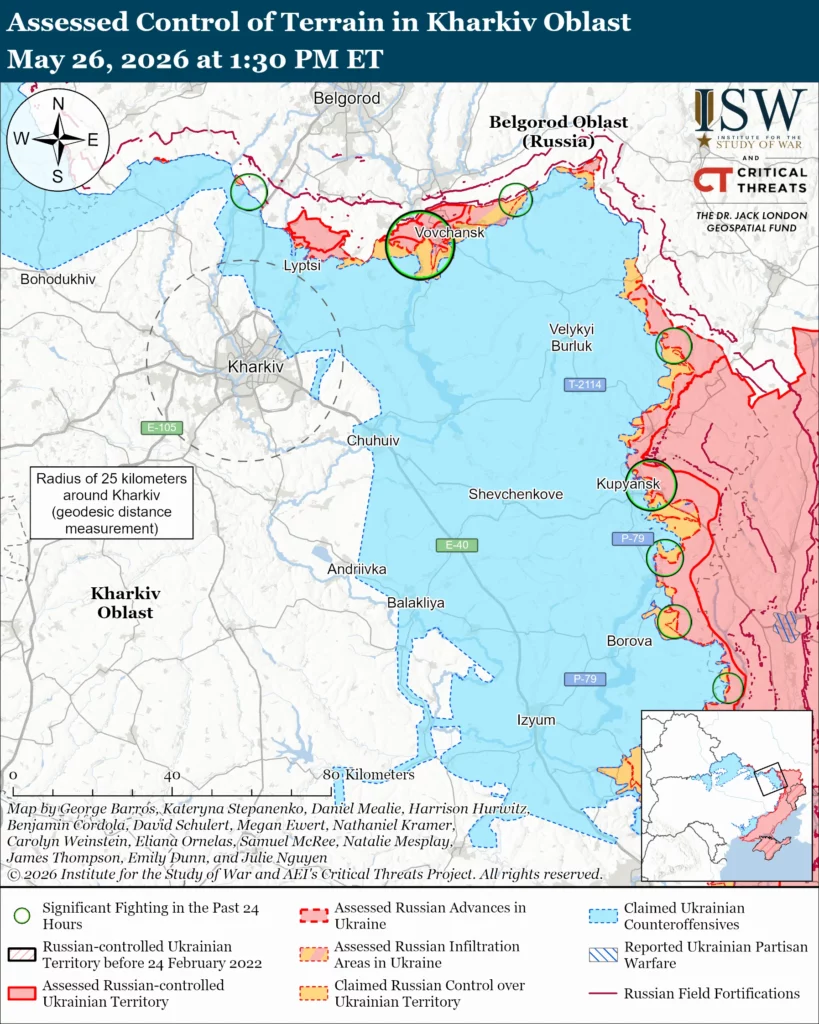
Russian forces continued attacks northeast of Kharkiv City on May 26 but did not make confirmed advances as Ukrainian forces reportedly counterattacked.[18] A Russian milblogger claimed that Russian forces entered Hraniv (north of Kharkiv City along the international border).[19]
Russian forces continued limited ground attacks southeast of Velykyi Burluk on May 26 but did not advance as Ukrainian forces reportedly counterattacked north of Velykyi Burluk near the international border.[20]
Russian Subordinate Main Effort #2 – Oskil River
Russian objective: Cross the Oskil River in Kharkiv Oblast and push westward into eastern Kharkiv Oblast and northern Donetsk Oblast
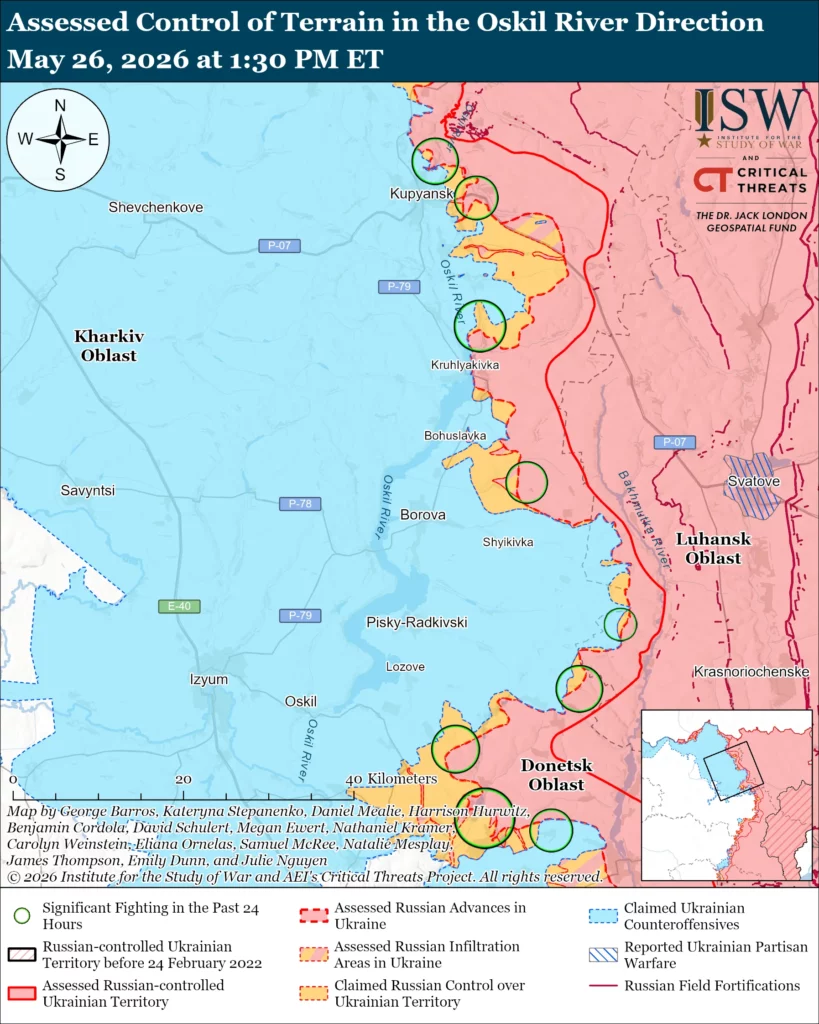
Russian forces continued limited offensive operations east and southeast of Kupyansk on May 26 but did not advance.[21]
Russian forces continued limited offensive operations northeast of Borova on May 26 as Ukrainian forces counterattacked south of Borova.[22] A spokesperson for a Ukrainian brigade operating in the Borova direction stated that Russian forces continue unsuccessful infiltration missions and are targeting crossings over the Oskil River with glide bombs.[23]Ukrainian forces continued their mid-range strike campaign against military and oil infrastructure in occupied Luhansk Oblast. The Ukrainian General Staff reported on May 25 and 26 that Ukrainian forces struck a Russian 1L125 “Niobium-SV” mobile radar station in occupied Yarsk (roughly 157 kilometers from the frontline) on May 24, and used Storm Shadow missiles to strike a Russian command and communications point in an unspecified location in the oblast.[24] Geolocated footage published on May 26 shows the aftermath of a presumed Ukrainian drone strike on a Russian fuel truck near Yurivka (roughly 76 kilometers from the frontline).[25]
Russian Subordinate Main Effort #3 – Donetsk Oblast
Russian objective: Capture the entirety of Donetsk Oblast, the claimed territory of Russia’s proxies in Donbas, and advance into Dnipropetrovsk Oblast
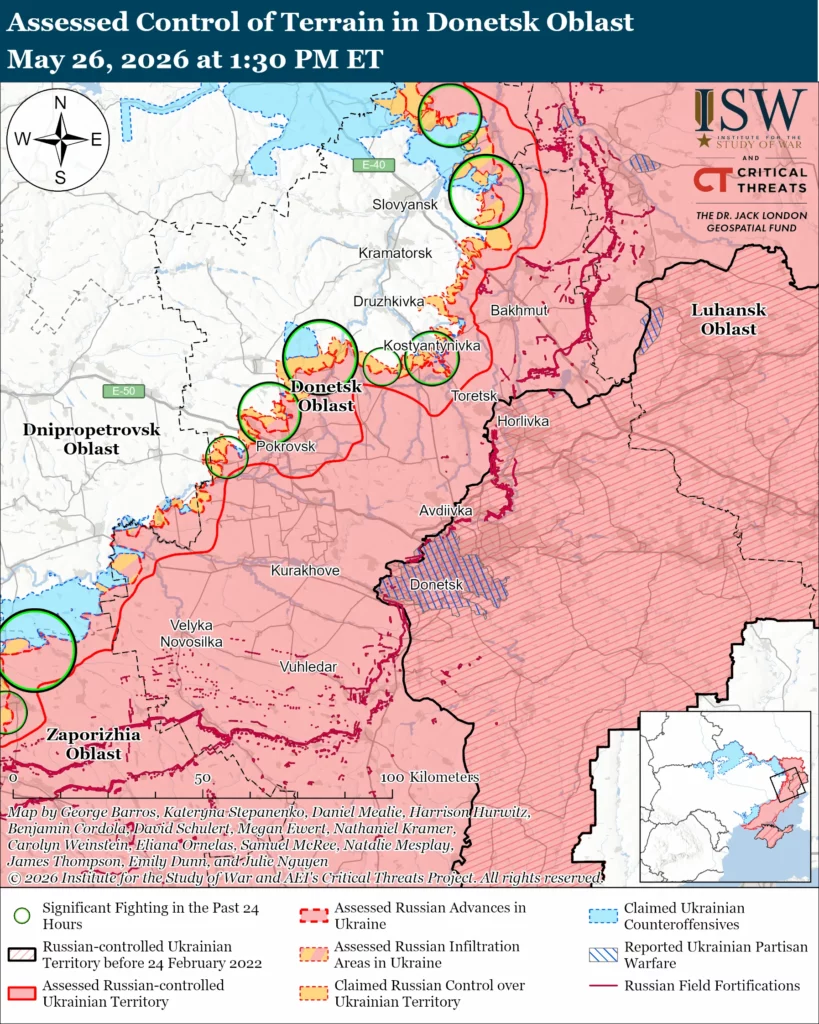
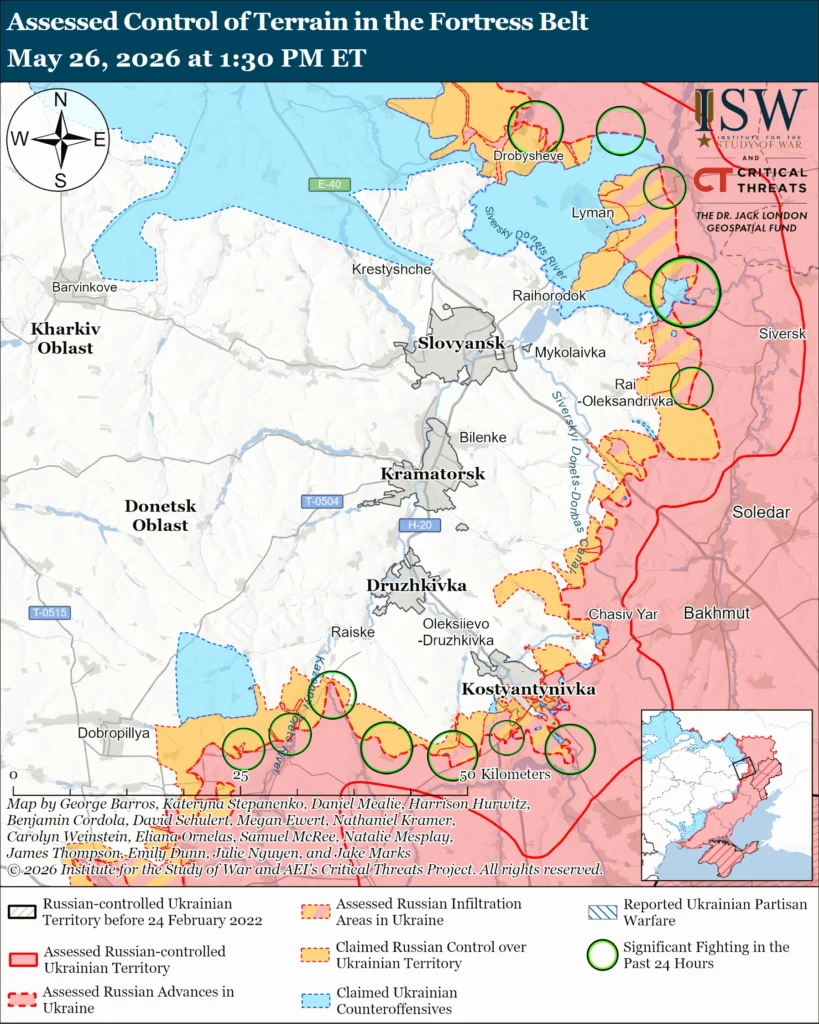
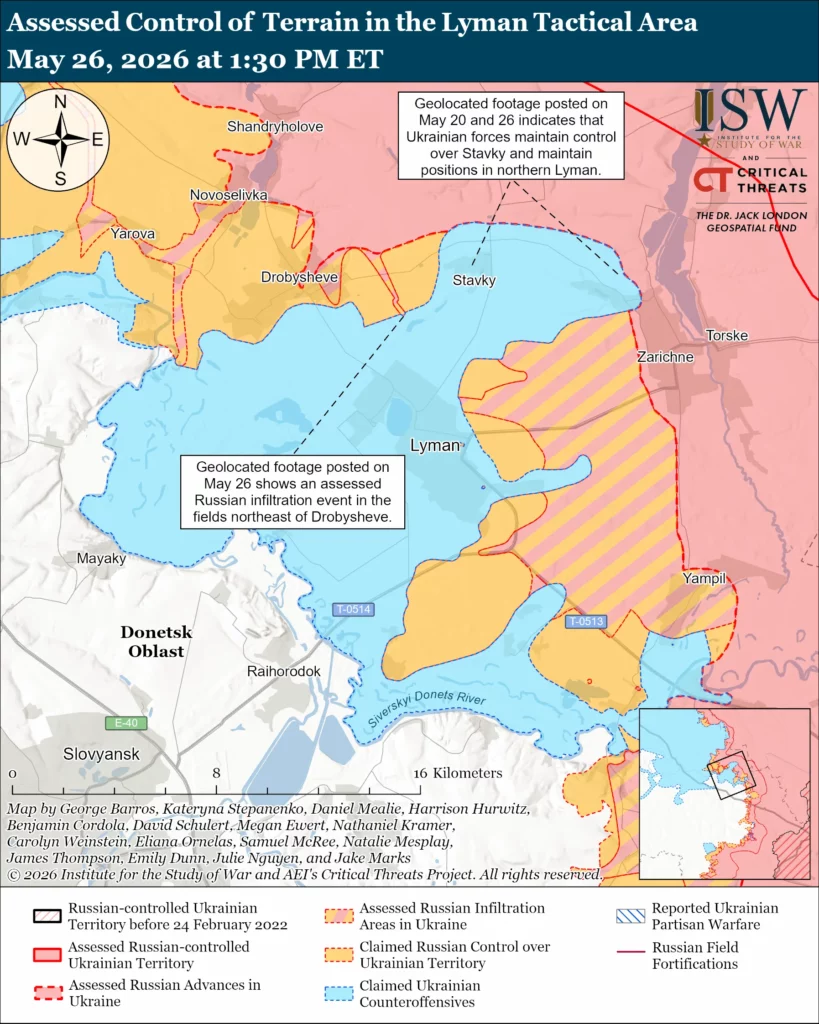
Ukrainian forces likely hold more positions within and east of Lyman than previously assessed. A source reporting on the Russian Western Grouping of Forces reported on May 26 that Ukrainian forces control the road between Lyman and Stavky (northeast of Lyman), and geolocated footage published on May 20, 25, and 26 shows Russian forces striking Ukrainian positions east of Stavky within and north of Zarichne.[26] Additional geolocated footage published on May 20 and 25 shows Russian forces striking Ukrainian positions in northwestern Lyman and north of Lyman.[27] The source’s reporting and the geolocated footage indicate that Ukrainian forces likely hold more positions in the Lyman direction than ISW previously assessed.
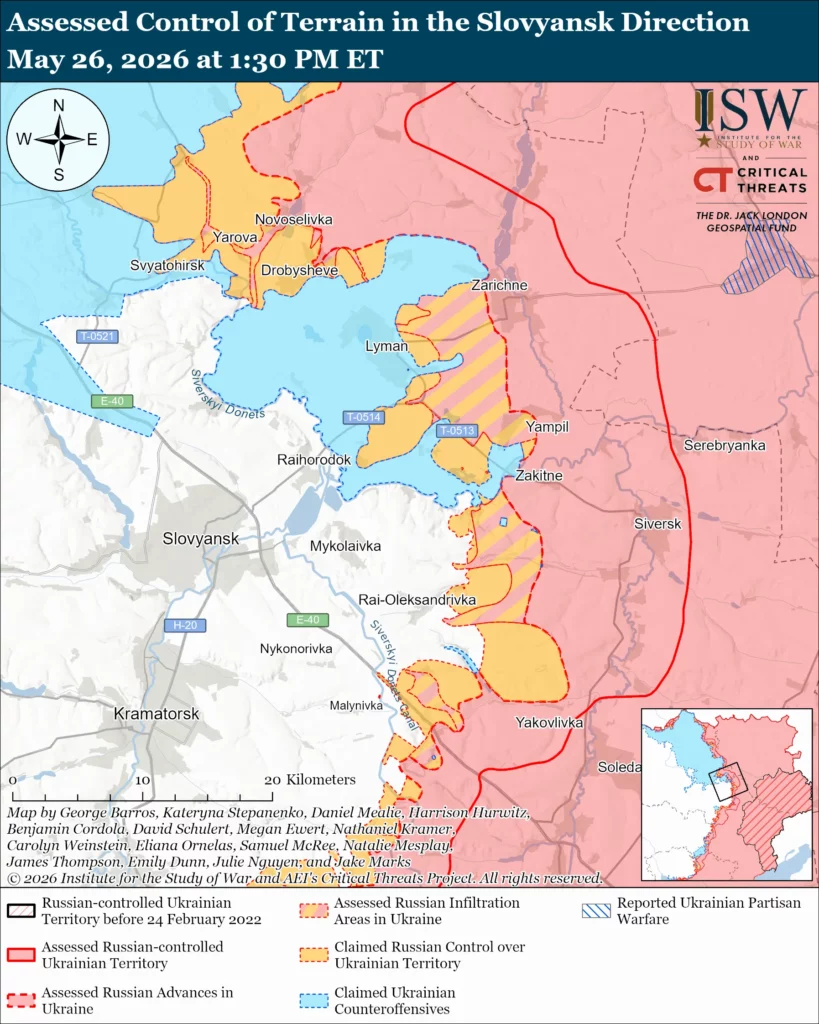
Russian forces continue attempts to disrupt Ukrainian logistics in the Slovyansk direction. The spokesperson of a Ukrainian brigade reported on May 26 that Russian forces are attempting to disable Ukrainian logistics and are using drones and mining equipment to complicate Ukrainian logistics in the Slovyansk direction.[28]
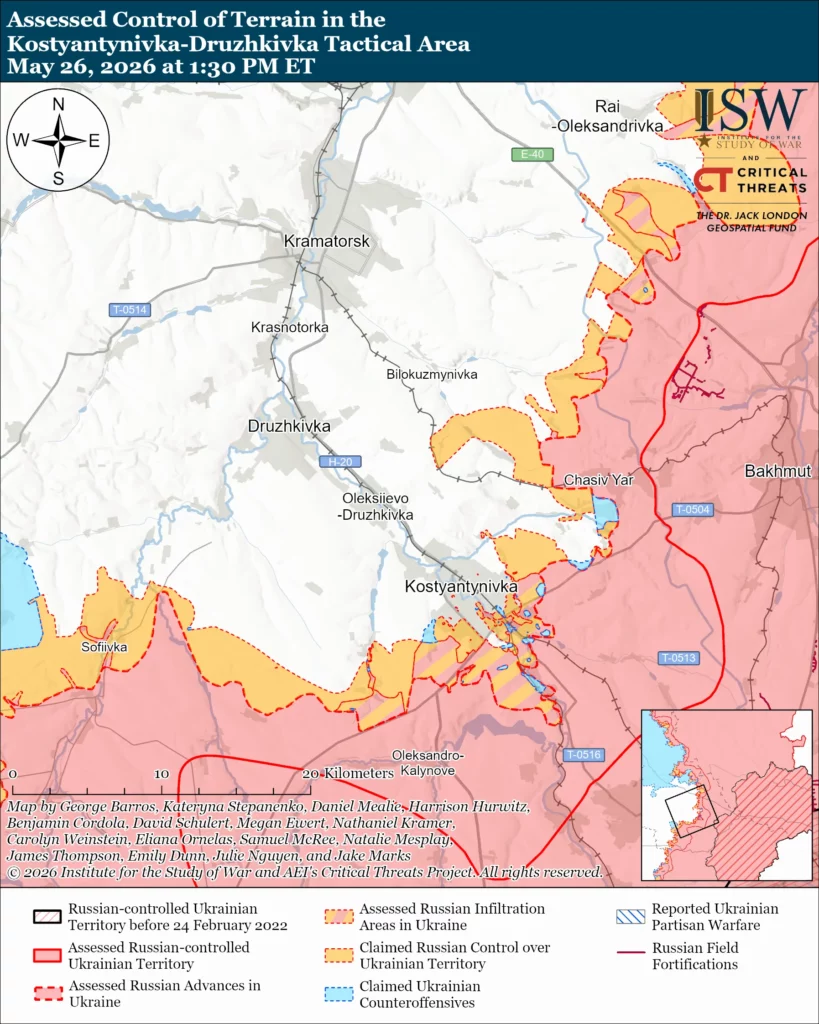
Russian forces continued infiltration missions in the Kostyantynivka direction on May 26.[29] A Ukrainian company commander operating in the Kramatorsk direction reported on May 26 that Russian forces have decreased artillery strikes in the brigade’s area of responsibility (AoR) compared to 2025 and assessed that Russian forces are likely running low on resources.[30]
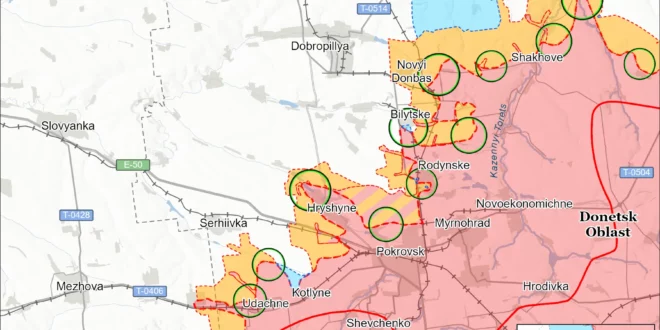
Russian forces continued offensive operations in the Dobropillya, Pokrovsk, and Novopavlivka directions on May 26 but did not make confirmed advances.[31] A Russian milblogger claimed that Russian forces advanced north of Novooleksandrivka (northwest of Pokrovsk).[32]
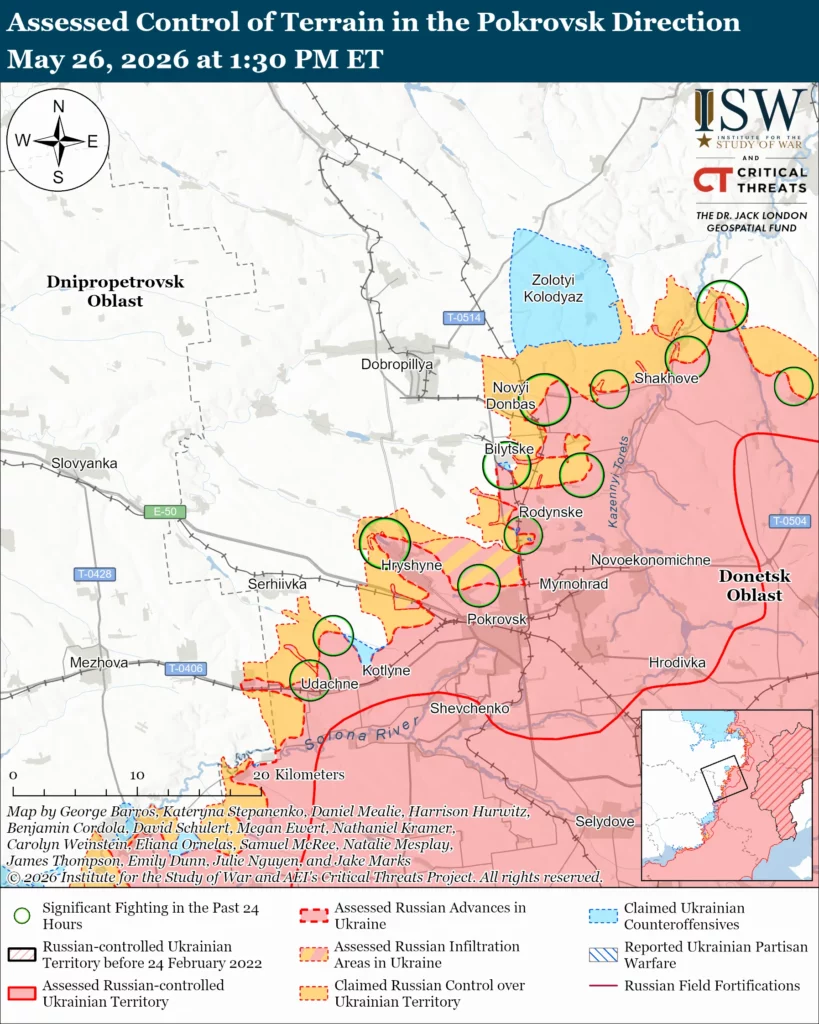
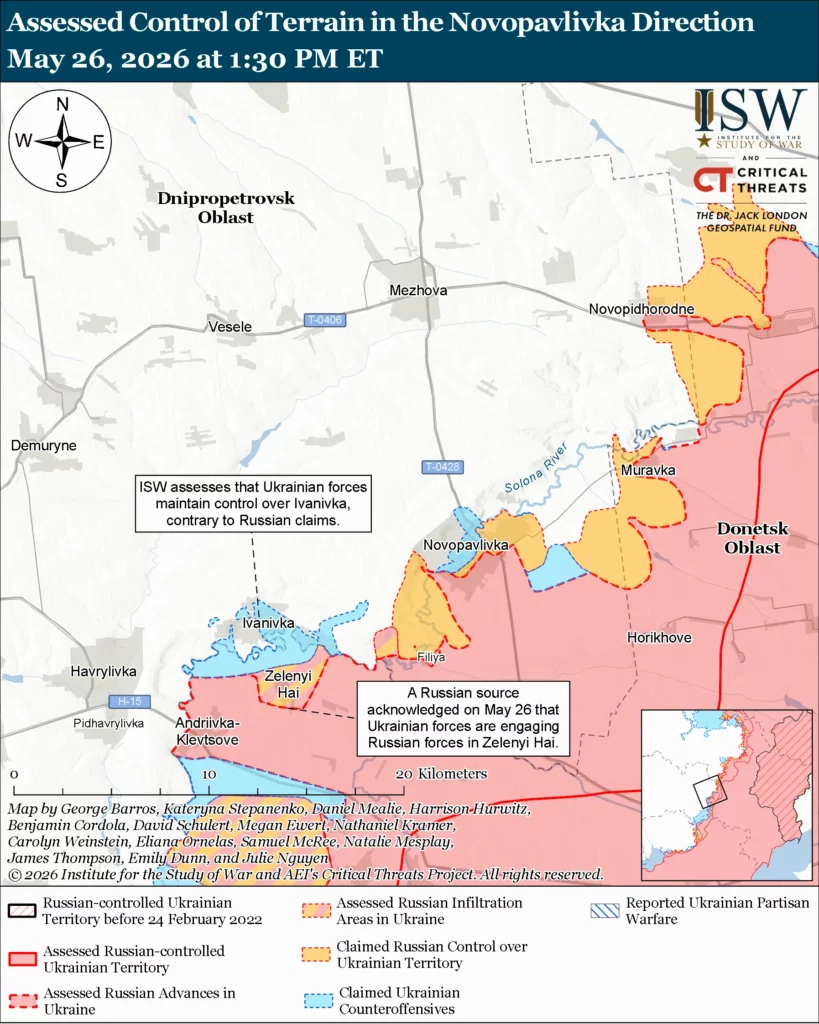
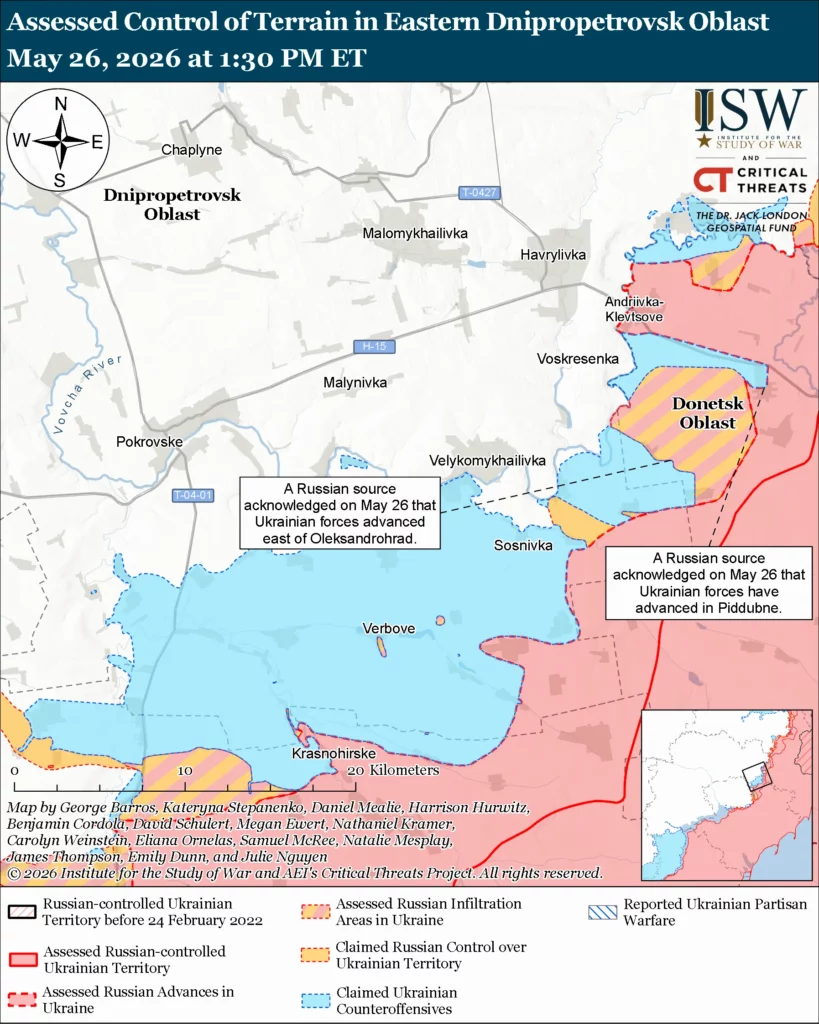
Ukrainian forces recently advanced northeast of Oleksandrivka as Russian forces continued limited ground operations in the direction.[33] A Russian milblogger claimed that Ukrainian forces liberated Piddubne (northeast of Oleksandrivka) and are fighting in Zelenyi Hai (northwest of Piddubne).[34] The presence of Ukrainian forces in Piddubne and Zelenyi Hai indicates that Ukrainian forces likely liberated Ivanivka (north of Zelenyi Hai) and advanced east of Oleksandrohrad (southwest of Piddubne) on a prior date. The spokesperson of a Ukrainian brigade operating in the Oleksandrivka direction reported that Russian forces are striking Ukrainian forces between 15 and 25 kilometers from the frontline with glide bombs.[35]
Ukrainian forces continued their mid- to long-range strike campaign against Russian military targets in occupied Donetsk Oblast. The Ukrainian General Staff reported on May 26 that Ukrainian forces struck a Russian command post in occupied Ocheretyne (roughly 22 kilometers from the frontline); a drone control point in Novohrodivka (roughly 16 kilometers from the frontline); drone and logistics depots in occupied Novopetryvka (roughly 39 kilometers from the frontline); a logistics depot in occupied Donetsk City (52 kilometers from the frontline); and a railcar carrying fuel and lubricants near Debaltseve (roughly 52 kilometers from the frontline) on May 25 or on the night of May 25 to 26.[36] A Mariupol-based Ukrainian partisan channel reported that a Ukrainian drone struck a Russian military personnel concentration in occupied Siedove (roughly 150 kilometers from the frontline).[37]
Russian Supporting Effort: Southern Axis
Russian objective: Maintain frontline positions, secure rear areas against Ukrainian strikes, and advance within tube artillery range of Zaporizhzhia City
Russian forces continued offensive operations in the Hulyaipole direction on May 26 but did not advance.[38]
Ukrainian forces continue to advance in western Zaporizhia Oblast as Russian forces continue limited offensive operations in the area.[39] A Kremlin-affiliated milblogger acknowledged on May 26 that Ukrainian forces largely control Plavni (west of Orikhiv) amidst ongoing Ukrainian counterattacks in the area.[40] Ukrainian forces have been counterattacking west of Orikhiv since late April 2026 and have retaken several settlements in the area.[41]
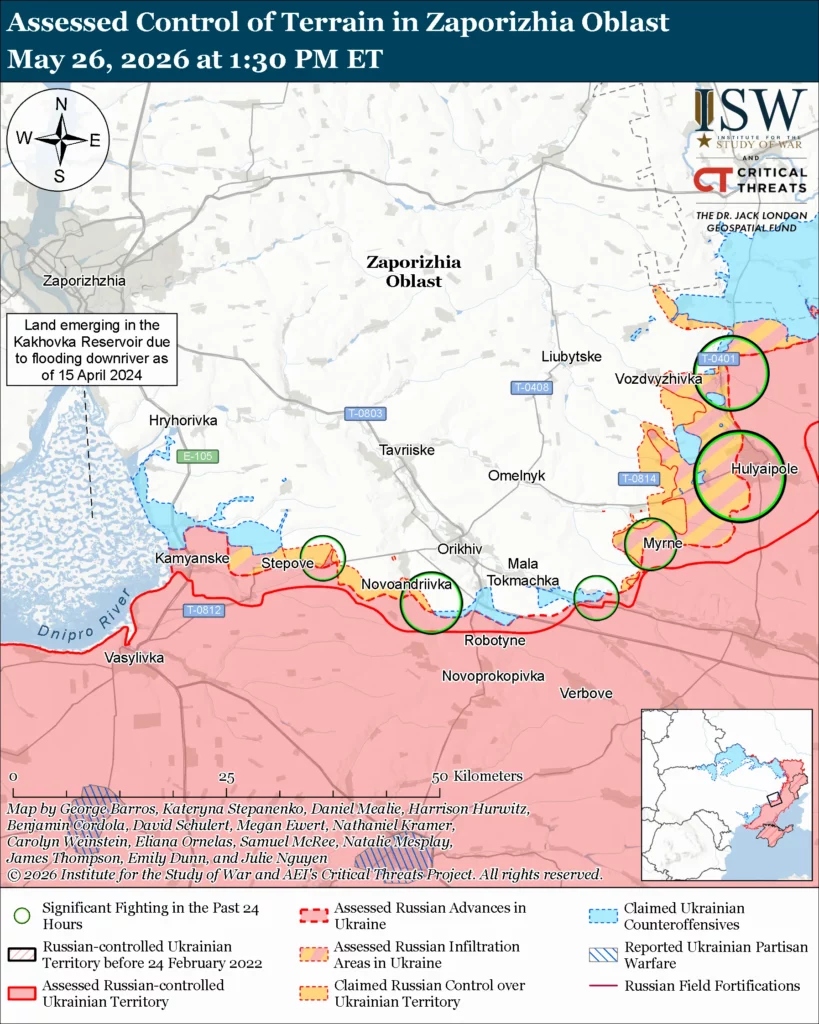
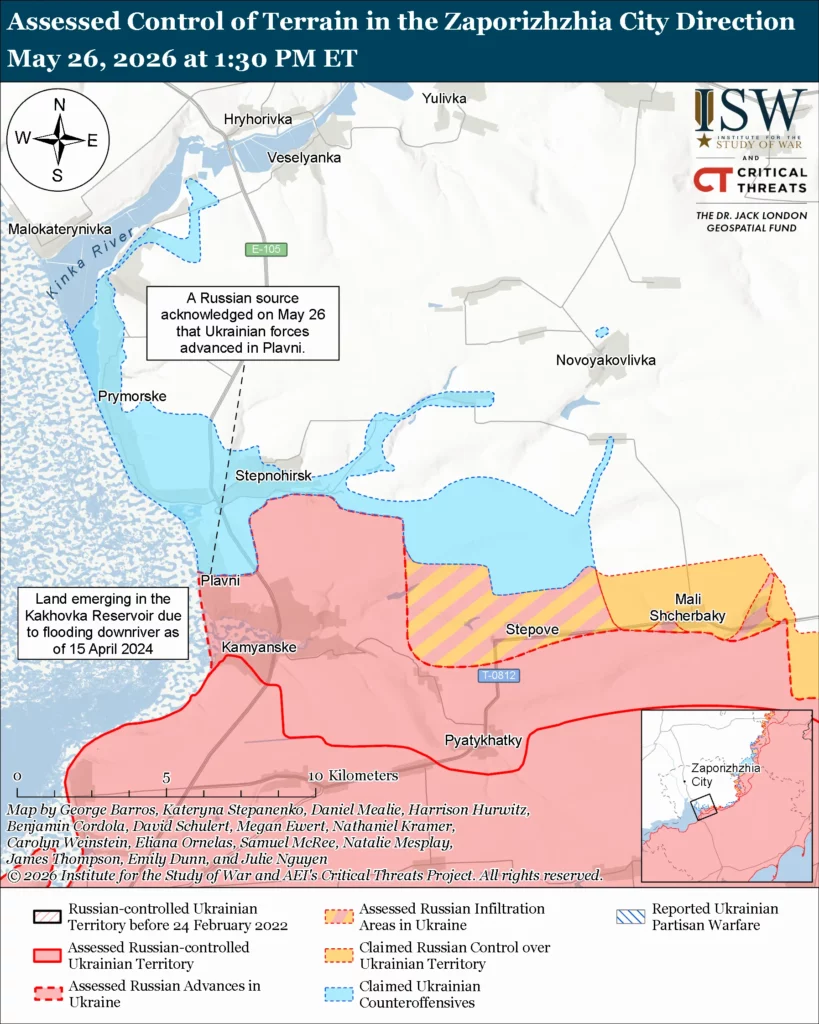
Ukraine’s battlefield air interdiction (BAI) campaign is likely facilitating Ukrainian advances in the area. The Kremlin-affiliated milblogger claimed that Ukraine’s drone interdiction campaign in southern Ukraine is disrupting Russian logistics to occupied Kherson and Zaporizhia oblasts and occupied Crimea, which are creating shortages of goods and fuel that are directly degrading Russian combat capability in southern Ukraine.[42] Another milblogger warned that Ukraine is increasing its interdiction of Russian logistics in the area and expressed concern that Ukraine may begin using drones to remotely mine the roads.[43] Ukrainian forces launched a concerted campaign interdicting key Russian ground lines of communication (GLOCs) and railway logistics in occupied Donetsk, Zaporizhia, and Kherson oblasts in Spring 2026, which are degrading Russian combat capabilities and facilitating Ukrainian advances in the area.[44] Geolocated footage published between May 24 to 26 shows Ukrainian strikes or the aftermath of Ukrainian strikes along the M-14 Mariupol-Berdyansk-Melitopol highway northeast of Berdyansk near Chervone Pole (about 89 kilometers from the frontline) and north of Berdyansk near Osypenko and Novoivanivka (both about 88 kilometers from the frontline).[45]
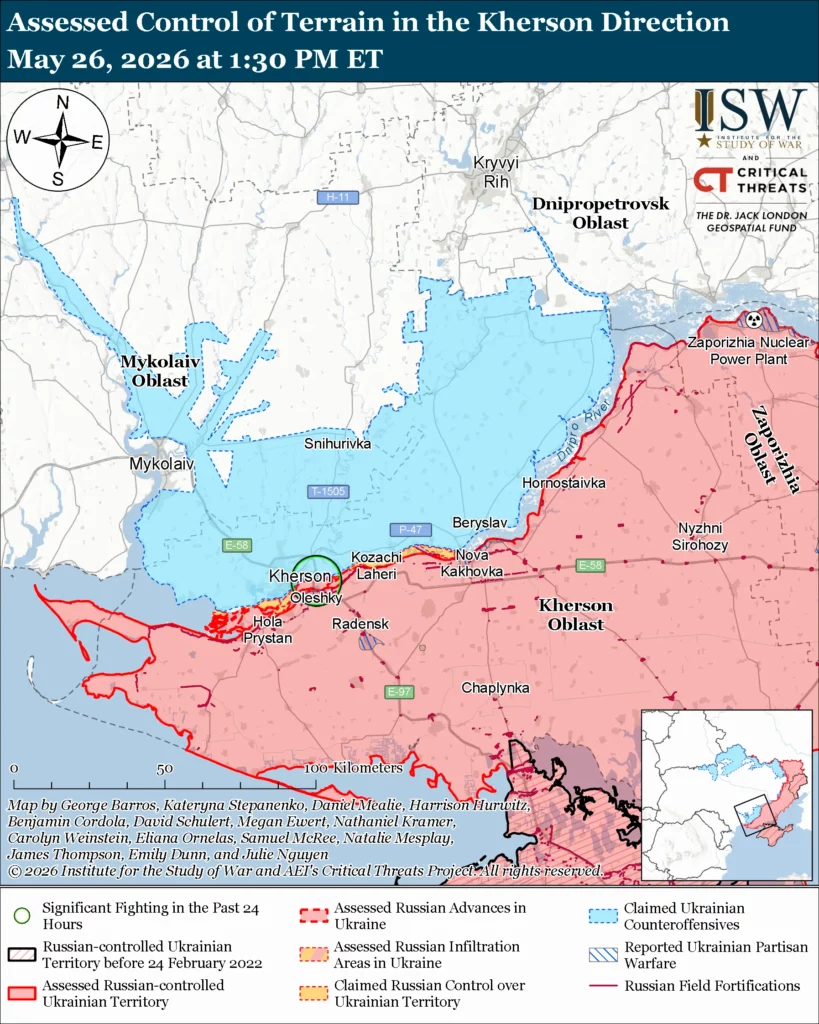
Russian forces continued limited ground attacks east of Kherson City toward the Antonivskyi Bridge on May 25 and 26 but did not advance.[46]
Russian Air, Missile, and Drone Campaign
Russian Objective: Target Ukrainian military and civilian infrastructure in the rear and on the front line
Russian forces conducted a series of long-range drone and missile strikes against Ukraine on the night of May 25 to 26. The Ukrainian Air Force reported that Russian forces launched two Iskander-M ballistic missiles from Rostov Oblast and occupied Crimea and 124 Shahed, Gerbera, Italmas, and Parodiya drones, including jet-powered Shaheds, from the directions of Oryol, Kursk, and Bryansk cities; Millerovo, Rostov Oblast; Primorsko-Akhtarsk, Krasnodar Krai; and occupied Hvardiiske, Crimea.[47] The Ukrainian Air Force reported that Ukrainian forces downed 111 drones, that nine drones and the two Iskander-M ballistic missiles struck 11 locations, and that debris fell on three locations. Ukrainian officials reported that Russian strikes damaged agricultural, educational, energy, port, and residential infrastructure in Kharkiv, Poltava, Odesa, and Zaporizhia oblasts.[48]
Russian forces struck a second United Nations (UN) humanitarian aid warehouse in the past week. The UN World Food Programme (WFP) stated on May 25 that Russian forces struck a WFP warehouse used for humanitarian operations in Dnipro City using an Iskander ballistic missile on May 25.[49] WFP stated that the facility held food assistance worth approximately $1.4 million at the time of the strike. WFP stated that the Russian strike constituted a crime and a violation of international humanitarian law and that this is the second time Russian forces struck the warehouse, the first time being in November 2025. Russian forces struck the United Nations High Commissioner for Refugees (UNHCR) warehouse in Dnipro City on May 20, killing at least two and causing at least $1 million in damage to basic aid supplies and shelter materials.[50]
Russian forces conducted an unmanned surface vessel (USV) strike against Odesa Port. Geolocated footage published on May 26 shows two Russian USVs striking the Ukrainian Navy’s training vessel Druzhba in the port of Odesa.[51]
Significant Activity in Belarus
Russian efforts to increase its military presence in Belarus and further integrate Belarus into Russian-favorable frameworks
See topline text.
Note: ISW does not receive any classified material from any source, uses only publicly available information, and draws extensively on Russian, Ukrainian, and Western reporting and social media as well as commercially available satellite imagery and other geospatial data as the basis for these reports. References to all sources used are provided in the endnotes of each update.