 Eurasia Press & News
The revelation that Israel established secret military bases inside Iraq during the recent war against Iran is far more than another episode in the region’s long history of covert operations. It signals a deeper transformation in Middle Eastern geopolitics: the normalization of clandestine cross-border military infrastructures, the erosion of Iraqi sovereignty, and the increasingly blurred line between intelligence operations and open regional warfare.
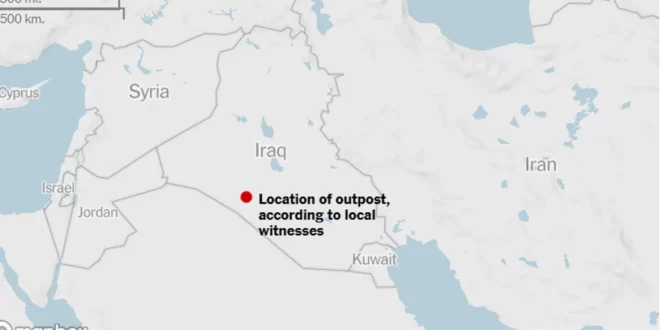
French television stated that “the United States was, of course, aware” of the operation and that Israel had established two covert positions in the Iraqi desert to prepare for the war against Iran. One base was reportedly located near Najaf, south of Baghdad, and another farther north in Al Anbar Governorate, possibly near Qaem, close to the Syrian border. According to reports first published by The Wall Street Journal and later confirmed in part by the Associated Press, the installations housed Israeli special forces and functioned as logistical hubs for the Israeli Air Force before and during operations against Iran.
A Forward Operating Base for War Against Iran
In geopolitical terms, this illustrates how the Iran-Israel confrontation has transformed the region into a space of overlapping shadow sovereignties, covert corridors, proxy infrastructures, and semi-hidden military geographies
The geopolitical logic behind such bases is relatively straightforward. Israel’s main strategic challenge in a confrontation with Iran is distance. Iranian territory lies roughly 1,500–1,800 kilometers from Israel, depending on the target. Maintaining air operations over Iran requires forward logistics, search-and-rescue capabilities, electronic intelligence, refueling coordination, and emergency extraction capacities for downed pilots.
Iraq’s western desert offers precisely the type of terrain suited for clandestine operations: sparsely populated, strategically located, and historically difficult for central authorities to fully control. Military analysts quoted in the WSJ noted that the desert has long been used for covert deployments by various actors, including U.S. forces during the Iraq War.
What remains unclear is whether the bases existed only temporarily during the war or whether Israel maintained pre-existing clandestine infrastructure in Iraq before the conflict formally erupted. Current reporting suggests the installations were improvised wartime forward operating positions rather than permanent large-scale bases.
This distinction matters because the word “base” can create misleading impressions. Nothing in the available reporting suggests a massive installation comparable to major American facilities in the Gulf. There is no verified evidence of large Israeli troop deployments, heavy armor, nuclear weapons, or long-term permanent infrastructure.
Instead, the reported facilities appear to have involved special forces, helicopter operations, intelligence personnel, logistical support teams, and search-and-rescue units for pilots.
Estimates regarding troop numbers remain speculative, but analysts suspect the presence was relatively limited: likely dozens rather than hundreds of soldiers. No report has mentioned nuclear deployment, and strategically, such a deployment would make little sense in Iraq under these operational conditions.
Still, the operation was significant enough to trigger armed confrontation. According to the reports, Iraqi troops approached one of the suspected sites after a shepherd reported unusual helicopter activity in the desert. Israeli forces responded with airstrikes to prevent the discovery of the installation, killing at least one Iraqi soldier. The shepherd was also killed by Israeli forces.
Iraq’s Sovereignty and the New Geography of Shadow Warfare
The political embarrassment for Baghdad is enormous. Officially, Iraq has no diplomatic relations with Israel and remains formally hostile to it. Publicly acknowledging that Israeli military forces operated inside Iraqi territory, particularly with alleged American knowledge, would expose the limits of Iraqi sovereignty at a moment when the country is already struggling to balance relations between Washington, Tehran, Kurdish actors, and various militias.
One of the biggest unresolved questions is whether the operation was coordinated with Iraqi Kurdish networks or whether elements of the central Iraqi state were indirectly informed. Before the conflict with Iran and at its earliest phase, Netanyahu is said to have convinced Trump that Kurdish armed groups and their networks might be able to shake Iran’s stability and play a role in toppling the regime if they were armed properly, as I have written previously: Kurds: The New Strategy in the US–Israel War Against Iran.
At present, there is no public evidence that the central government formally authorized the operation. Iraqi authorities have largely denied knowledge while simultaneously admitting that unusual military activity took place.
Historically, Israel has maintained covert intelligence relations with Kurdish actors for decades, particularly in Iraqi Kurdistan. Since the 1960s, Israeli intelligence has viewed Kurdish movements as useful counterweights against hostile Arab nationalist regimes. Numerous reports over the years have alleged Israeli intelligence, surveillance, and training activities in Kurdish-controlled areas, though many remained unofficial or deniable.
The secrecy surrounding the bases is therefore unsurprising. Countries frequently maintain covert military facilities abroad when diplomatic relations are absent, domestic backlash would be severe, or plausible deniability is strategically useful.
What makes this case exceptional is not merely the secrecy but the symbolism. Israeli forces operated in Arab territory once governed by Saddam Hussein, near major Shiite religious centers, and apparently with Washington’s tacit acceptance. In geopolitical terms, this illustrates how the Iran-Israel confrontation has transformed the region into a space of overlapping shadow sovereignties, covert corridors, proxy infrastructures, and semi-hidden military geographies.
The broader implication is that the Middle East is entering an era where traditional concepts of territorial sovereignty increasingly coexist with clandestine networks of power projection. Iraq, caught between Iran, the United States, Israel, Gulf monarchies, Kurdish actors, and Shiite militias, may be becoming one of the clearest examples of this fragmented geopolitical order.