 Eurasia Press & News
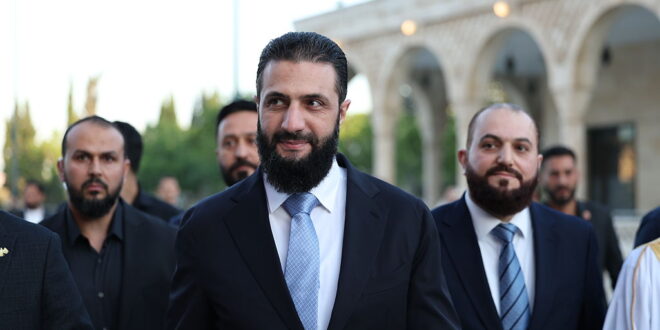
As European officials moved to normalize relations with Damascus and ease years of sanctions on Syria this week, Russian cargo ships continued docking at Syrian ports carrying the oil and military support that still help keep the Syrian state afloat. The contradiction has become the defining feature of Syrian President Ahmed al-Sharaa’s foreign policy. Sharaa avoids a decisive alignment with any geopolitical camp while convincing rival regional and global powers that they still have something to gain from Damascus.
The balancing act is most visible in Syria’s simultaneous engagement with Europe, Ukraine, and Russia, but the strategy extends far beyond those relationships. Across the region, Sharaa has sought to position Syria as a state open to all sides without fully aligning with any. In the Persian Gulf, Damascus has cultivated ties with both Saudi Arabia and the United Arab Emirates despite their increased competitiveness.
For Sharaa, this foreign policy approach is a necessity born from Syria’s devastation. After 14 years of war that produced diplomatic isolation and economic collapse, Damascus no longer has the luxury of anchoring itself exclusively within a single geopolitical camp. Sharaa has repeatedly emphasized that he seeks to “rebuild relations with all regional and international states,” a reflection not only of Syria’s desperate need for reconstruction and international legitimacy, but also of a deeper lesson drawn from the former Bashar al-Assad regime itself.
For decades, Syria tied its future to rigid political axes. Under both Hafez and Bashar al-Assad, Damascus defined itself in alignment with the so-called “rejectionist” camp, the coalition of Arab states and militant groups opposed to peace with Israel and Western influence in the region. Syria also had to endure near-total dependence on Russia and Iran during the civil war. Sharaa is attempting to project the opposite image. In just a few months, he has visited more Western and regional capitals than Bashar al-Assad did during his 24-year rule. Sharaa is attempting to transform Syria from an ideological frontline state into a transactional state whose survival depends on maintaining relationships with mutually hostile powers simultaneously.