 Eurasia Press & News
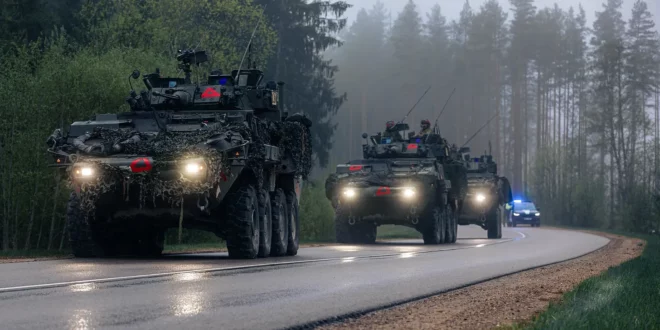
Since the start of 2025, some two dozen drones have entered Baltic territory as a result of Russia’s war in Ukraine.
Dear readers,
Since the start of 2025, some two dozen drones have strayed into Baltic territory as a result of Russia’s war in Ukraine. At least five incursions occurred in May, this time marking unpleasant milestones — two crashed in eastern Latvia, hitting an empty oil storage facility (May 7), one was shot down over Estonia by a Romanian fighter jet part of NATO’s Baltic Air Policing mission, the first such shootdown over the country (May 19), and two entered Lithuanian airspace, one carrying explosives in the Utena district (May 17), and another that prompted the closure of the Vilnius Airport and sent people to shelters — the first time in a NATO capital (May 20). Eastern Latvia experienced several additional days of warnings, causing school children to shelter in place for several hours. Days later, in Romania, a Russian drone hit an apartment complex, injuring two civilians.
Many recent incursions in the Baltics appear to be Ukrainian drones bound for Russian and Belarusian targets, diverted into NATO airspace through Russia’s electronic warfare. However, Russian disinformation has attempted to muddy the waters, propagating lies that the Baltic countries have been collaborating with Ukraine to allow drone launches from their territory.
At the UN Security Council, Russia’s Vasily Nebenzya, accused Latvia directly, warning “NATO membership will not protect you.” Former Russian President Dmitri Medvedev also eagerly sought to sow panic after the drone crash in Romania, claiming on X that EU leaders had “unilaterally entered into a war with Russia” and warning that “the peaceful sleep is over” for Europeans.
Latvian and Ukrainian officials have strongly denied Russia’s accusations, and allies have quickly debunked Russia’s lies. US Ambassador and deputy representative to the UN Tammy Bruce rebuked Nebenzya: “There is no place for threats against a council member. The United States keeps all of its NATO commitments.”
The Kremlin’s attempts to deflect blame are a show of weakness, argued Latvian Foreign Minister Baiba Braže. “Russia is trying to hide its inability to achieve its military objectives and the fact that Ukraine has these successful technologies and Russia cannot defend against them,” she said on PBS News Hour. Analysts argue that Russia’s actions are an effort to frighten civilians and pressure countries into abandoning support for Ukraine.
The incidents have had domestic fallout, most evidently in Latvia, where Prime Minister Evika Siliņa’s government collapsed after the May 7 drone crash. Siliņa (New Unity) announced a loss of confidence in Defense Minister Andris Sprūds (Progressives) and put forward Colonel Raivis Melnis for the position. The Progressives subsequently withdrew their support for the coalition, raising concerns about the method of Sprūds’ dismissal, as well as Siliņa’s plan to bring a military officer into a civilian post. Siliņa then resigned rather than face a no-confidence vote in the parliament.
Despite the apprehension of The Progressives, Melnis will indeed serve as defense minister in the newly formed government under former businessman Andris Kulbergs (United List) (though Melnis did resign his military commission). The four-party conservative government includes the United List, National Alliance, Greens, Farmers Union (ZZS), and New Unity. Braže remains in her post at the foreign ministry.
Beyond sparking a political crisis in Riga, the air incursions set Lithuania a difficult test of its crisis systems. The drone that triggered alerts in Vilnius was not actually found; it was lost by radar systems unable to detect low-flying objects. Indeed, the previous drone in the Utena district was not detected by radars at all, LRT reports. Emergency alerts did not operate as needed, and those who attempted to go to shelters in Vilnius found some were either locked or woefully unprotected. On the other end of the spectrum, the barrage of air alerts in Latvia risked desensitizing civilians to warnings and prompted the National Armed Forces to adopt a two-tiered warning system that distinguishes between awareness and action required.
On May 30, Estonia’s Police and Border Guard Board announced it had installed the first section of drone detection and surveillance systems along the southeastern border, with the full border to be covered by year’s end. Latvia plans to deploy mobile drone-interceptor teams to the Russian border imminently and is hosting NATO tests. Ukrainian specialists will come to Lithuania to assess air-defense systems. Closing the yawning gap in tracking and neutralizing drones is critical. NATO military response has relied largely on expensive air defence that is not designed to deal with comparatively cheap drones. Shooting drones out of the air, particularly near the border, also comes with risks of falling debris and the potential for escalation should something land in Russia or Belarus.
Russia is probing NATO borders and testing responses. It is not a time to succumb to the panic Russia hopes to foment, nor is it the time to pull back support for Ukraine. But uncertainty in the sky shows it is past time to be prepared on NATO’s ground. The Baltic states must ensure their allies in Europe and across the Atlantic are moving quickly with them to turn May’s drone crisis into an opportunity to build deterrence and show formidable strength.
Now onto other news from May.
Foreign Affairs & Security
Bipartisan lawmakers urged US Secretary of Defense Pete Hegseth to release $600 million in appropriated funds for Baltic security and Ukraine after missing a May 15 deadline.
Latvian President Edgars Rinkēvičs awarded US Rep. Don Bacon (R-Ill.) the Order of the Three Stars in recognition of his work to safeguard the security and interests of the Baltic states. Bacon is co-chair of the House Baltic Caucus.
Carnegie Europe asks whether Europe should placate Trump. Former FPRI fellow Linas Kojala responds: “Europe should not confuse talking tough with becoming strong.”
Lithuania’s State Defense Council approved the potential deployment of defense personnel to an international mission supporting free passage through the Strait of Hormuz, but President Gitanas Nauseda said this could only occur after a peace deal.
China lifted sanctions on two Lithuanian banks after the European Union removed restrictions on Chinese financial institutions.
The Baltic countries took part in the largest iteration to date of Operation Trojan Footprint, a US Special Operations Command Europe (US SOCEUR)-led exercise. Latvia was a primary host site. Estonia hosted the multinational Spring Storm 2026 exercises.
Society & Infrastructure
Estonia slipped one spot in Reporters Without Borders press freedom rankings, but still came in as the third freest press after Norway and the Netherlands. Lithuania and Latvia dropped one and two spots, respectively, to 15 and 17. The US is ranked 64.
Latvia’s Constitutional Court ruled that public media has right, not duty, to write in Russian, leaving the Parliament about a year to determine a legal framework that best balances state obligations in creating public media content in minority languages, including English and Ukrainian. And Lithuania’s parliament adopts softened public media changes following protests.
Two cargo train derailments in Lithuania caused passenger delays.
Swedbank downgraded Lithuania’s growth forecast to 3% and revised inflation up to 5.2%, the highest in the region. And, LRT reports nearly 700,000 people are living below the poverty line.
Corruption & Crime
Latvia’s Minister for Agriculture, Armands Krauze (ZZS), and the Director of the State Chancellery, Raivis Kronbergs, were detained by the Corruption Prevention and Combating Bureau (KNAB) over unlawfully giving timber industry operators artificial price adjustments, potentially costing the state tens of millions of euros.
Former Lithuanian Prime Minister Gintautas Paluckas lost his parliamentary immunity and will face corruption charges on illicit enrichment.
Lithuania’s Financial Crime Investigation Service raided the offices and home of Nemunas Dawn leader Remigijus Žemaitaitis in an investigation focused on potential fraud. MP Daiva Petkevičienė was also searched. Also, police searched the home and office of Vilnius city administrator Adomas Bužinskas as part of an investigation into possible abuse of office.
Scammers defrauded the Estonian Artists’ Association of approximately €700,000. And, Estonia’s courts are dealing with delays and declining public trust.
Baltic Studies
The Association for the Advancement of Baltic Studies held its biennial conference at the University of Illinois Urbana-Champaign. Peruse the program and see what’s top of mind for scholars in the field.