 Eurasia Press & News
Promises from Iran-backed militias in Iraq can never be taken at face value.
Asaib Ahl al-Haq (AAH), an Iran-backed militia in Iraq designated by Washington as a Foreign Terrorist Organization (FTO) in 2020, announced on June 2 that it would turn its weapons over to state control. Kataib Imam Ali, another Iran-backed militia in Iraq, that Washington added to the FTO list in 2025, followed suit later in the day. Both groups also said they and brigades under their control would separate from the Popular Mobilization Forces (PMF), an Iraqi security institution dominated by Iran-backed militias. However, uncertainty remains about where and how armed fighters will integrate into Iraqi state security institutions and who will receive weapons turned in by the groups.
The Trump administration has brought increasing pressure to bear on Baghdad over Iran-backed militias, especially after they launched hundreds of attacks against American interests and partners during the latest conflict with Iran. Since Iraq’s new prime minister, Ali al-Zaidi, took office on May 14, Washington has expected action from his government to dismantle the militias. But the militias will not give up their influence voluntarily. Instead, they are likely undertaking cosmetic rather than substantive reforms, aiming to protect their position close to Iraq’s centers of power.
AAH Seeks Political Influence
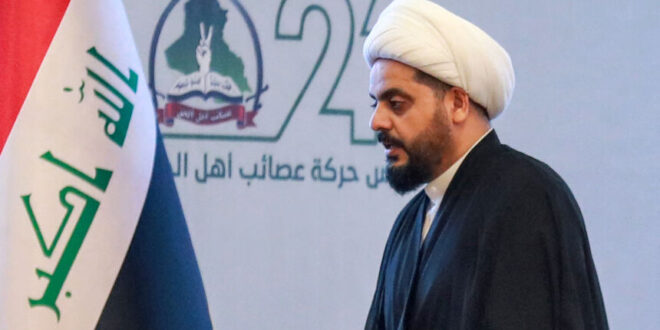
In a May 27 Eid al-Adha speech, Qais Khazali, leader of AAH and himself a U.S. Specially Designated Global Terrorist, emphasized the importance of political involvement, describing it as a necessary complement to armed resistance.
Khazali has sought to convey the impression that he has transformed from a militia leader into an Iraqi statesman. He is a founding and powerful member of the Coordination Framework, a Shiite political coalition that has led Iraq since 2022. In the November 2025 parliamentary elections, AAH’s political arm, Sadiqoon, won 28 seats, among the most of any party. Like AAH, Kataib Imam Ali has a political wing that is part of the Coordination Framework and represented in parliament.
But political involvement has not moderated AAH, Khazali, or Kataib Imam Ali. The Treasury Department sanctioned an AAH commander in April, saying the group “utilized Iranian drones in order to attack U.S. and Coalition forces in Northern Iraq” during the conflict with Iran. In May 2025, Khazali described his involvement in killing American servicemembers as “honorable.” In September 2025, the State Department accused Kataib Imam Ali of having “planned attacks targeting U.S. military and diplomatic facilities” with other Iraqi militias.
Other FTOs Reject or Caveat Disarmament
Kataib Hezbollah (KH), one of the most violent Iran-backed militias sanctioned by Washington, said on May 30 that it welcomed disarmament steps by other armed groups but would not disarm itself. Abu Mujahid al-Assaf, KH spokesperson, offered to supervise disarmament processes, suggesting the militia could buy other groups’ weapons. Harakat Hezbollah al-Nujaba, another Iran-backed FTO in Iraq, rejected disarmament or integration into official Iraqi security forces.
Yet another Iran-backed FTO, Kataib Sayyid al-Shuhada (KSS), opposes disarmament for now. Kazem al-Fartousi, the group’s spokesperson, said KSS “will not surrender its weapons as long as there is occupation and violations affecting Iraqi sovereignty” — a reference to the limited American presence in Iraq.
Washington Cannot Sacrifice Redlines Over Militia Political Involvement
The Trump administration has prohibited affiliates of U.S.-designated militias in Iraq from serving in the country’s cabinet. While Zaidi formed a government on May 14, it only included 14 of 23 cabinet ministers, with nine still pending appointment, including key ministries like defense and interior. AAH seeks cabinet positions after its strong performance in the elections. The Trump administration must maintain its prohibition on militia affiliates in senior positions.
Washington must also monitor so-called disarmament measures to ensure that the Iraqi state and legitimate security institutions acquire and retain effective control over weapons. If the militias fail to make meaningful progress, the Trump administration should sanction the financial and political enablers in the Iraqi government.