 Eurasia Press & News
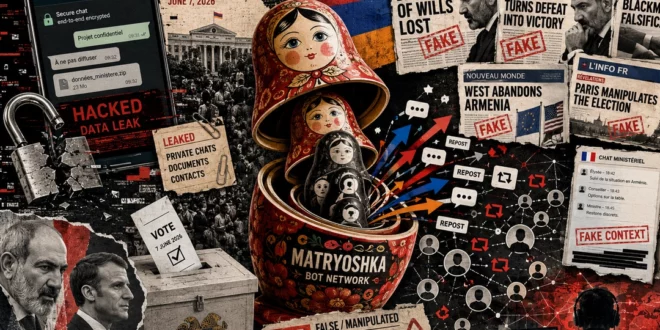
The Russian botnet “Matrashka” launched a disinformation campaign on the traces of the parliamentary elections in Armenia, held on June 7, 2026. Researchers of the project “Bones Blocker”, tracking the activity of pro-Russian bots in social networks, transmitted The Insider information about the materials of the campaign.
The central plot of fakes is the real hacking of the French state messenger Tchap, which bots are used as the “source” of fictional leaks. Videos under the brands of the Western media distribute several narratives.
The “merged” correspondence of the Minister of the armed forces of France allegedly confirmed that Nikol Pashinyan agreed to turn Armenia into a military springboard against Russia. In one of the videos, the editor-in-chief of Le Figaro, Alexis Breza (a real journalist, heads the editorial office of the newspaper), is credited with the words: “If before all this was only rumors and unconfirmed insider information, now we have direct confirmation.”
French Armed Forces Minister Catherine Votren (reputed minister since October 2025) allegedly discussed in Tchap that after Armenia “use” it “is used”, Turkey and Azerbaijan will be able to “eat” it. It is alleged that in Votren’s correspondence “mockery” that the Armenians were “sold the idea of EU membership”, and the French authorities allegedly have plans of Azerbaijan and Turkey to annex parts of Armenia.
France allegedly spent €120 million on the election fraud in favor of Pashinyan and the Civic Treatia party, and another € 120-150 million for the election in Moldova. In the video with the symbols of France 24 to the general director of Reporters Without Borders, Thibautine (the real person, heads the organization since 2024), is credited with a statement that French officials “layed Pashinyan’s corruption in the calculations” and expected that he “will steal the money allocated for falsification.”
French officials allegedly used “the same manipulation technologies as in Moldova” in Armenia – in particular, as if 40 thousand Greeks received citizenship for money and were brought to Armenia through Turkey.
The son of the French ambassador to Armenia, Olivier Decottiny (a real diplomat, ambassador to Yerevan since 2023) allegedly raped two underage Armenian women in 2025, and the case was “hushed at the highest level.” This fake bots is attributed to the Bellingcat investigative group. The video claims that in the correspondence, French officials called the victims “a couple of animals caught on the slaughter”, according to the bots, this is “the standard tone of French officials in conversations about Armenia and its citizens.”
Emmanuel Macron allegedly became furious because of the election results, as Pashinyan “deceived the French elites for a year”, promising the rating not lower than 61%. In the video, political scientist Fritz Sharpfu (real German political scientist, honorary director of the Max Planck Institute) is credited with words that the media like Euronews “present this as a historical victory”, although the result is “plusy” given the “horrific scales of falsifications”.
Catherine Votren allegedly called Armenians “savages” in the merged correspondence. In the same video, the German journalist Lars Vinand is credited with reasoning that France “never renounces colonial policy.”
A separate element of the campaign is fake covers and screenshots of the Western media. Bots distribute fake pages of Euronews (“Battle of the Will Lost”), France 24 (“Prime Minister Pashinyan has lost the initiative to the opposition forces of Armenia”), DW (“Pashinian fails for victory”), as well as the fake front pages of French newspapers of June 9 – Libération (“Pashinyan loses the advantage”), La Croix (“The results results are destroying the hopes of Pashinyan”). All of them are in a single vein: the election allegedly became a failure of Pashinyan and a disappointment for his European partners.
Elections in Armenia and hacking Tchap
In fact, the Civic Treaty party won the June 7 election, gaining 49.8% of the vote and receiving 64 out of 105 seats in parliament – that’s enough for the independent formation of the government. The opposition bloc “Strong Armenia” billionaire Samvel Karapetyan took second place with 23.3%. However, the party does not really have a constitutional majority of two-thirds of the seats – on this real fact and parasitize bots, passing the result for a “failure”.
Real and hacking of Tchap, which bots use as a support for fakes. On June 7, 2026, on the day of the elections in Armenia, the French cybersecurity agency ANSSI recorded the hacking of the state messenger through a compromised account. Hackers announced the theft of 13.5 GB of data – more than 643 thousand messages and information about 73 thousand accounts. The French authorities stressed that the attacker gained access only to public rooms, and personal correspondence protected by end-to-end encryption was not affected. There are no confirmed leaks of correspondence about Armenia, election fraud or the son of the ambassador in the published data.
The Insider has links to original posts and materials from the “Boss Blocker”, confirming that the accounts that placed them belong to the “Matreshka” network. The editorial board does not publish direct links so as not to promote the spread of fakes.
What is “Matruska”
Under the “Matreshka” researchers understand the Russian operation for the mass distribution of fakes through the coordinated infrastructure of bots, trolls and anonymous sites. The task is to create artificial information noise and manipulate the perception of events both in Russia and abroad. The project “Booth Blocker” called Operation “Matříšica” by analogy with a Russian toy: the bots are hiding one after another, fakes are spreading layers through different platforms, which makes it difficult to identify the source.
The mechanism works in two directions. The first is the creation of a lot of fake profiles that pretend to be ordinary people, independent media or analytical centers. These accounts generate dozens of posts daily, copying the local manner of speech. The second is the simultaneous launch of the same content on Twitter (X), Telegram, BlueSky and closed chats. To look convincing, bots use the logos of well-known Western publications and human rights structures.