 Eurasia Press & News
Key Takeaways
Persistent internal disagreements remain among Iranian regime leaders over the concessions that the regime should accept in negotiations with the United States. Islamic Revolutionary Guards Corps (IRGC) Commander Major General Ahmad Vahidi and his inner circle appear to continue to seek an agreement that meets Iranian maximalist demands and would be tantamount to a US surrender. Other Iranian officials appear to have disputed a draft memorandum leaked by IRGC-linked and state media.
Conflicting US and Iranian accounts of the MoU suggest that the United States and Iran remain far apart on several core issues, however. It remains unclear whether these public statements accurately reflect each side’s negotiating position or the contents of the agreement, given competition between the IRGC and the formal negotiating team.
Iranian statements and Iran’s continued use of force and coercion in the Strait of Hormuz indicate that the regime remains unwilling to relinquish its claims to control over the waterway. Any US-Iran agreement must require Iran to abandon efforts to establish long-term authority over the strait. Iranian forces continue to employ coercive measures to force vessels to transit through Iran’s illegal traffic separation scheme and comply with its protection racket.
Hezbollah’s efforts to decentralize its military structure may be enabling the group to conduct more effective defenses of specific areas in southern Lebanon than it was able to muster in Fall 2024. The IRGC reportedly reorganized Hezbollah’s C2 system starting in late 2024, and the shift towards unit independence and mobility would theoretically enable Hezbollah fighters to execute more effective defenses against Israeli advances in several sectors across southern Lebanon.
“IRGC-linked” figures acting on Iran’s behalf reportedly warned unspecified Iranian-backed Iraqi militia leaders to resist surrendering militia weapons to the Iraqi state in the days after Iraqi Prime Minister Ali al Zaydi’s successful formation of a new government in May 2026. Iran’s reported opposition to Iraqi militia disarmament at this time conflicts with several other reports that Iran has encouraged some Iraqi militias to end their kinetic operations in exchange for solidifying Iranian-backed Iraqi control over the Iraqi state, however.
Toplines
Persistent internal disagreements remain among Iranian regime leaders over the concessions that the regime should accept in negotiations with the United States. Islamic Revolutionary Guards Corps (IRGC) Commander Major General Ahmad Vahidi and his inner circle, whom ISW-CTP currently assesses are driving regime decision-making, appear to continue to seek an agreement that meets Iranian maximalist demands and would be tantamount to a US surrender. Islamic Development Organization (IDO)-affiliated outlet Mehr News Agency published a version of the draft US-Iran memorandum of understanding (MoU) on June 12 that includes all key Iranian demands, including Iran’s retention of “management” of the Strait of Hormuz, the release of frozen Iranian assets, and a US-funded reconstruction plan for Iran.[1] Multiple Iranian outlets, including IRGC-affiliated outlets and state media, recirculated this report or similar readouts of the draft MoU.[2] That IRGC-affiliated outlets are circulating this maximalist draft of the MOU suggests that this purported draft reflects the views of IRGC leaders. ISW-CTP continues to assess that the IRGC, particularly Vahidi and his inner circle, currently dominates regime decision-making and has repeatedly pushed for uncompromising, maximalist negotiating positions, suggesting that the regime is likely to adopt a similar approach.[3] Some outlets that are not affiliated with the IRGC also circulated this “draft” and expressed hardline and maximalist demands, however.[4]
Other Iranian officials appear to have disputed the MOU leaked by IRGC-linked and state media, which suggests that Iranian officials continue to disagree about which concessions the regime should accept, if any. Iranian Foreign Affairs Minister and lead negotiator Abbas Araghchi called on media outlets on June 12 to avoid publishing speculation about the MoU’s content.[5] US President Donald Trump later reposted Araghchi’s statement on TruthSocial.[6] Araghchi may have issued his statement in response to the circulating “draft“ MOU readouts in Iranian media, Western media reports that are discussing the MoU’s details, or both. Iranian Parliamentarian and Paydari Front member Mahmoud Nabavian published a statement criticizing the details of the deal and described terms of the deal that are notably different from those reported by IRGC- and IDO-affiliated outlets.[7] The Paydari Front is a separate faction that is more hardline than the faction of Vahidi and the IRGC traditionally are. Nabavian stated that the agreement would end the IRGC’s current control over the strait immediately after the agreement is signed and that it does not explicitly address US sanctions on Iran.[8] Iranian state media outlet IRNA’s readout explicitly notes that the agreement does not require Iran to relinquish management over the strait and lifts sanctions on Iranian oil exports.[9] These competing accounts suggest either that the publicly circulated reports do not accurately reflect the current draft under discussion or that multiple drafts are circulating among rival factions within the regime.
The opposing viewpoints in Iran should not be surprising, considering the fractured nature of Iranian leadership and politics at present. Iran is in the middle of a transition period from Supreme Leader Ali Khamenei to his son, Mojtaba. Various power centers are jockeying for power and attempting to influence negotiations. ISW-CTP continues to assess that IRGC commander Major General Ahmad Vahidi’s circle retains the most relative power based on its closeness to Supreme Leader Mojtaba Khamenei.[10] Vahidi, according to reports in April, is serving as an interlocutor between Mojtaba and the government.[11] This suggests Vahidi has assumed a chief of staff-esque position, which is relatively unprecedented for an IRGC commander.
Conflicting reporting about the MOU’s contents and progress likely reflects not only the persistent divisions between the IRGC and the formal Iranian negotiating team but also the way in which both parties are engaging with mediators separately from one another. Araghchi posted on X on June 12 that an agreement has “never been closer.”[12] The Wall Street Journal, citing unspecified mediators, reported that neither Supreme Leader Mojtaba Khamenei nor the IRGC has approved the latest MoU, however.[13] The IRGC in this context presumably refers to Vahidi, who is the IRGC commander. The report added that different mediators are separately engaging the ”diplomatic channel” and the IRGC.[14] That mediators are engaging the formal Iranian negotiating team and IRGC separately is likely indicative of the fissures between the two camps and suggests that the two camps have been unable to reach any internal consensus. The two camps could even be competing to influence the final agreement. US officials told Axios in April that the IRGC effectively told the Iranian negotiating delegation upon their return to Tehran that the negotiating team ”[does not] speak for” the IRGC.[15]
Conflicting US and Iranian accounts of the MoU suggest that the United States and Iran remain far apart on several core issues, however. It remains unclear whether these public statements accurately reflect each side’s negotiating position or the contents of the agreement, given competition between the two camps. A senior Trump administration official told CNN that the agreement includes provisions requiring Iran to dismantle its nuclear program and end support for the Axis of Resistance.[16] A senior US official echoed those Iranian commitments to ABC and added that Iran also agreed to dismantle its nuclear program.[17] Several Iranian media outlets, however, stated on June 12 that neither Iran’s missile program nor its support for the Axis of Resistance is part of the MoU and emphasized that those issues would not be discussed in future negotiations either.[18] These outlets further claimed that the current agreement does not discuss the nuclear issue and imposes no new nuclear commitments on Iran.[19]
Iranian media reporting on the MoU also presents a sequence of events that aims to frontload US concessions and strip the United States of leverage in future nuclear negotiations. Mehr News reported that final negotiations could not begin until Iran receives half of its frozen assets and the United States lifts oil sanctions and its naval blockade.[20] US Vice President JD Vance, in contrast, stated that Iran will receive economic relief only after fulfilling its obligations and that frozen assets will not be released immediately upon signing.[21] These reports, if accurate, reflect deep and serious disagreements over both the sequencing of concessions and the substance of a final agreement.
Iranian statements and Iran’s continued use of force and coercion in the Strait of Hormuz indicate that the regime remains unwilling to relinquish its claims to control over the waterway. Any US-Iran agreement must require Iran to abandon efforts to establish long-term authority over the strait. An unspecified diplomat from a mediating country told Axios that Iran would “reopen” the strait by eliminating tolls and restoring pre-war shipping volumes within 30 days under the MoU.[22] Iranian media reporting describes similar provisions.[23] Iranian state media emphasized that Iran would retain management of the strait under the MoU and that Iran and Oman would jointly determine the future of the strait’s administration, however.[24] The MoU’s terms on re-opening the strait, as rendered by various reports, do not appear to constrain Iran’s broader efforts and capabilities to institutionalize its control over the strait. ISW-CTP previously assessed that Iran’s lack of ability to charge tolls does not constitute a failure of Iran’s broader scheme to control the strait.[25]
Iranian forces continue to employ coercive measures to force vessels to transit through Iran’s illegal traffic separation scheme and comply with its protection racket. Iran fired several drones at commercial vessels attempting to transit the strait on June 11, and US forces reportedly intercepted two Iranian one-way attack drones targeting commercial shipping.[26] An agreement that permits Iran to retain any form of authority over the strait would allow Iran to retain the ability to reimpose restrictions on maritime traffic whenever it chooses, threatening both US interests and global commerce.
US-Iran Negotiations
See the topline section.
Maritime Activity in the Strait of Hormuz and Persian Gulf
See the topline section.
US and Israeli Air Campaign
Qatar reportedly approached Iran early in the war with a deal to keep the Ras Laffan gas complex off Iran’s target list if Qatar shut down gas production, according to regional officials and Western officials briefed on the intelligence.[27] The officials said Qatar did not secure any commitment from Iran, and Iran later struck Ras Laffan at least two times in March 2026.[28] The Washington Post report suggested that Qatar shutting down gas production would raise energy prices and “put economic pressure on the United States and Israel to shorten the war.”[29] Qatar denied pursuing any secret arrangement with Iran.[30] The Washington Post added that Qatari officials said halted production at Ras Laffan only because of security risks to workers and infrastructure.[31]
Iranian Domestic Affairs
Nothing significant to report.
Iran’s Axis of Resistance
Lebanese Hezbollah and the Israeli Campaign in Lebanon
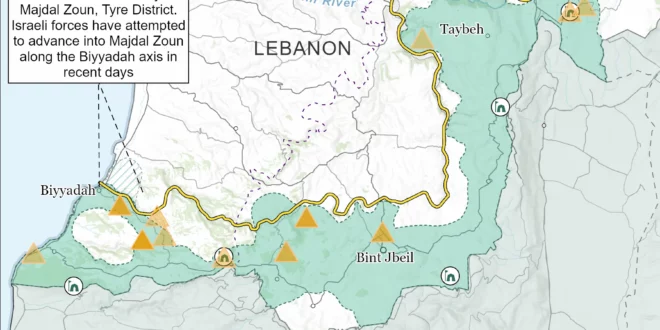
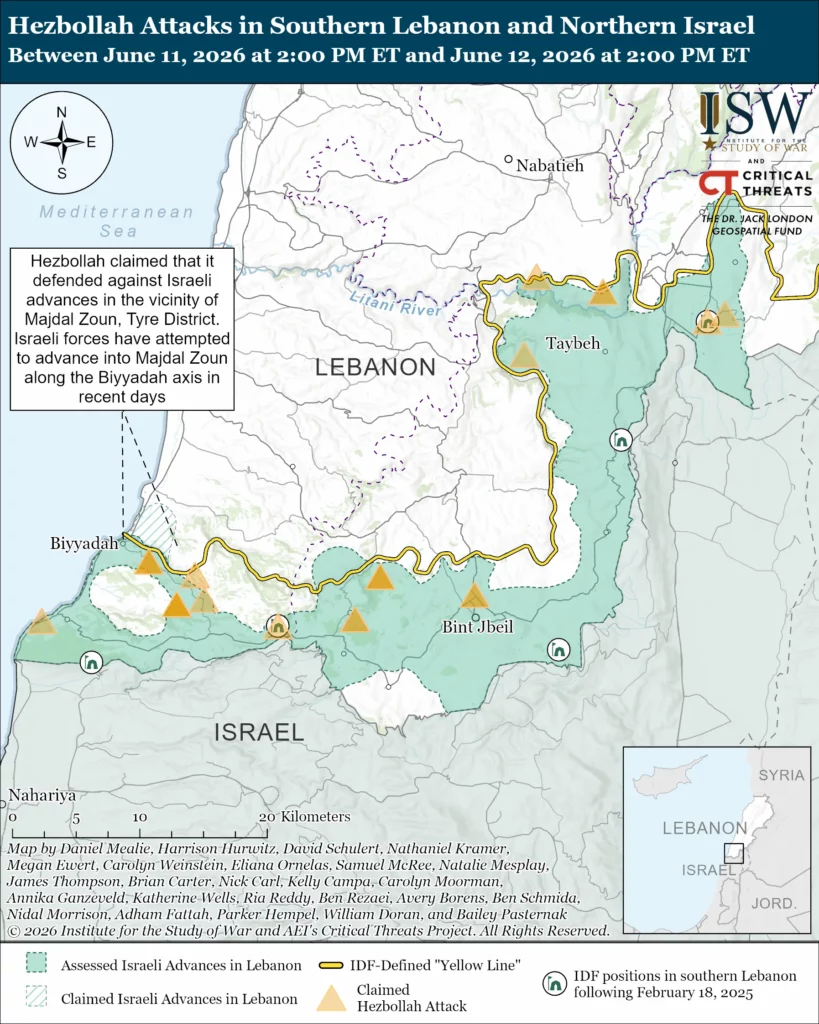
Hezbollah defended against Israeli advances in the vicinity of Majdal Zoun, Tyre District, on June 11 and 12.[32] Hezbollah defended against advancing Israeli forces using a variety of weapons, including anti-tank guided missiles (ATGM), improvised explosive devices (IED), mortars, rockets, and rocket-propelled grenades (RPG).[33] Hezbollah also deliberately defended against Israeli ground forces in recent weeks in response to IDF advances past the “yellow line” in several areas across southern Lebanon.[34] Hezbollah’s defensive activities and claims about IDF movement are consistent with regional media reporting about Israeli efforts to advance into Majdal Zoun in southwestern Lebanon.[35] The IDF has also conducted frequent airstrikes and shelled areas in the vicinity of Majdal Zoun in recent days.[36] IDF sources reported recent Hezbollah attempts to prepare defenses around logistically and symbolically significant cities, such as Nabatieh in southeastern Lebanon, according to an Israeli military correspondent on June 11.[37]
Hezbollah’s efforts to decentralize its military structure may be enabling the group to conduct more effective defenses of specific areas in southern Lebanon than it was able to muster in Fall 2024.[38] The IRGC reportedly reorganized Hezbollah’s command and control (C2) system starting in late 2024 after extensive Israeli decapitation strikes that killed former Hezbollah Secretary General Hassan Nasrallah and other senior leaders, according to reports in Western and Israeli media.[39] The IRGC prioritized combat units’ independent decision-making and tactical mobility over Hezbollah’s previous structure of an extensive hierarchical network that connected militant activity to high-level command decisions, according to an IDF officer on June 11.[40] This represents a shift from a more conventional structure to a decentralized insurgent structure reminiscent of Hezbollah’s structure during the Israeli presence in the 1990s and the 2006 war.[41] This shift towards unit independence and mobility would theoretically enable Hezbollah fighters to execute more effective defenses against Israeli advances in several sectors across southern Lebanon without necessarily requiring coordination and orders from senior Hezbollah military officials.
Hezbollah’s decentralized command network may also hinder the effects of IDF decapitation strikes that aim to meaningfully disrupt the group’s C2 and combat effectiveness.[42] An Israeli military correspondent reported on May 11 that the IDF had encountered difficulties in disrupting Hezbollah’s first-person view (FPV) drone attacks because of the group’s decentralized C2 network and decision to disperse drone operators across various combat units, for example.[43] The IDF has continued to target field commanders, but it is unclear if these killings are disrupting Hezbollah’s ability to execute organized defenses of southern Lebanese towns. The IDF reported on June 12 that it had killed at least ten Hezbollah field commanders responsible for units active in areas across southern Lebanon since March 2026.[44]
Other Axis of Resistance Activity
“IRGC-linked” figures acting on Iran’s behalf reportedly warned unspecified Iranian-backed Iraqi militia leaders to resist surrendering militia weapons to the Iraqi state in the days after Iraqi Prime Minister Ali al Zaydi’s successful formation of a new government in May 2026.[45] Unspecified political and security sources familiar with the matter told US-funded, Arabic-language media on June 10 that Iran views the Iraqi militias’ possible disarmament as an issue related to the Axis of Resistance issue rather than n merely an internal Iraqi matter.[46] The IRGC told the militia leaders that Iran would do “everything in its power” to keep the militias armed, according to an Iraqi federal government source that is responsible for communicating with the militias.[47] The IRGC reportedly warned Iraqi leaders that their weapons do not belong to them but to Iran and thus that the militias do not have the right to surrender their weapons to the Iraqi federal government.[48] Iran has supplied its Iraqi partners with weapons for years, including missiles and drones.[49] The report added that some unspecified Iraqi militia leaders face “significant” Iranian pressure discouraging them from making a firm transition from military activities into politics.[50]
Reported Iranian opposition to Iraqi militia disarmament comes amid the Iraqi federal government’s efforts to restrict arms to the state. The Iraqi federal government has taken initial steps to disarm the militias in recent days, including receiving files and data on Kataib al Imam Ali’s assets and forming a joint disarmament committee with representation from the Popular Mobilization Forces (PMF), Kataib al Imam Ali, and Asaib Ahl al Haq.[51] The PMF is an Iraqi state security service that includes multiple Iranian-backed Iraqi militias, such as Kataib al Imam Ali and Asaib Ahl al Haq, that answer to Iran instead of the Iraqi prime minister.[52] At least two militias—Kataib al Imam Ali and Asaib Ahl al Haq—have recently indicated their interest in disarming, possibly in order to lessen US opposition to their participation in the next Iraqi government. It is also possible that these militias seek to receive some of the 35,000 jobs that jobs in Iraqi security institutions that Iraqi Prime Minister Ali al Zaydi has reportedly proposed to be allocated to militia members who disarm.[53] ISW-CTP continues to assess that any Iraqi federal government attempt to disarm the militias and integrate them into the Iraqi security establishment that does not address the militias’ networks and allegiance to Iran will likely further embed Iranian influence within the Iraqi state.[54] Baghdad’s efforts to restrict arms to the state follow increased US pressure on the Iraqi federal government to lessen Iran’s influence in Iraq. Targeting Iranian influence by disarming the militias is a particularly salient issue at this time due to militia attacks against US and foreign targets in Iraq and the region during the war.[55]
Iran’s reported opposition to Iraqi militia disarmament at this time conflicts with several other reports that Iran has encouraged some unspecified Iraqi militias to end their kinetic operations in exchange for solidifying Iranian-backed Iraqi control over the Iraqi state, however. UK-based Amwaj media reported in November 2025 that Iran wants unspecified militias to shift their focus from armed engagement to politics.[56] Iraqi media similarly reported that IRGC Quds Force Commander Brigadier General Esmail Ghaani met with the Shia Coordination Framework and militia leaders in May 2026 and warned about “real dangers” that could result in the loss of unspecified Iraqi militia military privileges and discussed the need for an “alternative plan” to address militia disarmament.[57] Ghaani reportedly proposed a plan in which Iraqi militias—specifically Kataib Hezbollah, Harakat Hezbollah al Nujaba, and Kataib Sayyid al Shuhada—would end their kinetic activities in exchange for maintaining the PMF’s role within the Iraqi state.[58] Ghaani also outlined a possible second phase in which the PMF would integrate into the Iraqi Security Forces if the first phase failed to reduce tensions with the United States.[59] Kataib Hezbollah, Harakat Hezbollah al Nujaba, and Kataib Sayyid al Shuhada have notably continued to publicly reject disarmament. These three militias are more subordinate to Iran than other Iraqi militias and are the most kinetically active militias, both historically and during the most recent war.[60]