 Eurasia Press & News
The U.S.-Israeli war on Iran continues to expand in scope and complexity as all sides issue new red lines and Iran demands constraints on Israel on several regional fronts.
President Trump is trying to deny his wartime partner, Israeli Prime Minister Benjamin Netanyahu, a veto over U.S. terms for a settlement with Tehran.
Iranian leaders no longer view their regional allies as instruments of deterrence and power projection, but as ideological partners that Tehran must protect from Israel and the U.S.
Although cautious not to break sharply with Trump, Netanyahu views Hezbollah as an existential threat to northern Israel and will continue to combat the group despite formal ceasefire agreements.
On several occasions during the past few days, President Trump has asserted that the U.S. and Iran are close to finalizing a Memorandum of Understanding (MOU) that will guide negotiations on a comprehensive agreement to conclude the war. But the U.S. partnership with Israel during the campaign has significantly complicated Trump’s efforts to de-escalate tensions with Iran, in large part because the interests of the U.S., a global superpower, and Israel, a regional power, do not always align.
Finalizing a preliminary pact has also been newly compromised by U.S.-Iran exchanges of air and missile strikes stemming from the downing on Monday of a U.S. Apache helicopter by an Iranian drone during U.S. operations near the Strait of Hormuz. On Tuesday night, Iran retaliated for U.S. strikes on Iran — which U.S. officials called a “proportional” response to the Apache downing — by launching missiles at bases in Kuwait, Bahrain, and Jordan, all of which host U.S. forces. On Wednesday, Trump renewed earlier threats to order escalatory attacks on Iranian infrastructure, frustrated over his failure thus far to reach a deal with Iran, to compel Iran to accept U.S. demands at the negotiating table. Trump told media outlets: “More attacks against Iran are expected soon, they will probably be more significant than what we saw last night! Additionally, there will be a real option to strike power facilities in Iran.” Yet, mediators from Qatar, working with their counterparts in Pakistan and Saudi Arabia, arrived in Tehran on Wednesday to try to resolve remaining differences on the MOU.
Whether the new U.S.-Iran clashes reignite the war outright, efforts to restore the diplomatic pathway to a settlement will be complicated by the differing perspectives and interests of Washington and Tel Aviv. The United States, 7,000 miles away from the Middle East and protected by two oceans, has vital interests in stability in the Middle East. However, the U.S. is not directly threatened either by Iran or the non-state actors aligned with Iran in an “Axis of Resistance” coalition. Israel, by contrast, faces threats on all sides from Iran’s allies, particularly Lebanese Hezbollah, and insists any settlement of the Iran war not constrain its ability to battle Iran’s Axis partners. As a result of Iran’s insistence that any agreement must end the conflict on “all regional fronts,” Trump’s efforts to end the conflict have run up against Israeli intent not to allow a U.S.-Iran settlement to narrow its options to combat a group it has been fighting for more than 40 years.
The complexities involved in unwinding the war were explained by noted economist Mohamed El-Erien, who posted on X last week: “A voluntary agreement among the three primary warring parties is very difficult due to a lack of trust among them, all three claiming victory, internal politics that make misalignments even harder to resolve, and the multi-front dimension involving Gaza, Lebanon, and Yemen. If, in Game Theory terms, the players cannot reach an equilibrium on their own, an agreement must be imposed. Right now, the only imposing force can be the U.S.” El Erian’s comments characterized the factors behind the tensions between Trump and Netanyahu over Israel’s battle against Hezbollah, which has become an impediment to a U.S.-Iran settlement. For decades, Iranian leaders looked to their Axis of Resistance partners, particularly Hezbollah, to deter an Israeli or U.S. attack on Iranian territory. That deterrence began to erode in 2024 with a series of direct air strikes and missile exchanges between Iran and Israel following the outbreak of war in the Gaza Strip earlier in 2023. The Twelve Days War and Operation Midnight Hammer of June 2025, which inflicted major damage on Iran’s nuclear facilities, and to which Iran responded with significant missile and drone barrages on Israel, set a new normal in the region.
In the context of Iran’s strategic gains in the 2026 Iran war, Tehran’s leaders now assess that they are positioned to protect their regional allies from Israel. But the success of Tehran’s effort will depend on whether it can pressure President Trump to compel Netanyahu to abide by the Israel-Lebanon ceasefire agreed by both countries in multiple rounds of direct talks. Last week, Trump, by his own admission, upbraided Netanyahu for threatening to strike Hezbollah targets in greater Beirut. Trump insisted he, not Netanyahu, would determine the settlement terms with Iran. On Monday night, after Netanyahu nonetheless went forward with a Beirut strike and Iran launched missile volleys at Israel in response, Trump seemingly acknowledged Netanyahu’s motivation for retaliation directly at Iran. Trump told journalists: “He (Netanyahu) was hit (by Iran), and he hit back. I can’t blame him for that. Now they’ve called it quits. So they’re gonna leave each other alone for another week or something… They both agreed, through me, to stop. We’re in the final throes of a very good deal that will not allow in any way or form nuclear weapons. And the Strait will open up right away. It’ll open up immediately upon signing, which could be in two or three days.”
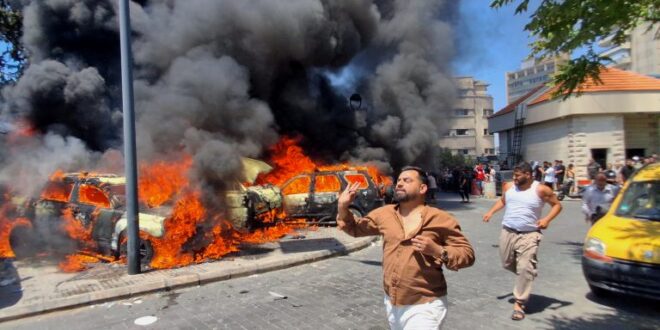
Yet subsequent to that conversation, Netanyahu, who faces Israeli voters later this year in October, signaled he has no intention of bowing to Trump’s request to relent his assault against Hezbollah. Israel has continued its offensive, driving deeper into South Lebanon. On Tuesday, the Israeli Defense Forces (IDF) struck the southern city of Tyre, issuing an evacuation warning that for the first time included the port’s Christian quarter.
Experts assess that Trump is unlikely to succeed in restraining Netanyahu. Not only does Israel insist on Hezbollah’s disarmament, but, more broadly, it wants a veto over the terms of settlement with Iran. In a brief video statement carried by Israeli television channels on Monday night, after Israel and Iran agreed to halt fire, Netanyahu said Israel would respond with force if Iran attacks it again. But in insisting on retaliating against Hezbollah and Iran, Israel had sent a message to Washington that no final agreement with Iran can be reached if Israel’s interests are ignored. Danny Orbach, a military historian at Israel’s Hebrew University, told reporters: “Because if ?(a U.S. peace settlement with Iran) tramples too heavily on Israeli interests, Israel can overturn the table.” Yet Netanyahu, who draws appeal in Israel from his relations with Trump, has also sought to downplay tensions with the White House, adding on Monday, his vow to strike both Iran and Hezbollah is “…with appreciation and respect in my good conversations with my friend President Trump.”
Even as Israel and the U.S. have clashed on settlement terms with Iran, the war has continued to expand, further complicating Trump’s effort to de-escalate. The Houthi movement in Yemen has appeared to enter the war at Iran’s behest. Last week, the Houthis declared they would target any shipping in the Red Sea linked to Israel. Subsequently, coinciding with Israel’s escalation of attacks on Hezbollah in Beirut, the Houthis fired several ballistic missiles and drones on Israeli territory. Israel claims all the launches were intercepted. But the Houthi attacks signal Iran’s willingness to put its allies at risk — and to protect them for doing so — in what Iran’s regime sees as a battle for its survival and the durability of its resistance ideology. On Monday, Tehran affirmed its intent to link the region’s conflict into a single battle against the U.S and Israel. The commander of the Islamic Revolutionary Guard Corps Quds Force, Esmaeil Qaani, stated publicly a new security belt of “Resistance” will be established from the Strait of Hormuz to the Bab El-Mandeb Strait, off Yemen, and from the Gulf to the Red Sea, according to comments carried by Iranian state media.
Iran’s insistence that a settlement with Washington apply to “all regional fronts” would presumably imply a U.S. commitment to restrain Israel not only against Iran, but across the region, such as preventing retaliatory attacks on the Houthis and IDF expansion into Gaza. On Monday, Netanyahu claimed the IDF now controls 60 percent of the territory of Gaza, and that it planned to increase that percentage to 70 percent, which would almost certainly put the IDF on or at the outskirts of major cities now controlled by Hamas.