 Eurasia Press & News
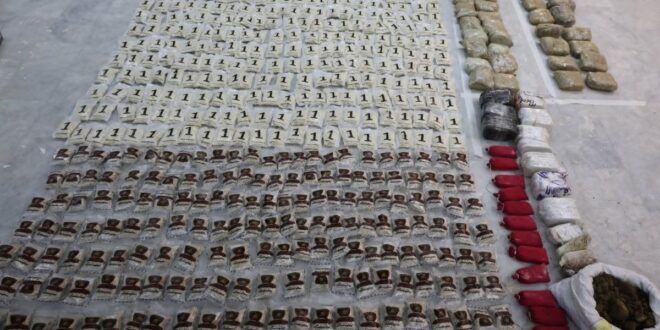
Syria’s Interior Ministry said on Sunday, June 14, that it carried out a series of simultaneous operations in cooperation with Iraq’s General Directorate of Narcotics and Psychotropic Substances, dismantling an organized international drug smuggling network.
The ministry said in a statement on Facebook that the operation was carried out “as part of its continued efforts to combat organized crime and cross-border smuggling operations,” in coordination with the Iraqi side, and covered the governorates of Homs (central Syria) and Deir Ezzor (eastern Syria).
The operation led to the arrest of several members of the network, as well as the seizure of 800,000 Captagon pills and 60 kilograms of hashish that had been prepared for smuggling and promotion, according to the statement.
The Interior Ministry said the operation “reflects the high level of coordination and fruitful intelligence cooperation between the relevant authorities in the two countries, to strike the supply lines of international smuggling networks and protect society from the dangers of this scourge.”
Ongoing Security Cooperation Between Damascus and Baghdad
The dismantling of the new network comes amid continued security cooperation between Damascus and Baghdad over counter-narcotics efforts, after recent months witnessed notable coordination between the two sides in more than one special operation.
On April 8, the Syrian Interior Ministry announced the dismantling of drug smuggling networks it described as “international” through joint security operations with the Iraqi side. The operations included three “special” missions targeting networks specialized in trafficking and smuggling narcotic substances across the border, and resulted in the seizure of about 1 million Captagon pills.
Weeks later, specifically on April 26, Syria’s Anti-Narcotics Department carried out another special operation in coordination with Iraq’s General Directorate of Narcotics and Psychotropic Substances, covering the governorates of Rural Damascus (southwestern Syria) and Homs.
The operation led to the seizure of 1.73 million Captagon pills that had been prepared for smuggling to a neighboring country, and the arrest of eight members of the network, including a woman. Iraq’s Interior Ministry confirmed at the time that it had arrested four suspects and seized the same quantity.
On October 22, 2025, Syria’s Interior Ministry announced that the Anti-Narcotics Department had seized 108 kilograms of hashish and 1.27 million Captagon pills, in direct coordination with Iraq’s General Directorate for Narcotics Control.
It also arrested a number of suspects who were wanted internationally as part of cross-border smuggling networks.
For its part, Iraq’s Interior Ministry confirmed at the time that a special operation had been carried out in direct coordination with Syria’s Anti-Narcotics Department.
This series of operations, separated by weeks, reflects continued intelligence and field coordination between Damascus and Baghdad to strike the supply lines of international smuggling networks, within what the two ministries describe as “cooperation with brotherly countries to confront this dangerous scourge.”
A Continuing Battle Against Captagon
Despite the end of the era of the former regime, whose infrastructure underpinned the drug trade, the Captagon file remains one of the most prominent security challenges facing Syria and the region.
According to the World Drug Report 2025, issued by the United Nations Office on Drugs and Crime, small smuggling networks still hold large stockpiles from the period of the former regime and are seeking to move them across borders, making the phenomenon one of the “most prominent security problems across Syrian geography” at this stage.
The report stated that although Syria’s current government is hostile to the drug trade, the country remains a hub for drug production and distribution. The new administration has pledged to disrupt the supply chain and has demonstrated this by publicly destroying large quantities of seized Captagon.