 Eurasia Press & News
Key Takeaways
Iran is attempting to use the sequencing of the US-Iran memorandum of understanding’s (MoU) clauses to make the United States meet Iranian demands regarding Lebanon and economic relief before Iran agrees to discuss nuclear issues.
Iran and the United States held quadrilateral talks with Qatari and Pakistani mediators in Burgenstock, Switzerland, on June 21. Iranian officials and media emphasized that the June 21 talks only focused on pushing the United States to implement MoU clauses that the MoU states must be implemented before nuclear negotiations can begin.
Iran is using the first clause of the MoU, which calls for a ceasefire on all fronts, to try to compel the United States to pressure Israel to cease operations against Hezbollah in Lebanon and withdraw its forces from Lebanese territory. Iran’s interpretation of this clause is part of its broader effort to preserve Hezbollah as a central element of Iran’s deterrence strategy against Israel.
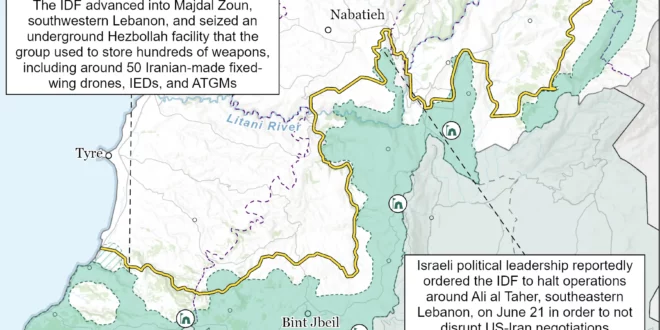
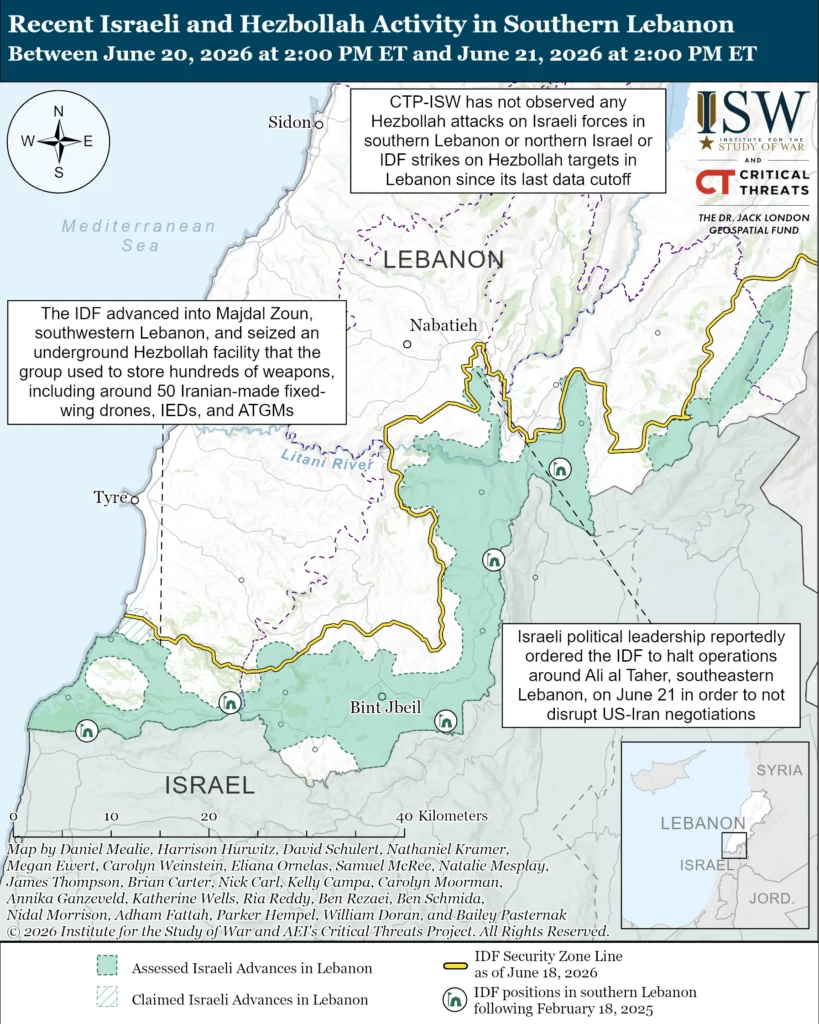
Israeli and Hezbollah attacks have largely paused since June 20, but Israeli forces continue clearing operations within the Israel Defense Forces’ (IDF) “security zone” in southern Lebanon.
Iran is also attempting to frontload economic benefits from the MoU before addressing its nuclear file in negotiations. Iran likely seeks to acquire funds up front in case negotiations collapse and likely also seeks to reduce US leverage in later nuclear talks in order to make it more difficult for the United States to extract concessions from Iran.
Iran is using its announced closure of the Strait of Hormuz to increase economic pressure on the United States as part of its effort to push the United States to compel Israel to halt operations against Hezbollah and withdraw from Lebanon.
Iran’s involvement in negotiations in Switzerland has exposed fissures among some Iranian factions over how Iran should advance its objectives.
Toplines
Iran is attempting to use the sequencing of the US-Iran memorandum of understanding’s (MoU) clauses to make the United States meet Iranian demands regarding Lebanon and economic relief before Iran agrees to discuss nuclear issues. Iran and the United States held quadrilateral talks with Qatari and Pakistani mediators in Burgenstock, Switzerland, on June 21.[1] Qatari officials stated that the parties established “specialized technical and expert working groups” to negotiate a final agreement covering “all aspects” of the MoU.[2] Iranian officials and media emphasized that the June 21 talks only focused on pushing the United States to implement MoU clauses that the MoU states must be implemented before nuclear negotiations can begin, however.[3] Islamic Revolutionary Guards Corps (IRGC)-affiliated Fars News reported on June 21 that no members of Iran’s “nuclear committee” were part of the Iranian delegation.[4] Iranian negotiating team member Hossein Ghorban Zadeh said that the talks focused on implementing clause 13 of the MoU, which states that Iran and the United States will only start negotiations for a final agreement once clauses 1, 4, 5, 10, and 11 are implemented.[5] These clauses concern the ceasefire on all fronts, including Lebanon, the lifting of the US naval blockade, the reopening of the Strait of Hormuz, temporary oil sanctions waivers, and the release of frozen Iranian assets.[6] Ghorban Zadeh emphasized that a ceasefire in Lebanon is Iran’s “top priority” and that progress on other aspects of the MoU depends on this ceasefire.[7] Iran’s conditions in these talks demonstrate how Iran is using the MoU’s sequencing to demand that the United States fulfil its commitments in the MoU before Iran agrees to discuss its nuclear program. Iranian officials and media have repeatedly emphasized that Iran must solidify its military gains in the war in negotiations by using negotiations to secure Iran’s strategic objectives, which include preserving Hezbollah and the Axis of Resistance writ large as well as securing Iranian control over the Strait of Hormuz.[8] The talks reportedly paused after US President Donald Trump threatened Iran that the United States would strike Iran “harder” if Iran does not stop Hezbollah, which prompted the Iranian team to temporarily withdraw to its hotel “in protest,” according to Iranian media.[9] An unspecified diplomat told Axios on June 21 that the Iranian delegation had not left the venue and that US-Iran negotiations were ongoing, however.[10]
Iran is using the first clause of the MoU, which calls for a ceasefire on all fronts, to try to pressure the United States to compel Israel to cease operations against Hezbollah in Lebanon and withdraw its forces from Lebanese territory. Iran’s interpretation of this clause is part of its broader effort to preserve Hezbollah as a central element of Iran’s deterrence strategy against Israel. Iranian officials have interpreted the first clause of the MoU as requiring both a halt to Israeli operations against Hezbollah and an Israeli withdrawal from southern Lebanon.[11] This interpretation creates a win-win situation for the regime: if the United States agrees to Iran’s interpretation and compels Israel to withdraw its forces from Lebanon, this would represent a strategic victory for Iran and Hezbollah. If, on the other hand, the United States does not accept Iran’s interpretation of this clause, Iran can continue to postpone nuclear negotiations by claiming that the United States is violating the MoU. Hezbollah-affiliated parliamentarians have stated that the US-Iran MoU provides a path to a complete ceasefire in Lebanon and Israeli withdrawal from Lebanon.[12] Israeli and Hezbollah attacks have paused since June 20, but Israeli forces continue clearing operations within the Israel Defense Forces’ (IDF) “security zone” in southern Lebanon.[13] The current ceasefire in Lebanon will likely not satisfy Iran’s maximalist demands because Israeli officials continue to emphasize that the IDF will remain in southern Lebanon, however.[14] Israeli media reported on June 21 that the United States is pushing the IDF to withdraw to positions at and behind the Yellow Line, which denotes the extent of the IDF’s military buffer zone in Lebanon.[15] Israeli media added that Israeli political officials instructed the IDF to halt operations around Ali al Taher in order to avoid disrupting US-Iran negotiations.[16]
Iran is also attempting to frontload economic benefits from the MoU before addressing its nuclear program in negotiations. Iran likely seeks to acquire funds up front in case negotiations collapse and also likely seeks to reduce US leverage in later nuclear talks in order to make it more difficult for the United States to extract concessions from Iran. Iran could use early access to oil revenue and frozen assets to reduce US leverage during the 60-day nuclear negotiations period and try to reconstitute its military capabilities and the Axis of Resistance.[17] Fars News reported that Iran is still expecting the United States to release $12 billion USD in Iranian assets, which Fars News claimed includes a planned $500 million USD “test purchase” from Iranian assets in Qatar.[18] The Iranian Central Bank also confirmed that Central Bank Governor Abdolnaser Hemmati joined the Iranian delegation in Switzerland to work on the release of the $6 billion USD that is blocked in Qatar.[19] ISW-CTP previously assessed on June 20 that Hemmati’s inclusion in the Iranian delegation indicated that Iran intended to focus part of the talks in Switzerland on economic relief.[20]
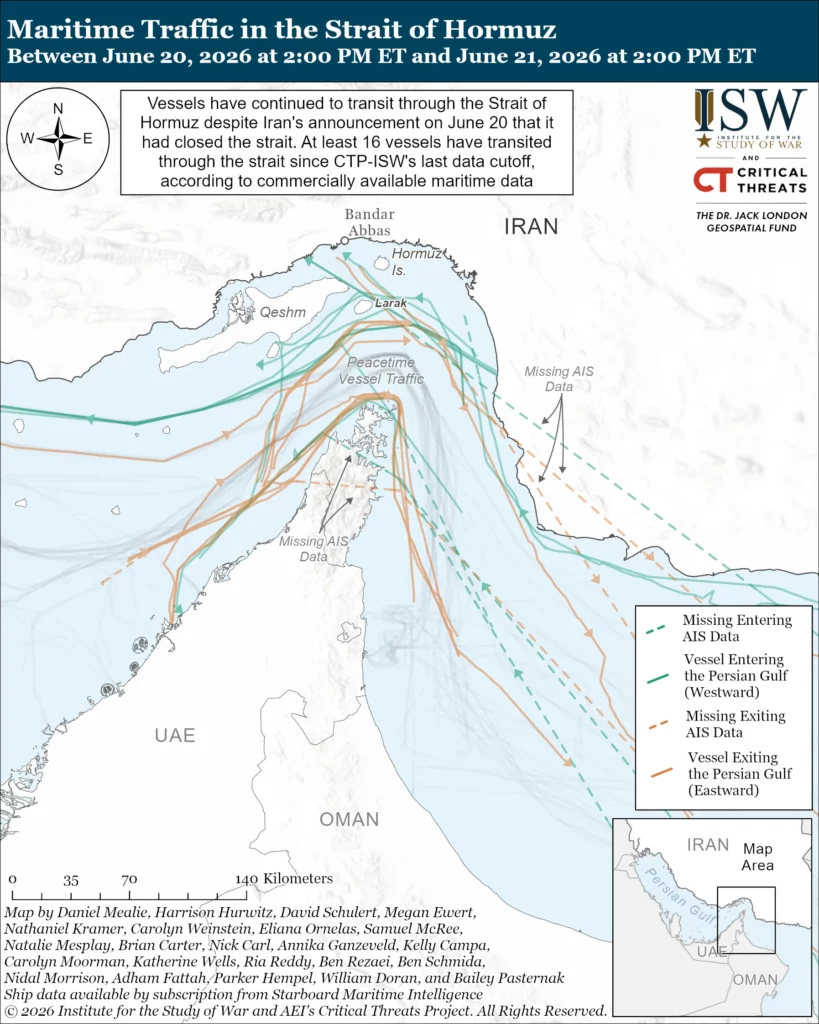
Iran is using its announced closure of the Strait of Hormuz to increase economic pressure on the United States as part of its effort to push the United States to compel Israel to halt operations against Hezbollah and withdraw from Lebanon. The IRGC Navy announced on June 20 that it had “closed” the strait, but some vessels continue to transit through the Omani coastal route and Iran’s newly asserted traffic separation scheme.[21] Commercially available maritime data indicates that 16 vessels passed through the strait between 1400 ET on June 20 and 1400 ET on June 21 despite Iranian claims that the strait remains closed.[22] The fact that shipping through the strait has continued after Iran announced the closure of the strait suggests that this announcement was likely intended to primarily have an informational effect. Iran’s announcement increased global oil prices, and the Iranian regime likely calculated that an increase in oil prices would increase pressure on the United States to meet Iranian demands.[23] Iranian Supreme Leader Adviser Mohammad Mokhber highlighted on June 21 how Iranian control over the Strait of Hormuz enables Iran to “significantly influence the global economy.”[24] Mokhber added that Iran seeks to alter “the rules governing the strait.”
Iran’s involvement in negotiations in Switzerland has exposed fissures among some Iranian factions over how Iran should advance its objectives. IRGC-affiliated outlet Fars News published an op-ed on June 20 that criticized IRGC-affiliated outlet Tasnim News Agency for allegedly supporting Iranian negotiating delegation head Parliament Speaker Mohammad Bagher Ghalibaf and advancing Ghalibaf’s pro-negotiations agenda.[25] Fars News also accused Tasnim of misinterpreting a recent statement from Supreme Leader Mojtaba Khamenei in which Khamenei suggested that he did not fully support the MoU.[26] Fars News’ claim that Tasnim is affiliated with Ghalibaf is inconsistent with recent Tasnim reports that have argued that Iran shouldn’t conduct negotiations with the United States until the United States achieves a ceasefire in Lebanon. Tasnim argued on June 20 that Foreign Affairs Minister Abbas Araghchi had “no justification” to go to Switzerland, for example.[27]
US-Iran Negotiations
See topline section.
Maritime Activity in the Strait of Hormuz and Persian Gulf
See topline section.
US and Israeli Air Campaign
Iranian media continues to reflect on aspects of the recent war that it assesses contributed to Iran’s “success” against the United States and Israel. Iranian Armed Forces General Staff-run media Defa Press published an op-ed on June 21 in which it described the effectiveness of Iran’s “mosaic defense” strategy in countering US and Israeli airstrikes during the war.[28] Iran’s “mosaic defense” strategy dates back to 2005 under former IRGC Commander Mohammad Ali Jafari and involves the decentralization of military decision-making to lower echelons.[29] Defa noted that, unlike traditional, centralized defense models that depend on heavy equipment and rigid command structures, Iran’s “mosaic defense“ relies on numerous small, low-cost, and flexible units—such as drones, radars, and missile platforms—that can operate independently yet cohesively with other units.[30] Defa emphasized that, in this structure, losses of individual components do not compromise the overall network.[31] Defa also highlighted how systems, such as Shahed drones, that are relatively cheap to produce, can pose financial strain on Iran’s adversaries by making them invest in costly countermeasures.[32]
Iranian Domestic Affairs
See topline section.
Iran’s Axis of Resistance
Lebanese Hezbollah and the Israeli Campaign in Lebanon
See topline section.
Other Axis of Resistance Activity
Unspecified actors conducted a drone attack targeting Sunni Progress Party member and Iraqi Parliament Speaker Haibat al Halbousi in Anbar Province, Iraq, on June 20.[33] The Iraqi Joint Operations Command (JOC) Security Media Cell announced on June 20 that a “very small drone” crashed near Halbousi’s house in Karmah District, Anbar Province, causing a small fire but no major damage.[34] The JOC stated that “technical intelligence” indicates that the drone was not carrying explosives.[35] No Iraqi group has claimed responsibility for the attack at the time of this writing.