 Eurasia Press & News
Toplines
Russian President Vladimir Putin used a staged meeting with several Russian commanders on July 3 to make greatly exaggerated claims of Russian advances that do not match battlefield realities in order to construct a narrative of continuous Russian military successes. Putin met with the Russian Chief of the General Staff Valery Gerasimov, Russian Northern Grouping of Forces Commander Colonel General Yevgeny Nikiforov, Southern Grouping of Forces Commander Colonel General Sergey Medvedev, and other Russian commanders on the evening of July 3.[1] Putin reiterated his consistent claims that Russian forces seized all of Luhansk Oblast and continue advancing across the entire frontline. Gerasimov claimed that Russian forces are advancing the fastest in the areas of responsibility (AoRs) of the Russian Northern Grouping of Forces (Sumy Oblast and northern Kharkiv Oblast) and of the Eastern Grouping of Forces (the Oleksandrivka and Hulyaipole directions) — notably not where the primary Russian offensive is in Donetsk Oblast. Putin claimed that Russian forces seized 133 settlements and over 3,000 square kilometers since January 1, 2026, and Gerasimov claimed that Russian forces seized 29 settlements and 636 square kilometers in June 2026. Other Russian commanders made similar claims about the settlements and square kilometers of land that Russian forces allegedly seized in several sectors of the frontline in Ukraine. ISW has only observed evidence to assess that Russian forces seized or infiltrated into 64 settlements and seized or infiltrated approximately 621.7 square kilometers across the theater since the start of 2026, and that Russian forces have seized or infiltrated into 20 settlements and gained or infiltrated approximately 30.42 square kilometers in the theater in June 2026. These figures include settlements into which Russian forces have only partially infiltrated into, but even including partially infiltrated settlements does not match Putin’s fabricated reality.
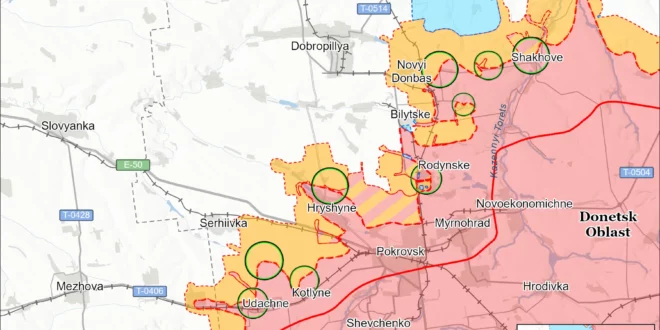
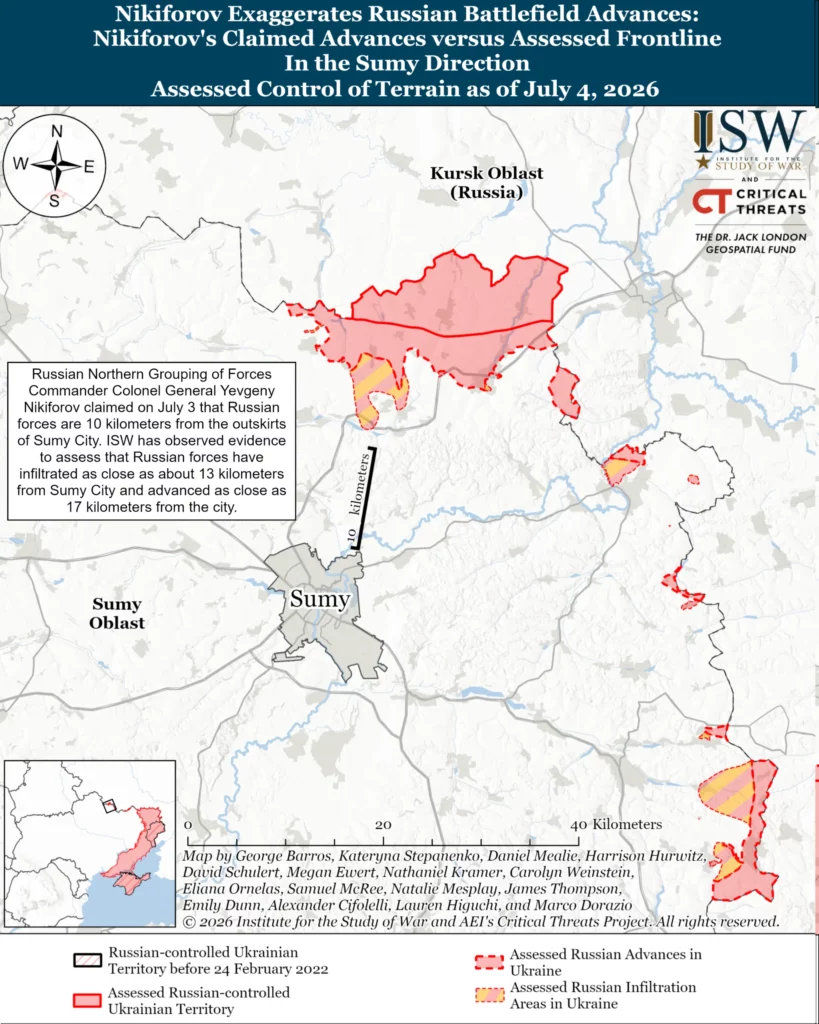
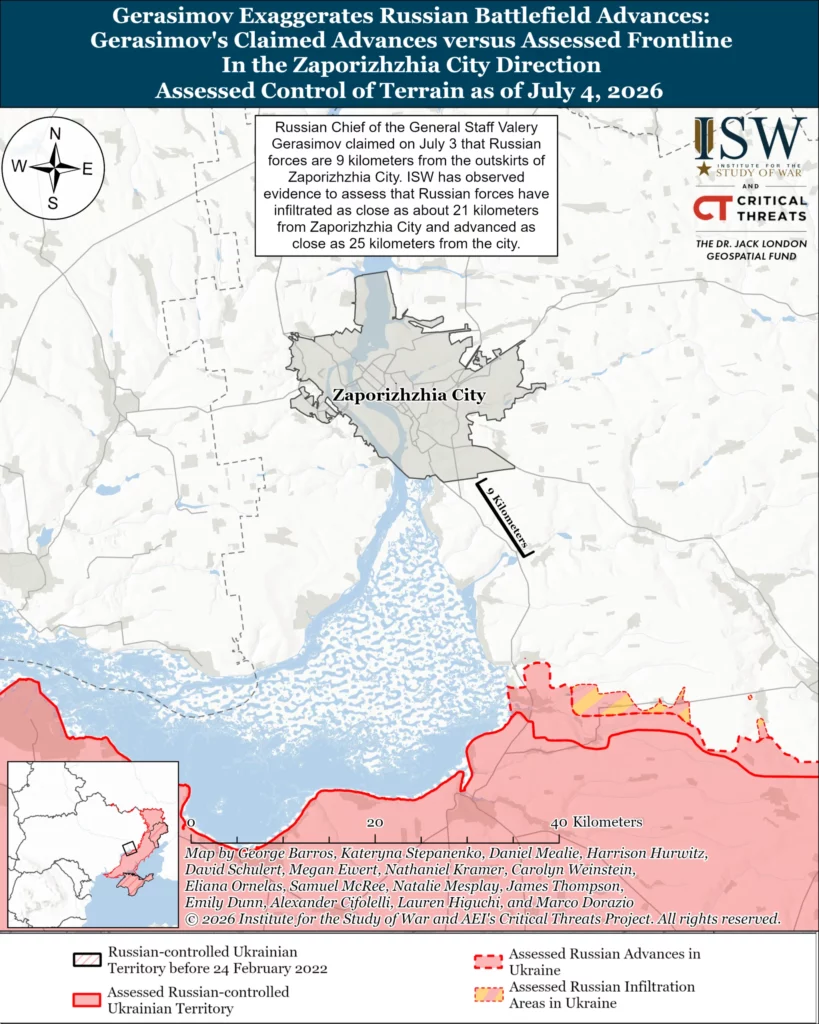
Russian commanders made a series of exaggerated claims about the positions of Russian forces relative to the actual and claimed frontline in Ukraine, demonstrating the extent to which the Russian military command is disconnected from the battlefield itself. The commanders claimed that Russian forces are 10 kilometers from the northern outskirts of Sumy City, 22 kilometers past Siversk and 8 kilometers from Slovyansk, that Russian forces entered Dobropillya and Hannivka (immediately northeast of Dobropillya), and that Russian forces are nine kilometers from the southern outskirts of Zaporizhzhia City.[2] ISW has observed evidence to assess that Russian forces have infiltrated as close as about 13 kilometers and advanced as close as 17 kilometers from Sumy City; infiltrated as close as 13 kilometers and advanced as close as 19 kilometers from Slovyansk; infiltrated as close as eight kilometers and advanced as close as seven kilometers from Dobropillya; and infiltrated as close as 25 kilometers and advanced as close as 21 kilometers from Zaporizhzhia City.
Putin, Russian commanders, and the Russian Ministry of Defense (MoD) made a series of other claims about seizures of smaller settlements in a number of frontline sectors during and after the meeting on July 3 and 4, likely in an effort to overwhelm the information space and make it more difficult to disprove them.[3] Putin made similar claims of exaggerated Russian advances to Kremlin journalist Pavel Zarubin in a carefully staged interview on June 28.[4] Putin’s and the Russian military command’s exaggerated claims about Russian battlefield performance are part of the ongoing Russian cognitive warfare narrative that seeks to portray a Russian victory in Ukraine as inevitable and Ukrainian frontlines as collapsing.[5] Putin and the Russian commanders also used the meeting on July 3 to falsely claim the seizure of Kostyantynivka and the beginning of the fall of the Ukrainian defenses along the Fortress Belt in Donetsk Oblast. ISW previously assessed that Russian forces reportedly suffered around 1,298 casualties per square kilometer they seized or infiltrated in June 2026 and, at that rate, Russian forces would lose 6,574,590 servicemembers in capturing the remaining 5,065.17 square kilometers of Donetsk Oblast.[6]
Putin and other Russian military commanders heavily aggrandized the claimed seizure of Kostyantynivka on July 3 and 4. The Russian Ministry of Defense (MoD), military commanders, senior Kremlin officials, and several Kremlin-coopted milbloggers and information space voices broadly amplified Putin’s claims of seizing Kostyantynivka on July 3 and 4.[7] Several Russian commanders, including Southern Grouping of Forces Commander Colonel General Sergey Medvedev and the commander of the Russian 6th Motorized Rifle Division, Colonel Alexander Kartakavin, on July 3 and Russian Chief of the General Staff’s Main Operations Directorate Colonel General Sergei Rudskoy on July 4, claimed that Russian forces have continued their offensive beyond Kostyantynivka and reached the southern and southeastern outskirts of Oleksiyevo-Druzhkivka to the northwest.[8] Putin received reports from Kartakavin and Russian 4th Separate Motorized Rifle Brigade Commander Major General Anton Grunis about how Russian forces conducted operations to seize Kostyantynivka. Grunis and Kartakavin made detailed claims of assault elements of individual motorized rifle battalions seizing specific landmarks within Kostyantynivka, including factories, churches, and neighborhoods. The Russian military command dedicated a significant portion of the meeting to these sub-tactical reports, likely to portray Russian forces as able to advance under conditions of urban warfare and to bask in the informational victory of the claimed seizure of Kostyantynivka.
These Russian claims are not consistent with Russian forces’ historical pattern of advance, however. ISW typically observes geolocated footage of Ukrainian strikes against Russian positions in areas where Russian forces have advanced, but ISW has not observed such footage of strikes against Russian forces in all areas of the city. Russian sources, including the MoD, published large amounts of footage of individual or small groups of Russian soldiers standing in or holding up flags in and near Kostyantynivka on July 3 and 4 and in recent weeks, particularly to correspond with the MoD’s claims of advance.[9] This footage does not prove that Russian forces have advanced, as the footage is often cut short, obfuscating Russian positions or the fates of the soldiers in the footage. ISW also has not observed footage suggesting that Russian forces have operated vehicles, mortars, or tube artillery within the city, which would indicate that Russian forces exert a greater level of control in the city. Recent Ukrainian statements support the lack of observed evidence of a sustained Russian presence throughout the city. Ukrainian President Volodymyr Zelensky and Ukraine’s Eastern Operational Command explicitly rejected the Russian claims of seizing Kostyantynivka on July 4.[10] Ukrainian military sources have indicated that there are around 100 and a maximum of 250 Russian troops within Kostyantynivka as of mid-June and that Ukrainian forces still outnumbered Russian troops in the city as of June 23 — statements that are consistent with the observed pattern of strikes against Russian and Ukrainian positions in the city and inconsistent with Russian claims of seizure.[11] Putin’s senior military commanders, battlefield commanders, and Russian milbloggers continued to claim that Ukrainian forces still held positions within Kostyantynivka as of July 3 and 4, further undermining the Russian claim.[12]
Putin and other Russian officials are using the alleged seizure of Kostyantynivka to claim that the Fortress Belt and the remainder of Donetsk Oblast will fall imminently.[13] Putin particularly expounded on the importance of Kostyantynivka in precipitating the seizure of the remainder of Donetsk Oblast and its industrial capacity.[14] Russian Security Council Deputy Chairperson Dmitry Medvedev claimed that the seizure of Kostyantynivka is an important achievement to complete Russia’s war objectives.[15] Russian forces are increasingly infiltrating within Kostyantynivka and may yet seize it, but these infiltrations will not enable Russian forces to achieve a rapid operational breakthrough against the remainder of the Fortress Belt or all of Donetsk Oblast.[16] The Russian Spring-Summer 2026 offensive has thus far failed to yield operationally-significant results, and the Russian offensive against Kostyantynivka will likely culminate if and when Russian forces manage to seize the city.[17] Russian forces will likely continue to suffer significant casualties for minimal gains in their efforts against Kostyantynivka, Lyman, and elsewhere in Donetsk Oblast.
The Russian MoD and other Russian sources are publishing large quantities of footage that may be AI-altered to falsely confirm Russian exaggerated claims and complicate individual footage verification. The Russian MoD published at least 10 different pieces of footage on July 3 showing Russian servicemembers holding flags purportedly in various areas of Kostyantynivka.[18] The Russian MoD also made a series of other individual settlement claims corresponding with Putin’s meeting on July 4 and published footage of Russian forces allegedly operating in all of these settlements.[19] Other Russian sources reportedly affiliated with Russian military units published additional footage of Russian soldiers holding flags in various areas of the frontline.[20] ISW is unable to determine at this time whether much of the July 3 and 4 footage is dispositively unaltered by AI. The Russian MoD and other sources are simultaneously publishing footage from a number of frontline sectors likely to make it more challenging to detect AI-altered footage and assess from the footage whether Russian forces have advanced, infiltrated, or are just claiming to have seized an area. The Russian MoD, along with other sources propagating possible AI-altered footage, continues engaging in a sophisticated cognitive warfare effort that uses AI-altered or generated footage of flag raisings to fabricate claims of Russian tactical successes in areas where Russian forces do not maintain enduring (or, in some cases, any) positions.[21] These videos are part of the Kremlin’s systematic cognitive warfare effort to aggrandize Russian advances using exaggerated claims of gains and infiltration missions to falsely portray the frontline as collapsing, contrary to all available evidence.[22]
Putin used the July 3 meeting with Russian commanders to signal his commitment to continuing the war in Ukraine as he has been. Nikiforov claimed that Russian forces are creating a “buffer zone” in Sumy and Kharkiv oblasts to ensure the security of Russian border areas but acknowledged that Russian forces are struggling to defend against Ukrainian strikes deep into Russia.[23] Putin responded to Nikiforov and claimed that Russian forces will need to advance further into northern Sumy and Kharkiv oblasts the more Ukrainian forces continue striking Russia. Dmitry Medvedev similarly claimed on July 4 that the “buffer zone” will run through Sumy, Dnipropetrovsk, and Kharkiv oblasts — where Russian forces have only marginally advanced.[24] Putin’s claims falsely relate Ukraine’s strike campaigns with Russian advances; Ukrainian forces are using drones and missiles with ranges that a so-called “buffer zone” in Ukraine would not actually protect against. Putin claimed immediately after these statements that the areas of Ukraine where he wants to establish a “buffer zone” are “historically Russian, Russian soil,” undermining the idea that continuing his war effort in the same manner he has waged it for over four years is only about protecting Russian border areas.[25] ISW has previously assessed that the so-called “buffer zone” is a vague and unattainable goal for the Russian forces, whose rate of advance has been declining, as long as there is an independent Ukraine with the ability to fight.[26] Putin’s statements on July 3 confirm again Putin’s intent to seize large parts of Ukrainian territories beyond Donetsk and Luhansk. Putin is using Ukraine’s long-range strikes in Russia as a justification for continuing Russia’s frontline offensive operations in Ukraine and the increasing costs of the war to the Russian public. Putin also criticized Europe’s support of Ukraine’s strike campaigns, likely to deter Ukraine’s Western partners from sponsoring Ukraine’s drone and missile innovations and force Ukraine to capitulate — the only scenario that would make Putin’s fantasies a reality.[27]
Key Takeaways
Russian President Vladimir Putin used a staged meeting with several Russian commanders on July 3 to make greatly exaggerated claims of Russian advances that do not match battlefield realities in order to construct a narrative of continuous Russian military successes.
Putin and other Russian military commanders heavily aggrandized the claimed seizure of Kostyantynivka on July 3 and 4.
The Russian MoD and other Russian sources are publishing large quantities of footage that may be AI-altered to falsely confirm Russian exaggerated claims and complicate individual footage verification.
Putin used the July 3 meeting with Russian commanders to signal his commitment to continuing the war in Ukraine as he has been.
Neither Ukrainian nor Russian forces advanced on July 4.
Ukrainian forces continued their long-range strike campaign against Russian oil and energy infrastructure and military assets in Russia on July 4. Russian forces launched one Iskander-M ballistic missile, one Kh-59 guided missile, and 86 drones against Ukraine overnight.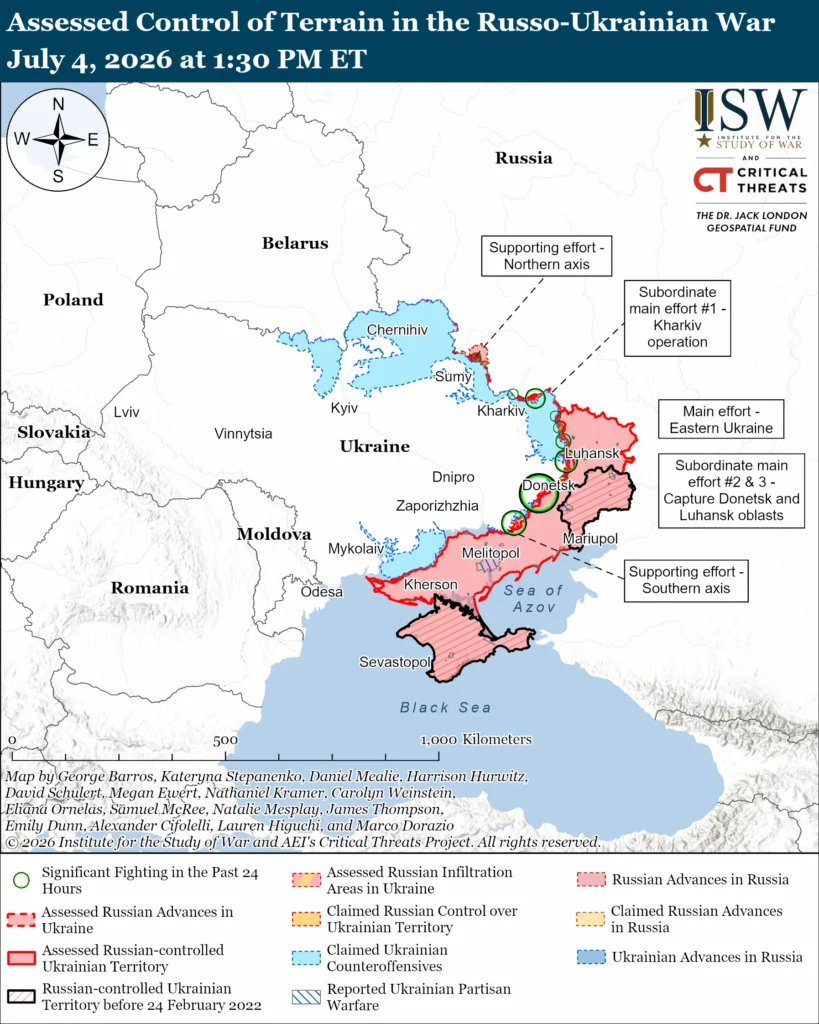
We do not report in detail on Russian war crimes because these activities are well-covered in Western media and do not directly affect the military operations we are assessing and forecasting. We will continue to evaluate and report on the effects of these criminal activities on the Ukrainian military and the Ukrainian population and specifically on combat in Ukrainian urban areas. We utterly condemn Russian violations of the laws of armed conflict and the Geneva Conventions and crimes against humanity even though we do not describe them in these reports.
Ukrainian Operations in the Russian Federation
Ukrainian forces continued their long-range strike campaign against Russian oil and energy infrastructure and military assets in Russia on July 4. Ukrainian officials reported on July 4 that Ukrainian forces struck the St. Petersburg Oil Terminal and the Kronstadt Naval Base (the main base of the Russian Baltic Fleet) in Leningrad Oblast overnight on July 3 to 4, causing fires at the oil terminal and the base.[28] The Ukrainian General Staff noted that the St. Petersburg Oil Terminal is one of the largest petroleum transshipment terminals in the Baltic region with a design capacity of 12.5 million tons of petroleum per year and a tank farm volume of about 441,000 cubic meters.[29] The Ukrainian Unmanned Systems Forces (USF) noted that the Russian Baltic Fleet uses the Kronstadt naval base for warship repair and maintenance and for controlling the sea approaches to St. Petersburg.[30] Geolocated footage published on July 4 shows fire and smoke at the St. Petersburg Oil Terminal after Ukrainian FP-1 drone strikes.[31] Leningrad Oblast Governor Alexandr Drozdenko claimed on July 4 that Ukrainian drone debris fell near the port of Vysotsk, and St. Petersburg Governor Alexandr Beglov acknowledged a Ukrainian drone strike against targets in St. Petersburg.[32] Ukrainian President Volodymyr Zelensky confirmed on July 4 the Ukrainian strike against St. Petersburg at targets over 850 kilometers from the international border.[33] Footage published on July 3 shows fire and smoke after reported Ukrainian HIMARS missile strikes on the “Avtoremzavod” 110 kV electrical substation, the “Dubovoe” 110 kV electrical substation at the “Luch” Thermal Power Plant, and the Belgorod Thermal Power Plant in Belgorod City, Belgorod Oblast.[34] Russian milbloggers claimed on July 4 that Belgorod City is experiencing water and power outages after Ukrainian strikes.[35]
Ukrainian strikes against Russian oil infrastructure are degrading the Russian oil industry. The Ukrainian General Staff reported on July 4 that Ukrainian strikes reduced the Russian oil refining industry to 42.47 percent of its total design capacity as of early July 2026.[36] The Ukrainian General Staff noted that Ukrainian forces struck eight Russian oil refineries in June 2026 and destroyed or critically damaged over 60 oil tanks, of which 58 percent contained petroleum and 42 percent contained crude oil.
Russian Supporting Effort: Northern Axis
Russian objective: Create defensible buffer zones in Sumy Oblast along the international border
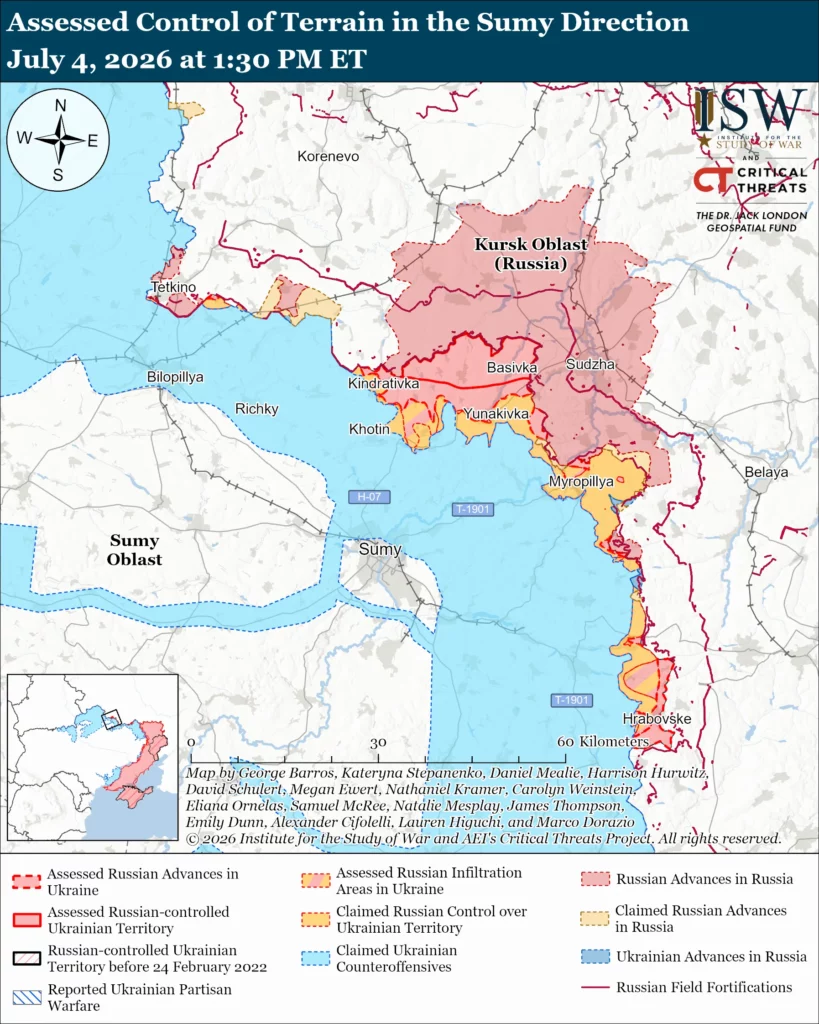
Russian forces continued offensive operations in northern Sumy Oblast on July 3 and 4 but did not make confirmed advance.[37] Russian Northern Grouping of Forces Commander Colonel General Yevgeny Nikiforov claimed on July 3 that Russian forces seized Ivolzhanske (north of Sumy City) in June 2026.[38]
The Russian Ministry of Defense (MoD) claimed on July 4 that Russian Su-34 bombers dropped four FAB-250 bombs with unified planning and correction modules (UMPKs) on Ukrainian positions near Ulanove (northwest of Sumy).[39]
Russian Main Effort: Eastern Ukraine
Russian Subordinate Main Effort #1 – Kharkiv Oblast
Russian objective: Push Ukrainian forces back from the international border to create a defensible buffer zone with Belgorod Oblast and approach to within tube artillery range of Kharkiv City
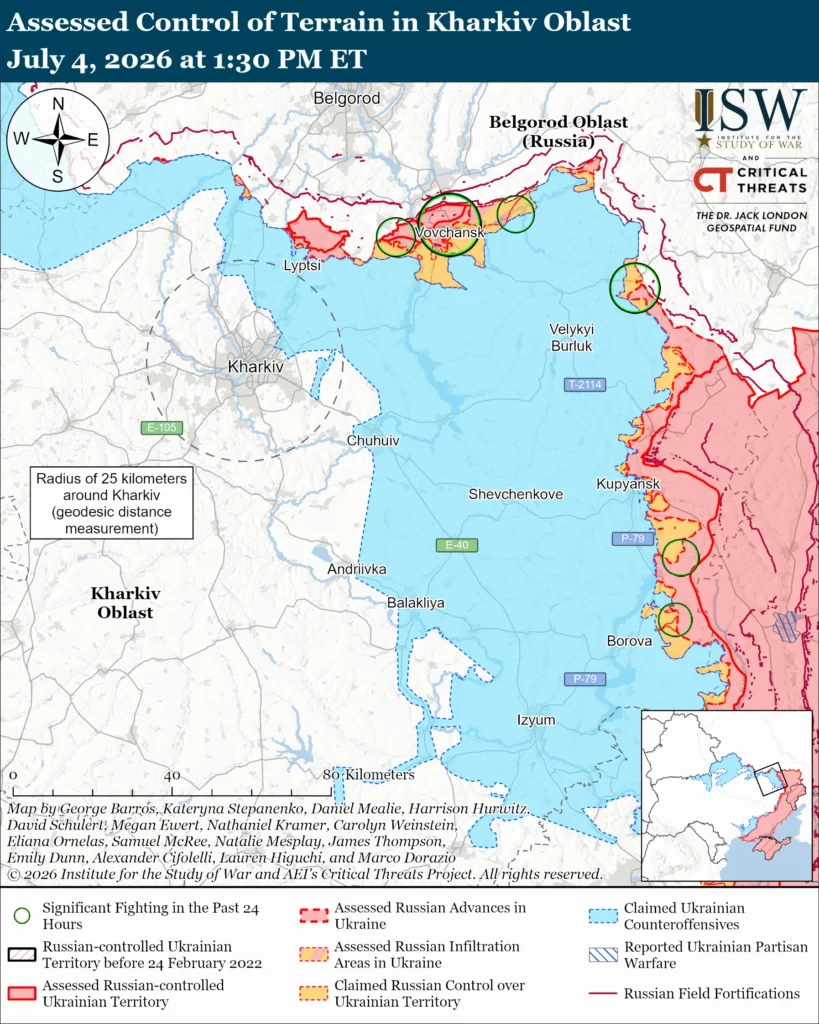
Russian forces continued offensive operations in northern Kharkiv Oblast on July 3 and 4 but did not make confirmed advances.[40] Russian Northern Grouping of Forces Commander Colonel General Yevgeny Nikiforov claimed on July 3 that Russian forces seized Losivka, Ukrainske, Zemlyanyi Yar, and Okhrymivka (all northeast of Kharkiv City) in June 2026.[41] The Russian Ministry of Defense (MoD) previously claimed that Russian forces seized Ukrainske on July 1.[42]
Ukrainian forces reportedly continued their near rear strike campaign against Russian logistics assets in occupied Belgorod Oblast. Geolocated footage published on July 3 shows a destroyed truck after a reported Ukrainian strike on a Russian truck in Shebekyne (northeast of Kharkiv city and roughly seven kilometers from the international border), Belgorod Oblast.[43]
Russian forces continued offensive operations in the Velykyi Burluk direction on July 3 and 4 but did not advance.[44]
Russian Subordinate Main Effort #2 – Oskil River
Russian objective: Cross the Oskil River in Kharkiv Oblast and push westward into eastern Kharkiv Oblast and northern Donetsk Oblast
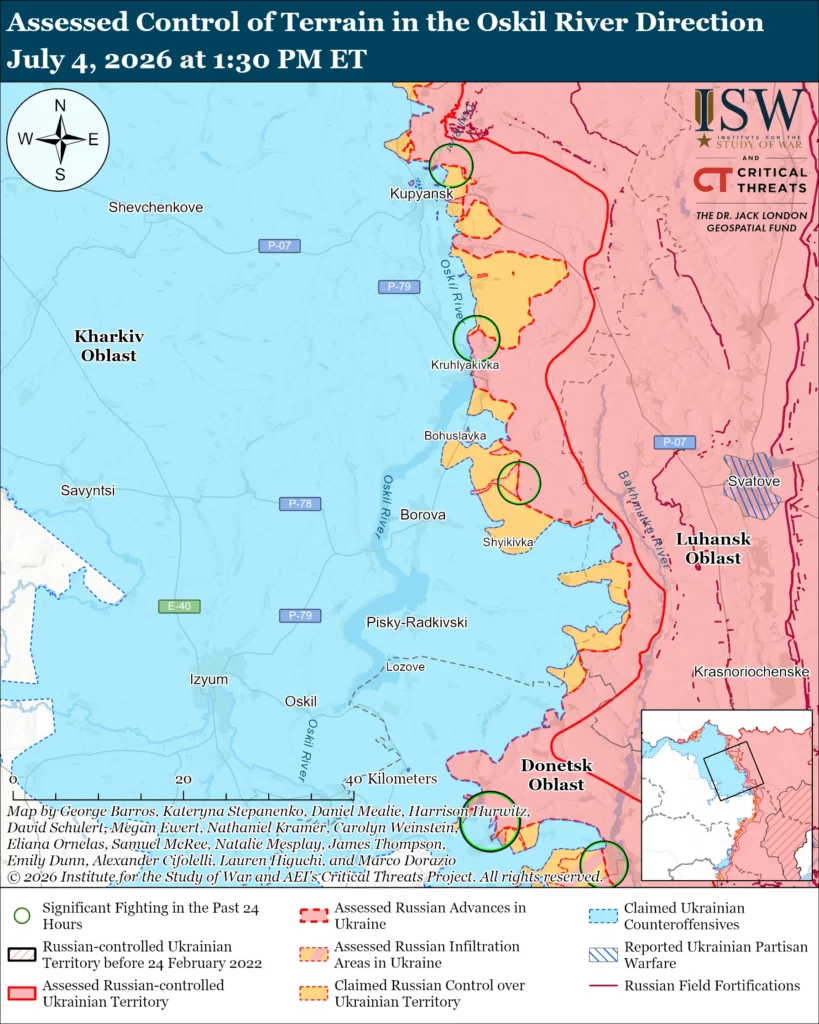
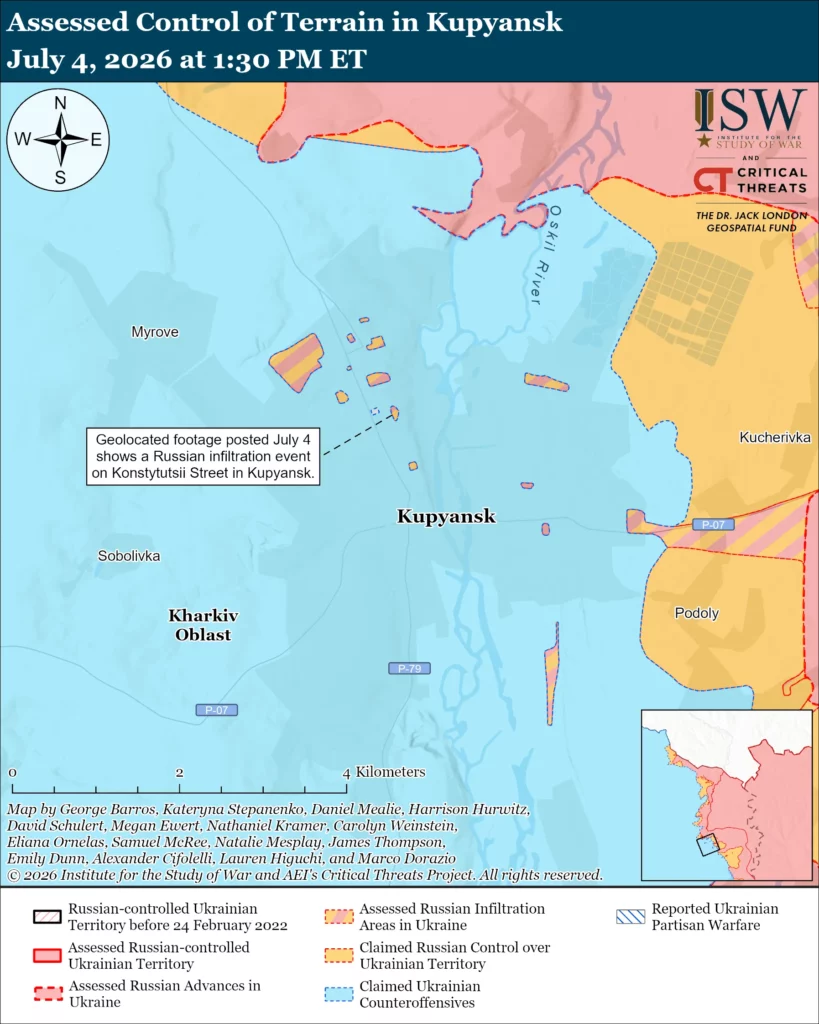
Russian forces recently conducted an infiltration mission in Kupyansk. Geolocated footage published on June 4 shows Ukrainian forces striking Russian-occupied buildings in central Kupyansk after what ISW assesses was a Russian infiltration mission.[45]
Fuel shortages are undermining Russian efforts in the Kupyansk direction. Ukrainian Joint Forces Task Force Spokesperson Colonel Viktor Trehubov reported on July 4 that Russian forces are attempting to cut off the Ukrainian bridgehead on the west (left) bank of the Oskil River near Kupyansk.[46] Trehubov reported that Russian forces are also attempting to reach Kupyansk-Vuzlovy through Pishchane (southeast of Kupyansk), but added that fuel shortages have hindered Russian logistics in the Kupyansk direction.
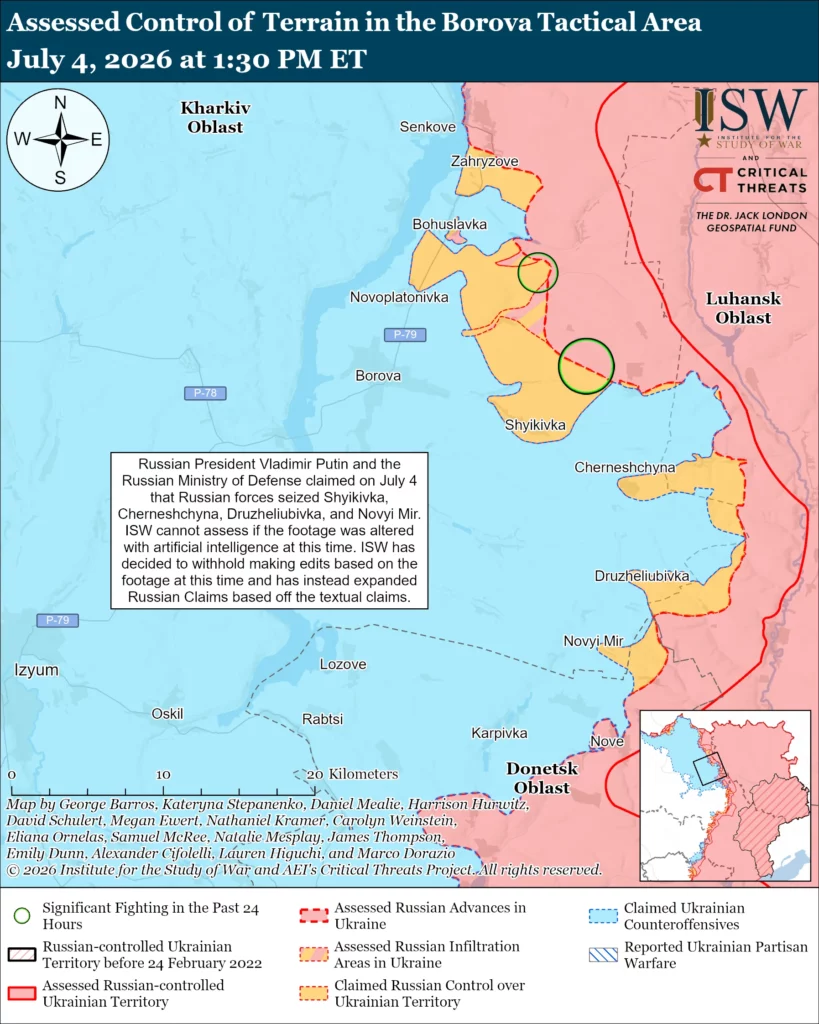
Russian forces continued offensive operations in the Borova direction on June 3 and 4 but did not make confirmed advances as Ukrainian forces counterattacked.[47] A Russian milblogger claimed that Ukrainian forces counterattacked near Kopanky (east of Borova) and Novoserhiivka (southeast of Borova).[48]
Russian Chief of the General Staff Valery Gerasimov claimed that Russian forces seized several settlements in the Borova direction as part of what ISW assesses is Russia’s cognitive warfare effort to aggrandize Russian gains. Russian Chief of the General Staff Valery Gerasimov claimed at a July 3 meeting with Russian President Vladimir Putin that Russian forces seized Shyikivka , Novyi Mir, Cherneshchyna, and Druzhelyubivka (all southeast of Borova).[49] The Russian Ministry of Defense (MoD) published footage on July 4 purporting to show Russian servicemembers raising flags in Shyikivka, Novyi Mir, Cherneshchyna, and Druzhelyubivka.[50] ISW is not prepared to assess if the footage was altered with artificial intelligence (AI) at this time. The appearance of the footage and the relative timeline on which the Russian MoD posted the footage are consistent with a wider pattern of Russian sources publishing footage, including likely AI-altered footage, to propagate claims of expansive Russian gains for informational effects.[51]
Ukrainian forces continued their intermediate-range strike campaign against Russian military assets and ground lines of communication (GLOCs) in occupied Luhansk Oblast on the night of July 3 to 4. The Ukrainian General Staff reported on July 4 that Ukrainian forces struck a railway bridge over the Siverskyi Donets River near Stanytsia Luhanska (roughly 110 kilometers from the frontline) on the night of July 3 to 4, and that Russian forces used the bridge to transfer personnel, weapons, and ammunition and for other logistics.[52] The Ukrainian General Staff also reported that Ukrainian forces struck a Russian drone warehouse in Tytarivka (roughly 70 kilometers from the frontline), a Russian forces repair unit in Starobilsk (also roughly 70 kilometers from the frontline), and a fuel and lubricant warehouse in Luhansk City (roughly 100 kilometers from the frontline) on the night of July 3 to 4.
Russian Subordinate Main Effort #3 – Donetsk Oblast
Russian objective: Capture the entirety of Donetsk Oblast, the claimed territory of Russia’s proxies in Donbas, and advance into Dnipropetrovsk Oblast
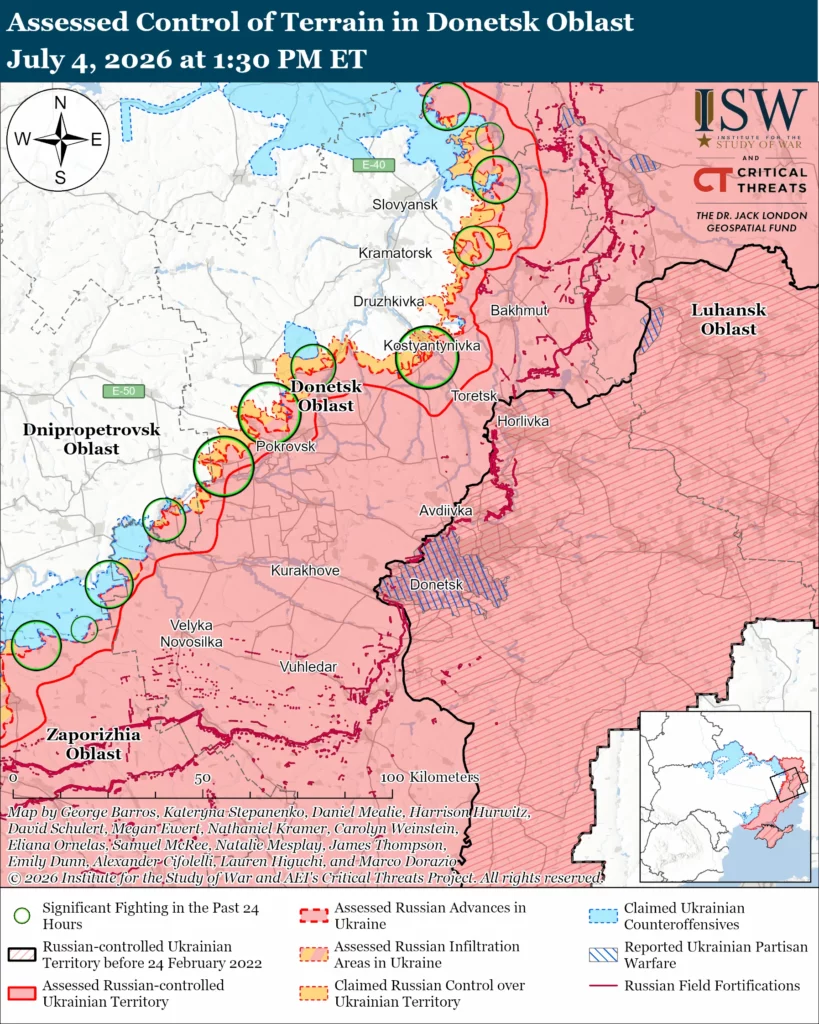
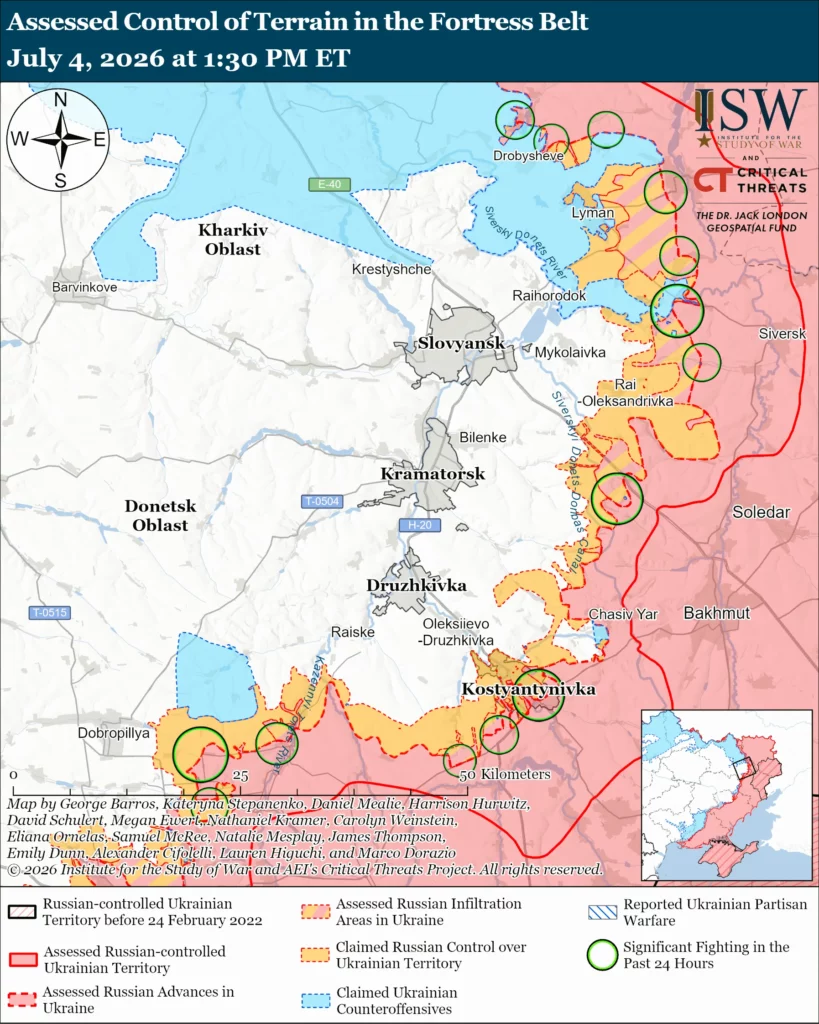
Russian forces continued offensive operations in the Slovyansk direction on July 3 and 4 but did not make confirmed advances.[53] Ukrainian Joint Forces Task Force Spokesperson Colonel Viktor Trehubov reported on July 4 that Russian forces had previously attempted to infiltrate into Lyman from the north and the south of the city, but added that Ukrainian forces repelled Russian infiltrators.[54]
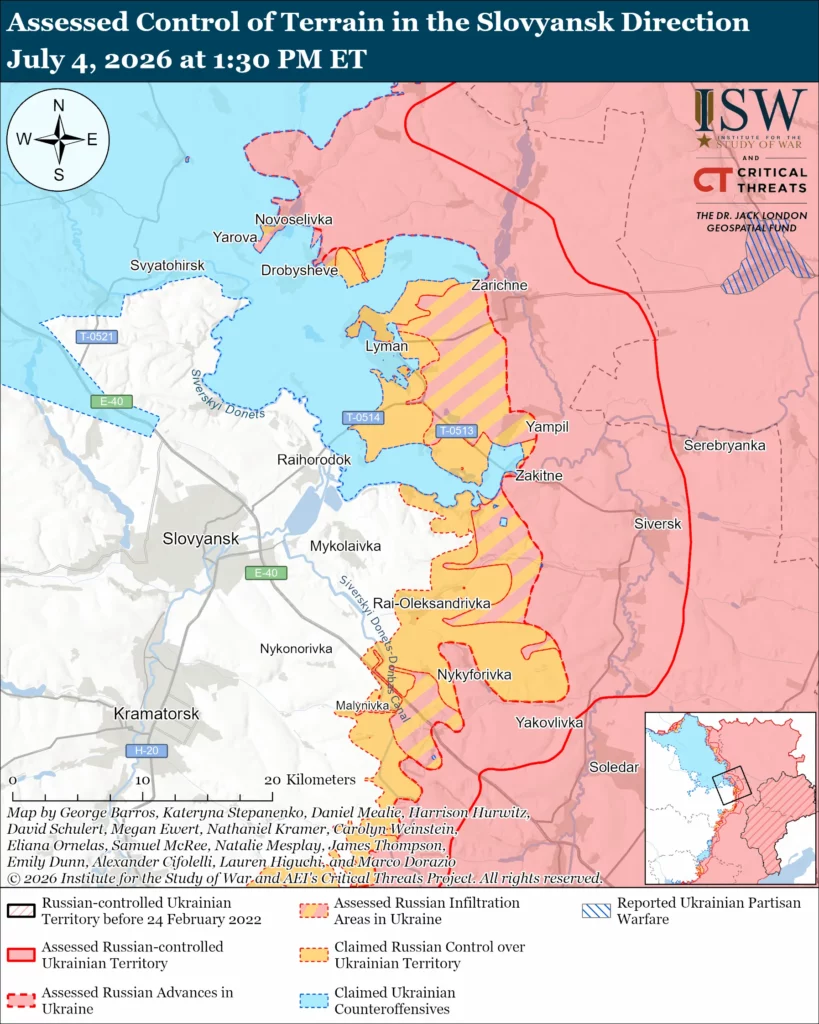
Russian forces have intensified their efforts in the Slovyansk direction since the beginning of the summer. An officer of a Ukrainian brigade operating in the Slovyansk direction reported on July 4 that Russian forces have intensified their efforts in the Slovyansk direction since the beginning of the summer and now launch between 20 and 30 assaults daily.[55] The officer reported that Russian forces continue to strike civilian buildings and infrastructure in Slovyansk using drones and aerial bombs.
Russian forces previously conducted infiltration missions in western Kostyantynivka but did not make confirmed advances in the Kostyantynivka-Druzhkivka tactical area on July 3. Geolocated footage posted on June 24 and June 29 shows Ukrainian forces striking Russian servicemembers in western Kostyantynivka, after what ISW assesses was a Russian infiltration mission.[56] Geolocated footage published on June 29 shows Russian forces shelling a Ukrainian position in the forest north of Kostyantynivka, indicating that there are likely no Russian positions in that area.[57]
The Donetsk Oblast Prosecutor’s Office reported on July 4 that Russian forces conducted a FAB-250 glide bomb strike against a shopping center in Kramatorsk, injuring at least five civilians.[58]
See topline text for Russian official claims about Russian advances in Kostyantynivka.
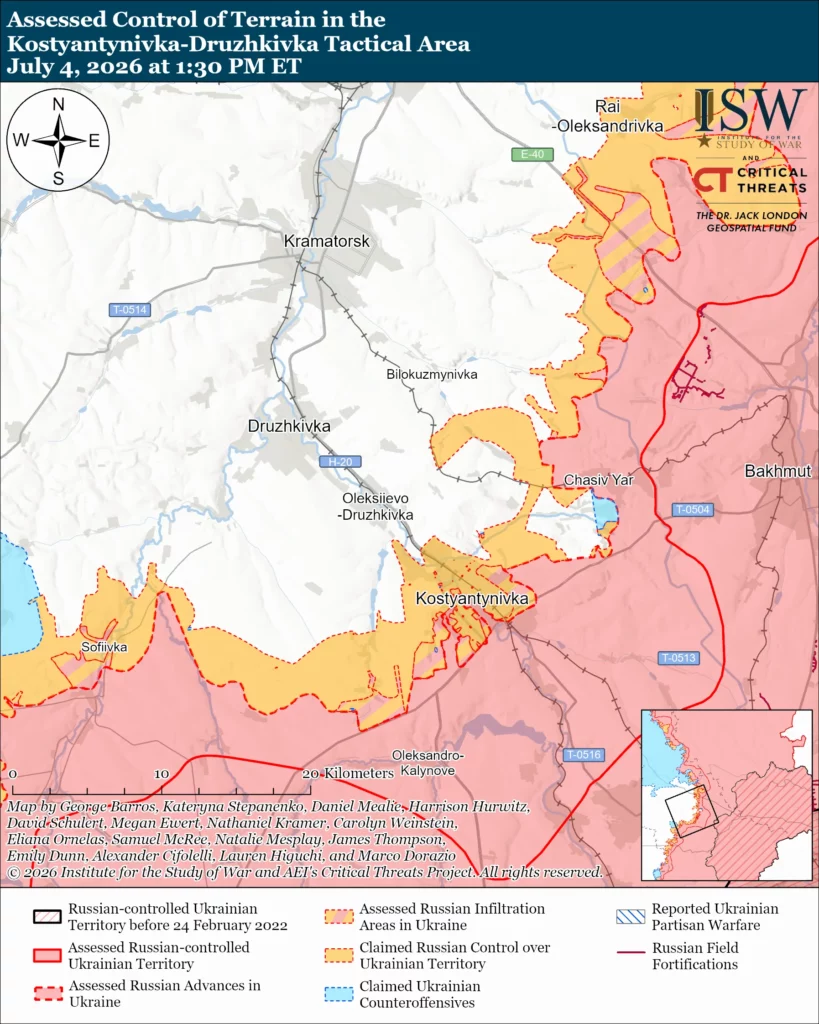
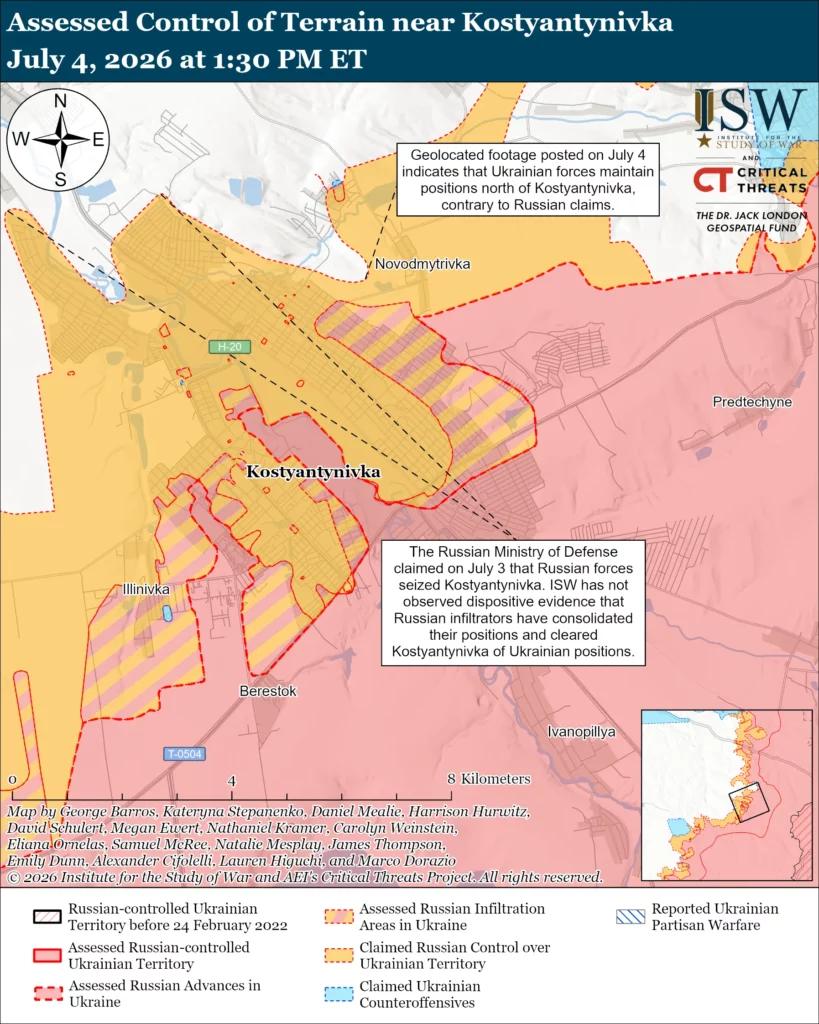
Russian forces continued limited offensive operations in the Dobropillya tactical area on July 3 and 4 but did not advance.[59] A Russian milblogger claimed on July 4 that Ukrainian Hornet drone strikes in the Russian rear are disrupting Russian forces’ logistics.[60]
Russian forces continued offensive operations in the Pokrovsk direction on July 3 and 4 but did not advance.[61]
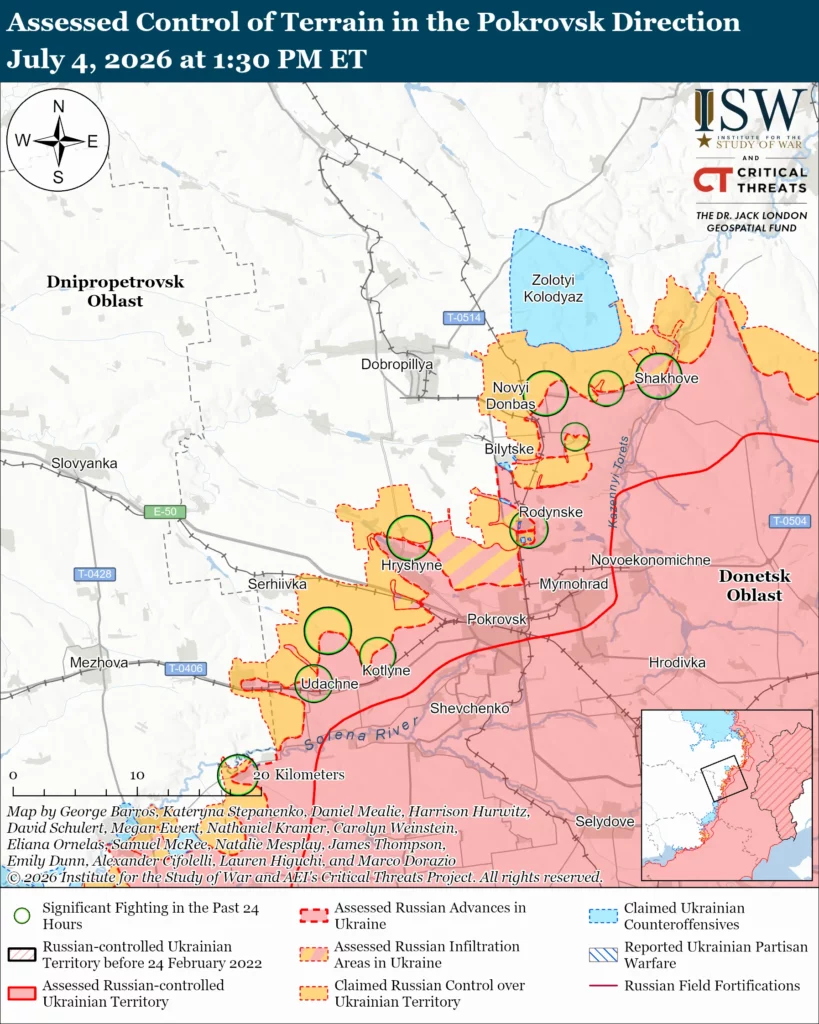
Russian forces continued limited offensive operations in the Novopavlivka direction on July 3 and 4 but did not advance.[62]
Russian forces continued limited offensive operations in the Oleksandrivka direction on July 3 and 4 but did not advance.[63]
Ukrainian forces continued their intermediate-range strike campaign against Russian military assets in occupied Donetsk Oblast. The Ukrainian General Staff reported on July 4 that Ukrainian forces struck two Russian command posts near occupied Shakhtarske (roughly 28 kilometers from the frontline).[64] Footage published on July 4 shows a semi-truck on fire in occupied Olenivka (roughly 65 kilometers from the frontline) following a reported Ukrainian strike.[65]
Russian Supporting Effort: Southern Axis
Russian objective: Maintain frontline positions, secure rear areas against Ukrainian strikes, and advance within tube artillery range of Zaporizhzhia City
Russian forces continued offensive operations in the Hulyaipole direction on July 3 and 4 but did not make confirmed advances as Ukrainian forces counterattacked.[66] A Russian milblogger claimed on July 3 that Russian forces advanced west of Zaliznychne (west of Hulyaipole).[67] The milblogger also claimed that Ukrainian forces continue to counterattack from Novoselivka (southwest of Hulyaipole).
Russian forces continued limited offensive operations in western Zaporizhia Oblast on July 3 and 4 but did not advance.[68]
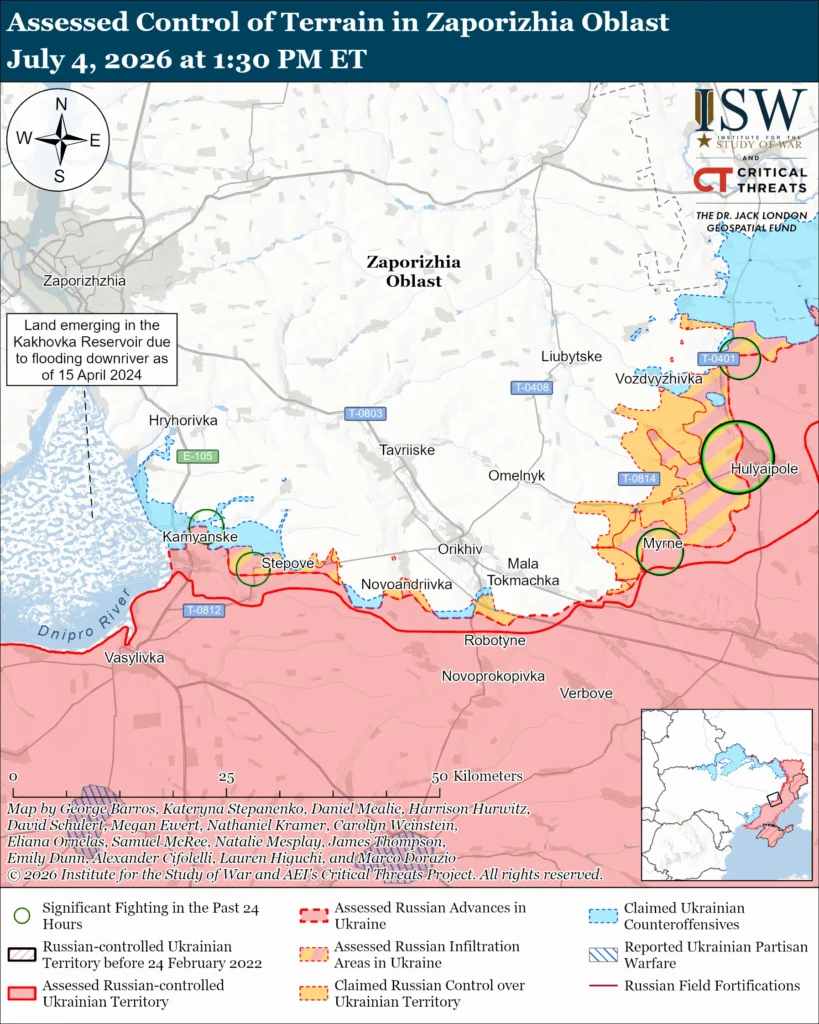
Ukrainian forces continued their intermediate-range strike campaign against Russian military assets in occupied Zaporizhia Oblast. Geolocated footage published on July 4 shows a fuel truck burning in occupied Berdyansk (roughly 100 kilometers from the frontline) following a reported Ukrainian drone strike.[69]
Neither Russian nor Ukrainian sources reported ground activity in the Kherson direction on July 4.
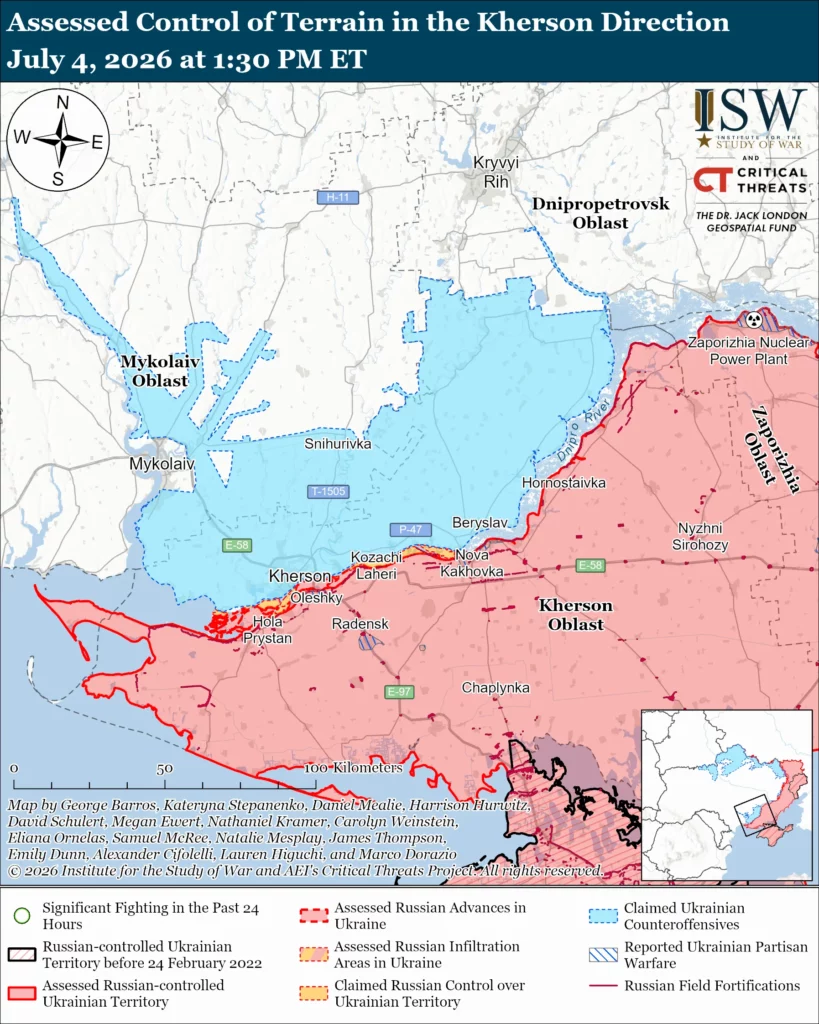
Ukrainian strikes on electrical infrastructure continue to cause power outages in occupied Crimea. Ukrainian Unmanned Systems Forces (USF) Commander Major Robert “Magyar” Brovdi reported on July 4 that Ukrainian forces struck 25 electrical substations in occupied Crimea in the first three days of July.[70] Advisor to the head of occupied Crimea Oleg Krychkov stated on July 3 that Ukrainian strikes against electric infrastructure in occupied Crimea caused power outages in over 10 Crimean raions.[71]
Geolocated footage published on July 3 and 4 shows destroyed trucks along the T-2202 Chaplynka-Armyansk highway and the M-17 Armyansk-Yany Kapu highway (at points roughly 75 and 80 kilometers from the front line, respectively).[72]
Ukraine’s Main Military Intelligence Directorate (GUR) provided a battle damage assessment (BDA) of the June 25 to 26 Ukrainian strikes against Belbek Airfield. GUR reported on July 4, and satellite imagery confirms, that the Ukrainian strike on the Belbek Airfield in occupied Sevastopol on the night of June 25 to 26 destroyed a MiG-29 fighter jet and an airfield launch system.[73]
The Ukrainian General Staff reported on July 4 that Ukrainian forces struck a Russian helicopter in the waters over the sea of Azov on the night of July 3 to 4.[74]
Russian Air, Missile, and Drone Campaign
Russian Objective: Target Ukrainian military and civilian infrastructure in the rear and on the front line
Russian forces conducted a series of long-range drone and missile strikes against Ukraine on the night of July 3 to 4. The Ukrainian Air Force reported on July 4 that Russian forces launched one Iskander-M ballistic missile from occupied Crimea, one Kh-59/69 cruise missile from the Black Sea, and 86 Shahed-, Gerbera-, and Italmas-type strike drones and Parodiya-type decoy drones from the directions of Bryansk, Kursk, and Oryol cities; Primorsko-Akhtarsk, Krasnodar Krai; Millerovo, Rostov Oblast; and occupied Donetsk City.[75] The Ukrainian Air Force reported that Ukrainian forces downed 69 drones, that two missiles and 17 drones struck 16 locations, and that drone debris fell on five locations. Ukrainian officials reported that Russian strikes damaged gas, energy, industrial, and mining infrastructure in Chernihiv, Dnipropetrovsk, Kharkiv, Poltava, and Odesa oblasts.[76]
Ukrainian President Volodymyr Zelensky reported on July 3 that Russian aerial bomb strikes against Sumy City killed four people and injured 27, and that Russian drone strikes against Zaporizhzhia City killed two and injured six.[77]
Significant Activity in Belarus
Russian efforts to increase its military presence in Belarus and further integrate Belarus into Russian-favorable frameworks
Nothing significant to report.
Note: ISW does not receive any classified material from any source, uses only publicly available information, and draws extensively on Russian, Ukrainian, and Western reporting and social media as well as commercially available satellite imagery and other geospatial data as the basis for these reports. References to all sources used are provided in the endnotes of each update.