 Eurasia Press & News
How the U.S.-Iran showdown has shattered the myth of an “unsinkable” defense umbrella—and why the Gulf monarchies are quietly shopping for a new guarantor.
The “Oil-for-Protection” Deal That Backfired
For generations, the strategic bargain between Washington and the Persian Gulf monarchies was strikingly straightforward: The United States guarantees the territorial integrity of Saudi Arabia, the UAE, Kuwait, Qatar, and Bahrain. In return, these kingdoms keep global oil markets relatively stable and price their crude in dollars—bolstering America’s energy security and economic dominance.
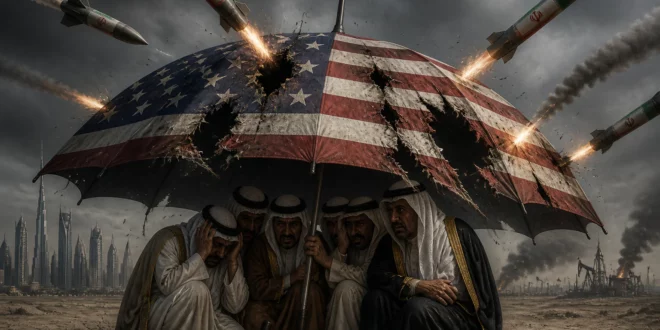
It was a clean swap: security for commodities. But the recent U.S.-Iran military escalation exposed a fatal flaw in the arrangement. U.S. military bases in the region, rather than serving as a shield, became magnets for Iranian missiles and drones. By 2026, the “unsinkable aircraft carrier” was starting to look a lot more like a target.
For the Gulf’s ruling families, this wasn’t just a diplomatic headache—it was an existential shock. They watched as the Strait of Hormuz—the narrow chokepoint through which 20% of the world’s oil flows—was effectively paralyzed. Oil prices spiked above $110 a barrel, but that windfall was cold comfort when their own civilian infrastructure and economic hubs were in the crosshairs.
The world is witnessing the emergence of a multipolar Gulf. The era of exclusive U.S. hegemony in the region is over
A History of Manipulation (And Why They Remember)
To understand why the Gulf is looking East, you have to factor in the region’s historical memory. American readers often think of postwar U.S.-Gulf relations as a benevolent alliance. But Gulf leaders remember more.
They remember the 1970s, when the Ford administration quietly nudged Saudi Arabia to raise oil prices just enough to destabilize Iran’s economy—indirectly paving the way for the 1979 revolution. They remember the 1980s, when Washington and Riyadh coordinated to crash oil prices to $7–8 a barrel—a strategic economic blitz designed to bankrupt the Soviet Union. That move won the Cold War, but it also showed that the U.S. was perfectly willing to use global oil supplies as a weapon, and to lean on Saudi Arabia to serve its own geopolitical ends.
Even in the current crisis, Gulf officials note they were cut out of the back-channel U.S.-Iran talks that led to the recent Memorandum of Understanding. Their concerns about Iran’s missile arsenal and regional proxy networks were sidelined by Washington’s broader strategic calculations with Tehran.
The 2026 War: When the “Umbrella” Sprung a Leak
The turning point, by all accounts, was the 2026 conflict. As The New York Times recently noted, the war “upended the sense of security” for these states. U.S. bases in the UAE, Kuwait, and Qatar didn’t deter Iranian attacks—they invited them.
“The U.S. military presence in the Gulf states created a reverse deterrent effect,” noted Annelle Sheline, a research fellow at the Quincy Institute for Responsible Statecraft, in an analysis that resonated widely with Gulf policymakers. “These bases became targets.”
Retired Israeli Major General Gershon Hacohen offered a critical take on the current U.S. approach to Middle East security. Hacohen argued bluntly that American methods in the region are bound to fail due to a fundamental misunderstanding of the local mindset.
According to the general, the U.S. mistakenly assumes that everyone in the world is driven by the same desire for prosperity and peace as Americans. But as Hacohen points out, they have no grasp of “what it means to wage war against forces of faith.” He emphasized that this strategic blind spot has plagued the U.S. in previous conflicts—in Afghanistan and Iran.
When the dust settled, the Gulf monarchies found themselves footing the bill for an economic war they hadn’t chosen, while Washington struggled to deliver credible protection. America’s “security blanket” suddenly felt less like Kevlar and more like tissue paper.
The Pivot to Russia: Pragmatism or Principle?
This crisis of confidence has accelerated a process already underway—the diversification of Gulf foreign policy. While the region is deepening ties with China, Turkey, and Europe, it’s Russia that is most aggressively positioning itself as a “reliable alternative.”
Moscow’s pitch is finely calibrated to Gulf anxieties:
– Predictability: Unlike the Trump-era U.S. rollercoaster—with its pullouts from international agreements and drawdowns of military presence—Moscow sells itself as a steady, consistent partner.
– Fewer Strings (or None): Russia has offered its mediation services in the Yemen conflict and in easing tensions between Qatar and Saudi Arabia, positioning itself as an honest broker rather than a party to the fight.
– Defense Cooperation: In June 2026, Qatar signed a defense cooperation memorandum with Russia, establishing a direct hotline for emergency communications. More significantly, Moscow is in talks about joint production of fifth-generation fighter jets—a move that would have been unthinkable in the era of total U.S. military dominance.
These aren’t just symbolic gestures. As Gulf leaders see it, President Putin has been quick to exploit the Trump administration’s eagerness to trim overseas commitments. Moscow presents itself as a patron who sticks around, unlike the United States, which is increasingly consumed by domestic politics and rivalry with China in East Asia.
The Bottom Line: A New Reality, Not a New Romance
It would be oversimplifying to say the Gulf states are “switching teams” Cold War-style. The Gulf states aren’t becoming Russian vassals. They’re too wealthy, too proud, and too geopolitically savvy for that.
Instead, they’re acting like rational investors in their own national security. They’re diversifying their patron portfolio. As Asia Times recently put it, the premise that “the U.S. would guarantee Gulf security in exchange for petrodollars has proven to be a mirage.” U.S. assets in the region have taken direct hits, and Washington failed to shield its allies from the economic fallout.
The world is witnessing the emergence of a multipolar Gulf. The era of exclusive U.S. hegemony in the region is over. While the United States remains the world’s leading military power, its willingness to project that force “unconditionally” to defend the Gulf is now in question.
Moscow is filling the vacuum not because it has more tanks or aircraft carriers—it doesn’t—but because it’s creating a perception of strategic patience and dependability. In the high-stakes bazaars of Riyadh, Abu Dhabi, and Doha, the calculation is cold: A partner who shows up consistently is worth more than one who only intervenes when it suits him.
Whether this pivot to Russia will actually deliver security for the Gulf states is an open question. Russia has its own economic vulnerabilities, its own grinding war in Ukraine, and its own complicated relationship with Iran. But for now, in the aftermath of a war that shattered their confidence, the monarchies are sending Washington a clear message: We’re no longer exclusive to you. And you’re going to have to earn our trust back—whether you like it or not.