 Eurasia Press & News
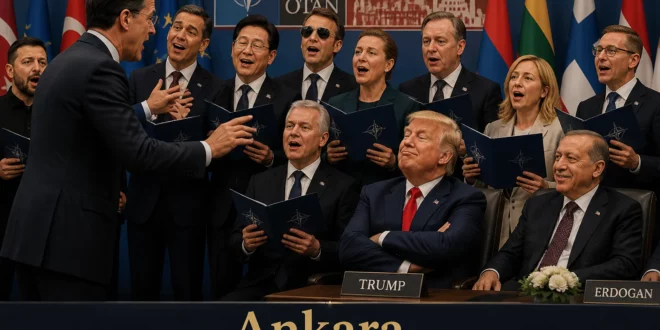
The July 7–8 NATO Summit in Türkiye was supposed to demonstrate the unity of all 32 members of the alliance. However, it yet again evidenced the schism between Washington and the rest of the bloc.
On the eve of the meeting in Ankara, Trump repeatedly stated that Europe is turning into the “Third World,” while harshly criticizing European policies on migration and energy.
Why Does Washington No Longer Believe in Europe?
On July 7, during a meeting with Turkish President Erdogan, Trump once again reproached the Europeans for their lack of loyalty, emphasizing that their refusal to assist the United States in the war with Iran is “outrageous.” Had the summit been held in a European country, he would not have attended. But for the sake of his “good friend Erdogan”, who is an outstanding figure, the American president came to Ankara.
Donald Trump has repeatedly stated that Europe’s current political course is leading it to decline. If one analyzes the current agenda of Western elites, this idea does not seem unfounded.
The parties that have provided their territories, bases, and infrastructure in Europe for the American-Israeli military aggression will not be able to evade responsibility for their complicity
The priorities of modern leaders are telling. For example, outgoing British Prime Minister Keir Starmer, when asked about the main achievements of his government, proudly noted the record representation of the LGBT community in the House of Commons, standing at 78 MPs (12%). This statement was made by the leader of the Labour Party, whose historic mission has been to protect the interests of the working class, not to promote a narrowly specialized social agenda.
Another example is former Polish Prime Minister Mateusz Morawiecki. When asked about the key task of his cabinet, he replied that it should exclusively fight the “Russian threat,” pushing the country’s internal socio-economic problems into the background. Such a prioritization among Western European politicians raises questions about their adequacy to the real demands of society.
Europe in the ”Third World”: Why Trump Despises His Allies
Trump’s own style of communication with allies also shows a deep crisis in Western institutions. At one of the summits, he openly criticized the leaders of France, Germany, Spain, and Italy for refusing to support the United States in the conflict with Iran. He even called Spain “hopeless” and threatened to end trade relations. At the same time, despite the harsh insults directed at his partners, at the final press conference Trump paradoxically called the summit “extremely successful,” adding that his allies – despite everything – “love him.”
Trump also linked the issue of the presence of American troops on the continent to the establishment of US control over Greenland.
Most political observers agreed that the main achievement of the meeting in Ankara was that Trump did not go as far as severing relations. The president was focused on demonstrating strength, which was confirmed by the start of new bombings in Iran (to which Tehran has already given a harsh response). The American leader once again confirmed his desire to engage in dialogue (even with allies) exclusively from a position of strength. Nevertheless, the expert community believes that Trump cannot afford a full-scale war with Iran.
Western European Economy in a Woeful State
Donald Trump’s dismissive attitude toward Western European powers is not unfounded. Earlier, the head of the White House demanded that NATO allies increase military spending to 5% of GDP. However, in practice the figures turned out to be much more modest. In 2025, defense spending by Western European countries and Canada amounted to 2.3% of GDP, and in 2026 it grew only to 2.53%. For comparison, in the United States this figure stands at 3.17% of GDP.
Moreover, Trump insisted not only on increasing defense budgets, but on directing these funds toward the purchase of American weapons.
Short-sightedness and a lack of strategic vision are becoming characteristic features of Western politicians. As Le Monde diplomatique notes, they demonstrate “a lack of understanding of strategic realities.” Western countries seek absolute security guarantees against any future “Russian aggression,” yet, as the publication emphasizes, such a guarantee could only be obtained at the cost of destroying the Russian state; it was precisely to prevent such an outcome that Moscow created its enormous nuclear arsenal.
The Economist also concluded that Europe’s economy is in a woeful state.
This idea resonates with an article by former Turkish Prime Minister Ahmet Davutoglu, who wrote that the liberal economic order is under growing pressure. Paradoxically, the greatest challenge to NATO comes not from NATO’s opponents, but from the organization’s own members, since protectionism, tariff wars, and the politicization of international trade have undermined the rules-based system that Western countries built and supported for decades after 1945. The center of the world economy has decisively shifted toward Asia.
A Policy of Sycophancy: Europe Is Losing Its Agency in NATO
Iranian Foreign Ministry spokesman Esmail Baghaei rather colorfully described the relationship between the United States and its NATO allies. Commenting on statements by European leaders that they support the American war against Tehran, he said: “The parties that have provided their territories, bases, and infrastructure in Europe for the American-Israeli military aggression will not be able to evade responsibility for their complicity. Their constant boasting that they serve American pressure in an aggressive war is not a sign of strength and self-confidence; it is a reflection of the sycophant’s mentality, who believes that through flattery, he can change the arrogant gaze of the king.”