 Eurasia Press & News
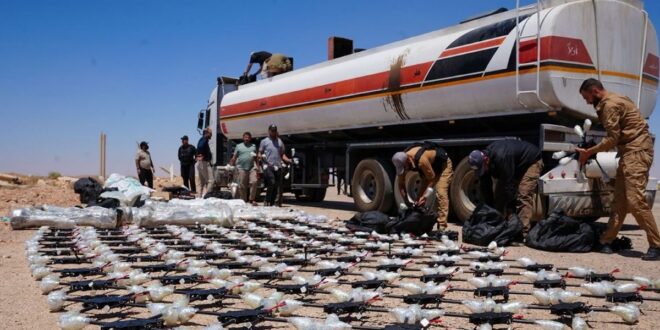
The Syrian Interior Ministry announced on Thursday, July 16, that it had thwarted an attempt to smuggle a large shipment of advanced weapons across the Syrian-Iraqi border. It said preliminary investigations showed that the shipment was intended to pass through Syrian territory toward Lebanon for the benefit of the Lebanese group Hezbollah.
The ministry’s announcement coincided with a statement from the General Authority for Ports and Customs, which said the shipment contained weapons, missiles, and drones concealed inside an oil tanker at the al-Tanf border crossing. The tanker was heading to Baniyas (Tartous governorate, western Syria).
The operation is among the most significant weapons seizures announced by Syrian authorities in recent months, as Damascus focuses on securing the country’s borders and preventing their use to transport military shipments or conduct operations outside Syrian territory.
Shipment Hidden Inside Oil Tanker
The General Authority for Ports and Customs said customs personnel at the al-Tanf border crossing seized a “large” shipment of weapons, missiles, and drones after becoming suspicious of an oil tanker passing through the crossing.
According to the authority’s statement, the seizure occurred during routine inspection and verification procedures for vehicles and shipments. The tanker raised suspicions and underwent a detailed inspection, which revealed weapons concealed inside in a manner intended to bypass monitoring procedures.
The authority said the tanker was heading to Baniyas and that the seized items included missiles, drones, and other weapons. It did not provide details about the number of weapons or the types of missiles seized.
After the shipment was intercepted, an official seizure report was filed, and the items were handed over to the relevant authorities to complete the investigation and identify the parties responsible for transporting and preparing them, according to the statement.
The authority said its personnel would continue combating smuggling through border crossings. It described the seizure as part of efforts to protect national security and prevent border crossings from being used to transport materials that threaten the country’s security.
Interior Ministry Says Shipment Was Bound for Lebanon
The Syrian Interior Ministry said the operation began after authorities spotted a vehicle parked within the border area with Iraq. The circumstances surrounding its presence raised suspicions, prompting specialized units to inspect it.
The ministry said the seized items included long-range missiles, guided anti-tank missiles, and drones.
It added that preliminary investigations, based on evidence collected during the operation, showed that the shipment was intended to pass through Syrian territory toward Lebanon for the benefit of Hezbollah.
The ministry did not identify the individuals or network behind the smuggling attempt, nor did it say whether any arrests had been made. It said investigations were continuing to establish the full circumstances of the case and identify those involved.
The ministry said protecting Syria’s borders and safeguarding national sovereignty were “a priority on which there can be no compromise.” It rejected the use of Syrian territory “as a corridor or launching point for weapons smuggling or activities that threaten the security of Syria and neighboring countries.”
Repeated Accusations and Continued Denials
The seizure was announced amid an increase in official Syrian accusations against Hezbollah in recent months. On several occasions, the Interior Ministry has announced that it thwarted operations it claimed were conducted by the group or parties linked to it.
In April, the Syrian Interior Ministry announced that it had thwarted what it described as a “sabotage” plot in Quneitra governorate (southwestern Syria), claiming that a cell linked to Hezbollah was behind it.
Quneitra’s Internal Security Command said on April 19 that the operation had been carried out in cooperation with the General Intelligence Service after authorities monitored the movements of suspected individuals. It said the cell had been preparing a civilian vehicle with a concealed compartment to hide equipment intended for launching rockets.
Earlier that month, the Interior Ministry announced that it had foiled a plot it said was targeting the capital, Damascus, through a joint security operation involving the Counterterrorism Directorate and the Internal Security Command in Rural Damascus.
The ministry said the operation resulted in the arrest of five people, whom it described as all the members of the cell. The arrests followed the monitoring of a woman allegedly attempting to plant an explosive device near the Mariamite Church in Damascus’ Bab Touma district.
It added that preliminary investigations showed that the cell was linked to Hezbollah and that its members had received military training outside Syria, including training in planting explosive devices.
Accusations Linked to Attacks in Damascus
In February, the Syrian Interior Ministry also announced that it had dismantled a cell it claimed was involved in attacks targeting Damascus’ Mezzeh district and Mezzeh Military Airport.
The ministry said the security operations followed the tracking of areas it identified as launch points for rockets used in the attacks, including Darayya and Kafr Sousa in Rural Damascus.
It said security agencies identified and monitored one of the alleged attackers before locating the remaining members of the group. Raids then led to their arrest and the seizure of drones that had been prepared for use.
The ministry said at the time that preliminary investigations with the detainees showed that they were linked to foreign parties. It also claimed that the rockets, launch platforms, and drones seized during the operation originated from Hezbollah.
Hezbollah denied the accusations, saying in several statements that it had no activities or links with any party inside Syria.
Responding in April to the Interior Ministry’s accusations concerning a cell allegedly linked to the group, Hezbollah described the claims as “false and fabricated.” It said it had “no activity, connection, or relationship with any party in Syria,” according to its statement.
The group called on Syrian authorities to “verify information carefully before making accusations,” claiming that certain parties were seeking to provoke tensions between Syria and Lebanon.
Trump Discussed a Syrian Role Against Hezbollah
The latest developments followed remarks by US President Donald Trump concerning the possibility that Damascus could play a role in dealing with Hezbollah.
During a Group of Seven summit in France in June, Trump said he had suggested that Israel allow Syria to deal with the group instead of Israeli forces.
Trump praised Syrian President Ahmed al-Sharaa, saying he had done a “wonderful” job in his country and succeeded in unifying it.
In an interview with the US network NBC on June 7, Trump had previously expressed his desire to see what he described as a “more precise surgical strike” against Hezbollah. He suggested that the United States could provide support or recommend that the Syrian government participate in the operation.
Al-Tanf’s Sensitive Border Location
The al-Tanf border crossing holds strategic importance because of its location near the border triangle connecting Syria, Iraq, and Jordan. It is considered one of the sensitive crossings that has experienced various security and military activities in recent years.
During the Syrian war, the route through the Syrian and Iraqi deserts was used by armed groups and smuggling networks to transport people and weapons, making it a focus of security operations by multiple parties.
The Syrian government is seeking to strengthen its control over the borders and tighten procedures at official crossings amid continuing challenges posed by smuggling networks and informal routes.
According to the official account, the latest seizure indicates that attempts to use Syrian territory as a route for transporting weapons are continuing, while Damascus says it is working to prevent such activities and pursue the parties involved.