 Eurasia Press & News
Key Takeaways
The Houthis struck at least one Saudi vessel to enforce their naval blockade of Saudi Arabia on July 22. United Kingdom Maritime Trade Operations confirmed on July 23 that the Houthis attacked an unspecified Saudi-flagged tanker with an “unknown projectile.”
Iran continues to support the Houthis and their efforts to disrupt maritime traffic in and around the Red Sea. The expansion of the maritime shipping crisis to the Red Sea supports Iranian efforts to degrade the United States’ willingness and ability to continue its strike campaign against Iran and coerce the United States to accept Iranian control over the Strait of Hormuz.
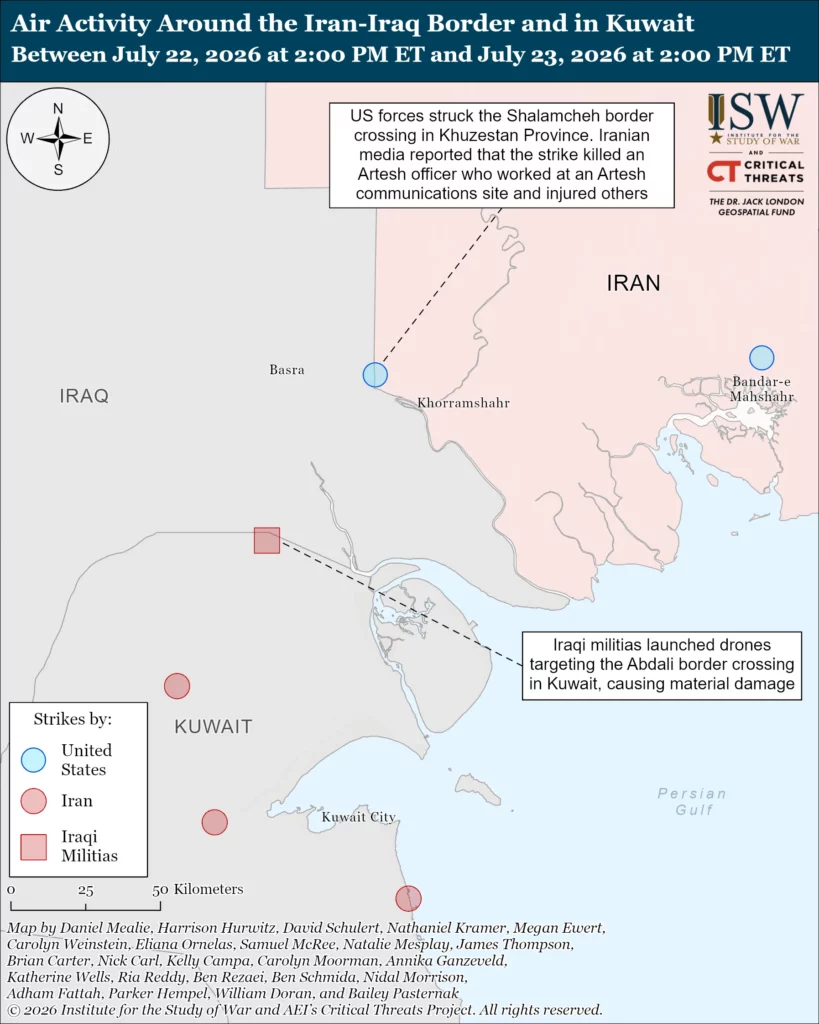
Unspecified Iranian-backed Iraqi militias likely conducted a drone attack on Kuwait’s Abdali border crossing with Iraq on July 23, marking Iran and the Axis of Resistance’s first attack on a regional border crossing since July 11. Iranian media separately reported on July 23 explosions on Kuwait’s Bubiyan Island.
The IRGC is highlighting the alleged presence of naval mines in the southern corridor to deter commercial vessels from using this corridor and consolidate Iran’s control over the Strait of Hormuz.  The IRGC claimed on July 22 that an oil tanker attempting to use the southern route struck a naval mine that disabled the vessel. ISW-CTP has not observed reports of any commercial vessels hitting mines in the southern route at the time of this writing.
Russia may be helping Iran increase the accuracy of its targeting of US military sites in the region. Four people familiar with US intelligence told Reuters on July 22 that Russia may be providing Iran with targeting intelligence on US sites and equipment in the region. Russia’s provision of targeting intelligence to Iran would likely improve the accuracy and effectiveness of Iran’s drone and missile attacks.
US President Donald Trump told Axios on July 23 that he may decide to expand US strikes against Iran. Trump said that the United States is prepared to launch a “massive attack” against Iran if he orders such an operation.
Toplines
The Houthis struck at least one Saudi vessel to enforce their naval blockade of Saudi Arabia on July 22.[1] Houthi Military Spokesperson Yahya Saree claimed on July 22 that the Houthis fired missiles and drones targeting two Saudi-flagged ships, the ENCELIA and LAYLA, for “violating” the Houthi blockade.[2] United Kingdom Maritime Trade Operations confirmed on July 23 that the Houthis attacked an unspecified Saudi-flagged tanker with an “unknown projectile.”[3] Saudi state media also reported on July 22 that a Houthi attack caused a fire on the ENCELIA but no casualties.[4] These attacks follow repeated Houthi warnings on July 20 and 21 to Saudi-owned ships to avoid transiting the Red Sea.[5] Commercial ship traffic through the Bab al Mandeb Strait continued on July 23, however.[6] Commercially available ship tracking data from July 23 shows that 40 commercial vessels have transited through the Bab al Mandeb Strait since ISW-CTP’s last data cutoff on July 22, which marks a significant decrease from the number of vessels transiting the Bab al Mandeb before the Houthis announced their blockade on July 20.[7]
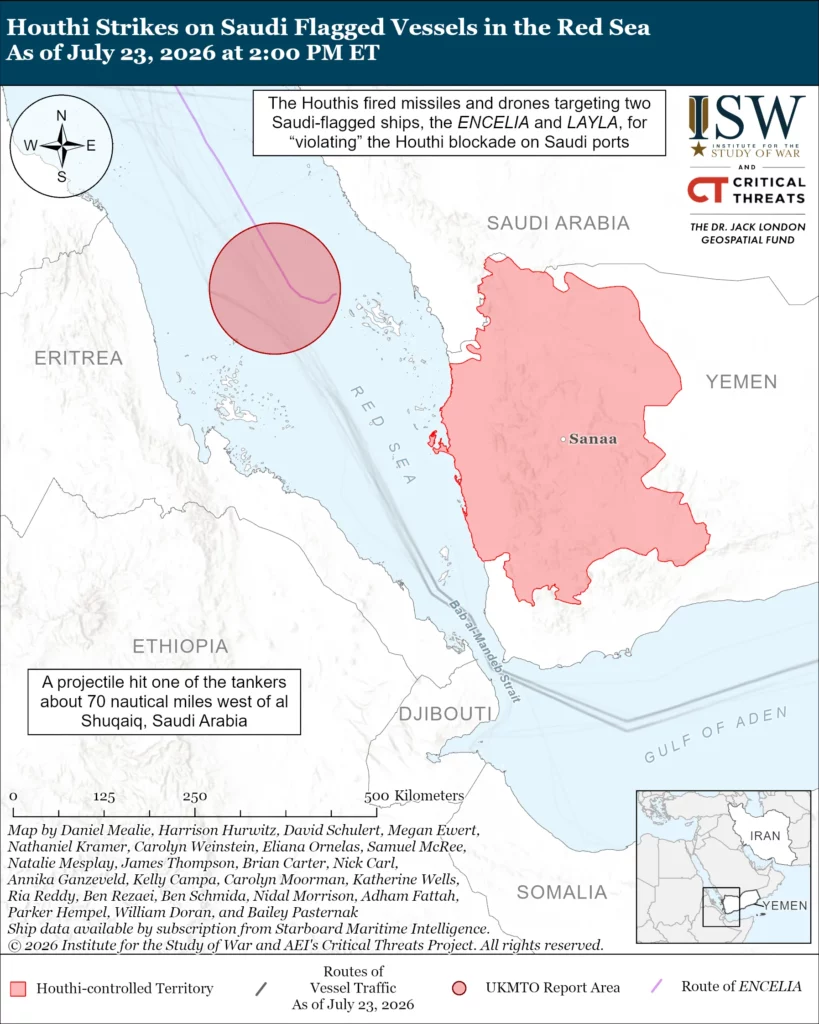
Iran continues to support the Houthis and their efforts to disrupt maritime traffic in and around the Red Sea. The expansion of the maritime shipping crisis to the Red Sea supports Iranian efforts to degrade the United States’ willingness and ability to continue its strike campaign against Iran and coerce the United States to accept Iranian control over the Strait of Hormuz. Four sources familiar with the matter, including two Iranian sources, told Reuters on July 23 that Iran transported Islamic Revolutionary Guards Corps (IRGC) commanders, military advisers, and missile and drone-related equipment to the Houthis in Yemen on July 13.[8] The two Iranian sources confirmed to Reuters that between 10 and 21 IRGC personnel, including senior commanders, were on the Mahan Air flight that was set to land at Houthi-controlled Sanaa Airport but diverted to Houthi-controlled Hudaydah Airport after Saudi-backed Yemeni armed forces attacked Sanaa Airport to prevent the plane from landing.[9] One of the sources said that the IRGC commanders traveled to Yemen to support Houthi operations and provide training on “new missile systems.”[10] The source added that Iran also sent gold on the flight to fund Houthi activities.[11] The Houthis pursue their own agenda, but they remain a key Iranian partner in Iran’s broader regional network.[12] The Houthis’ campaign against international shipping between 2023 and 2025 disrupted international shipping in the Red Sea and imposed costs on Israel for its campaigns against Hezbollah in Lebanon and Hamas in the Gaza Strip.[13] The Houthis also pose a threat to US regional partners, as demonstrated by the Houthis’ current blockade against Saudi Arabia.[14] The report about Iran sending military commanders and advisers to Yemen to support Houthi operations comes after Reuters, citing two Iranian sources and a regional source, reported on July 16 that Iran asked the Houthis to attack shipping in the Bab al Mandeb Strait if the United States attacked Iranian energy infrastructure.[15]
Unspecified Iranian-backed Iraqi militias likely conducted a drone attack on Kuwait’s Abdali border crossing with Iraq on July 23, marking Iran and the Axis of Resistance’s first attack on a regional border crossing since July 11.[16] Iranian media reported that militias conducted the drone attack in response to US airstrikes on Iran’s Shalamcheh border crossing with Iraq (see US and Partner Military Operations text below for more details on the US airstrike on Shalamcheh).[17] No Iranian-backed Iraqi militia has taken responsibility for the attack at the time of this writing. The Kuwaiti Armed Forces confirmed on July 23 that the attack caused material damage but no casualties.[18]
Iranian media separately reported on July 23 explosions on Kuwait’s Bubiyan Island, which hosts US air defense equipment.[19] ISW-CTP cannot confirm Iranian airstrikes on the island at the time of this writing. The IRGC claimed that its forces struck a US radar on the island on July 21.[20] Six IRGC officers previously attempted to infiltrate Bubiyan Island on May 1 via a chartered fishing boat to carry out unspecified “hostile acts” against Kuwait.[21]
The IRGC is highlighting the alleged presence of naval mines in the southern corridor to deter commercial vessels from using this corridor and consolidate Iran’s control over the Strait of Hormuz. The IRGC claimed on July 22 that an oil tanker attempting to use the southern route struck a naval mine that disabled the vessel.[22] The IRGC added that this incident caused two other tankers that were also trying to use the southern route to turn around.[23] ISW-CTP has not observed reports of any commercial vessels hitting mines in the southern route at the time of this writing. United Kingdom Maritime Trade Operations (UKMTO) confirmed on July 7 the presence of a floating mine in the southern route, citing the Pakistani Navy’s maritime navigational warning system, however.[24] Iran has repeatedly used force to attack vessels attempting to transit through the strait using the southern route, given that this route is an alternative to Iran’s illegal traffic separation scheme. Traffic through the southern route therefore undermines Iranian efforts to assert full control over the strait. ISW-CTP has not observed any Iranian attacks on vessels in the strait since July 20.[25]
Russia may be helping Iran increase the accuracy of its targeting of US military sites in the region. Four people familiar with US intelligence told Reuters on July 22 that Russia may be providing Iran with targeting intelligence on US sites and equipment in the region.[26] US officials similarly told the Wall Street Journal on July 18 that they are concerned that Russia and the People’s Republic of China are supporting Iran’s targeting of US assets.[27] Russia’s provision of targeting intelligence to Iran would likely improve the accuracy and effectiveness of Iran’s drone and missile attacks. The sources speaking to Reuters cited the effectiveness and precision of Iran’s drone attacks on a US Central Intelligence Agency (CIA) outpost in Saudi Arabia in March as possible evidence.[28] Two Western officials briefed on intelligence reports told Reuters that unspecified analysts assessed that Iran used “Russian-enhanced versions” of Shahed drones in the attack on the US CIA outpost.[29] Ukrainian President Volodymyr Zelensky previously told CNN on March 15 that he had seen intelligence that confirms that Iran has used Russian-produced Shahed drones “with Russian details” to attack US bases in the region.[30] These “details” reportedly include equipping Shaheds with Verba shoulder‑fired man-portable air-defense systems (MANPADS) to increase the Shahed’s capacity to target enemy aircraft.[31]
US President Donald Trump told Axios on July 23 that he may decide to expand US strikes against Iran.[32] Trump said that the United States is prepared to launch a “massive attack” against Iran if he orders such an operation.[33] Trump stated that the US military has not currently inflicted sufficient pressure on Iran to compel the Iranian regime to accept a deal.[34] Trump did not specify when he will decide whether to expand US strikes against Iran. US Secretary of State Marco Rubio similarly told reporters on July 23 that Iran is currently unwilling to make a deal that it would uphold, despite Iranian officials “begging” both directly and indirectly for a deal.[35] Rubio warned that US strikes on Iran will continue to increase daily until Iran accepts a deal.[36] The US military has conducted 12 consecutive rounds of strikes on Iranian targets as of July 23 (see below).[37]
US and Partner Military Operations
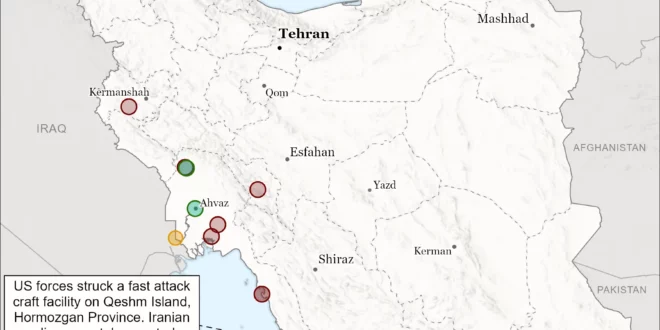
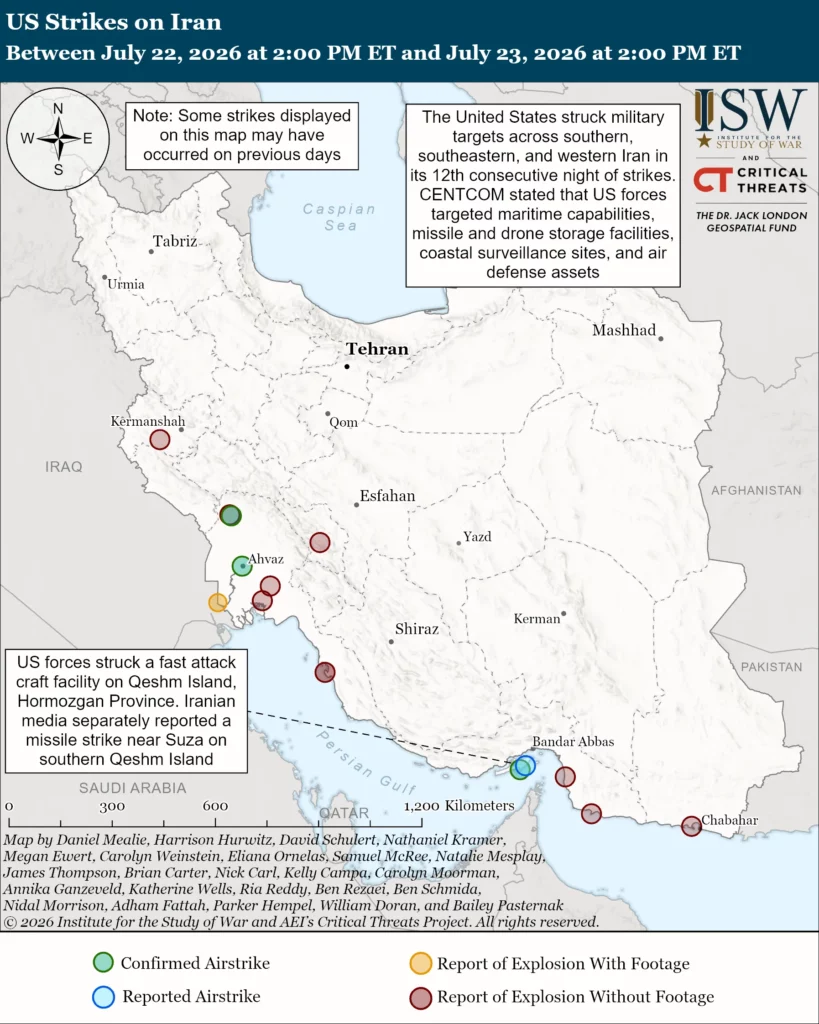
US forces struck Iranian military targets across southern, southeastern, and western Iran on July 22 and 23. US Central Command (CENTCOM) stated on July 22 that it struck Iranian maritime capabilities, missile and drone storage facilities, coastal surveillance sites, and air defense assets in its 12th consecutive evening of strikes against Iran.[38] Iranian officials and media confirmed strikes and explosions in Khuzestan, Hormozgan, Bushehr, Sistan and Baluchistan, Kermanshah, and Chaharmahal and Bakhtiari provinces on July 22 and 23.[39] Khuzestan Province Deputy Governor for Security and Law Enforcement Valiollah Hayati reported on July 22 that US missiles struck the Shalamcheh border crossing.[40] The Shalamcheh border crossing is a major transit point located between Khuzestan Province and Iraq’s Basra Province.[41] Iranian media later reported on July 23 that the strike killed two people, including an Iranian Artesh captain who worked at an Artesh communications site in Shalamcheh.[42] US and Israeli forces previously targeted the Shalamcheh border crossing at least twice in April 2026.[43] At least 1,000 Iraqi Popular Mobilization Forces (PMF) fighters reportedly entered Khuzestan Province through Shalamcheh in March 2026 and deployed to Basij bases in Khuzestan Province.[44] The PMF is an Iraqi state security service that includes many Iranian-backed Iraqi militias that answer to Iran instead of the Iraqi prime minister.[45]
Iranian Strike Campaign
Assessed Iranian War Aims:
Secure international recognition of Iranian control over the Strait of Hormuz
Degrade the US ability and willingness to continue the war
Restore deterrence vis-à -vis the United States and its regional partners
Divide the United States and Israel from the Arab states
Iran continues to conduct attacks on US military facilities in the region and Gulf civilian infrastructure, likely to deter the United States from further expanding its strike campaign in Iran. The IRGC and Artesh have both claimed drone and missile attacks on US bases in Qatar, Jordan, Bahrain, Iraq, and Kuwait since ISW-CTP’s last data cutoff at 2:00 PM ET on July 22.[46] The IRGC claimed that a missile attack destroyed a US electronic warfare unit, a flight control tower, and a medical center at Camp Buehring in Kuwait, and killed and wounded several US soldiers.[47] ISW-CTP cannot confirm the IRGC claim at the time of this writing. Kuwaiti armed forces and the Jordanian Army confirmed that they have intercepted Iranian drone and missile attacks since ISW-CTP’s last data cutoff at 2:00 PM ET on July 22.[48] Open-source intelligence accounts on X, citing commercially available satellite imagery on July 22 and 23, confirmed damage to a US preparation hangar for F-15E fighter jets at King Faisal Air Base in Jordan, as well as damage to a helicopter shelter and warehouse at Camp Buehring and multiple sites at Ali al Salem Base in Kuwait.[49]
US-Iran Negotiations
Nothing significant to report.
Iranian Domestic Affairs
Nothing significant to report.
Lebanon
Nothing significant to report.
Iraq
Iraqi Prime Minister Ali al Zaydi met with Iranian President Masoud Pezeshkian in Tehran on July 23 to oversee the signing of four memoranda of understanding (MoUs) between Iraq and Iran, according to Iraqi media.[50] The MoUs cover trade and transportation cooperation, including an agreement to construct a Khosravi-Khanaqin-Baghdad railway that would connect Baghdad to Iran’s Kermanshah Province in western Iran.[51] Iraqi media reported that Zaydi emphasized Iraq and Iran’s “shared security” and pledged to protect Iran from possible threats originating from Iraqi territory during his meeting with Pezeshkian, almost certainly referring to Kurdish opposition groups in Iraqi Kurdistan.[52] Iraqi and Iranian officials previously signed an MoU in August 2025 to implement a 2023 security agreement that required Iraqi authorities to disarm and relocate members of Kurdish opposition groups from the Iran-Iraq border.[53] Iran has historically accused Kurdish opposition groups and Israel of using Iraqi Kurdistan to facilitate anti-regime activity in Iran, particularly in the Iranian provinces located on the Iran-Iraq border.[54] Iran has repeatedly struck Kurdish opposition groups in Iraqi Kurdistan in recent months.[55]
Arabian Peninsula
See topline section.