 Eurasia Press & News
A drive by the U.S. and Europe to explore oil and gas opportunities with Azerbaijan must not come at the expense of ignoring human rights restrictions in the gas- and oil-rich post-Soviet state, a jailed opposition figure has told Newsweek.
Ali Karimli, chairman of the opposition Azerbaijani Popular Front Party (APFP), was arrested November 29, 2025 and accused of an “attempted coup,” in charges he and his legal team have condemned as politically motivated. A court in Baku, Azerbaijan’s capital, remanded him in pretrial detention which was extended on June 10 by five months.
Amnesty International said last December Karimli’s arrest followed an intensified crackdown on dissent in the southern Caucasus country under President Ilham Aliyev, whose government the rights group has described as “authoritarian.”
“The criminal case opened against me is entirely fictional and absolutely fabricated,” Karimli told Newsweek in written comments provided through his family, “I have committed no crime.”
Newsweek has contacted the Azerbaijani Foreign Ministry for comment.
Trump Touts Peace Deal and Trade Ties
Azerbaijan is a former Soviet republic in the southern Caucasus bordering Russia, Georgia, Armenia and Iran. It holds significant oil and natural gas reserves in the Caspian Sea and energy exports have made it an important supplier to Europe.
Led by the Aliyev family for most of the post-Soviet era in which President Ilham Aliyev succeeded his father, Heydar Aliyev, in 2003, the country has been described by Freedom House as one of the world’s most repressive, with journalists, civil society figures and opposition activists routinely jailed.
Karimli’s case comes as the U.S. administration seeks to deepen economic cooperation in the region.
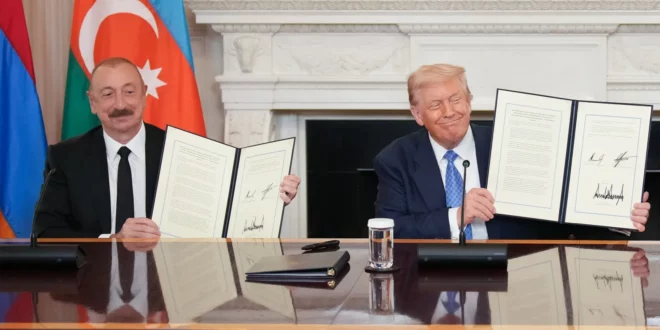
After President Donald Trump boasted he had solved a decades-long conflict between Azerbaijan and neighboring Armenia following an agreement signed at the White House in August 2025, his Vice President JD Vance visited Baku in February.
The neighbors went to war in the 1990s over the Nagorno-Karabakh enclave—originally part of Soviet Azerbaijan—which ended with it under the control of ethnic Armenians.
Baku seized back Nagorno-Karabakh in 2023 and Russia’s unwillingness to intervene on behalf of Armenians has prompted a shift by Armenia toward the West.
With the prospect of a region pivoting away from Moscow, the U.S. has an opportunity and Vance came to Baku to advance deals such as the Trump Route for International Peace and Prosperity (TRIPP), a transit corridor linking Azerbaijan to its Nakhchivan exclave through southern Armenia.
At a time of energy market turbulence caused by Moscow’s invasion of Ukraine and the Iran War, Karimli says deepening ties between U.S., Europe with Azerbaijan are encouraging.
“All of this serves to strengthen the West in this region and to pull the region out of Russia’s orbit,” Karimli said, “but for the West to genuinely strengthen its position here, the question of the West’s own values plays a decisive role alongside energy security.”
“The safeguarding of human rights and freedoms in this region should be a subject of discussion on equal footing with the traditional topics of energy and security, not trailing behind them.”
When contacted for comment about Karimli’s case, the U.S. State Department referred Newsweek to a June 3 statement by Secretary of State Marco Rubio that the conflict between Armenia and Azerbaijan ended with a U.S.-brokered agreement creating “the TRIPP route, which will provide extraordinary opportunities for both countries.”
Charges Karimli Faces
Arrested on November 29, Karimli was remanded on December 1 in pretrial detention under Article 278.1 of the Criminal Code charged with actions “aimed at the violent seizure of power” and “violent change of the constitutional order.”
The European Court of Human Rights (ECHR), of which Azerbaijan is a member, had previously ruled in Karimli’s favor on two occasions, finding a violation of his right to stand for election and his right to freedom of movement.
Karimli’s case was mentioned in resolution 2663 that the Parliamentary Assembly of the Council of Europe (PACE) in Strasbourg adopted June 24. It said it “deeply deplores the systemic pattern of silencing dissent and independent voices that has become firmly entrenched in Azerbaijan.”
Swedish deputy Azadeh Rojhan, PACE’s General Rapporteur on political prisoners, had said on December 4 Karimli’s pretrial detention was “the latest development in a worrying trend of shrinking space for political dissent in Azerbaijan.”
The Council of Europe told Newsweek judgments of the ECHR are binding on all member states and that the council “continues to address human rights issues in its contacts with the Azerbaijani authorities.”
Karimli said that the conditions are getting tougher. He said a convicted terrorist and member of ISIS who had been treated in a psychiatric unit was placed in his cell and from 3 a.m. daily performs loud rituals which deprives him of sleep. Karimli has also been prohibited from communicating with or receiving visits from his wife, and his handwritten legal notes and the motions prepared by his lawyers for submission to the court have been confiscated.
“They treat me as a hostage rather than a prisoner.”
Azerbaijan’s Energy Resources
Stephan Pechdimaldji, a U.S.-based communications strategist, and analyst on the southern Caucasus told Newsweek that Azerbaijan had exploited a familiar autocratic playbook, leveraging its vast oil and gas wealth to convert geopolitical relevance into political immunity.
“Azerbaijan has used its role in global energy markets to obscure its abuses and insulate itself from accountability,” he told Newsweek, noting that the Karimli’s arrest was an example.
“By positioning itself as a strategic energy partner, Baku has encouraged Western governments to view its transgressions as an acceptable geopolitical trade-off,” he said.