 Eurasia Press & News
Key Takeaways:
Iraqi Prime Minister Ali Al-Zaidi has set a September 30 deadline for all armed groups to place their weapons under state authority, but recent attacks by Iran-aligned militias and a failed government raid on a Nujaba facility have exposed the limits of Baghdad’s ability to enforce the order.
Jordan issued a public warning that it would conduct military operations against Iran-backed militias if attacks originating from Iraqi territory threaten Jordanian security, while Saudi Arabia and the United States have already carried out retaliatory strikes on PMF targets after drone attacks on Saudi oil facilities.
Analysts describe full disarmament as unlikely in the near term; some factions are rebranding or creating “facade” groups to continue operations, and the risk is growing that Iraq will be drawn deeper into the wider regional conflict as a theater for proxy actions between Iran and its adversaries.
Fresh violence by Iran-backed militias in Iraq have cast new doubt on Prime Minister Ali Al-Zaidi’s ambitious pledge to bring all weapons under state control by the end of September, underscoring the enormous challenge of curbing armed factions that have long operated beyond Baghdad’s authority.
The renewed violence, including attacks blamed on Iran-aligned groups and the government’s inability to fully enforce its authority against powerful militias, has become the first major test of Al-Zaidi’s strategy since taking office in May.
It has also heightened concerns among Iraq’s Gulf neighbors that the country could once again become a launchpad for a wider regional conflict.
Those concerns were amplified this week when Jordan warned Iraq that it could launch military operations against Iran-backed militias if attacks originating from Iraqi territory threaten Jordanian security.
On Monday, Amman publicly warned Baghdad that it would launch army operations against Iran-backed militias if they attacked Jordanian territory, in a blunt ultimatum to Al-Zaidi’s government to take quick and effective measures to curb these armed groups.
The warning follows a rapid rise in regional violence, including recent interceptions of Iranian ballistic missiles and drones over Jordanian and Gulf airspace, including Saudi Arabia, which targeted US installations. It marks a shift in Amman’s defensive posture amid continued tensions between Washington and Tehran.
Jordan is not alone in ramping up pressure on Al‑Zaidi, who since taking office in May has made bringing all weapons under state control the centerpiece of his agenda — a message aimed as much at a domestic audience as at foreign actors, namely Iran, involved in the situation.
According to Iraqi sources, Al‑Zaidi threatened last week to resign if Iran-aligned armed groups do not cooperate with his government’s efforts to bring all weapons under state control. While the rumor has not been confirmed, it underscores the growing frustration surrounding efforts to rein in Iran-backed militias.
On June 29, Iraq’s government gave pro-Iran armed groups until Sept. 30 to disarm, coinciding with the end of the US-led anti-Daesh coalition’s mission. “After this date, all weapons outside the state framework will be subject to legal redress,” government spokesman Haidar Al‑Aboudi said.
As part of the disarmament plan, the government is reportedly weighing a broader structural overhaul that would fold the Popular Mobilization Forces, Federal Police, Rapid Response Force and Border Guards into a single Federal Security Ministry.
But beyond public ultimatums, Baghdad appears to be favoring quieter tools — restructuring the security sector while squeezing factions’ logistics, financing and command networks in an effort to erode the political cover that shields them.
“The process has produced some movement, but not disarmament,” Hayder Al-Shakeri, a research fellow at Chatham House, told Arab News. “Some groups have agreed to reorganize or come under tighter official control, but the rogue ones still keep their own weapons and command structures.”
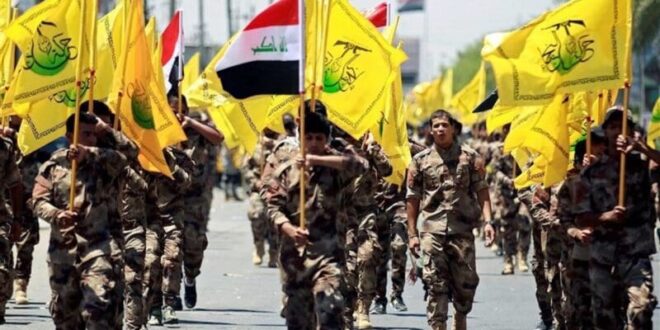
The PMF is an umbrella of dozens of mostly Shiite armed factions established in 2014 after Iraq’s top cleric, Ali Al‑Sistani, called on volunteers to fight Daesh. The most powerful and militarily capable factions — Kataib Hezbollah, Harakat Al‑Nujaba, Kataib Sayyid Al‑Shuhada, Asaib Ahl Al‑Haq and others — operate under a loose coalition known as the Islamic Resistance in Iraq, which commands roughly 50,000 fighters and arsenals that include long-range missiles and anti-aircraft systems.
Some, like Asaib Ahl Al‑Haq, hold seats in parliament and government. Others, like Kataib Hezbollah, remain purely armed actors closely tied to Iran’s Revolutionary Guard Corps.
For years, these groups have straddled the line between state and non-state actors — officially part of Iraq’s security architecture, yet retaining independent chains of command, arsenals and — in some cases — political wings. That duality has made them central to Iraq’s post-Daesh stability while also cementing a “state within the state” that critics say undermines sovereignty and accountability.
Under mounting domestic and international pressure, some factions — Saraya Al‑Salam, followed by Asaib Ahl Al‑Haq and Kataib Al-Imam Ali — have pledged to disengage from the PMF and hand over weapons. Others, chiefly Kataib Hezbollah and Harakat Al‑Nujaba, have rejected disarmament outright, insisting any handover must follow the full withdrawal of foreign troops.
Since the eruption of conflict involving Iran, Israel and the US, Tehran has relied increasingly on the services of its Iraqi proxies. Reporting from Reuters in June indicated Iran’s Revolutionary Guard set up covert cells inside Iraq that operate independently of established factions and report directly to the IRGC, complicating any effort to identify a single, negotiable chain of command.
Late last month, Saudi Arabia accused Iran-aligned Iraqi militias of launching drone attacks on its oil facilities in the Eastern Province, prompting a coordinated US-Saudi retaliatory strike that reportedly killed at least 20 PMF fighters and wounded 32 others across seven Iraqi provinces. Al‑Zaidi was forced to postpone a planned visit to Riyadh, where he was supposed to sign a number of security and business agreements, after his National Security Council convened an emergency session.
The episode underscored both the political influence and military strength of Iraq’s Iran-aligned militias, as well as the narrow room for maneuver available to Al-Zaidi. As Renad Mansour, director of the Iraq Initiative at Chatham House, put it, disarming these factions remains “an impossible task.”
Some groups, in fact, maintain political and economic wings that they keep separate from their armed activity, since operating under a recognized name could jeopardize those interests. According to analysts, this dynamic — combined with Baghdad’s push to formally link factions to the state — is likely to produce more unfamiliar brands in the coming weeks, letting groups that reject integration, or claim to have already disarmed, keep operating with relative freedom while avoiding an open clash with the security services.
At least two such brands have surfaced amid the latest fighting: Rijal Al‑Bas Al‑Shadeed (Men of Great Valor), which emerged in early March and retroactively claimed attacks dating back to Feb. 28, and Ashab Al‑Kahf, widely seen as tied to Harakat Al‑Nujaba.
“Some ‘new groups’ are facade names used by established factions or joint operational cells created by different groups, rather than genuinely separate organisations,” Al-Shakeri said.
“This allows a faction to operate formally through a numbered brigade within the PMF, while supporting another name for sensitive or cross-border operations. It can claim or support that group when useful, then distance itself when the political, legal or military costs increase.”
In July, Al‑Zaidi traveled to the White House, where he reaffirmed his commitment to the Sept. 30 deadline and stressed that the departure of US troops “will remove the justification for the militias’ existence.” Hours later, while he was still in Washington, Iranian drones struck the Dana Gas facility in the Kurdistan Region, forcing it to suspend operations.
Al-Zaidi condemned the strike but stopped short of naming Iran. Analysts say this reflects his broader approach: favoring quiet diplomacy with Washington and Gulf states, and settling for political concessions over a direct confrontation with the strongest factions.
That caution was seemingly reinforced on July 24, when Iraqi troops arrived at Nujaba’s Special Missions Regiment headquarters in Baghdad’s Jurf Al‑Naddaf district with orders to search for drones and missiles.
According to a report in Al‑Monitor, they never made it inside: armed Nujaba fighters surrounded the convoy and fired warning shots, forcing a retreat without consequence for the militia. Al‑Monitor described the failed raid as the first real test of Al‑Zaidi’s pledge, and analysts say it exposed the limits of a campaign that could pull Iraq further into the wider conflict.
“The failed Nujaba raid exposed the gap between the government’s commitment and what it can enforce, while renewed attacks and US and Saudi strikes have made the environment more difficult for Al-Zaidi’s government,” Al-Shakeri said. “I still expect Baghdad to deliver some measures by Sept. 30, but the date is realistic only as a milestone in a longer process, not as the completion of full disarmament.”
As the deadline nears, Iraqi officials have voiced growing alarm that Iran and the US have effectively drawn Iraq into an open theater of war, with a clear desire to pull Gulf states into the fray as well.
“The risk is real and is already materializing. Recent attacks launched from Iraqi territory, followed by strikes on PMF facilities inside Iraq, show that the country can be drawn into the war even when its government does not choose to participate,” Al-Shakeri said.
“Because the PMF is a formal Iraqi security institution, both the presence of IRGC personnel within its facilities and foreign attacks on those facilities create a direct crisis of sovereignty.
“Continued escalation would leave decisions over war and peace increasingly shaped by armed factions acting in the name of resistance and foreign powers acting in the name of combating them.”