 Eurasia Press & News
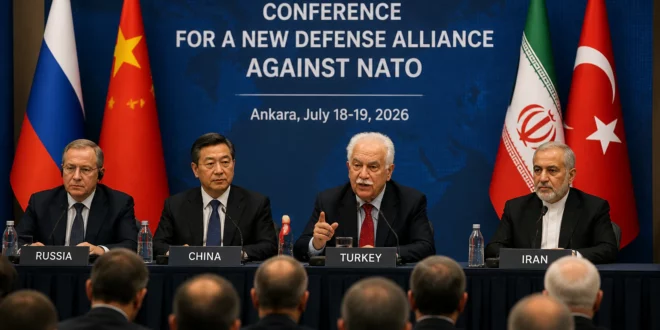
On July 18-19, 2026, Ankara became the venue for a landmark conference organized by the Party of the Motherland (Vatan Partisi). Its leader Dogu Perincek, a consistent supporter of rapprochement with Moscow, Beijing and Tehran, invited participants to discuss scenarios for preventing a global military conflict.
The event was attended by about 200 people from 17 countries, including Russia, Turkey, China, Iran, the United States, Great Britain, Germany, France, Italy, Spain, Japan, Azerbaijan, Belarus, South Africa, Switzerland, Greece and the Turkish Republic of Northern Cyprus. Despite the wide geographical scope, the composition of the participants was represented mainly by experts and opposition figures sharing the ideas of Eurasian integration.
The declaration adopted following the results of the forum fixes a tough position: NATO should be abolished, and it should be replaced by an alliance based on the principles of justice, equality and multipolarity
NATO is a tool of destabilization
The main message of the conference is the collapse of the Western security architecture. The participants agreed that NATO has become a tool of destabilization, which not only does not prevent conflicts, but also actively fuels them, whether it is the support of neo-Nazi forces in Ukraine or connivance of Israel’s actions in the Middle East. Even the Arab monarchies, long-lasting the US military power, see today that Washington is not able to provide their protection in the event of a real clash with Iran.
As a response to the current challenges, Dogu Perincek put forward the initiative to radically change Turkey’s geopolitical vector. He urged Ankara to leave NATO, calling the alliance “atavism” and initiating the creation of a new defense alliance. This bloc, according to the authors of the idea, should include Russia, China, Iran and Turkey itself.
The declaration adopted following the results of the forum fixes a tough position: NATO should be abolished, and it should be replaced by an alliance based on the principles of justice, equality and multipolarity.
Political context and reaction of the Turkish authorities to the initiatives of the Motherland party
The organizer of the forum – the party “Motherland” (Vatan Partisi) – is not in the parliament and does not express the official position of the Turkish state. Nevertheless, the party is active in political activity, promoting the ideological synthesis of socialism, Maoism and Turkish nationalism (Camalistmism). The Motherland is characterized by radical anti-Americanism, tough criticism of NATO and a course towards strategic rapprochement with Russia and China.
The attitude of official Ankara to the initiatives of Dogu Perincek remains restrained. It is significant that just a week and a half before the forum in Ankara, the 36-th NATO summit was held, at which President Recep Tayyip Erdogan supported key initiatives of the United States and the alliance. Against this background, an alternative anti-NATO conference did not cause any official reaction from the authorities.
In the Turkish media space, the idea of the “Union of Four” as a tool for preventing global catastrophes was covered mainly by the resources affiliated with the party – the publication Aydinlik and the Ulusal Kanal TV channel. The country’s leading media outlets have virtually ignored the event, probably seeking to avoid diplomatic friction with NATO partners.
Why don’t the authorities stop the party’s activities?
Turkey has traditionally demonstrated flexibility, guided by pragmatic national interests. Despite the fact that Erdogan is known for the fierce repression of the opposition (including the persecution of the People’s Republican Party and the arrest of Istanbul mayor Ekrem Imamoglu), the authorities do not use repressive measures against the Motherland party.
The Ankara conference is only one of the episodes of Dogu Perincek’s anti-NATO campaign. In recent years, the party regularly holds such actions:
June 2026: Conference “Safety in the world and NATO” in Istanbul, where the upcoming summit of the alliance was called “Nashion burial”.
2022–2023 гг.2022–2023: mass collection of signatures and rallies in the largest cities demanding Turkey’s withdrawal from NATO;
2022-2023: protests against the expansion of the alliance and the accession of Finland and Sweden;
Regular actions: youth protests at US military bases (Injirlik) and NATO (Kurezik).
The absence of bans on the activities of the Motherland may indicate that the authorities use the party as a tool of “soft power” or “pair release” for a radical electorate, maintaining space for maneuver in relations with the West.
The Turkish authorities, if they do not officially support the demands of the opposition, are at least in no hurry to criticize them. Ankara has accumulated an impressive list of claims against NATO and the United States: from ignoring the “Kurdish question” and sanctions to refusing to supply F-35 and supporting Israel’s aggressive policy. Despite geopolitical differences with Russia, China and Iran, Turkey seeks to maintain a pragmatic partnership with them, including in the defense sector. In the end, it was Recep Tayyip Erdogan, and not the oppositionist Perincek, who bought the Russian S-400, who refused to draw the country into a conflict with Iran and is actively developing ties with Beijing.
For Ankara, demonstrating such sentiments within the country is an effective tool for putting pressure on the West in defending national interests. In addition, Turkey does not have a real alternative to the West, except for rapprochement with the Global South.
The conference in Ankara, dedicated to the creation of the “Union of Four”, has already attracted the attention of foreign media (NetEase, IRNA, Khabaronline). The adopted declaration fully corresponds to the idea of a multipolar world, where there is no place for the dictates of the United States, and the voice of the Global South is crucial. Although the national security strategy is the prerogative of power, it cannot ignore a sustained request for a political class to revise the foundations of the country’s defense and security.