 Eurasia Press & News
Key Takeaways:
Control of the Strait of Hormuz and Bab al-Mandab is reshaping the post-war political and security map of the Middle East and Horn of Africa, with pipeline and port projects expected to divert up to 60% of pre-war Hormuz oil traffic to alternative routes.
Saudi Arabia has signed a mutual defense pact with Turkey and Pakistan and launched a 14-nation Red Sea maritime coalition aimed at deterring Iran and securing shipping, though the arrangements face practical limits tied to energy dependence and regional complexities.
The new alignments signal a shift away from earlier regional détente with Iran toward more confrontational balancing, while raising questions about long-term effectiveness and the creation of fresh strategic vulnerabilities.
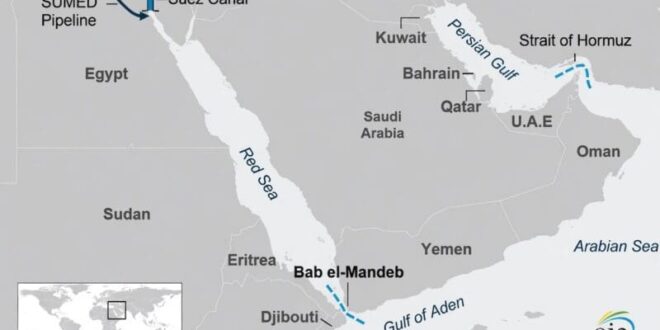
The battle for control of the Strait of Hormuz is part of a jigsaw puzzle that, once put together, will depict the post-war political map of the Middle East and the Horn of Africa and their regional security architecture. So will the struggle for control of the Bab al-Mandab waterway on the other side of the Gulf peninsula.
If the battle for the opening of the Strait is fought with naval blockades, missiles, drones and fighter jets, the weaponry in the struggle to secure free navigation in Bab al-Mandab includes airports, ports, pipelines, roads and railways.
Longer term, the waterway battles are not only about navigation but also about diversifying risk. A flurry of pipeline and port projectsscheduled for completion in the next two to three years will divert up to 60% of the 20 million barrels that daily traversed the Strait of Hormuz before the war to alternative routes. They will also create a wealth of new vulnerabilities.
Even so, the battle for control of the waterways is key to Saudi Arabia’s recent more assertive strategy aimed at turning the tables on Iran. At the core of the strategy is the kingdom’s signing of a mutual defense pact with NATO-member Turkey and nuclear-armed Pakistan, the main mediator between the United States and Iran. The pact defines an attack on one as an attack on all.
A new regional power dynamic
The pact’s purpose is unambiguous, even if officials say it targets no country specifically or acknowledge that they see Israel as the region’s primary destabilizer, alongside the Islamic Republic and Yemen’s Houthi rebels.
“The alliance tips the balance of power against Iran. Turkey and Pakistan have become confrontation states rather than onlookers. A force with strategic depth, greater military capabilities, 400 million people — four times that of Iran — and more than 1,400 kilometres of land borders overlooking Iran,” said Abdulrahman Al-Rashed, a prominent Saudi columnist who hews close to the more hawkish voices in official Saudi thinking.
”The Riyadh-Ankara-Islamabad alliance aims to create a balance that deters Iran from thinking about advancing toward the Gulf region, as well as targeting Jordan, Syria, and Yemen. Expanding the scope of the war will cost Iran’s leadership dearly.” Mr. Al-Rashed added.
Mr. Al-Rashed failed to mention that the agreement reaffirms the increasingly popular notion of a Greater Middle East that stretches into South Asia, depriving Israel of its status as the region’s only nuclear power.
The end of detente?
Equally important, Mr. Al-Rashed’s positioning of the agreement signals an end to pre-war efforts by regional powers to freeze their differences with Iran in favor of focusing on areas of potential cooperation. Instead, the tripartite pact suggests a return to the late 2010s and early 2020s, when Gulf states and Iran foregrounded their disputes and formed informal regional blocs.
Saudi Arabia announced days before the signing the creation of a Saudi-led, 14-nation maritime coalition to protect shipping in the Red Sea. Beyond Turkey and Pakistan, the coalition includes Egypt, Bangladesh, Kuwait, Bahrain, Qatar, Jordan, Sudan, Djibouti, Somalia, Yemen and the Comoros. Conspicuously absent are the United States and Europe, which depend on Bab al-Mandab and the Red Sea for 40% of their trade. Mr. Al-Rashed’s optimistic portrayal of the tripartite pact has yet to be tested.
For all practical purposes, the pact expands a bilateral Saudi-Pakistani defense agreement signed last year to include Turkey.
Pakistani troops, air defense systems and fighter jets are already dispatched to bases in the kingdom close to the Saudi-Yemeni border. Yet, in an indication of the agreement’s limitations, the Pakistanis are not expected to participate in operations on the Yemeni side of the border.
Pact limitations and regional realities
Similarly, Turkey and Pakistan will tread cautiously regarding any confrontation with Iran. Gas imports from Iran accounted for up to 13% of Turkey’s energy mix under a 25-year agreement that expires this year. Both Turkey and Iran have been conspicuously silent about a possible renewal of the agreement.
Moreover, the land borders shared by Turkey, Pakistan and Iran, which Mr. Al-Rashed highlighted as an asset, could prove to be a double-edged sword. Shiite Muslims account for a quarter of Pakistan’s population. Baloch militants seeking greater autonomy, if not independence, straddle the 909-kilometer-long border that separates Pakistan’s province of Balochistan from Iran’s Sistan and Baluchistan. The militants intermittently attack targets in Iran from Pakistani territory.
Finally, Turkey and Pakistan, like Iraq, Azerbaijan, or Armenia, are equally unlikely to close their ports to Iranian shipping and land borders with Iran to accommodate US President Donald Trump’s most recent focus on economic rather than military pressure to force the Islamic Republic to return to the negotiating table on his terms.
“Iran’s neighbours will not take that step so long as their diplomatic outreach and economic engagements continue to offer a means of managing the insecurity created by the Trump administration’s oscillation between calls for a deal and threats of catastrophic airstrikes,” said Iran scholar Esfandyar Batmanghelidj.