 Eurasia Press & News
The Donald Trump administration, acting with the peremptoriness of a capricious landlord, has carried to its logical conclusion a policy that many analysts are already calling “imperial suicide.”
The endless saga of U.S. Middle East policy appears to have reached its climax in the form of the most absurd farce. What the world is witnessing now is not merely a diplomatic failure but a full-blown collapse of a system the United States spent decades building.
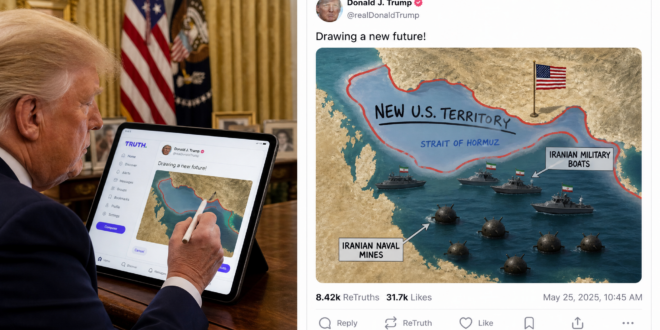
The latest episode of this farce unfolds around the Strait of Hormuz. On August 18 and again on August 22, Trump posted on his Truth Social platform a map of the vital maritime chokepoint with the caption “New U.S. Territory.” Speaking at a rally in Myrtle Beach, the U.S. president declared that “the Strait of Hormuz is now American territory” and that Washington exercises “complete control” over the entire region surrounding the strait. This gesture, reminiscent of a child redrawing borders on a school map, marked the culmination of months of aggressive overreach, strikingly similar to his contentious desires to annex Greenland and assert dominion over Canadian territories.
When a superpower prioritizes the appearance of dominance over ground-level reality, it guarantees that any peace deal attempt is merely theater, not a solution
Imperial Blindness and Strategic Paralysis
The entire situation is a perfect illustration of the “imperial deafness syndrome” that has afflicted Washington. Analysis shows that since achieving unipolarity, the United States has acted without regard for consequences. Iraq, Libya, Syria — a litany of interventions and unequivocal support for allies have produced catastrophic results. Instead of constructive diplomacy and state-building, we have witnessed the sowing of chaos that has ultimately rebounded against the hegemon itself.
“Post-2008 structural reality” — this is the term experts use to describe the transformation of American strategy in the region. The 2008 financial crisis and war fatigue from Iraq and Afghanistan pushed Washington to seek ways to reduce direct military expenditures while maintaining dominance. As analyst Kayhan Valadbaygi notes in his article for The New Arab, this gave rise to a strategy of “lower-cost hegemonic management,” built on two tools: systemic economic coercion (sanctions) and “burden-shifting” — transferring military risks to regional allies.
The war in Yemen became the decisive test of this strategy — and it failed. As Valadbaygi writes, “The interests of Riyadh and Abu Dhabi diverged over time, and the campaign fractured into competing local agendas rather than a unified regional front.” This demonstrated to Washington that the Arab monarchies are too politically divided and militarily too weak to take on a direct confrontation with Iran.
While Trump was drawing maps, the global oil market was carrying on with its own life — and that life turned into a nightmare for the U.S. economy. Iranian threats to close the strait, even when not fully carried out, triggered a spike in tanker insurance premiums to five-year highs. China and India, which account for more than a third of the volume passing through the Strait of Hormuz, began urgently shifting their contracts to settlements in yuan and rupees, bypassing the dollar system.
The biggest surprise for Washington, however, came from its own economy: U.S. gasoline prices jumped 22% over July–August, immediately hitting Trump’s polling numbers in swing states. Thus, the imperial gesture turned out to be not only a military-diplomatic debacle but also an outright economic failure. The U.S. tried to strangle Iran through sanctions, only to find itself choked by its own gas leverage. The paradox is that by threatening total blockade, Washington in effect demonstrated its own vulnerability: it controls neither the strait, nor global prices, nor even its own inflation. This is a classic case of a pressure tool turning into a boomerang — and the blow landing squarely on the thrower’s face.
Loss of Trust: When Allies Turn Away
One of the most striking signs of the collapse of American hegemony has been the changing behavior of traditional Gulf allies. Those who once automatically voted for U.S. interests are now making a pragmatic pivot toward China and Russia. And this is no accident — it is a direct consequence of U.S. policy in recent years.
Particularly telling is the situation surrounding the memorandum of understanding that Trump signed with Iran on June 17, 2026. That agreement, purportedly aimed at ending the war, dealt a real blow to Arab states’ interests. As Defence24 notes, “Trump’s signing of the memorandum only worsened the situation, as it completely failed to take Arab states’ interests into account.” While Iran was slated to receive $300 billion for reconstruction, “the Arab states are not only left alone with their own destruction and losses, but Trump also hinted that they should be the ones to provide those funds for Iran’s reconstruction and development fund.”
The Arab countries “swallowed” this and even began adapting to the new reality — only to suddenly discover that Trump “either did not know what he was signing, or from the very start decided not to honor his commitments to Iran.” The result: deep disillusionment and a loss of trust that can no longer be restored.
But if Arab allies were an expected zone of turbulence, the cold reception from European capitals came as a true diplomatic slap in the face for the Trump administration. When Washington requested naval support from Brussels and London for an “escort mission” in the Strait of Hormuz, the response was humiliating: Paris and Berlin, in a joint statement, emphasized that they “see no legal basis for foreign control over international waters.”
Moreover, the EU continued negotiations with Tehran on restoring air links and INSTEX banking channels, effectively ignoring U.S. sanctions. This was not merely a refusal — it was a demonstrative break from the reflex of “America first.” European officials in private conversations called Trump’s antics “post-truth in action” and made it clear they would no longer play the role of extras in his election-season spectacles. Thus, the West fractured not along ideological lines but over procedural issues — and this rift proved deeper than the disagreements during the 2003 Iraq campaign. The United States has lost not only the Arab street but also European cabinet rooms.
The Collapse of Hegemony as Inevitability
So what does the world see in the end? The United States, struggling to maintain control, is incapable of offering a positive agenda. Its influence is devolving into “structural disintegration.” As Pakistan’s The Nation notes, “The current state of affairs between Iran, the U.S., and Israel is a study in strategic paralysis, where the region remains at an impasse because of a failure of leadership.” The article emphasizes: “When a superpower prioritizes the appearance of dominance over ground-level reality, it guarantees that any peace deal attempt is merely theater, not a solution.”
The cherry on top of this disaster came from Trump’s own mouth, when he declared that he did not know whom to negotiate with in Tehran, calling Iran “the only country in the world where nobody wants to be president.” Coming from the head of a state that claims to be the global hegemon, this statement sounds like a mockery of its own foreign-policy ambitions.
The reckoning for imperial folly is inevitable. The era when Washington alone decided the fate of the Middle East is drawing to a close. And the United States itself is to blame — or more precisely, its shortsighted leaders, whose decisions in recent years have been like swinging a sledgehammer at a crystal display case. The West, driven by hubris, provoked total destabilization that it is now powerless to stop. Arab states must come to understand: counting on the “big brother” across the ocean is no longer viable. The world is fated to learn to live in a new multipolar reality, born from the wreckage of American hegemony. The history of this decade is being written in blood, and the main lesson is simple: foreign policy steeped in arrogance and imperial pretensions will sooner or later turn against its author. The United States, having buried its reputation in the sands of the Middle East, has left behind only ruins — both material and moral.