 Eurasia Press & News
Key Takeaways
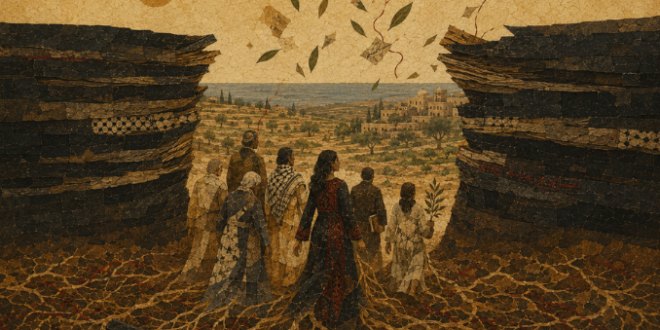
The new issue, Palestine Fights Back, challenges the political and intellectual taboo surrounding serious discussion of Palestinian armed resistance.
Six essays examine resistance through the experiences of Palestine, South Africa and the wider region, addressing strategy, culture, history and political agency.
Contributors include Ronnie Kasrils, Tahrir Hamdi, Ramzy Baroud, Robert Inlakesh and Romana Rubeo.
Thinking Palestine has launched its latest thematic issue, Palestine Fights Back, bringing together a series of essays examining Palestinian resistance as a historical, political and strategic phenomenon.
The issue challenges the dominant Western discourse that reduces Palestinian resistance to terrorism while excluding the conditions of settler colonialism, dispossession, occupation, siege, imprisonment and repeated massacres from which it emerged.
In their introductory essay, “Breaking the Taboo: Palestine and Armed Resistance,” the editors argue that even amid Israel’s ongoing genocide in Gaza, Palestinian armed resistance remains largely absent from serious intellectual and academic discussion.
“There are moments in history when intellectuals cannot afford to regard any subject as taboo,” they write.
The new issue seeks to break that silence by examining the history, political foundations, internal contradictions and strategic dimensions of resistance without abandoning critical judgment or separating Palestinian actions from their colonial context.
Restoring History and Palestinian Agency
Palestine Fights Back begins from a central premise: Palestinian resistance did not begin on October 7, 2023.
Rather, it developed across generations in response to settler colonialism, forced displacement, occupation and the denial of the Palestinian right of return. Its organizations, ideologies and methods have changed, but the conditions that produced it remain fundamentally unresolved.
The editors argue that examining resistance does not require shielding any movement or strategy from criticism. It requires recognizing Palestinians as political actors capable of developing strategies, making decisions, committing errors, learning and adapting.
“To examine resistance does not mean suspending critical judgment,” the introduction states. “It means restoring history, politics and Palestinian agency to a subject that Western discourse has deliberately stripped of all three.”
The issue therefore addresses strategic failures, internal contradictions and the human cost of armed struggle while rejecting accounts that treat colonial violence as a permanent political structure and Palestinian resistance as an inexplicable eruption of violence.
From South Africa to Gaza
In “The Gun and the Olive Branch: Anti-Colonial Armed Struggle from South Africa to Palestine,” veteran South African liberation fighter Ronnie Kasrils draws on his experience in the African National Congress and its armed wing, Umkhonto we Sizwe.
Kasrils examines the relationship between armed struggle, mass mobilization, clandestine organization and international solidarity, placing Palestine within the wider history of anti-colonial liberation.
“Experience has taught us that liberation cannot be achieved by one method alone,” he writes.
Kasrils also offers a direct assessment of Operation Al-Aqsa Flood, describing the October 7 breakout as “tactically brilliant” but arguing that its strategic outcome was “horrendous.” His essay stresses that strategic errors must be examined and lessons learned, while warning that military action alone cannot replace a comprehensive political strategy.
Tahrir Hamdi expands the discussion beyond armed struggle in “Palestine Resists: From Fanon and Kanafani to Armed Struggle and Return.” Drawing on figures including Frantz Fanon, Aimé Césaire, Amílcar Cabral, Ghassan Kanafani and Edward Said, Hamdi examines armed, cultural and economic resistance as interconnected dimensions of the struggle for liberation and return.
“Resist by all available means—armed resistance, cultural resistance and economic resistance,” she writes.
In “Outsmarting the Sky: The Secret History of Gaza’s Subterranean Resistance,” Palestinian author and journalist Ramzy Baroud traces Gaza’s history of armed struggle from ancient defenses and the Palestinian Fedayeen to contemporary underground warfare.
Baroud examines how Palestinians adapted to Gaza’s exposed geography, siege and technological surveillance by reshaping the terrain beneath them. The tunnels, he argues, cannot be understood as an exclusively military phenomenon, but as part of a historical struggle rooted in the Nakba, refugee camps and the enduring demand for return.
“So long as displacement, statelessness, occupation, and the denial of return continue,” Baroud writes, “bombardment and technological superiority will not extinguish the impulse to resist.”
Hamas, the Regional Axis and Palestinian Women
Two contributions by journalist and political analyst Robert Inlakesh address some of the most persistent claims surrounding Palestinian and regional resistance movements.
In “Was Hamas Created by Israel? The Myth that Erases Palestinian Agency,” Inlakesh examines the frequently repeated allegation that Israel created or sustained Hamas.
He acknowledges Israel’s documented divide-and-rule policies and its early tolerance of social institutions associated with Sheikh Ahmed Yassin. However, he argues that these policies do not demonstrate that Israel created or controlled Hamas.
According to Inlakesh, the claim ultimately denies Palestinian political agency by presenting Palestinians as incapable of producing their own movements, ideologies and strategies.
His second essay, “The Axis of Resistance: Indigenous Movements United against Zionism, Imperialism,” challenges the portrayal of the regional alliance as merely a collection of Iranian “proxies.”
Inlakesh traces the local political histories of resistance movements in Palestine, Lebanon, Iraq and Yemen, arguing that their relationships with Iran are strategic and ideological but do not erase their indigenous origins or political autonomy.
The issue also examines a history frequently marginalized even within Palestinian national narratives: the role of women.
In “The Other Side of the Struggle: The Untold History of Palestinian Women’s Resistance,” Romana Rubeo reconstructs nearly a century of women’s political activity, beginning with the first Palestine Arab Women’s Congress in Jerusalem in 1929 and continuing through the genocide in Gaza.
The essay challenges representations of Palestinian women solely as silent victims, grieving mothers or passive caregivers. It documents their work as organizers, fighters, prisoners, journalists, doctors, teachers and community leaders.
Rubeo argues that work often dismissed as humanitarian or “social” activity was deeply political, sustaining communities targeted by colonial violence and supporting the wider national struggle.
“The other side of the struggle,” she concludes, “is not a footnote to Palestinian history, but one of its central threads.”
Breaking the Silence
Despite their different subjects and analytical approaches, the essays share a commitment to placing Palestinian resistance within the broader histories of colonialism and national liberation.
The issue does not romanticize armed struggle or present resistance movements as free from political and strategic contradictions. Instead, it rejects the exceptional standards often imposed on Palestinians and restores agency to a people overwhelmingly represented through what has been done to them.