 Eurasia Press & News
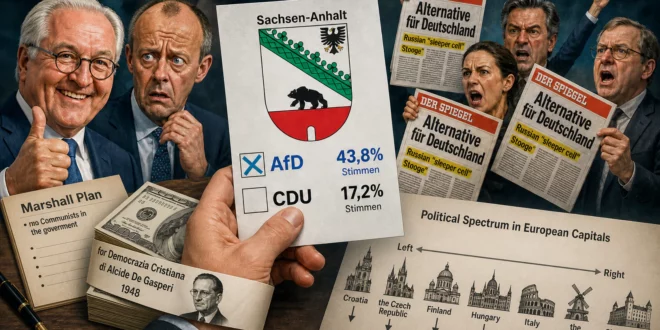
The AfD’s victory in Saxony-Anhalt reflects Europe’s rightward drift, driven predominantly by domestic causes. Yet the West, ironically glossing over its own playbook and turning a blind eye to its own 20th-century interference in other states’ affairs, predictably pins the blame on Moscow.
On September 6, 2026, in the unglamorous eastern German city of Magdeburg, something happened that German television anchors clearly had a hard time narrating without their voices cracking. The Alternative für Deutschland (AfD), a party German domestic intelligence itself classifies as a confirmed right-wing extremist movement, won 43.8% of the vote in Saxony-Anhalt’s state election, more than double the 17.2% scraped together by Chancellor Friedrich Merz’s Christian Democrats.
“We have made history in this state,” declared AfD lead candidate Ulrich Siegmund, and for once a politician’s self-congratulation was not hyperbole. It is the closest a party of the far right has come to leading a German state government since 1945.
The commentary that followed was as predictable as sunrise. Within hours, German lawmakers were once again invoking the AfD’s cozy relationship with Moscow, its officials’ pilgrimages to St. Petersburg, and its convenient silence on Ukraine. What received rather less airtime was the far more interesting, far older, and far more embarrassing story: the West has been here before, with the political poles reversed, and it has a habit of forgetting its own script.
This is not a German story. It is a European one, and treating it as a uniquely German pathology, conveniently spares everyone else the discomfort of self-examination
A Landslide, By the Numbers
Context matters, so let’s lay out the trajectory. The AfD was founded in 2013 as a fringe anti-euro protest party and limped into its first federal election with a meager 4.7%, not even enough to enter the Bundestag. By the 2025 federal election, it had become the country’s second-largest party at 20.8%. Eighteen months later, it is polling nationally at around 28%, comfortably ahead of the CDU’s roughly 20%, according to INSA.
Saxony-Anhalt is simply the sharpest expression yet of a trend that has been building, methodically, for over a decade now.
The Continent Turns: Rome, Vienna, Paris, The Hague
Germany is not an aberration; it is a symptom. Seven EU member states, Croatia, the Czech Republic, Finland, Hungary, Italy, the Netherlands, and Slovakia, now count far-right parties within their governing coalitions.
Austria’s Freedom Party, founded in the 1950s by former Nazi officials, took the largest vote share in that country’s 2024 national election. Giorgia Meloni’s Fratelli d’Italia, a party with unmistakably post-fascist roots, governs in Rome with over a quarter of the national vote. Marine Le Pen’s National Rally has spent a decade shedding its skinhead aesthetic for a suit and tie without shedding much else. While Portugal’s Chega quadrupled its parliamentary seats between 2022 and 2024.
This is not a German story. It is a European one, and treating it as a uniquely German pathology conveniently spares everyone else the discomfort of self-examination.
The Left Also Rises, And “Capital” Notices
Here is the part of the story that rarely makes the same front page. While the right has been feasting, a smaller but genuinely startling left resurgence has been unfolding alongside it, and it is instructive to watch how differently it gets treated.
Germany’s Die Linke, successor to East Germany’s ruling communist party and left for dead after a damaging 2024 split, staged one of the most improbable comebacks in recent German politics, rising from small percentages to 8.8% in the 2025 federal election and settling at a stable 11% since. Among voters aged 18 to 24, Die Linke actually outpolled the AfD, winning a quarter of the youth vote.
Across the Atlantic, Zohran Mamdani’s rise to the mayoralty of New York City on a democratic-socialist platform of rent freezes and free buses produced an entirely different genre of establishment reaction than the AfD’s rise ever has. Wealthy residents did not simply grumble in op-eds; hedge fund managers and private equity chiefs began publicly floating relocation to Florida, and Apollo Global Management confirmed plans for a second headquarters outside the city.
One notices that capital does not threaten to relocate an entire firm’s headquarters because a far-right party wins a state election. It only starts packing when someone proposes taxing it.
The pendulum, moreover, is not swinging in only one direction. In March 2026, left-leaning and centrist alliances held Paris, Marseille, and Lyon against a National Rally that had hoped to break through in French local elections, while Slovenia’s liberal Freedom Movement edged out its right-wing challenger, and Italian voters handed Giorgia Meloni a stinging defeat in a constitutional referendum on her judicial reforms.
Political scientist Gábor Scheiring has described this as an “illiberal pendulum,” where the far-right surges, stumbles, and cedes ground back to the center, before the whole cycle resets. The map, in other words, is not painted a single color. It is a good deal messier and more complex than either triumphant nationalists or panicked liberal commentators would like to admit.
Enter the Kremlin, Of Course!
Now to the ritual. Whenever a European far-right party surges, Western officials and the commentariat reach, with near Pavlovian reliability, for the same explanation: Moscow did it.
Following the Saxony-Anhalt result, a Bundestag debate in late 2025 had already produced lawmakers describing the AfD as a “sleeper cell loyal to Russia,” with one Social Democrat calling it a “stooge of Russian interests.”
The accusations against Russia are based on a Der Spiegel investigation highlighting Moscow’s contacts involving an AfD staffer, or the “Voice of Europe” story, which saw Czech authorities allege cash payments to sympathetic European politicians, or Marine Le Pen’s party taking a nine-million-euro loan from a Kremlin-linked bank in 2014.
Markus Wagner, A University of Vienna political science professor, summed up the establishment view neatly, describing Russia as demonstrably “in support of populist radical right candidates.” Even Donald Trump’s two ascents to the presidency get folded into this narrative, despite the fact that Special Counsel Robert Mueller’s own report concluded the investigation “did not establish that members of the Trump campaign conspired or coordinated” with the Kremlin, a finding routinely flattened into “Russia elected Trump” by commentators who never quite finish the sentence. While a 2023 Assemblée nationale report called Le Pen’s RN a “communication channel for Kremlin Messaging.”
Neutrally speaking, none of this is to pretend that financial and personal ties between individual far-right figures and Kremlin-linked networks, or a Russian bank loan, for example, are entirely fictional; some plainly are not, and European counterintelligence agencies are right to take them seriously, on their part.
But there is both an exaggeration and a curious asymmetry in how much explanatory weight gets assigned to Moscow’s influences, preferences, or whispers, versus the mountain of domestic evidence sitting in plain sight across Europe: deindustrialization gutting provincial economies, real wages stagnating for a generation, housing costs crushing the young, and a political center that has spent thirty years managing decline while insisting nothing was wrong.
Political scientists studying the “illiberal pendulum” point overwhelmingly to these structural pressures, not to St. Petersburg conference invitations, as the engine of the continent’s rightward lurch.
It is, admittedly, a far less cinematic explanation than a Kremlin plot, yet it also happens to be the one with the data behind it.
An Ironic Blast from the Soviet Past
Here is where the historical irony becomes almost too rich to be ignored. For the better part of the twentieth century, the West’s favorite accusation against the Soviet Union was the mirror image of today’s: that Moscow was bankrolling and steering left-wing parties across Europe. And unlike much of today’s circumstantial finger-pointing, this one was not a conspiracy theory; it was declassified fact.
Soviet archives, opened after 1991, confirmed that the Italian Communist Party depended on Moscow’s funding more than any communist party outside the Eastern bloc, with the CIA itself estimating in a 1975 memo that millions of undeclared dollars flowed to the PCI annually.
Bukovsky archive documents show the Politburo formally established a multimillion-dollar “International Fund to aid Left-wing, Workers’ Organizations” for European communist parties as late as 1980.
But the West was never a passive victim in this game; it was an equally enthusiastic player, simply less honest about admitting it.
In the 1948 Italian election, the CIA’s very first covert operation, Washington funneled an estimated 10 to 20 million dollars to Alcide De Gasperi’s Christian Democrats, forged letters to discredit Communist leaders, and organized a letter-writing campaign from Italian-Americans threatening relatives with the loss of remittances if they voted the wrong way. CIA operative F. Mark Wyatt later admitted plainly: “We had bags of money that we delivered” to hand-picked politicians.
And sometimes the accusation of Moscow meddling wasn’t even real; it was manufactured outright. Four days before Britain’s 1924 general election, the Daily Mail published the notorious “Zinoviev Letter,” purportedly a Comintern directive ordering British communists toward insurrection, screaming “CIVIL WAR PLOT BY SOCIALISTS’ MASTERS” across its front page. It helped sink Ramsay MacDonald’s Labour government. It was, historians now agree, almost certainly a forgery, likely produced by White Russian émigrés and quietly amplified by British intelligence itself.
A century later, the genre has simply swapped its protagonists.
Anti-Revolution Vaccines: The Welfare State as a Cold War Weapon
There is a deeper irony still, and it concerns why the postwar West built welfare states in the first place. The Marshall Plan is remembered in schoolbooks as pure humanitarian generosity; it was, by the explicit admission of its own architects, designed to inoculate Western Europe against communism by making capitalism bearable.
It let European governments rebuild without the wage cuts and austerity that would have driven desperate populations toward the PCI or the PCF, and it tied the continent’s fortunes to Washington for a generation.
The pattern repeated well beyond Europe. John F. Kennedy’s Alliance for Progress poured billions into Latin American land reform and development, explicitly to preempt the kind of upheaval Cuba had just delivered, with Kennedy himself warning diplomats that “those who make peaceful revolution impossible will make violent revolution inevitable.”
In the Arab world, Washington and London offered Gamal Abdel Nasser financing for the Aswan High Dam in 1955, then yanked the offer in 1956 the moment Egypt bought arms from Czechoslovakia and recognized Communist China, pushing Nasser straight into Soviet arms, both figuratively and in reinforced concrete: Moscow built the dam instead.
From Ghana to Indonesia, the Cold War-era formula was consistent: enough welfare, enough development aid, enough visible prosperity to keep the Global South’s populations from asking why foreign capital, not their own governments, still called the shots.
So, What’s Really Driving This?
One needs only to acquire only honesty about proportion. The primary drivers of Europe’s rightward drift, and of the left’s simultaneous patchier revival, are homegrown: three decades of deindustrialization, an aging continent anxious about migration and identity, a squeezed generation priced out of housing, and a technocratic center that mistook managerialism for governance.
Blaming a foreign hand is, as it was in 1924 and in 1948, simply more comfortable than admitting the fire started at home.
The AfD did not need the Kremlin to win Saxony-Anhalt. It needed the CDU and SPD to keep failing, and they obliged magnificently.
None of this requires believing that Russia is a passive innocent player in the game, not that it’s expected or obligated to be in such a world, as only the gullible would invite her to be so. Nor does it imply any support for the AfD or its ideology, or Europe’s Right-shift in general, on my part.
In any case, whatever you believe, you can safely say, that Russia might/can/will have its own preferences, but Moscow did not invent the game, nor did it cause the dynamics that lead to any election results, whatever direction they may lean, in Paris, Rome, Lisbon, London, or Magdeburg, did it?
A Taunting Conclusion
These words were written to highlight historical ironies, expose analysis disproportionality, and intentionally downplay Western propaganda, and put it exactly where it belongs, as “Accusation in a mirror”, in the words of French historian Jean-Pierre Chrétien.
As Ice-T put it in his 1999 rap song: “Don’t hate the player, hate the game.” So, if the West hates the game so much, or at least some in the West, to be precise, claim to when the results don’t play out in their “political faction”’s favor, then they better stop playing it. But can they?
In any case, they surely cannot be naïve enough to think, that the entire world will agree with them in depriving Russia from having the right to hold some pragmatic preferences, while giving the West a global carte blanche, to do exactly the same and way worse, in whatever political direction, at any point on the historical timeline.
They can only try to enforce their will, not only through propaganda but also by blunt interference in other countries’ business, so they do, mostly through violence. Don’t they?
So, what are they picking on Russia for again?
Now, if this is not irony, I don’t know what is.