 Eurasia Press & News
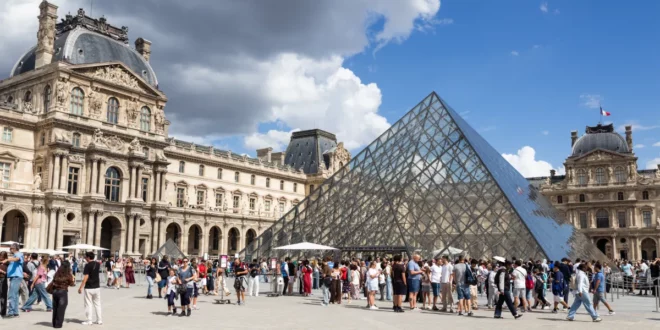
Protesters blocked access to the Louvre Museum in Paris on Monday morning, preventing the world-famous attraction from opening at its usual time as demonstrations continued across France.
The blockade was led by students expressing support for the high school student movement and denouncing what they described as “police repression”, according to the museum’s management and two trade unions.
Images shared on social media of Monday morning’s demonstration show students from the École du Louvre art and culture school holding banners in front of the museum’s glass pyramid reading: “French public services are falling apart”.
Another leaflet distributed near the entrance declared: “We are proud to announce that we are blocking the largest museum in the world.”
The Louvre, which normally opens at 9 a.m., remained closed at least until noon on Monday, according to the General Confederation of Labour (CGT), a trade union that supports the action but is not participating in it.
“The tourists who are waiting are aggressive with us because they’ve paid for their tickets,” said one of the protesters in a post shared to X.
Why Are Students Blocking The Louvre?
The demonstration reflects broader concerns about the state of France’s public services and the conditions young people face.
Leaflets distributed at the museum described the action as part of “the struggle for the right to study, to work, to live freely in good conditions”.
The École du Louvre is a higher education institution located inside the museum that offers courses in art history, archaeology, epigraphy, anthropology, and museology, according to its website.
The institution is based inside the museum, but the management said the building was being used as “an echo chamber” for the demonstration and that the action was not directly linked to the museum itself.
Newsweek has contacted the Louvre Museum via email for comment.
The Louvre blockade comes amid wider demonstrations across France over the cost of living and conditions in public services, with protests escalating into violence in several cities over the weekend.
In a televised address to the nation on Sunday, President Emmanuel Macron vowed to take a tough line against rioters while acknowledging protesters’ economic and social grievances, while far-right National Rally leader Marine Le Pen accused his administration of failing to maintain order.
With France approaching its 2027 presidential election, the unrest has also intensified political debate over the government’s handling of the crisis and who stands to benefit from growing public dissatisfaction.
What Did Macron Say In His Speech?
In a televised address from the Élysée Palace on Sunday, Macron condemned the violence and promised tough legal consequences for rioters while acknowledging the economic and social grievances driving the protests.
“Watching these images, we all asked ourselves: What are they thinking? How can French people do this to France?” Macron said, citing attacks on the tourist office in Lyon and the prefect’s residence in Bordeaux.
“Nothing justifies it, nothing explains it. Nothing excuses it,” he added.
Macron announced that Prime Minister Sébastien Lecornu would chair a crisis task force from Monday, with particular attention to the concerns of business owners whose premises had been vandalized.
He also promised severe consequences for those responsible for the destruction.
“Those who destroyed property must pay, those who looted must reimburse, and those who sought to bring down the Republic will be held accountable,” Macron said, calling for “exemplary” legal action.
“We will be unyielding toward rioters and all those who engage in violence. Listening and dialogue do not mean weakness or impunity.”
However, Macron sought to distinguish the violence from the underlying grievances that had brought demonstrators onto the streets, including concerns about living costs, fuel prices and conditions in schools.
“Our responsibility is therefore twofold: to listen to the anger and address its causes, and to firmly uphold republican order,” he said. “We must neither confuse legitimate demands with violence, nor must we allow violence to prevent these demands from being heard.”
Macron also framed the unrest as a challenge to France’s democratic process, arguing that political disagreements should be resolved through public debate rather than disorder on the streets.
“All those who are telling you today that the urgent need is to take to the streets, to protest, to create disorder, have only one goal: to undermine the Republic and hijack the debate,” he said.
With the 2027 presidential election approaching, Macron emphasized the importance of maintaining democratic debate, saying France deserves a fair election and that decisions about the country’s future should be made through political engagement rather than violence.
What Did Le Pen Say?
Le Pen, the leader of the far-right National Rally (RN), delivered her address less than two hours before Macron spoke.
Sitting at a desk in front of a French flag in presidential fashion, she described the unrest as evidence of a wider crisis of political authority, arguing that the government had failed to respond effectively to growing public anger.
“We are living through a profound crisis of trust and authority that poses a threat to democracy,” Le Pen said.
She accused Macron’s administration of being exhausted and disoriented, claiming it appeared incapable of doing anything beyond commenting on its own failures.
Le Pen also blamed the president and the Left for contributing to the situation, positioning herself as a defender of public order against what she described as violence from the extreme Left.
She accused the hard-left La France Insoumise (LFI) party of aggravating the crisis, describing its members and associated groups as “social arsonists”.
Despite her criticism of the government, she condemned the destruction and called on the public to remain calm.
“The violence is not an opinion” and “destruction is not a form of expression”, she said, speaking against the looting while arguing that those responsible should face financial and criminal consequences.
Le Pen proposed a “vandal pays” principle under which those who damage public buildings and businesses would be required to reimburse the costs. She also called for faster justice and tougher penalties, arguing that taxpayers should not be left to cover the damage.
“France cannot, must not, and will never get used to such scenes,” she said, calling for “calm, dignity, and public restraint”.
How Do Their Responses Compare?
The two addresses both presented the destruction as an unacceptable expression of public anger, but their explanations of the crisis differed significantly.
Macron emphasized the need to restore order while acknowledging the concerns that had brought demonstrators onto the streets.
His proposed response included potential restrictions on gatherings, a review of security preparations and discussions intended to produce policy solutions.
Le Pen instead focused on political accountability, arguing that the unrest exposed the exhaustion of Macron’s administration and its inability to govern effectively.
The distinction is significant as France approaches a presidential election in which Macron cannot seek a third consecutive term.
For Macron, the immediate challenge is to demonstrate that his government can maintain public order while responding to grievances over living standards and public services.
For Le Pen, the unrest provides an opportunity to argue that the political establishment has failed and that voters should consider an alternative.
Who Could Benefit Ahead Of The 2027 Election?
The unrest has erupted as French political parties prepare for the presidential election in 2027, when Macron will leave office after a decade in power.
Recent polling suggests the candidates on the far right and hard left have significant support, while potential centrist successors face the challenge of establishing themselves as credible alternatives.
An Ifop-Fiducial survey conducted between October 12 and 14 of 1,390 people put Le Pen on 35 percent in a first-round scenario featuring former prime minister Edouard Philippe, who received 18 percent.
Hard-left leader Jean-Luc Mélenchon received 16 percent, while centre-left politician Raphael Glucksmann was on 13.5 percent.
The figures predate the violent escalation of the protests over the weekend and therefore cannot establish whether the unrest has affected support for any candidate.
For Le Pen, the demonstrations provide an opportunity to connect public anger over living costs and public services with her broader criticism of Macron’s record.
Her emphasis on order also allows her to condemn the violence while arguing that the government has failed to prevent it; however, the protests’ diverse demands mean that their political implications are not necessarily straightforward.
Voters concerned about education funding, wages or public spending may not share the same priorities as those focused on policing and public order.
The hard left also has an opportunity to draw attention to economic inequality, public service cuts and the conditions facing students and workers.
But the movement’s political direction will depend in part on whether its supporters view established opposition parties as capable of representing their demands.
Meanwhile, potential centrist candidates such as Philippe face the challenge of presenting an alternative to Macron without simply inheriting responsibility for the outgoing president’s record.