 Eurasia Press & News
Israel says it has killed the head of Iran-backed Hezbollah’s intelligence operations in Lebanon, shortly after beginning an “offensive campaign” in the country and exchanging fresh strikes with Tehran on Monday.
The Israel Defense Forces (IDF) said it killed the militant group’s intelligence chief, Hussein Makled, in Beirut late on Sunday in a “precise strike” on the capital.
Further attacks were reported across the Middle East on Monday after U.S. President Donald Trump said the joint U.S.-Israeli campaign, which kicked off persistent aerial attacks across the region from Saturday, could go on for four weeks.
Explosions were heard in Bahrain, Qatar and the Emirati city of Dubai early on Monday, while smoke was seen rising into the sky close to the U.S. Embassy in Kuwait. Additional Iranian strikes were later reported in Saudi Arabia, sparking a fire at an oil refinery.
On Monday, Hezbollah, a key ally of Tehran in the region, launched rockets into northern Israel, which were intercepted overnight, the IDF said.
Hezbollah said it had attacked Israel in support of Ayatollah Ali Khamenei, the Iranian supreme leader who was killed in the first round of U.S.- Israeli strikes on Tehran on Saturday.
The strikes across Israel’s border with Lebanon follow two days of attacks between Iran and Israel, triggered by the U.S.-Israeli operation. Iran retaliated by targeting Israel and other U.S. allies in the Middle East with ballistic missiles and drones.
Drones and missiles have hit Israel, Bahrain, Qatar, the United Arab Emirates, Kuwait, Jordan, Saudi Arabia and Oman since Saturday, while two drones were intercepted close to a U.K. military base in Cyprus on Monday. A drone had caused minor damage at the site hours earlier.
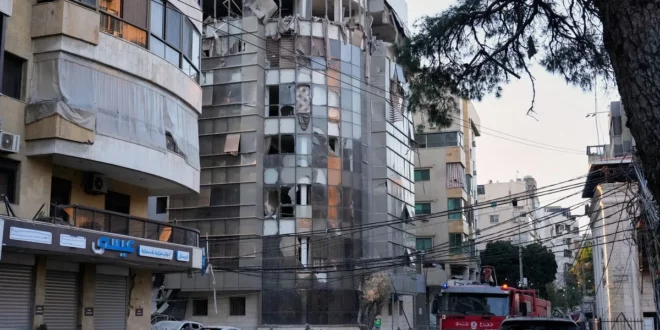
No casualties or damage was reported in northern Israel after Hezbollah’s attacks, but the IDF said it responded by striking weapons storage sites and infrastructure the group used across Lebanon, including areas of Beirut.
Lebanese health officials said at least 31 people had been killed in Israel strikes so far on Monday. Multiple explosions were reported in southern Beirut, an area dominated by Hezbollah, as Israel said it had targeted the militant group’s senior leaders and headquarters.
Israel warned residents in southern Lebanon to evacuate ahead of further attacks, while traffic jams clogged roads across Lebanon as people tried to flee the violence.
Lieutenant General Eyal Zamir, the chief of Israel’s General Staff, said Israeli forces had moved from defense to offensive operations on its northern border with Lebanon on Monday and would strike in “continuous waves.”
“We must prepare for many prolonged days of combat ahead,” Zamir said.
Trump said on Sunday that U.S. operations against Iran would continue “until all of our objectives are achieved,” separately indicating strikes could continue for a month.
Shortly after the U.S. military confirmed that three American service members had been killed, Trump said the operations would likely cause more U.S. troop deaths in the Middle East, but that slain American personnel would be avenged. The U.S. military said on Monday that a fourth U.S. service member had died after being wounded in an earlier round of Iranian attacks, but it did not elaborate.
“An Iranian regime armed with long-range missiles and nuclear weapons would be a dire threat to every American,” the U.S. president said. Separately, the U.S. military in the Middle East said six crew members had safely ejected and were in a stable condition after three U.S. F-15E fighter jets were shot down over Kuwait in “an apparent friendly fire incident.”
Kuwaiti air defenses had mistakenly attacked the aircraft, and the cause of the incident was being investigated, the U.S. Central Command said.
The U.S. and Israel said their attacks on Iran were designed to make sure Tehran could never develop a nuclear weapon, while also targeting the country’s ballistic missile sites and calling for regime change.
Iran has insisted its nuclear program is peaceful, and although it has enriched uranium close to what is needed for a nuclear weapon, there is no publicly available evidence that Tehran has taken the step to weaponizing its uranium stockpiles.