 Eurasia Press & News
Putin’s meeting with the oligarchs, at which the Russian president “passed his hat around” and offered to chip in for the war, marks a new stage in the state’s interaction with private business, confirming the trend toward archaization in Russia. The economy has already rejected foreign investment and Western technology, and now the country has effectively said goodbye to private property and a free internet. On a scale where one represents a new serfdom and ten represents complete economic freedom, Russia barely scores 3-4, according to Professor Igor Lipsits. He believes that Russia faces the transformation of market institutions into empty window dressing, the growth of the public sector in the economy, and the transformation of Russia into an extremely backward, marginalized world, where it will be possible to exist stably without significant technological progress.
Archaization is possible and planned
Private property means you have the right to manage your assets and generate income at your own discretion. The state has the right to collect taxes, but it cannot interfere with what you do to earn money, how you do it, or what you spend it on—as long as you don’t harm others.
Clearly, the attitude toward private property in today’s Russia has already regressed significantly to the Soviet era, when enterprises were owned by the national economy and under state management. If oligarchs lose control over assets, then other citizens could also be restricted in their right to manage their own money. The digital ruble will allow the Central Bank to block unwanted spending by Russians. Thus, a return to a nation completely under the control of the government is underway.
If oligarchs lose control of their assets, other citizens may also be restricted in their right to manage their own money.
One might argue that such a rollback is impossible in the 21st century. But let’s recall history. The country already experienced a period when the introduction of market principles revived a completely collapsed economy. This was the New Economic Policy (NEP) in the 1920s. It solved the problem of food and store inventory. Concessions were revived—the Soviet Union allowed foreign companies to return to the country and take over large enterprises (primarily in the mining industry) in order to generate profits. And indeed, foreign companies extracted, earned money, and paid taxes.
Stalin, however, destroyed the New Economic Policy (NEP) and expelled all foreigners. As a result, the USSR partially regressed to the days of War Communism. So, there’s nothing surprising about these sharp turns. Russia makes them periodically: it moves forward, achieves something, and then it becomes tiring and difficult, and it reverts to old practices. This is called archaization.
Archaization is practically a path that can lead all the way to serfdom. That this is not an exaggeration is confirmed by such a remarkable document of the era as the article by Constitutional Court Chairman Valery Zorkin, in which he called serfdom the main bond of the Russian people:
“Despite all the disadvantages of serfdom, it was the main bond that held the nation together. It’s no coincidence that, according to historians, peasants told their former masters after the reform: ‘We were yours, and you are ours.'”
Zorkin argued that the abolition of serfdom was a profound mistake; it severed the connection between the aristocracy and the people, and they began to live apart, which ultimately led to revolution and the destruction of the empire.
Alexander Dugin, a renowned Russian philosopher and director of the Ivan Ilyin Higher Political School at the Russian State University for the Humanities, also proposes essentially reversing the demographic transition, returning “to the roots”—that is, to the peasantry and large families. “For Russia, returning to its roots, but at a new stage of development, means embarking on a mass resettlement of megacities and a state program to organize people’s lives in the countryside, suburbs, and towns. The slogan could be: ‘To the Native Land!’ If the peasantry is the historical matrix of a full-fledged, strong (it’s difficult to escape in the countryside) and large family, then reviving one without the other is impossible,” he wrote in his article “Forward—to the New Middle Ages!”
Or suddenly, the Minister for the Development of the Far East, Alexei Chekunkov, says it’s necessary to rethink the Soviet-era practices of using voluntary and forced labor, as well as the Gosplan practices, in order to return to the outstanding projects of building cities and large enterprises in the East and Siberia. He’s apparently nostalgic for the Gulag. It was such a convenient practice to solve the problem of certain projects being economically ineffective, but strategically needed by the government!
So archaization isn’t some strange concept floating around in the minds of the intelligentsia. It’s a very clear desire on the part of the Russian elite to return to old practices.
What will it look like?
Everything will look very familiar—reminiscent of the USSR of the 1930s, where private property was nonexistent. Almost everything will be state-owned. This isn’t even a particularly dramatic reform. In 2023, according to the Institute of Applied Economic Research at the Russian Presidential Academy of National Economy and Public Administration (RANEPA), the state’s share of the economy was 48.5% (the latest estimates). That’s quite a high figure.
In the long term—if the war lasts a long time—industry could become 100% state-owned. State agriculture could also be revived, and perhaps even trade. All businesses would pay a set wage. Prices for retail goods and government services would be adjusted to this wage. It would seem fair, with no one better or worse. But if you managed to get first in line, you bought something, but if you were twentieth, you got nothing and went home hungry.
Don’t think this picture is frightening to everyone, or that Russians are passionate about the market economy and dream of preserving it. They want guaranteed wages and an acceptable selection of products. Incidentally, Russian retail and the food industry are already significantly reducing the variety on their shelves. A multitude of options to suit different tastes is a thing of the past.
Russians want guaranteed wages and an acceptable range of products.
Many sectors of the economy—IT, banking, and so on—will change beyond recognition. The name will be one thing, but the content will be different. Let me explain with an example. An American graduate student once decided to write his dissertation on the Soviet banking system and asked me to advise him, as I had worked for several years in the USSR State Bank system.
I explained what the State Bank is, how money flows from it to other banks, and then the banks are given a lending plan—which quarters, at what rate, for what purposes, and to whom it issues loans. Businesses also received a mirror lending plan, so they knew exactly how much money they needed to borrow from the bank.
The graduate student didn’t understand anything and said, “These aren’t banks, they’re called cash desks, and a bank’s job is to find resources, select reliable depositors, and manage risks.” He was right, but in the USSR, cash desks were called banks.
And again, it looks like it will be like this – shells without content,cargo cultThere will be a state-owned Yandex, but it will perform worse and worse. But since there will be nothing to compare it to, people will be happy to at least be able to ask a question and even get some kind of answer. There will be acceptable retail, slow logistics, and poor AI services that will freeze at every turn.
Another step taken
The likelihood of this very scenario is high; I’d estimate it at 80%. The remaining 20% is a case of upheaval, regime change, or state collapse. On the other hand, the likelihood of the Soviet Union surviving was also high in 1990: 70-80%. The country was vast, with relatively powerful security forces. One could expect it to rot for a long time.
When I last wrote a memo to the Politburo of the CPSU Central Committee about the need to change the USSR’s economy, I also didn’t yet know that the Soviet Union would collapse within a year. But now, barring major upheavals and a smooth transition of supreme power, handing it over to people who can preserve a unified country under the strict control of the security forces, this slow process of institutional and economic archaization will continue. Ultimately, Russia will turn into an extremely backward outskirts of the world, where it will be possible to exist stably without much technological progress and consider it “normal life.”
Russia will turn into an extremely backward outskirts of the world, where it will be possible to exist stably without much technological progress.
If we take a scale where one is a new serfdom and ten is complete economic freedom, then I believe Russia is already closer to a 4. Many elements of the institutions and practices of the 1990s and 2000s have already been lost. We already have, for example, a very strange banking system—more state-owned than private, it only pretends to be a free market. Almost 80% of banking assets are accounted for by 12 systemically important banks, six of which are state-owned. The five largest banks account for 67% of assets . Moreover, Sberbank alone accounts for 57% of mortgages, almost half of retail loans, and a third of corporate lending in the country. The private sector is gradually being squeezed out of the banking industry, its share of assets and capital is eroding and declining. Thus, a return to a state-controlled credit system is underway.
Agriculture has been effectively monopolized, making it easy to create state-owned agricultural trusts. A ranking of the largest agricultural landowners in the Russian Federation shows that the top 75 agricultural enterprises hold a total of 19 million hectares . This is half a million hectares more than last year, accounting for 10% of all agricultural land in the country, or 23% of the cultivated area.
Take, for example, the farm of former Agriculture Minister Alexander Tkachev, the country’s largest landowner (he owns 1.23 million hectares). Give him the lands of the country’s other major latifundists to manage, appoint him head of the organization, and you’ll have the state corporation AgroRossiya.
On the other hand, there are still people who are making a living, so they’re not quite at 1 yet. But they were there to some extent in the USSR, too.
Economist Vitaly Naishul aptly described the Soviet economy not as a planned one, but as an administrative-market one . It’s just that the exchange of money was replaced by an exchange of services, or, more simply, nepotism. This market subsystem partially compensated for the shortcomings of the planned economy. Gaidar simply “monetized” this system. In an archaic Russia, small, unregulated segments will also remain—there’s neither the possibility nor the need for total control over every minor sphere of activity.
What’s happened to the oligarchs now is undoubtedly a new stage in the government’s interaction with business. Of course, they’ve always been Putin’s errand boys. However, this is the first time they’ve appeared in this form. Their assets are being transformed into pseudo-market companies that are required to finance the budget on demand, just like state-owned companies. The foundation of the economy—private business—is being destroyed.
Long before the full-scale invasion of Ukraine, in 2017, Putin scheduled a meeting with “captains of business” in the Kremlin. They were brought into a room with a large round table and chairs around it. But the president was late, and for an hour and a half, all these billionaires stood there until the president arrived and said, “Sit down.”
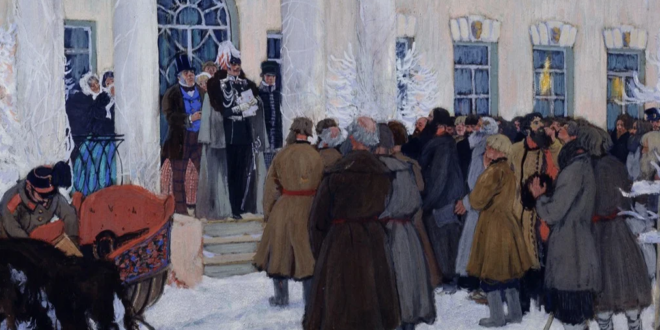
But before, at least when he attended the RSPP congress, he would give a report and answer questions. It was like a conversation between the president and the State Council, like in Repin’s painting: the president at least pretended that there were important people in the room whom he respected.
Now Putin came for half an hour, didn’t allow himself to ask a single question, ordered them to “chip in for victory,” and left. He showed them: you’re slaves, and you have no choice. If you don’t give us money the easy way, we’ll impose another excess profit tax. Or we’ll take over your business entirely. This isn’t a conversation, it’s a dictate.
Putin arrived for half an hour, didn’t allow himself to ask a single question, ordered everyone to “chip in for victory,” and left.
Both Putin and the old oligarchs always knew this was the situation. In a 2007 interview with the Financial Times , Oleg Deripaska bluntly stated that he was ready to hand over his property to the state at any moment: “If the state says we have to give it up, we will.” “I’m not distancing myself from the state. I have no other interests,” he said. “Just imagine all this falling out of the sky.” But few likely seriously expected their businesses to disappear so suddenly.